

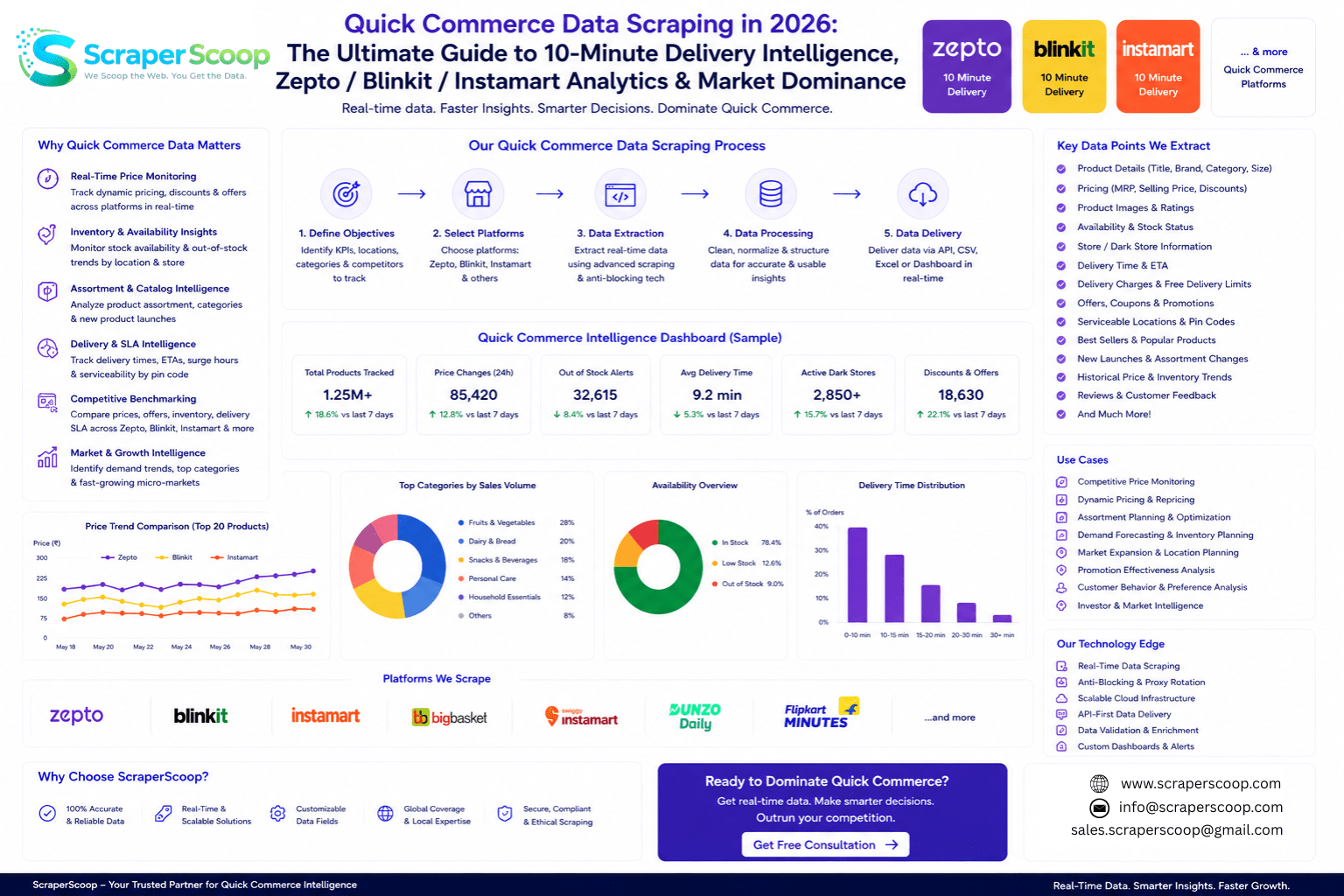
Quick Commerce Data Scraping in 2026: The Ultimate Guide to 10-Minute Delivery Intelligence, Zepto/Blinkit/Instamart Analytics & Market Dominance
📑 Table of Contents
- Introduction: The Quick Commerce Revolution
- What Is Quick Commerce Data Scraping?
- Why Quick Commerce Data Matters in 2026
- Types of Quick Commerce Data You Can Extract
- Major Quick Commerce Platforms
- Top 10 Use Cases for Quick Commerce Scraping
- Inventory & Availability Intelligence
- Pricing Strategy in 10-Minute Delivery
- Dark Store Network Analysis
- Challenges & Solutions
- Best Practices
- Why ScraperScoop
- Getting Started
- FAQ
Introduction: The Quick Commerce Revolution
Imagine this: A consumer in Mumbai opens Zepto at 7:45 PM on a Tuesday, searching for fresh vegetables for dinner. The app shows tomatoes at ₹42/kg. At the exact same moment, Blinkit lists them at ₹38/kg, and Swiggy Instamart has them at ₹45/kg. The consumer chooses Blinkit, saving ₹4 and getting delivery in 8 minutes.
This micro-decision happens millions of times daily across India, Europe, and the Middle East. Welcome to quick commerce — the 10-minute grocery delivery revolution that has transformed retail faster than any channel before it.
In 2026, the global quick commerce market has exploded to over $50 billion, growing at 35% annually. Zepto, Blinkit (formerly Grofers), Swiggy Instamart, Dunzo, Getir, Flink, and Gorillas have fundamentally changed consumer expectations. Speed is now the primary battleground, but data is the weapon that wins.
This comprehensive guide reveals how quick commerce data scraping gives brands, retailers, and analysts unprecedented visibility into this fast-moving market.
What Is Quick Commerce Data Scraping?
Quick commerce data scraping is the automated extraction of real-time product, pricing, and availability data from 10-minute delivery apps like Zepto, Blinkit, Instamart, Dunzo, and their global counterparts. Unlike traditional e-commerce where inventory changes slowly, quick commerce data changes by the minute — making real-time scraping essential.
Think of it as building a live nervous system for the quick commerce ecosystem: every product listed, every price adjusted, every stock-out, every new dark store launch — all captured continuously and structured for analysis.
The data includes product catalogs (groceries, fresh produce, household items), real-time pricing and promotional offers, inventory availability by location, delivery time estimates, dark store locations and coverage areas, seller and brand information, and customer ratings by product.
Why Quick Commerce Data Matters in 2026
⚡ Speed Creates Unique Data Challenges
Quick commerce inventory turns over every 2-3 hours. Prices change multiple times daily. Products go out of stock and return within minutes. This velocity makes manual monitoring impossible — only automated quick commerce data extraction can keep pace.
🎯 Location Is Everything
Quick commerce is hyperlocal. The same product costs different amounts across neighborhoods. Availability varies street by street. Understanding this geographic granularity requires scraping data across multiple pin codes and cities simultaneously.
📊 First-Mover Advantage in New Categories
Quick commerce is expanding beyond groceries into electronics, pharmacy, flowers, and fashion. Brands that monitor these expansions through data can be first to capitalize on new distribution channels before competitors notice.
Types of Quick Commerce Data You Can Extract
Product Catalog Data
Groceries, fresh produce, dairy, packaged foods, household essentials, and expanding categories like electronics and pharmacy.
Dynamic Pricing
Real-time prices, flash deals, membership pricing (Blinkit Plus, Instamart One), and surge pricing during peak hours.
Inventory Status
Stock availability, out-of-stock alerts, restock patterns, and inventory velocity by product and location.
Delivery Metrics
Promised delivery times, actual delivery performance, delivery fees, and minimum order values by area.
Dark Store Intel
Store locations, coverage radius, operating hours, and SKU assortment by dark store.
Product Ratings
Customer reviews, freshness ratings, delivery ratings, and product quality scores.
Major Quick Commerce Platforms
| Platform | Markets | Dark Stores | Key Categories |
|---|---|---|---|
| Zepto | India | 300+ | Groceries, Fresh |
| Blinkit | India | 400+ | Groceries, Electronics |
| Swiggy Instamart | India | 350+ | Groceries, Pharmacy |
| Dunzo | India | 150+ | Multi-category |
| Getir | Europe, US, Turkey | 1,500+ | Groceries, Ready meals |
| Flink | Europe | 300+ | Groceries, Fresh |
Access comprehensive quick commerce datasets covering all major platforms with real-time and historical data.
Top 10 Use Cases for Quick Commerce Scraping
Competitive Price Monitoring
Track competitor prices across Zepto, Blinkit, and Instamart in real-time. Get instant alerts when competitors undercut your pricing. Price intelligence is critical in this margin-sensitive business.
Inventory Gap Analysis
Identify which products competitors stock that you don't. Discover trending SKUs entering the quick commerce channel. Monitor category expansion (electronics, pharmacy, fashion).
Geographic Market Analysis
Analyze quick commerce coverage by city, neighborhood, and pin code. Identify underserved areas for new dark store locations. Compare pricing and availability across geographic zones.
Fresh Produce Benchmarking
Monitor fruit and vegetable pricing across platforms to ensure competitive positioning. Track freshness indicators and quality ratings. Analyze seasonal pricing patterns for perishables.
Promotion & Deal Intelligence
Track flash sales, membership discounts, first-order offers, and app-exclusive deals. Understand competitor promotional strategies and timing. Optimize your own promotional calendar.
Inventory & Availability Intelligence
In quick commerce, inventory visibility is everything. Stock-outs mean lost customers who won't return. Product inventory scraping from quick commerce platforms reveals:
- Real-time stock availability by SKU and location
- Out-of-stock patterns and duration
- Inventory velocity indicators (fast vs slow movers)
- Category-level availability metrics
- Restock frequency and timing patterns
Pricing Strategy in 10-Minute Delivery
Quick commerce pricing is uniquely dynamic. Multiple factors influence price in real-time: time of day (peak vs off-peak), location (premium vs standard areas), platform membership status, bundle deals and cross-selling, and surge pricing during high demand.
💡 Case Study: How a Brand Optimized Quick Commerce Pricing
A FMCG brand used scraped data to discover that competitors were charging 12-15% premiums during evening peak hours (6-9 PM) when demand surges. By implementing time-based pricing, they increased margins by 18% during peak periods without losing volume during off-peak hours.
This insight came from continuous price monitoring & competitor tracking across all major quick commerce platforms.
Dark Store Network Analysis
Dark stores are the secret sauce of quick commerce. These mini-warehouses, strategically located in residential areas, enable 10-minute delivery. Understanding dark store networks through data provides competitive advantage:
- Location Intelligence: Map competitor dark store locations and coverage radius
- SKU Assortment: Analyze which products are stocked at which locations
- Expansion Tracking: Monitor new dark store launches to predict market expansion
- Coverage Gaps: Identify underserved areas for new store opportunities
Challenges & Solutions
Ultra-Fast Data Changes
Challenge: Inventory and prices change every few minutes.
Solution: High-frequency scraping with sub-15-minute update cycles.
Hyperlocal Complexity
Challenge: Data varies by neighborhood and pin code.
Solution: Multi-location scraping across geographic grids.
App-First Architecture
Challenge: Many platforms are mobile-app only.
Solution: Mobile app scraping and API interception techniques.
Anti-Bot Protection
Challenge: Aggressive bot detection and blocking.
Solution: Advanced proxy rotation and browser fingerprinting.
Best Practices for Quick Commerce Scraping
Scrape Multiple Times Daily
Quick commerce data has a short shelf life. Scrape at least every 15-30 minutes for pricing, and hourly for inventory during peak periods.
Cover Multiple Locations
Scrape from diverse pin codes to capture geographic variations. Urban, suburban, and premium locations often show different pricing.
Track Peak vs Off-Peak
Monitor pricing during morning (7-9 AM), evening (6-9 PM), and weekend peaks. Surge pricing patterns reveal demand elasticity.
Monitor Category Expansion
Quick commerce platforms are rapidly adding electronics, pharmacy, and fashion. Track these expansions early for competitive advantage.
Why ScraperScoop for Quick Commerce Data
Real-Time Speed
Updates every 15 minutes to match quick commerce velocity. Never miss a price change or stock-out.
Hyperlocal Coverage
Scrape across 500+ Indian cities and pin codes. Geographic granularity that matches the business model.
App Scraping Expertise
Specialized in extracting data from mobile-first quick commerce platforms with advanced techniques.
Ready Datasets
Access pre-built quick commerce datasets for instant insights without setup delays.
99.9% Accuracy
Multi-layer validation ensures data reliability even at high-frequency scraping intervals.
24/7 Support
Expert team understands quick commerce dynamics and can customize solutions for your needs.
Ready to Master Quick Commerce Intelligence?
Whether you need real-time price monitoring, inventory tracking, or comprehensive market analysis across Zepto, Blinkit, Instamart, and more — ScraperScoop delivers.
✅ Free sample data · ✅ No credit card required · ✅ Response within 2 hours
Getting Started
Ready to leverage quick commerce data for your business? Follow this roadmap:
- Define Objectives: Are you monitoring competitors, tracking prices, or analyzing expansion?
- Select Platforms: Which quick commerce apps matter most for your market? Zepto? Blinkit? Instamart? All three?
- Choose Geography: Which cities and pin codes are priority for your analysis?
- Contact ScraperScoop: Reach out for a free consultation and sample data tailored to your requirements.
FAQ: Quick Commerce Data Scraping
How fast can you update quick commerce data?
We offer updates as frequent as every 15 minutes for critical pricing data, and hourly for inventory and catalog data. This matches the velocity of quick commerce operations.
Can you scrape data from mobile apps like Zepto and Blinkit?
Yes. We specialize in mobile app data extraction using advanced techniques to capture data from app-first platforms like Zepto, Blinkit, and Instamart.
Do you cover multiple cities in India?
Yes. We scrape quick commerce data across all major Indian cities including Mumbai, Delhi, Bangalore, Hyderabad, Pune, Chennai, Kolkata, and 500+ pin codes.
How much does quick commerce scraping cost?
Pricing depends on platforms covered, geographic scope, update frequency, and data volume. Contact us for a custom quote with free sample data.
🚀 Speed Is Everything in Quick Commerce
Start Scraping Quick Commerce Data Today
Don't let competitors outpace you in the fastest-growing retail channel. Get the data advantage you need to win in 10-minute delivery.
Get Free Consultation →

