

Dynamic Repricing Data: The Fuel Behind Intelligent E‑Commerce Pricing
The complete guide to dynamic repricing data — from competitive price monitoring to AI-driven automation. Learn how retailers collect, structure, and leverage real-time pricing intelligence to maximize margins, win market share, and stay ahead in the $6.3 trillion e‑commerce economy.
🤖 What You'll Learn in This Guide
- What Is Dynamic Repricing Data?
- Why Data Quality Makes or Breaks Dynamic Repricing
- What Data Do You Need for Dynamic Repricing?
- How Dynamic Repricing Works: From Data to Decision
- The Strategic Benefits of Dynamic Repricing
- Data Sources for Dynamic Repricing
- Common Challenges & How to Overcome Them
- Getting Started: Your Dynamic Repricing Roadmap
- Frequently Asked Questions
- Conclusion
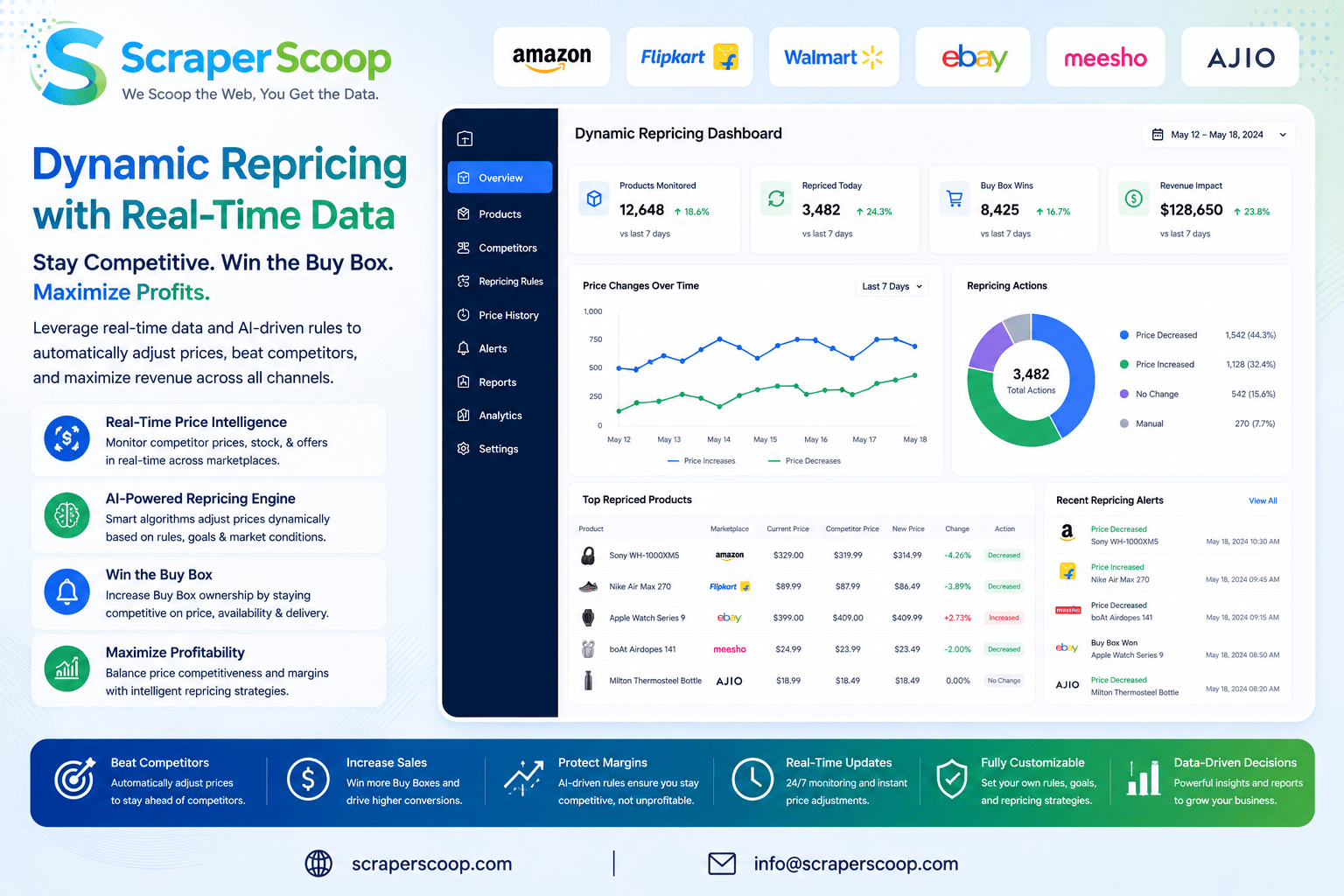
What Is Dynamic Repricing Data?
There are two types of e‑commerce sellers in 2026. One type checks competitor prices quarterly, adjusts pricing once a month, and wonders why margins keep shrinking. The other type operates in real time — monitoring competitors, stock signals, and margin requirements continuously, adjusting prices automatically.
Dynamic repricing data is the lifeblood of the second type. It's the structured, real‑time competitive intelligence that feeds pricing algorithms — enabling automated price adjustments based on competitor movements, demand signals, inventory levels, and customer behavior.
Dynamic pricing turns static price lists into adaptive engines that adjust based on what's happening right now — demand, inventory, competitor moves, store performance, and even local events. This shift from static pricing to dynamic execution is what separates reactive sellers from competitive ones.
The Core Truth: Dynamic repricing is only as good as the data that powers it. Automation without accurate, timely market data just makes bad pricing decisions faster. Quality data is the foundation of intelligent pricing.
Why Data Quality Makes or Breaks Dynamic Repricing
Dynamic pricing only works when the underlying market data is timely and accurate. Garbage in, garbage out — and in the world of algorithmic pricing, bad data doesn't just waste time. It actively destroys margin.
Consider what happens when a repricing system receives stale competitor data. It might:
- Keep prices too high while competitors have already dropped theirs — losing sales and market share
- Drop prices unnecessarily based on outdated competitor discounts — sacrificing margin for no reason
- Miss competitor stock‑outs that represent prime opportunities to capture demand
- React to phantom price changes caused by data errors or parsing issues
According to Decodo's Dynamic Pricing Index — an annual benchmark of global e‑commerce pricing behavior — pricing volatility varies dramatically by category. Understanding these dynamics and having the right data infrastructure to match them is essential.
The Cost of Bad Data: Retailers running dynamic pricing report profit improvements of 5‑8% on average. But those gains are only possible with high‑quality data. Without it, automation just makes bad decisions faster. Data quality isn't a nice‑to‑have — it's the difference between profit and loss.
What Data Do You Need for Dynamic Repricing?
Dynamic repricing requires a rich, multi‑dimensional data set. Here's what modern repricing systems consume:
| Data Category | Specific Fields | Strategic Value |
|---|---|---|
| Competitor Prices | Current price, list price, sale price, historical price data | Primary input for competitive repricing decisions |
| Stock Availability | In‑stock status, backorder status, shipping estimates | Reveals competitor supply gaps and demand capture opportunities |
| Promotional Activity | Coupon codes, percentage discounts, BOGO offers, flash sales | Provides full picture of competitor pricing, not just base price |
| Buy Box Dynamics | Buy Box winner, seller rating, fulfillment method | Critical for marketplace sellers — Buy Box wins drive majority of sales |
| Demand Signals | Search volume, sales velocity, conversion rates | Enables demand‑based pricing adjustments |
| Inventory Levels | Your stock levels, restock dates, sell‑through rates | Enables inventory‑driven pricing decisions |
| Price Elasticity | Historical price‑volume relationships, segment‑level sensitivity | Informs optimal pricing based on customer behavior |
| Marketplace Rankings | Best‑seller rank, organic rank, sponsored rank | Reveals competitive visibility and marketplace dynamics |
For pre‑built data extraction solutions, explore our e‑commerce scraping services and e‑commerce datasets.
How Dynamic Repricing Works: From Data to Decision
Dynamic repricing is a continuous cycle of data collection, analysis, decision, and execution. Here's how it works in practice:
- Data Collection Web scraping tools continuously monitor competitor prices, stock status, promotions, and assortment changes across the channels that matter to your business. This data is collected in real time — because in competitive retail, being 30 minutes behind a competitor's price change can mean losing hundreds of orders.
- Data Normalization & Structuring Raw scraped data comes in countless formats — different product identifiers, currencies, units, and data structures. Normalization transforms this raw data into a clean, consistent format that repricing algorithms can consume. Our data cleaning and structuring services handle this critical step.
- Rule Definition & Strategy Configuration Retailers define their repricing rules and strategies — price floors and ceilings, target competitive positions, margin requirements, and inventory considerations. These rules govern how the system responds to market data.
- Algorithmic Decision‑Making AI‑powered repricing engines analyze competitor pricing data, stock signals, and margin requirements to determine optimal prices. Advanced systems use machine learning to forecast demand and recommend prices across product categories. Some are now incorporating causal machine learning and Bayesian optimization to estimate heterogeneous price elasticities while controlling for competitor pricing, seasonal events, and weather effects.
- Automated Price Execution Prices are updated automatically across all sales channels — store, web, app, and marketplaces — simultaneously. This synchronized repricing ensures consistent pricing across every touchpoint.
- Performance Monitoring & Optimization The system tracks the impact of every price change on sales, revenue, and margin. This feedback loop enables continuous refinement of pricing rules and algorithms. Tools that combine elasticity modeling with proper segmentation help hold margins while retaining customers.
Real‑World Impact: A leading online retailer implemented automated pricing with real‑time tracking of over 8 million competitor products. They gained a competitive edge, improved efficiency, enhanced profitability, and responded to market dynamics faster than ever before.
The Strategic Benefits of Dynamic Repricing
Dynamic repricing delivers transformative benefits across the entire retail organization. Here's what systematic dynamic pricing intelligence delivers:
Revenue & Margin Optimization
Dynamic pricing can increase revenue by 22%, with average profit improvements of 5‑8% and AI‑powered systems pushing gross profit gains as high as 22%. These gains come from pricing intelligence — capturing margin in high‑demand periods and driving volume when demand softens.
Real‑Time Competitive Response
Instead of manually updating prices, dynamic repricing systems monitor competitor pricing data continuously. This enables immediate response to competitor price changes — before they erode your market share.
Operational Efficiency
Pricing automation frees your team from manual price checking — saving an average of 3.6 hours per week per employee. That's over 40 hours per month for a team of three. Your team shifts from manual execution to strategic oversight.
Data‑Driven Decision Making
Dynamic repricing transforms pricing from a guessing game into a science. Every price change is informed by competitor data, demand signals, and customer behavior. The result is pricing that's both competitive and profitable.
Key Insight: AI‑driven competitor pricing gives retailers the ability to see what's coming, not just what's happened. It blends prediction with precision, ensuring every price is competitive and drives the most revenue.
Data Sources for Dynamic Repricing
Dynamic repricing relies on data from multiple sources. Here's where the data comes from:
Marketplaces
Amazon, Walmart, eBay, and other marketplaces provide the richest competitive pricing data — including Buy Box dynamics, seller ratings, and fulfillment information.
Amazon Data Scraping →Retailer Websites
Direct retailer websites — from big‑box chains to DTC brands — reveal pricing strategies across the competitive landscape. Scraping these sites provides a complete picture of market pricing.
E‑Commerce Scraping →Price Comparison Sites
Google Shopping, PriceGrabber, and other comparison engines aggregate pricing from thousands of retailers — providing a consolidated view of competitive pricing.
Website Data Scraping →Our real‑time data feeds deliver competitor pricing data as fast as it changes — enabling repricing systems that respond in near real‑time.
Common Challenges & How to Overcome Them
Dynamic repricing isn't without its challenges. Here's what to watch out for — and how to address it:
Getting Started: Your Dynamic Repricing Roadmap
Building a dynamic repricing capability doesn't require a massive upfront investment. Here's the practical path from zero to intelligent pricing:
- Assess Your Current Pricing Capability Where are you today? Manual price checking? Quarterly competitor reviews? Static pricing? Understanding your starting point determines the right path forward.
- Identify Your Highest‑Value Data Gap What single piece of competitive data would most improve your pricing decisions? For most retailers, it's daily competitor price tracking on top SKUs. For marketplace sellers, it's Buy Box intelligence. Start there.
- Choose Your Data Collection Approach Three options: (1) Download pre‑built e‑commerce datasets for immediate market analysis. (2) Deploy our e‑commerce scraping services for on‑demand data extraction. (3) Engage our custom data scraping services for fully customized, ongoing intelligence.
- Define Your Repricing Rules Set price floors and ceilings. Define your target competitive position — match the lowest price? Stay within 2%? Lead with premium positioning? Define margin requirements and inventory rules.
- Select Your Repricing Platform Choose a repricing solution that integrates with your data sources and sales channels. Options range from marketplace‑specific tools to enterprise‑grade omnichannel platforms. Our data feeds integrate with leading repricing platforms including Repricer.com, Linnworks, and ChannelAdvisor.
- Set Up Your Data Pipeline Choose how data flows to your repricing system: API‑based delivery for real‑time integration, real‑time data feeds for dynamic pricing dashboards, or batch delivery for periodic updates.
- Monitor, Measure, Optimize Track the impact of every price change on sales, revenue, and margin. Use these insights to refine your repricing rules. Continuous improvement is the key to sustained success.
Ready‑made e‑commerce datasets for immediate market analysis
Browse E‑Commerce Datasets →Cross‑Industry Intelligence That Amplifies Dynamic Repricing
The most powerful retail intelligence combines dynamic repricing data with insights from adjacent capabilities. Here's how forward‑thinking retailers build holistic pricing intelligence:
- Competitor Price Tracking: Competitor price tracking is the foundation of dynamic repricing. It provides the competitive intelligence that fuels your repricing algorithms.
- MAP Monitoring: MAP monitoring ensures your dynamic repricing stays within policy boundaries — protecting brand value while optimizing prices.
- Review & Sentiment Intelligence: Review data reveals product quality gaps and customer preferences — informing not just pricing but product development.
- Social Media & Trend Detection: Social media data reveals trending products and viral content — early signals of demand spikes that should inform your pricing strategy.
- Real‑Time Data Feeds: Real‑time data feeds deliver competitor pricing data as fast as it changes — enabling repricing systems that respond in near real‑time.
For a comprehensive view of price intelligence capabilities, explore our Price Intelligence Solutions and use cases library.
Frequently Asked Questions
Q What is dynamic repricing data?
Dynamic repricing data is structured, real‑time competitive intelligence that feeds pricing algorithms. It includes competitor prices, stock availability, promotional activity, Buy Box dynamics, demand signals, and inventory levels. This data enables automated price adjustments based on market conditions.
Q How does dynamic repricing work?
Dynamic repricing works through a continuous cycle: web scraping tools collect competitor pricing data in real time, the data is normalized and structured, repricing rules and strategies are applied, AI‑powered engines determine optimal prices, prices are automatically updated across all sales channels, and performance is continuously monitored and optimized.
Q What data sources are used for dynamic repricing?
Dynamic repricing draws data from multiple sources: marketplaces like Amazon and Walmart, retailer websites, price comparison sites like Google Shopping, and your own internal data systems. Our real‑time data feeds consolidate these sources into a single, actionable stream.
Q What are the benefits of dynamic repricing?
Benefits include revenue increases of up to 22%, average profit improvements of 5‑8%, gross profit gains as high as 22% with AI‑powered systems, real‑time competitive response, operational efficiency gains of 3.6+ hours per week per employee, and data‑driven decision making.
Q Is dynamic repricing legal?
Yes. Dynamic repricing based on publicly available competitor data is a legitimate competitive practice. Unlike price fixing (collusion between competitors), dynamic repricing is unilateral — your business making independent pricing decisions based on market data. Always consult legal counsel for your specific jurisdiction and practices.
Q I'm a small retailer. Is dynamic repricing relevant for me?
Absolutely. Start with our pre‑built e‑commerce datasets to understand your competitive landscape. Even monitoring just 20‑30 of your top SKUs against 3‑5 key competitors can reveal pricing opportunities that significantly impact your conversion and profitability. Contact us to discuss the right starting point for your business.
Q Can dynamic repricing integrate with my existing systems?
Yes. Our API‑based data delivery is designed for seamless integration with popular repricing tools, ERP systems, business intelligence platforms, and custom applications. We deliver data in formats compatible with virtually any system — JSON, CSV, XML, or direct database push.
Conclusion: In E‑Commerce, Dynamic Repricing Is the Competitive Advantage
E‑commerce operates on razor‑thin margins, infinite transparency, and near‑perfect price comparison. Every product priced too high loses sales to a competitor who offers better value. Every margin left on the table is revenue that could have been captured.
In this environment, dynamic repricing isn't a luxury — it's survival. The retailers that outperform their markets in 2026 are the ones with the best data infrastructure, the freshest competitive intelligence, and the fastest decision‑making cycles.
Dynamic repricing data from ScraperScoop provides the foundation for all of this — from competitor price tracking and real‑time data feeds to e‑commerce scraping and data structuring.
The data is publicly available on every e‑commerce platform. Competitor prices are changing right now. The question is whether you're capturing this intelligence systematically — and using it to power intelligent pricing decisions.
Don't leave revenue on the table. Talk to our e‑commerce data experts today and let's build the dynamic repricing system your business needs to compete — and win — in 2026.


