

In today’s competitive online retail market, businesses need accurate and real-time information to grow faster. Prices change frequently, new products launch every day, and customer preferences evolve quickly. To stay ahead, companies rely on eCommerce data scraping to collect valuable product information from online stores and marketplaces. This data helps businesses make smarter pricing, marketing, and inventory decisions.
Whether you run an online store, marketplace, analytics agency, or retail brand, data scraping for ecommerce gives you access to structured product data without manual effort. Instead of checking hundreds of product pages manually, automated scraping tools can gather thousands of records quickly and efficiently. Businesses use this data to compare prices, monitor stock availability, track ratings, and identify trending products.
What is eCommerce Data Scraping?
eCommerce data scraping is the automated process of extracting publicly visible data from eCommerce websites, shopping platforms, and online marketplaces. The collected information is converted into usable formats such as CSV, Excel, JSON, or API feeds.
Typical data fields include:
- Product titles
- Prices and discounts
- Product descriptions
- Ratings and reviews
- Brand names
- Images
- SKU codes
- Availability status
- Seller details
- Category rankings
This information is then used for market intelligence, pricing optimization, business analytics, and growth strategies.
Why Businesses Need Data Scraping for eCommerce
The online retail space changes rapidly. Businesses that depend on outdated or incomplete data often lose opportunities. Here are the main reasons companies choose to scrape ecommerce data regularly:
1. Competitor Price Monitoring
Businesses track competitor prices in real time to stay competitive. If rivals reduce prices or offer discounts, brands can respond faster and protect market share.
2. Product Trend Discovery
By collecting listing and category data, businesses can identify hot-selling products, rising brands, and growing niches before competitors do.
3. Customer Review Analysis
Reviews reveal customer pain points, preferences, and buying behavior. Brands use this data to improve products and customer experience.
4. Inventory Intelligence
Knowing when competitors are low on stock or sold out helps businesses increase ads, improve visibility, and win more sales.
5. Better Product Assortment
Retailers compare competitor catalogs, colors, sizes, and variants to improve their own product offerings.
What Data Can You Scrape from eCommerce Websites?
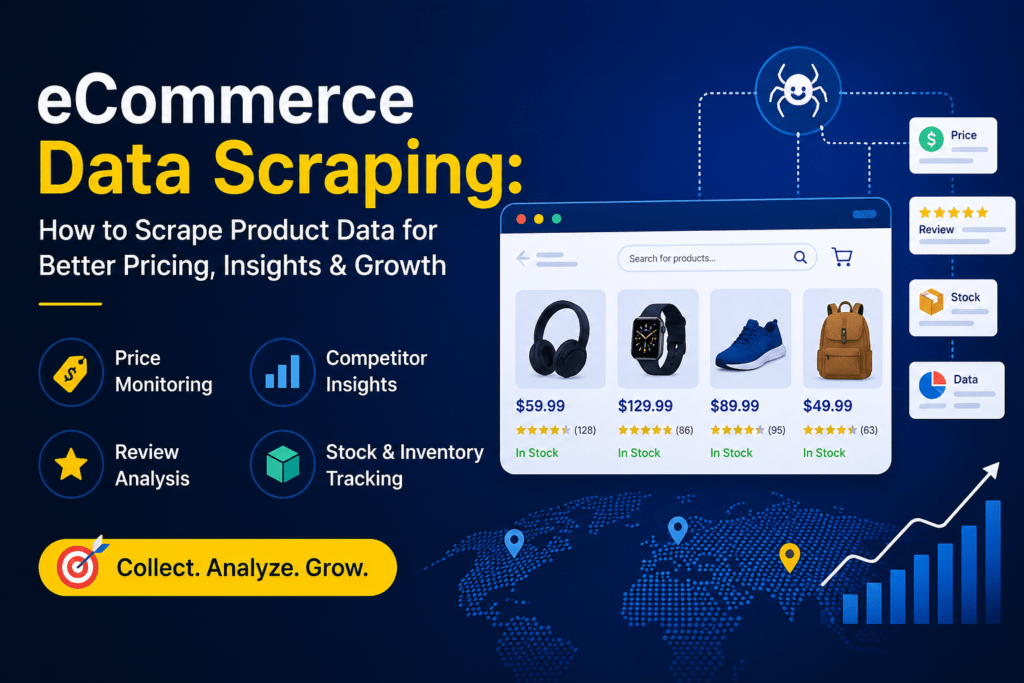
A robust scraping solution can extract many valuable data points from product and category pages.
| Data Type | Example |
|---|---|
| Product Name | Smart Watch |
| Price | ₹4,999 |
| Discount | 30% Off |
| Brand | Noise |
| Rating | 4.4 Stars |
| Reviews | 8,500 Reviews |
| Stock Status | In Stock |
| Seller Name | Official Seller |
| Category Rank | Top 10 |
This structured information can be integrated into dashboards, pricing systems, analytics software, and BI tools.
Industries Using eCommerce Data Scraping
Many industries benefit from ecommerce data scraping, including:
- Online retailers
- D2C brands
- Price comparison websites
- Market research firms
- Digital agencies
- Logistics companies
- Investment analysts
- SaaS analytics providers
Each industry uses data differently, but the goal remains the same: make better business decisions with fresh market intelligence.
Common Challenges in eCommerce Scraping
Many eCommerce websites use advanced technology to prevent automated access. Common challenges include:
- CAPTCHA verification
- Dynamic JavaScript content
- Rate limiting
- IP blocking
- Frequent website structure changes
- Geo-restricted pages
- Anti-bot systems
To solve these issues, businesses often use professional scraping services with rotating proxies, browser automation, and managed infrastructure.
Is eCommerce Data Scraping Legal?
Legality depends on several factors such as region, website terms, data type, and collection method. In many cases, collecting publicly available information may be allowed when done responsibly. However, businesses should always avoid scraping personal, private, or restricted data. It is also recommended to review applicable laws and seek legal guidance for large-scale projects.
How to Choose the Right eCommerce Scraping Solution
When selecting a provider, focus on these important factors:
- High data accuracy
- Real-time or scheduled delivery
- API integration support
- Global coverage
- Scalable infrastructure
- Custom data fields
- Fast turnaround time
- Reliable support team
A strong solution saves time, reduces manual effort, and delivers dependable insights.
Benefits of Automated eCommerce Data Collection
Manual research takes time and often contains errors. Automated scraping offers several advantages:
- Faster data collection
- Better accuracy
- Large-scale coverage
- Real-time updates
- Lower operational cost
- Improved decision-making
- Competitive advantage
These benefits make data scraping for ecommerce a valuable strategy for modern retail businesses.
Need eCommerce Product Data at Scale?
If your business needs competitor pricing, stock monitoring, product intelligence, or marketplace insights, a professional scraping solution can help you collect clean and reliable data from any eCommerce platform.
Get custom eCommerce scraping services today and turn market data into growth opportunities.
Conclusion
As online competition becomes stronger every year, access to accurate market data is no longer optional. eCommerce data scraping empowers businesses with real-time pricing, product, review, and inventory intelligence. Whether you are a startup brand or enterprise retailer, the ability to scrape ecommerce data efficiently can improve decisions, increase profitability, and unlock faster growth.
FAQs
1. What is eCommerce data scraping?
It is the automated collection of publicly visible product data from online stores.
2. Why is ecommerce scraping important?
It helps businesses monitor competitors, pricing, reviews, and market trends.
3. Which data can be scraped?
Prices, ratings, reviews, stock status, titles, seller data, and more.
4. Is ecommerce scraping legal?
It depends on laws, website policies, and the type of data collected.
5. How often should data be updated?
Daily or hourly updates are common in competitive industries.
6. What output formats are available?
CSV, Excel, JSON, APIs, and dashboards.
7. Who uses ecommerce scraping services?
Retailers, brands, agencies, analysts, and research firms.
8. Can scraping improve pricing strategy?
Yes, real-time competitor pricing helps businesses optimize prices faster.


