

Food Delivery Data Scraping: How Restaurants & Brands Win With Platform Intelligence
The definitive guide to extracting actionable data from Zomato, Swiggy, DoorDash, and Uber Eats — powering smarter decisions for restaurants, cloud kitchens, food brands, and investors.
🍽️ What's Inside This Guide
- Why Food Delivery Data Is the Hottest Intelligence Asset in 2026
- What Data Can You Scrape from Food Delivery Platforms?
- Who Uses Food Delivery Data — And How
- Platform Deep Dive: Zomato, Swiggy & Beyond
- Cloud Kitchen Intelligence: The Data-Driven Advantage
- Menu Pricing Intelligence: The Hidden Battleground
- Review Intelligence: What 10,000 Customer Reviews Reveal
- Getting Started: From Zero to Food Delivery Intelligence
- Frequently Asked Questions
- Conclusion
Why Food Delivery Data Is the Hottest Intelligence Asset in 2026
The global online food delivery market crossed $350 billion in 2024 and is accelerating. In India alone, Zomato and Swiggy together serve over 2.5 million orders daily. In the US, DoorDash commands 67% market share. In Southeast Asia, Grab Food dominates. Globally, hundreds of millions of restaurant listings, menus, reviews, and prices update every single day across these platforms.
That's not just a lot of food being ordered. That's an ocean of publicly available business intelligence that most restaurants, food brands, and investors are completely ignoring.
Think about what food delivery platform data actually represents: real-time consumer demand signals, competitor pricing strategies, menu innovation trends, restaurant performance metrics, and location-level market dynamics — all publicly visible, constantly refreshing, and waiting to be captured by anyone smart enough to collect it systematically.
That's exactly what food delivery data scraping makes possible. And the businesses using it are making decisions their competitors can't even imagine.
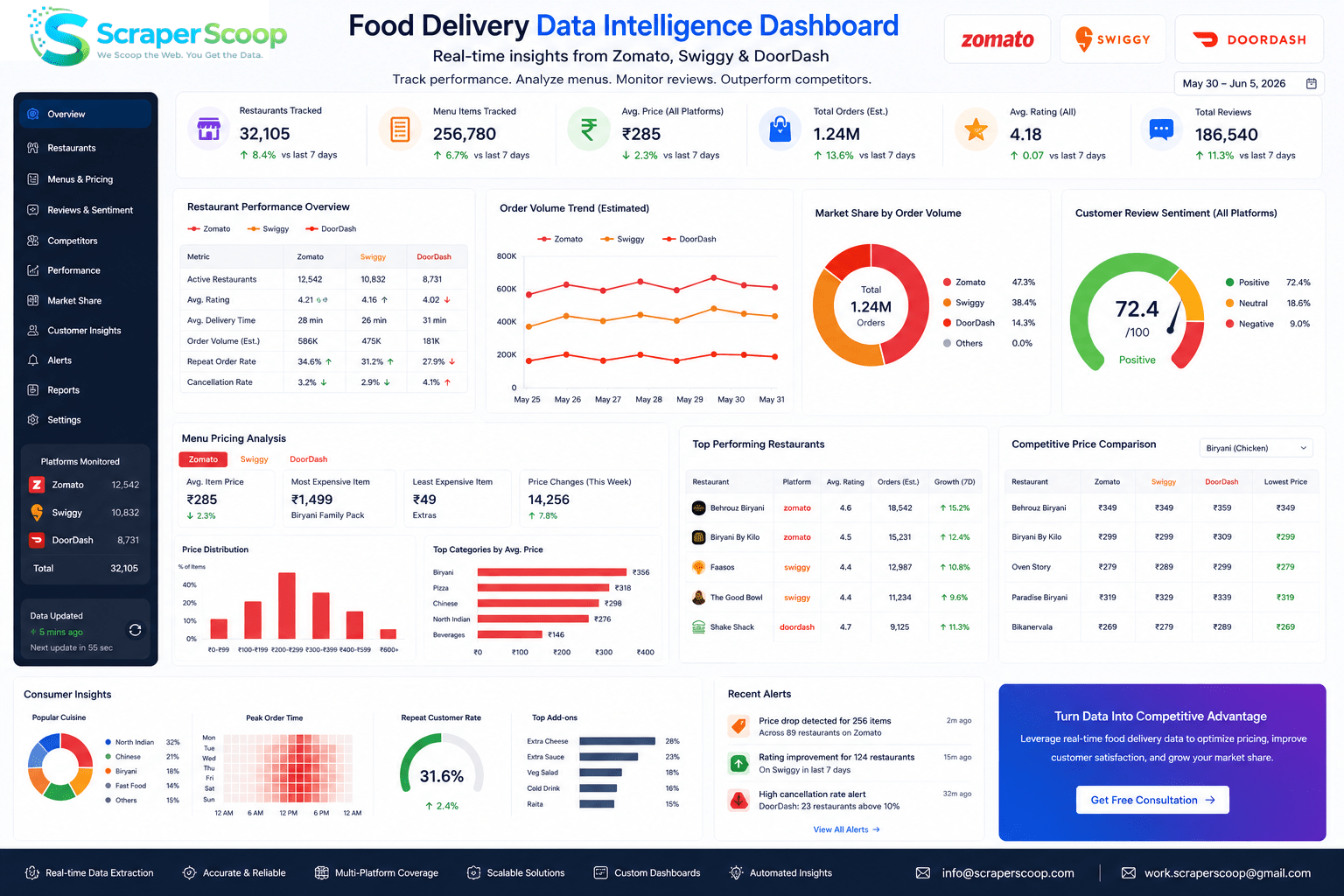
What Data Can You Scrape from Food Delivery Platforms?
Food delivery platforms are essentially massive, real-time databases of restaurant intelligence — openly displayed to every visitor. Here's the complete breakdown of what's extractable and why each data point matters:
| Data Category | Specific Fields | Intelligence Value |
|---|---|---|
| Restaurant Profile | Name, location, cuisine type, operating hours, delivery radius, platform badges | Market mapping, competitive landscape analysis |
| Menu Data | Item names, descriptions, prices, categories, vegetarian/non-veg tags, customizations | Menu optimization, pricing strategy, trend detection |
| Pricing & Offers | Item prices, combo deals, platform discounts, delivery fees, minimum order values | Competitive pricing, promotional calendar tracking |
| Ratings & Reviews | Overall rating, total reviews, individual review text, star ratings, recency | Sentiment analysis, quality benchmarking, brand health |
| Delivery Metrics | Estimated delivery time, delivery partner info, delivery charges by distance | Operational benchmarking, location strategy |
| Popularity Signals | "Bestseller" tags, "Trending" badges, order count indicators, repeat customer rates | Demand forecasting, menu innovation inspiration |
| Brand/Chain Data | Number of outlets, locations, consistency across outlets, chain identifiers | Franchise analysis, expansion tracking |
Explore our ready-made food delivery datasets for immediate access to structured data from major food delivery platforms — or check out our complete restaurant datasets for broader restaurant intelligence.
Key Insight: Most food businesses only look at their own platform analytics. But your competitors' menus, prices, and reviews are publicly visible too. The restaurants that scrape and analyze this data gain a competitive advantage that's virtually impossible to replicate through manual research alone.
Who Uses Food Delivery Data — And How They Use It
Food delivery data scraping isn't just for tech-savvy restaurant chains. The applications span a surprisingly wide range of businesses and use cases. Here's who's getting the most value:
Cloud Kitchen Operators
Identify underserved cuisines by location, analyze competitor menu density, track pricing sweet spots, and optimize brand portfolio strategy based on real demand data rather than assumptions.
Restaurant Chains & Franchises
Monitor pricing consistency across outlets, track competitor promotions, benchmark delivery performance, and identify high-performing menu items in their category to inform new menu launches.
Food Brands & FMCG Companies
Track how their products appear in restaurant menus and delivery platforms, monitor brand mentions in reviews, identify partnership opportunities, and understand consumer taste preferences at scale.
Market Research Firms
Build comprehensive food industry reports, track cuisine trends over time, analyze city-level restaurant economics, and deliver actionable insights to clients entering the food delivery space.
Investors & PE Firms
Evaluate restaurant chain and cloud kitchen acquisitions using real operational data — review trajectories, menu evolution, competitive positioning, and market saturation metrics.
Real Estate & Commercial Developers
Analyze restaurant density by neighborhood, identify food deserts with high delivery demand, and evaluate commercial locations based on existing food delivery ecosystem data.
Platform Deep Dive: Scraping Zomato, Swiggy & Beyond
Each food delivery platform has its own data structure, scraping challenges, and intelligence strengths. Here's what you need to know about the major platforms and how our services handle each one:
Zomato
India's largest food delivery platform with 250,000+ restaurant partners. Rich data on menus, ratings, restaurant photos, and dine-in reviews.
Zomato Scraping Service →Swiggy
India's second-largest food delivery platform expanding into quick commerce. Granular menu data, delivery time tracking, and real-time availability.
Swiggy Scraping Service →Other Platforms
DoorDash, Uber Eats, Grab Food, Deliveroo — our scraping infrastructure covers global platforms with region-specific configurations.
All Food Delivery Scraping →Zomato: The Review & Rating Goldmine
Zomato's unique strength is its deep review culture. With millions of detailed text reviews (not just star ratings), Zomato data is particularly valuable for sentiment analysis, cuisine trend tracking, and restaurant reputation monitoring. Our Zomato data scraping service captures the full spectrum of available data — from restaurant profiles and menus to individual reviews and ratings.
Want to explore Zomato insights right now? Our Zomato Analytics Dashboard provides interactive visualizations powered by continuously scraped Zomato data.
Swiggy: The Operational Intelligence Platform
Swiggy's data is especially valuable for operational intelligence — delivery time benchmarks, availability patterns, promotional offer tracking, and real-time menu changes. Our Swiggy data scraping service captures these dynamic metrics alongside static restaurant and menu data.
Cross-Platform Intelligence
The most powerful food delivery insights come from comparing data across platforms. A restaurant might price a biryani at ₹299 on Zomato but ₹349 on Swiggy. A cloud kitchen might have a 4.5 rating on one platform but 3.8 on another. These discrepancies reveal strategies, market dynamics, and opportunities that single-platform analysis completely misses.
Our food delivery scrapers and food delivery APIs are designed for exactly this kind of multi-platform intelligence work.
See live food delivery intelligence in action
Explore the Zomato Analytics Dashboard →Cloud Kitchen Intelligence: The Data-Driven Advantage
Cloud kitchens — delivery-only restaurants operating without a physical storefront — represent one of the fastest-growing segments in food service. By 2026, the global cloud kitchen market is expected to surpass $120 billion. And unlike traditional restaurants, cloud kitchens live and die entirely by their digital performance on delivery platforms.
This makes cloud kitchen data intelligence not just useful — it's existential. Here's what the best cloud kitchen operators are tracking through scraped data:
- Location demand mapping: What cuisines are underserved in specific pin codes? Where is delivery demand high but restaurant supply low? This data directly drives kitchen location decisions.
- Brand portfolio optimization: Cloud kitchen operators often run 4–8 virtual brands from a single kitchen. Scraping competitor performance across these cuisine categories tells you which brands to launch, scale, or sunset.
- Menu engineering: Which specific items at which price points generate the highest review scores and "bestseller" badges in your target market? Menu data scraping provides the answer.
- Pricing sweet spots: Analyze pricing distribution across thousands of competing restaurants to find the optimal price point for each category — where you maximize orders without sacrificing perception of quality.
- Review velocity as a growth metric: Track how quickly competing cloud kitchen brands are accumulating reviews — a strong proxy for order volume growth that's invisible without automated data collection.
Real-World Example: A multi-brand cloud kitchen operator used our food delivery scraping service to analyze 12,000 competing restaurants across 8 Indian cities. They discovered that "Korean Fried Chicken" had exploded in review volume by 340% year-over-year — but only 12% of delivery zones had a dedicated Korean food brand. They launched a virtual Korean brand in underserved zones and hit 500 daily orders within 45 days.
Menu Pricing Intelligence: The Hidden Battleground
Most restaurant owners set their menu prices based on food cost percentages and gut feeling. The smart ones use data. And the smartest use competitive data scraped systematically from delivery platforms.
Here's what menu pricing intelligence through web scraping actually reveals:
Price Distribution Analysis
For any cuisine category in any delivery zone, you can map the complete price distribution — from the cheapest to the most premium. This tells you exactly where you sit relative to every competitor and whether your pricing is aligned with your positioning.
Promotional Pattern Detection
Competitors run platform-specific promotions — BOGO offers, flat discounts, free delivery — on predictable schedules. Scraping this data over time reveals their promotional calendar, letting you either counter-program or avoid head-to-head promotional wars on their strongest days.
Menu Item Price Tracking Over Time
Are competitors gradually raising prices? Are they shrinking portions instead (detectable through description/weight changes)? Are new premium or value tiers appearing? This longitudinal view is only possible with automated, ongoing food delivery data scraping.
Platform-Specific Pricing Differences
Many restaurants charge different prices on Zomato versus Swiggy versus their own website. Tracking these differences reveals how competitors think about platform economics — and whether there's an arbitrage opportunity you're missing.
For systematic pricing analysis, combine food delivery data with broader price intelligence monitoring and competitor price tracking capabilities.
Review Intelligence: What 10,000 Customer Reviews Reveal That No Survey Can
Food delivery platform reviews are the most honest, voluminous, and underutilized source of consumer intelligence in the restaurant industry. Unlike surveys where respondents give sanitized answers, delivery reviews are written in the heat of the moment — immediately after eating — with no filter and no incentive to be polite.
Here's what happens when you scrape and analyze reviews at scale using our restaurant reviews dataset services:
Pain Point Mapping
Across 10,000 reviews in your category, what are the top 5 recurring complaints? Is it portion size? Packaging? Spice levels? Delivery temperature? This data tells you exactly which operational improvements will have the biggest customer impact.
Delight Factor Identification
What makes customers leave 5-star reviews? Extract the exact language — "perfectly crispy," "generous portions," "arrived hot" — and engineer your operations to consistently deliver those moments.
Rating Trajectory Tracking
Is a competitor's rating rising or falling? Are there sudden drops that correlate with operational changes? Tracking rating trajectories over time reveals the health trajectory of competing brands months before it's visible in order volumes.
Voice of Customer for Marketing
The words customers use in reviews are the exact words they search for and respond to in advertising. Extract review language to inform your listing descriptions, ad copy, and social media content strategy.
For broader consumer intelligence, combine food review data with sentiment analysis data collection, brand monitoring, and social media data scraping to build a comprehensive picture of how your brand is perceived across every consumer touchpoint.
Impact Example: A QSR chain scraped and analyzed 43,000 competitor reviews across Zomato and Swiggy. They found that 28% of negative reviews across the biryani category mentioned "packaging leaked" or "gravy spilled." By investing in spill-proof packaging and highlighting "leak-proof packaging guaranteed" in their listing, they saw their review rating jump from 3.9 to 4.4 in 8 weeks — driving a measurable increase in order volume.
Getting Started: From Zero to Food Delivery Intelligence
Whether you're a single-outlet restaurant owner or a multi-brand cloud kitchen operator backed by venture capital, the path to food delivery data intelligence follows a practical, repeatable process:
- Define Your Intelligence Objectives What specific business decisions will this data drive? Common starting points include competitive menu pricing, cuisine gap analysis for new location planning, or review-based product improvement. Be specific — vague goals produce vague results.
- Identify Your Target Platforms & Geographies Are you focused on Zomato and Swiggy in Indian metros? DoorDash in the US? Multiple platforms across Southeast Asia? Define the scope clearly. Our custom data scraping services configure scrapers for any combination of platforms and cities.
- Choose Your Data Access Model Three options: (1) Download pre-built food delivery datasets for immediate exploration; (2) Use our food delivery scrapers for self-service extraction; or (3) Engage our managed food delivery scraping service for fully customized, ongoing intelligence.
- Establish Your Data Pipeline Define how data flows from collection to analysis. Options include API-based delivery for direct integration with your BI tools, real-time data feeds for live dashboards, or batch file delivery (CSV/JSON) for periodic analysis.
- Clean, Structure, and Enrich Raw food delivery data needs normalization — standardizing cuisine categories, cleaning menu item names, deduplicating restaurant listings across platforms. Our data cleaning and structuring services handle this automatically.
- Analyze, Act, and Iterate Build your analysis frameworks, extract insights, make decisions, measure results, and expand your intelligence scope. Our scheduled scraping services ensure your data stays fresh as your intelligence needs evolve.
Quick Start Tip: If you're new to food delivery data, start with our pre-built food delivery datasets or explore the live Zomato Analytics Dashboard and Zepto Products Intelligence Dashboard to see what's possible before committing to a custom project.
Beyond Food: Cross-Industry Intelligence That Amplifies Your Research
Food delivery intelligence becomes even more powerful when combined with data from adjacent industries and platforms. Here's how smart operators are building holistic market views:
- Quick Commerce Integration: If you're a food brand, your products appear on both food delivery and quick commerce platforms. Quick commerce data scraping from Zepto, Blinkit, and Swiggy Instamart completes the picture. Explore the Zepto Product Comparison Dashboard for insights.
- E-commerce Cross-Reference: For packaged food brands, tracking the same products on Amazon and Flipkart alongside food delivery platforms reveals channel-specific pricing and positioning strategies. Browse our e-commerce datasets for complementary data.
- Social Media Sentiment: What are people posting about your restaurant or competitors on Instagram, Twitter, and food blogs? Social media data scraping and influencer data scraping capture the broader brand narrative that delivery platform reviews alone can't provide.
- Real Estate Intelligence: For cloud kitchens evaluating new locations, pairing food delivery demand data with real estate data scraping and commercial property data creates a comprehensive location intelligence framework.
- Travel & Hospitality: For restaurants in tourist-heavy areas, travel data scraping reveals seasonal demand patterns from Airbnb and hotel booking data that directly impact food delivery volumes.
For a comprehensive overview of intelligence solutions across all industries, visit our use cases library or explore all available featured datasets and web scrapers and APIs.
Frequently Asked Questions
Can you scrape data from Zomato and Swiggy without getting blocked?
Yes. Our scraping infrastructure is specifically engineered for food delivery platforms, which have unique anti-bot measures. We use residential proxy rotation, browser fingerprint randomization, and intelligent request throttling to maintain high success rates. When platforms update their defenses, our engineering team adapts within hours — not days. This is the core advantage of using a professional service versus building your own solution.
Is it legal to scrape restaurant data from food delivery platforms?
We scrape only publicly available data — the same restaurant listings, menus, prices, and reviews that any visitor can see by browsing the platform. We don't access private data, bypass login walls, or violate any authentication systems. This approach aligns with established legal precedents regarding public web data. As always, we recommend consulting your legal counsel for jurisdiction-specific guidance.
What's the difference between your food delivery datasets and your scraping service?
Our pre-built datasets are ready-made, periodically updated collections — perfect for market research, academic use, or exploratory analysis. Our managed scraping service is fully customized — you define the cities, cuisines, data fields, and delivery schedule. Think of datasets as the off-the-shelf option and the scraping service as the tailored suit.
How many restaurants can you scrape, and how fast?
We routinely handle extractions covering 100,000+ restaurant listings in a single run. For a major Indian metro, a complete Zomato scrape (all restaurants, menus, and reviews) typically completes within 24–48 hours. Smaller, targeted extractions (specific cuisine categories or neighborhoods) can be completed in hours. Contact us with your specific scope for a time estimate.
Can you track menu changes and price changes over time?
Absolutely. This is one of the most popular use cases. Our scheduled scraping services can capture menu and pricing snapshots daily, weekly, or at any custom frequency. We store timestamped data, enabling you to build historical trend analysis, detect seasonal pricing patterns, and track competitor menu evolution over weeks, months, or years.
I'm a single-restaurant owner. Is this relevant for me?
Definitely — and you don't need a massive budget. Start with our pre-built food delivery datasets to analyze your local competitive landscape, understand pricing benchmarks, and identify what top-rated restaurants in your cuisine are doing differently. Even a one-time dataset purchase can reveal insights that transform your menu strategy and pricing approach.
Conclusion: The Restaurants That Win Are the Ones With Better Data
The food delivery industry is one of the most fiercely competitive sectors on the planet. Margins are thin. Customer loyalty is fickle. Platform algorithms change without warning. And every day, thousands of new restaurants and cloud kitchens enter the market.
In this environment, the businesses that survive and thrive aren't necessarily the ones with the best chefs or the prettiest branding. They're the ones making faster, smarter decisions based on better data — data about what competitors charge, what customers say, what menus perform, and where market gaps exist.
Food delivery platform data is the richest, most granular, most frequently updated source of restaurant market intelligence available anywhere. And with ScraperScoop, accessing it has never been easier — whether through ready-made datasets, self-service scrapers, or fully managed scraping services tailored to your exact business needs.
The competitive advantage is there. The data is publicly available. The only question is whether you'll be the one using it — or the one wondering why your competitor always seems to be one step ahead.
Ready to start? Talk to our food delivery data experts today. We'll help you identify the highest-impact data opportunities for your specific business and get you from zero to actionable intelligence in days, not months.


