

Tracking Alibaba MOQ: The Complete Guide to Minimum Order Quantity Intelligence
The definitive guide to tracking, monitoring, and benchmarking Minimum Order Quantities (MOQ) on Alibaba — from manual discovery to automated scraping. Learn how sourcing professionals, importers, and e‑commerce sellers gain competitive advantage through MOQ intelligence in the world's largest B2B marketplace.
📦 What You'll Learn in This Guide
- What Is MOQ on Alibaba?
- Why Tracking MOQ Matters for Sourcing Success
- Manual Methods: How to Find MOQ on Alibaba
- Automated MOQ Tracking with Web Scraping
- Tools & Platforms for MOQ Data Extraction
- MOQ Monitoring Strategies
- Tracking MOQ on 1688: The Domestic Source
- Getting Started: Your MOQ Tracking Roadmap
- Frequently Asked Questions
- Conclusion
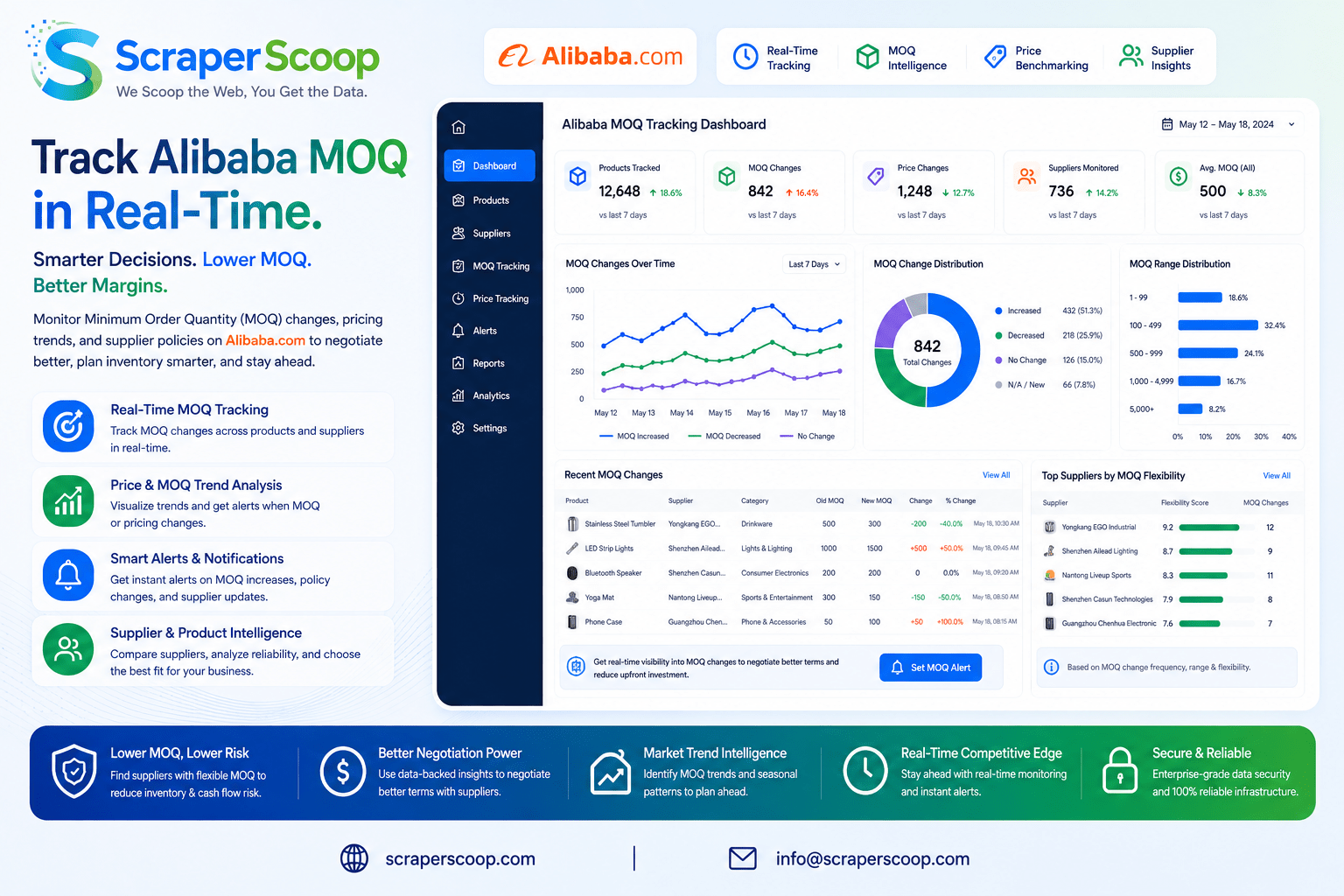
What Is MOQ on Alibaba?
If you've ever sourced products from Alibaba, you've encountered the three letters that can make or break your supply chain: MOQ.
Minimum Order Quantity (MOQ) is the lowest number of units a wholesale supplier allows buyers to purchase at one time. When you see "MOQ: 100-500 units" on Alibaba.com, it represents a specific positioning in the manufacturing ecosystem — one that balances supplier efficiency with buyer flexibility.
MOQ is not arbitrary. It reflects real production economics. Suppliers calculate MOQ based on material procurement minimums, machine setup costs, labor efficiency thresholds, and quality control requirements. A factory producing custom metal parts might need 500 units to justify CNC programming and tooling setup, while a simpler product like standard fasteners could accommodate orders as low as 100 units.
On Alibaba, MOQs vary dramatically by product category and supplier type:
| MOQ Range | Typical Supplier Type | Best For | Price Premium |
|---|---|---|---|
| 1-50 units | Workshops, small factories | Prototyping, samples | Very High (30-50%+) |
| 50-100 units | Small-medium factories | Market testing, niche products | High (15-30%) |
| 100-500 units | Medium factories | Initial launches, regional distribution | Moderate (5-15%) |
| 500-1000 units | Medium-large factories | Established products, regular orders | Low (0-5%) |
| 1000+ units | Large factories | Mass production, commodity items | Lowest (baseline) |
Most Alibaba manufacturers set MOQs of 50-500 units, with some products requiring 1,000+ units for custom specifications or branding. For electronics, typical Alibaba MOQs run $500 to $5,000 per order, or 100 to 1,000 units depending on the product.
Key Insight: MOQs are often negotiable — especially when framed as trial orders with a growth roadmap. Understanding the typical MOQ ranges in your category gives you leverage in negotiations.
Why Tracking MOQ Matters for Sourcing Success
MOQs are the main barrier for many businesses on Alibaba. Tracking and monitoring MOQ data systematically provides several strategic advantages:
1. Identify Low-MOQ Suppliers
A growing number of Alibaba suppliers now accommodate low-MOQ and single-unit fulfillment, especially through the platform's "Ready to Ship" section and dedicated Dropshipping Center. Tracking MOQs helps you find suppliers that match your order volume requirements.
2. Benchmark Supplier Pricing
MOQ directly impacts unit price. By tracking MOQs across multiple suppliers for the same product, you can identify which suppliers offer the best price-to-quantity ratios — and negotiate more effectively.
3. Detect Supplier Changes
Suppliers sometimes change their MOQs based on production capacity, raw material costs, or demand. Monitoring these changes helps you anticipate supply constraints or pricing adjustments before they impact your business.
4. Optimize Inventory Planning
Understanding supplier MOQs helps you plan inventory levels, manage cash flow, and minimize storage costs. You can identify the sweet spot where order quantity meets both supplier requirements and your business needs.
Pro Tip: A Gold supplier badge on Alibaba confirms that a company paid for membership and passed a basic identity check. It does not confirm production capacity, financial stability, or intent to fulfill a large order after a deposit clears. Always verify MOQs through multiple channels.
Manual Methods: How to Find MOQ on Alibaba
Before diving into automation, it's essential to understand how MOQ appears on Alibaba. Here are five proven methods to find MOQ manually:
Method 1: Check the "Transaction Information" Module
This is the fastest and most reliable method. On any product detail page, scroll down to the "Transaction Information" or "Procurement Notice" section. Look for the "Minimum Order Quantity" (MOQ) field — the value often includes units like "pieces," "sets," or "rolls".
Method 2: Identify SKU-Level MOQ in Specifications
For multi-specification products (different colors, sizes, materials), MOQ may vary by SKU. Navigate to the "Specifications" or "Sales Specifications" area and click through different options. Each SKU may display its own MOQ, and custom versions often have separate requirements.
Method 3: Reverse-Validate Through Transaction Records
If MOQ is missing, marked as "negotiable," or seems inconsistent, check the "Transaction Records" or "Recent Orders" section at the bottom of the product page. Look for orders below the stated MOQ — if you see multiple small orders (e.g., 3 pieces when MOQ is 500), the supplier likely accepts lower quantities.
Method 4: Ask via Alibaba TradeManager (WangWang)
When no MOQ information is visible, contact the supplier directly through the instant messaging tool. Use a specific question like: "What is the minimum order quantity for this product? Do you support mixed orders?" Many suppliers with "Smart Reception" enabled will auto-reply with structured MOQ information.
Method 5: Switch to the "Find Factory" Channel
For a more accurate view of production capacity, switch to Alibaba's "Find Factory" channel. This helps you bypass trading companies and connect directly with manufacturers who can provide real production MOQs.
Automated MOQ Tracking with Web Scraping
Manual MOQ discovery works for occasional sourcing, but for systematic supplier research, competitive benchmarking, and ongoing monitoring, you need automation. Web scraping is the engine that makes MOQ tracking work at scale.
Here's what automated MOQ scraping delivers:
Key Consideration: Alibaba uses strict bot detection mechanisms, which may block automated scraping. Professional scraping solutions use residential proxies, browser rendering, and CAPTCHA handling to ensure reliable data collection at scale.
Tools & Platforms for MOQ Data Extraction
Whether you're a solo entrepreneur or a procurement team, there's a tool for every scale of MOQ tracking:
Browser Extensions (Entry Level)
For occasional research, browser extensions offer a lightweight way to extract MOQ data:
- A-Wholesale Scraper: Extracts product details, supplier profiles, prices, and MOQ from Alibaba search results and category pages. Exports to CSV, JSON, and XLSX.
- Page Watcher Add-on: Tracks changes on any Alibaba page and sends alerts when MOQs or prices change.
- 1688 Product Collector Assistant: A specialized extension for Alibaba's domestic wholesale marketplace.
Apify Actors (Mid-Market)
Apify provides a range of pre-built scrapers (called "Actors") for Alibaba data extraction at scale:
Alibaba Product Scraper
Scrape product listings, wholesale prices, MOQ, and supplier information by keyword or URL. Extracts MOQ as both text and numeric value. Pricing from $5.00 / 1,000 results.
Alibaba Supplier Scraper
Returns MOQ, quantity price breaks, verification status, years on Alibaba, staff count, and factory size — built for sourcing agents and procurement teams.
Reverse Image Search Scraper
Find suppliers behind any product using text or image search — perfect for discovering who actually manufactures competitor products.
Alibaba Products Scraper
Clean, structured JSON for every product — tier prices, MOQ, supplier name, years on Alibaba, Gold Supplier status, response rate, GMV, and reviews. Pricing from $3.00 / 1,000 products.
Enterprise Solutions
For large-scale, ongoing MOQ monitoring, enterprise platforms provide robust infrastructure:
- Bright Data's Alibaba MCP Server: An enterprise-grade solution for Alibaba data extraction — search products, extract specs and MOQ, capture supplier details, and track pricing and supply changes at scale. Built-in proxy rotation and CAPTCHA solving.
- RetailGators Alibaba Scraper: Extracts product names, prices, descriptions, specifications, supplier details, MOQ, reviews, and ratings. Monitors MOQ changes and supplier pricing updates.
- ScrapeIt Alibaba Data Scraper: Customizable extraction tailored to specific needs — from pricing and MOQ to technical specs and customer reviews.
MOQ Monitoring Strategies
Once you've set up MOQ data collection, the real value comes from systematic monitoring. Here's how to build a monitoring strategy that delivers actionable intelligence:
1. Create a Supplier Shortlist
Use scraping to build a shortlist of suppliers for each product category. Sort by MOQ, price tier, verification status, and years in business. This gives you a clear view of your options before you start negotiations.
2. Track MOQ Changes Over Time
Suppliers adjust MOQs based on production capacity, raw material costs, and market demand. Set up scheduled scraping to capture MOQ data weekly or monthly. When a supplier's MOQ changes, you'll know immediately.
3. Benchmark Price Tiers
Most Alibaba listings show tiered pricing — different unit prices at different order quantities. Scraping these tiers lets you identify the optimal order quantity that balances unit cost and cash flow.
4. Combine MOQ with Trust Signals
MOQ alone doesn't tell the full story. Combine MOQ data with supplier verification status, Trade Assurance, response rate, years in business, and review scores to evaluate supplier quality.
5. Set Up Real-Time Alerts
When significant changes are detected — an MOQ increase, a price drop, or a new supplier entering the market — automated alerts let you act quickly.
Need automated Alibaba MOQ tracking for your sourcing operation?
Contact Our Data Experts →Tracking MOQ on 1688: The Domestic Source
If you're serious about sourcing from China, you need to understand 1688.com — Alibaba's domestic B2B marketplace and the original source for most products you'll find on Alibaba.com.
1688 offers factory-direct prices that are typically 30-60% lower than Alibaba international. However, navigating 1688 requires understanding Chinese wholesale dynamics and often higher MOQs — though some suppliers offer flexibility.
1688 MOQ Tools
- 1688 Wholesale Analyzer with AI Smart Labels: One-click product analysis with AI labels, supplier trust scoring, cross-platform price comparison, and MOQ optimization.
- 1688 Product Scraper: Extracts product prices, MOQ, suppliers, locations, and images from 1688 product URLs.
- 1688 Listings Scraper: Captures titles, tiered prices, MOQ, attributes, images, and supplier info by keyword or offer ID.
- 1688-cli: A command-line tool for 1688 wholesale — supports product search, supplier research, image search, and order tracking.
Pro Tip: When sourcing on 1688, use Chinese keywords for better search results. Many 1688 suppliers accept lower MOQs than their Alibaba international counterparts — but you'll need to communicate in Chinese or use a sourcing agent.
Getting Started: Your MOQ Tracking Roadmap
Building an MOQ tracking capability doesn't require a massive upfront investment. Here's the practical path from manual discovery to automated intelligence:
- Start Manual Begin with the five manual methods described above. Understand how MOQ appears on different product types and categories. Build a spreadsheet of your target products and suppliers.
- Add Browser Extensions Install a lightweight scraper like A-Wholesale Scraper to speed up data collection. Export search results to CSV and start building your supplier database.
- Deploy Apify Actors When you need to scale beyond a few hundred products, use Apify's Alibaba scrapers. Start with a single keyword search and expand to multiple searches and categories. Pricing starts at $3-5 per 1,000 products.
- Build a Monitoring Pipeline Set up scheduled scraping to track MOQ changes over time. Export data to your BI tools or spreadsheets for analysis. Configure alerts for significant changes.
- Expand to 1688 Once your Alibaba international monitoring is running, expand to 1688 for factory-direct pricing and additional supplier discovery.
- Integrate with Procurement Workflows For enterprise teams, integrate MOQ data with your procurement systems, supplier management platforms, or AI agents for automated sourcing decisions.
Ready to automate your Alibaba MOQ tracking?
Talk to Our Team →Cross‑Platform Intelligence That Amplifies MOQ Tracking
The most powerful sourcing intelligence combines Alibaba MOQ data with insights from adjacent platforms and capabilities:
- 1688 Domestic Platform: Alibaba's domestic marketplace offers factory-direct prices typically 30-60% lower than Alibaba international. Track MOQs and pricing on both platforms for comprehensive sourcing intelligence.
- Competitor Price Monitoring: Combine MOQ data with competitor price tracking to understand how your sourcing costs compare to market rates.
- Supplier Verification: Cross-reference MOQ data with supplier verification status, Trade Assurance, response rates, and review scores.
- Cross-Border E‑Commerce Intelligence: For Amazon FBA sellers and dropshippers, combine Alibaba MOQ data with marketplace pricing to calculate landed costs and profit margins.
For a comprehensive view of data intelligence capabilities, explore our Price Intelligence Solutions and use cases library.
Frequently Asked Questions
Q What does MOQ stand for on Alibaba?
MOQ stands for Minimum Order Quantity. It's the lowest number of units a wholesale supplier allows buyers to purchase at one time.
Q How can I find MOQ on Alibaba?
You can find MOQ through five primary methods: checking the "Transaction Information" module on product detail pages, identifying SKU-level MOQ in specifications, reverse-validating through transaction records, asking via Alibaba TradeManager, or switching to the "Find Factory" channel.
Q Can I scrape MOQ data from Alibaba?
Yes. Multiple tools support Alibaba MOQ scraping — from browser extensions like A-Wholesale Scraper to Apify Actors and enterprise platforms like Bright Data. Professional solutions handle anti-bot measures and deliver structured data in JSON, CSV, or Excel formats.
Q What's a typical MOQ on Alibaba?
Most Alibaba manufacturers set MOQs of 50-500 units, with some products requiring 1,000+ units for custom specifications or branding. For electronics, typical MOQs run $500 to $5,000 per order, or 100 to 1,000 units. Low-MOQ suppliers (as low as 5-10 units) are increasingly available through the "Ready to Ship" section.
Q How does 1688 compare to Alibaba for MOQs?
1688 is Alibaba's domestic Chinese B2B marketplace, offering factory-direct prices typically 30-60% lower than Alibaba international. MOQs on 1688 can be higher or lower depending on the supplier — some accept small orders, while others require large bulk orders. Using a sourcing agent or translation tools is recommended for 1688.
Q Are MOQs negotiable on Alibaba?
Yes. MOQs are often negotiable — especially when framed as trial orders with a growth roadmap. Suppliers are more likely to negotiate on MOQs for simple products or when you demonstrate long-term potential. Use the "成交记录" (transaction records) to identify suppliers who have accepted smaller orders in the past.
Q How much does Alibaba MOQ scraping cost?
Pricing varies by tool. Apify Actors typically cost $3-5 per 1,000 products scraped. Browser extensions are often free or low-cost. Enterprise solutions like Bright Data offer custom pricing with free tiers starting at 5,000 requests per month.
Q Can I track MOQ changes over time?
Yes. Scheduled scraping captures MOQ data at regular intervals — daily, weekly, or monthly. When suppliers adjust their minimums, automated monitoring detects the change and can trigger alerts. This is essential for procurement teams managing multiple suppliers.
Conclusion: MOQ Intelligence Is Sourcing Intelligence
In B2B sourcing, MOQ is the gatekeeper between you and your supply chain. A supplier with the perfect product but an MOQ of 5,000 units is useless to a small business. A supplier with a low MOQ but poor quality control is a risk you can't afford. Understanding, tracking, and benchmarking MOQs across suppliers is the foundation of smart sourcing decisions.
In 2026, the sourcing professionals who win are the ones with the best data — not just the best relationships. They know which suppliers offer the lowest MOQs, which categories have the most flexibility, and which suppliers are changing their terms before it impacts their business.
Whether you're just starting with manual MOQ discovery or building an enterprise-scale monitoring pipeline, the tools and strategies in this guide give you the foundation to make smarter sourcing decisions.
Don't let MOQs limit your sourcing potential. Talk to our data intelligence experts today and let's build the sourcing intelligence system your business needs to compete in 2026.


