

Retail Price Integrity: The Strategic Imperative for Brand Protection & Profitability
The complete guide to retail price integrity — from MAP monitoring and multi-channel consistency to AI-driven enforcement. Learn how brands protect margins, maintain consumer trust, and build sustainable pricing power in the $6.3 trillion e‑commerce economy.
🛡️ What You'll Learn in This Guide
- What Is Retail Price Integrity?
- Why Price Integrity Matters for Brands
- The Threats to Price Integrity
- MAP Monitoring: The First Line of Defense
- Multi-Channel Price Consistency
- Dynamic Pricing & Price Integrity
- How Technology Powers Price Integrity
- Getting Started: Your Price Integrity Roadmap
- Frequently Asked Questions
- Conclusion
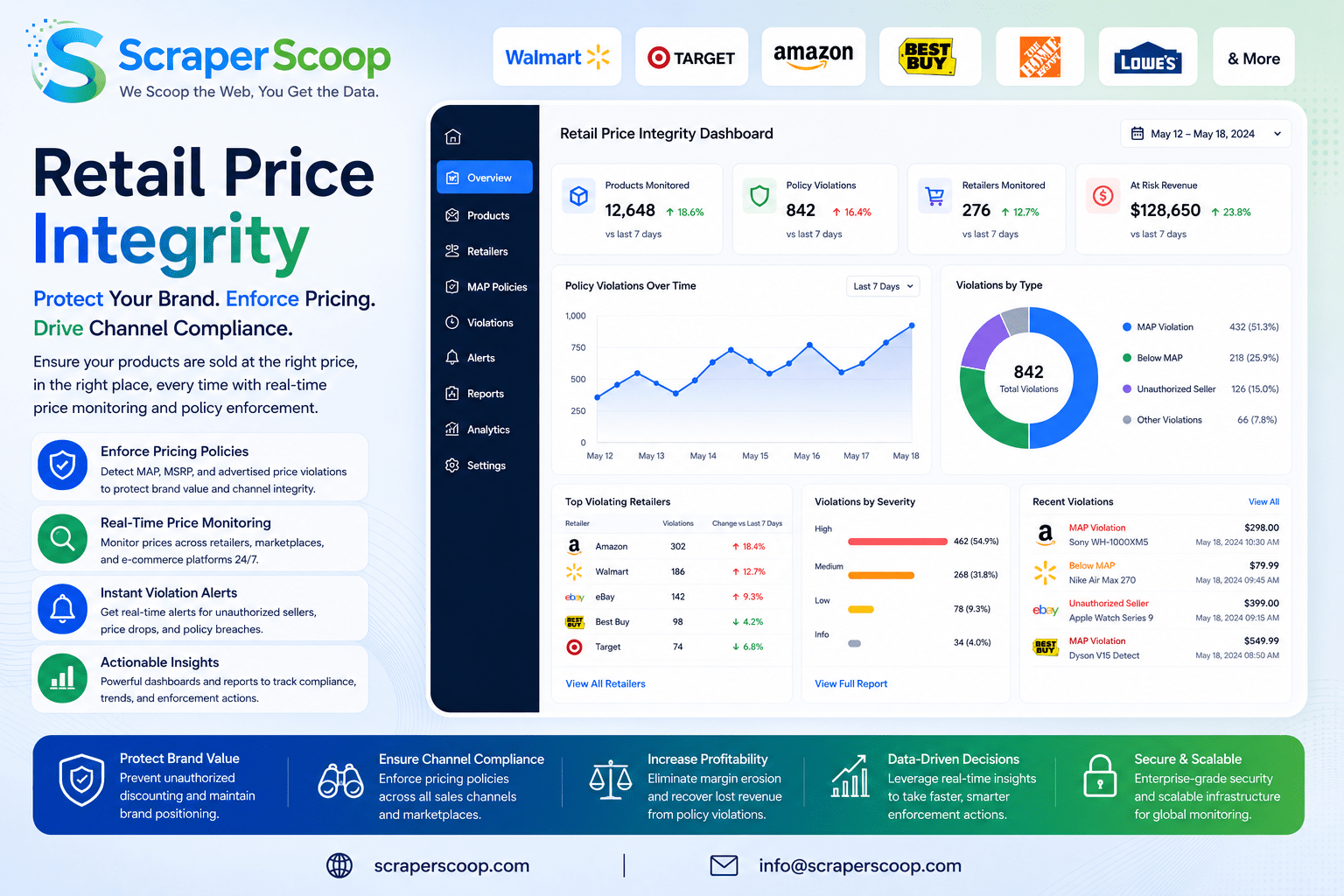
What Is Retail Price Integrity?
Price integrity is one of those concepts that sounds abstract until you see it broken. It's the difference between a brand that commands premium pricing and one that's trapped in a race to the bottom. It's the trust a customer feels when they see the same price online and in-store. It's the confidence a retailer has that their margins won't be undercut by a competitor who plays by different rules.
Retail price integrity is the consistent, transparent, and fair pricing of products across all sales channels and resellers. It means that:
- A product's advertised price aligns with brand positioning and value perception
- Prices are consistent across online marketplaces, retailer websites, and physical stores
- Resellers honor minimum advertised price (MAP) policies
- Promotions and discounts are applied fairly and transparently
- Customers trust that they're getting fair value regardless of where they shop
Key Insight: "Price integrity isn't about being the lowest. It's about being the clearest and most consistent. Shoppers reward that. Retailers appreciate it. Your P&L depends on it." Leaders now treat price integrity as a capability, not a reaction — it's part of their operating system, governed, data-driven, and strategically aligned.
Why Price Integrity Matters for Brands
In today's hyper-transparent retail environment, price integrity isn't a nice-to-have — it's a strategic imperative. Here's why:
Brand Value Protection
A product that keeps appearing at lower prices loses its quality association. That shift in perception is slow to build and hard to reverse. Price integrity prevents the "race to the bottom" that cheapens everything you've built.
Healthy Retailer Relationships
Sellers who follow your pricing standards lose sales to those who don't. When compliance costs them business, authorized partners either match the lower price or step back from your product entirely. Price integrity protects your distribution network.
Margin Protection
Brands typically see a 2% to 6% increase in overall gross margins once the "race to the bottom" is halted. That's margin that goes directly to your bottom line.
Investor Confidence
Over 60% of institutional investors now evaluate pricing integrity in assessing consumer businesses.[re10] Price integrity isn't just a commercial concern — it's a governance and valuation issue.
The price customers see online becomes the reference point, directly affecting how they judge product value and quality. When the same product appears at different prices across platforms, shoppers don't investigate — they default to the lowest number. And once customers settle on a lower price as the norm, the original feels unjustified.
The Hidden Cost: "Price erosion often begins with one seller but spreads quickly as other sellers match lower prices to stay competitive." Within days, that lower number is showing up everywhere, and your intended price starts to look out of place.
The Threats to Price Integrity
Price integrity faces threats from multiple directions. Understanding them is the first step to defending against them.
1. MAP Violations
Minimum Advertised Price (MAP) violations occur when a retailer advertises a product below the brand's established minimum price. 53% of unauthorized sellers routinely advertise products below a brand's MAP. One listing goes lower, others follow, and repricing tools do the rest automatically.
2. Multi-Channel Inconsistency
When customers see noticeable price differences across a brand's website, marketplaces, or stores, their confidence drops. A PwC survey found that more than 60% of shoppers lose trust when prices vary between channels. 78% of consumers expect in-store and online prices to be identical, and 66% are frustrated by offers only available in one place.
3. Unauthorized Sellers
Unauthorized sellers frequently bypass established distribution agreements, introducing pricing inconsistencies and contributing to brand dilution. They can appear without warning and erode pricing discipline across entire categories.
4. Algorithmic Repricing
Repricing tools automatically match competitor prices — including MAP violations. What starts as a single violation can quickly reset the entire market's expectations for what customers will pay.
5. Dynamic Pricing Without Governance
If prices fluctuate too often, or without clear logic, brands risk losing clarity in the shopper's mind and creating perceptions of unfairness. Nearly three-quarters (72%) of consumers interpret frequent repricing to mean prices are "only going up."
MAP Monitoring: The First Line of Defense
MAP monitoring is the systematic tracking of advertised prices to detect violations of a brand's minimum advertised price policy. It's the process of ensuring no seller advertises below a brand's established MAP threshold.
How MAP Monitoring Works
Tracking, detecting, and enforcing MAP is an ongoing process. It starts by searching the internet for every instance of your product, identifying the specific sellers who are violating your price policies, and obtaining the proof required to take appropriate action.
Automated technologies employ data scraping to crawl both tiny individual webstores and large marketplaces like Amazon and Walmart. These digital investigators scan hundreds of pages in seconds, noting the stated price and taking time-stamped screenshots to provide indisputable evidence of a violation.
The real value lies in real-time alerts. In e-commerce, a price war can start and finish in under an hour, especially during high-stakes holiday sales. Getting an immediate notification allows you to stop a violation before it triggers a market-wide "race to the bottom."
What Counts as a MAP Violation
MAP violations typically include product listing pages, Google Shopping ads, Amazon Sponsored Product listings, and promotional banners. These are the surfaces where a retailer's advertised price is publicly visible and attributable.
Pricing situations that fall outside MAP scope include:
- In-cart prices (discounts applied at checkout)
- Membership-gated discounts like Amazon Prime
- Phone orders and in-person transactions
- Bundled pricing where the individual product price isn't displayed
Enforcement Impact: Advanced MAP enforcement platforms have demonstrated the ability to eliminate 65% of MAP violations and achieve 92% overall MAP compliance rates. Real-time detection in as little as 10 seconds helps teams respond before violations impact margins and reseller relationships.
Need automated MAP monitoring for your brand?
Explore MAP Monitoring Solutions →Multi-Channel Price Consistency
Price consistency is becoming a key test of trust for online retailers. When customers see different prices across channels, their confidence drops and conversion rates often follow.
A great approach is to establish a consistent pricing framework — defining clear principles for how prices are set across each channel and agreeing acceptable tolerances. For example, a small variance to cover platform fees may be acceptable, but large unexplained differences are not.
Data visibility is essential. Many eCommerce teams now use automated price monitoring to track listings across their own channels as well as competitors. These systems quickly flag when a product's marketplace price undercuts the retailer's own site or when in-store pricing drifts too far from online.
Maintaining consistency also protects brand value. Shoppers who see stable, transparent pricing may be more likely to return, recommend, and trust that future promotions are genuine. It helps position the retailer as dependable rather than reactive.
Consumer Expectations: 79% of consumers say price consistency directly drives their loyalty. 78% expect in-store and online prices to be identical. "Price integrity has become a hygiene factor. When shoppers see one price on a shelf and another online, it feels unfair, and they vote with their feet."
Dynamic Pricing & Price Integrity
Dynamic pricing is a powerful tool for optimizing revenue, but it introduces new challenges for price integrity.
If prices fluctuate too often, or without clear logic, brands risk losing clarity in the shopper's mind and creating perceptions of unfairness. Without clarity and consistency in how changes are communicated, dynamic pricing risks undermining confidence in the retailer.
Nearly three-quarters (72%) of consumers interpret frequent repricing to mean prices are "only going up." Half (50%) are frustrated when in-store information does not match what they find online.
Retailers should evaluate the software and data they use to set prices and confirm compliance with recently enacted statutes. Heightened scrutiny of personalized or "surveillance" pricing has followed in the wake of growing adoption of dynamic pricing technologies.
The key to maintaining price integrity with dynamic pricing is transparency and consistency. Shoppers are seeking both value and fairness. They will hunt for deals, but they still expect retailers to keep pricing predictable and transparent.
How Technology Powers Price Integrity
Modern price integrity depends on technology. Here's how the tools work:
Getting Started: Your Price Integrity Roadmap
Building a price integrity capability doesn't require a massive upfront investment. Here's the practical path from policy to enforcement:
- Define Your Pricing Policies Establish clear MAP thresholds for every SKU. Ensure your policy is unilateral (not a contract) and includes proper disclaimer language. Confirm the legal framework for your jurisdiction — US MAP policy is supported by the Colgate Doctrine and Leegin ruling, but EU laws treat advertised price restrictions far more strictly.
- Map Your Retailer Network Identify all authorized retailers, marketplaces, and channels where your products are sold. Include the unauthorized sellers you know about — and the ones you don't.
- Choose Your Monitoring Approach Three options: (1) Deploy our MAP Monitoring solution for automated SKU‑level tracking. (2) Use e‑commerce scraping services for custom monitoring. (3) Build your own infrastructure with real‑time data feeds.
- Set Up Alerts & Reporting Configure real‑time alerts for MAP violations. Set up dashboards to track compliance metrics across channels, SKUs, and sellers.
- Establish Enforcement Workflows Define who receives violation alerts, who contacts violators, and what the escalation path looks like. Enforcement typically follows a tiered sequence: written warning first, then removal from the authorized reseller list, then supply restriction.
- Monitor, Iterate, Scale Price integrity is an ongoing process. Review your violation patterns quarterly. Adjust MAP thresholds based on market dynamics. Expand coverage to new channels and new SKUs as your business grows.
Ready‑made e‑commerce datasets for immediate market analysis
Browse E‑Commerce Datasets →Cross‑Industry Intelligence That Amplifies Price Integrity
The most powerful price integrity programs combine MAP monitoring with insights from adjacent capabilities. Here's how forward‑thinking brands build holistic protection:
- Competitor Price Tracking: Competitor price tracking shares infrastructure with MAP monitoring but serves a different function. Price tracking captures historical price movements for competitive intelligence. MAP monitoring has a single, compliance-oriented job: detect when an advertised price crosses a threshold.
- Dynamic Repricing Data: Once your price integrity foundation is solid, dynamic pricing data helps you optimize your own pricing while staying compliant.
- Brand Protection & Sentiment Analysis: Combine price monitoring with brand monitoring and review analysis to detect unauthorized sellers, counterfeit products, and reputation damage.
- Multi-Channel Intelligence: Track pricing across your own channels as well as competitors to ensure consistency and identify discrepancies early.
For a comprehensive view of price intelligence capabilities, explore our Price Intelligence Solutions and use cases library.
Frequently Asked Questions
Q What is retail price integrity?
Retail price integrity is the consistent, transparent, and fair pricing of products across all sales channels and resellers. It means that advertised prices align with brand positioning, prices are consistent across channels, resellers honor MAP policies, and customers trust they're getting fair value regardless of where they shop.
Q Why does price integrity matter?
Price integrity protects brand value, maintains healthy retailer relationships, preserves margins (brands typically see 2‑6% gross margin improvement after halting the race to the bottom), and builds investor confidence — over 60% of institutional investors now evaluate pricing integrity in assessing consumer businesses.
Q What is MAP monitoring?
MAP monitoring is the systematic tracking of advertised prices to detect violations of a brand's minimum advertised price policy. It ensures no seller advertises below a brand's established MAP threshold, using automated scraping to crawl thousands of retailer pages and provide real-time alerts when violations occur.
Q What's the difference between MAP and MSRP?
MAP (Minimum Advertised Price) is the lowest price a product can be advertised at — it's enforceable. MSRP (Manufacturer's Suggested Retail Price) is a recommended selling price that retailers can advertise above or below freely. A retailer ignoring your MSRP is making a positioning call; a retailer advertising below your MAP is violating a policy you can enforce.
Q How does web scraping help with price integrity?
Web scraping provides the data foundation for price integrity monitoring. It enables brands to automatically crawl thousands of retailer pages, extract advertised prices, take time-stamped screenshots as evidence, and deliver real-time alerts when violations occur. Manual monitoring simply can't keep up with the scale and speed of modern e-commerce.
Q How do I enforce MAP violations?
Enforcement typically follows a tiered sequence: written warning first, then removal from the authorized reseller list, then supply restriction. The key is having documented evidence of each violation — which automated monitoring provides. Consistency matters: enforce your policy across every reseller, without exception.
Q I'm a small brand with a limited budget. Is price integrity monitoring relevant for me?
Absolutely. Even a single MAP violation can damage your brand equity and retailer relationships. Start with our pre‑built e‑commerce datasets to understand your current pricing landscape. As your needs grow, scale to fully automated price integrity monitoring. Contact us to discuss the right starting point for your budget.
Conclusion: In Retail, Price Integrity Is the Foundation of Brand Value
E‑commerce has made pricing more transparent than ever — and more vulnerable than ever. A single MAP violation can trigger a chain reaction that erodes margins, damages retailer relationships, and cheapens everything you've built. Inconsistent pricing across channels undermines consumer trust and drives shoppers to competitors.
In this environment, price integrity isn't a luxury — it's survival. The brands that protect their pricing integrity in 2026 are the ones with the best monitoring infrastructure, the fastest violation detection, and the most consistent enforcement.
Price integrity isn't about being the lowest. It's about being the clearest and most consistent. Shoppers reward that. Retailers appreciate it. Your P&L depends on it.
Price integrity monitoring from ScraperScoop provides the data foundation for all of this — automated SKU‑level tracking, real‑time alerts, evidence‑ready documentation, and comprehensive reporting across thousands of retailers and marketplaces.
The data is publicly available on every e‑commerce platform. Retailers are advertising your products right now. The question is whether you're monitoring these prices systematically — or discovering violations weeks late, after the damage is done.
Don't let pricing chaos erode your brand value. Talk to our price integrity experts today and let's build the monitoring system your brand needs to protect pricing, margins, and value in 2026.


