

Scraper vs. Dataset: Which One Should You Use for Your Data Intelligence Needs?
The definitive guide to choosing between building a custom web scraper and buying a ready‑to‑use dataset. Learn when to build, when to buy, and how to make the right data acquisition decision for your business, budget, and timeline.
📊 What You'll Learn in This Guide
- What Is a Web Scraper?
- What Is a Ready‑to‑Use Dataset?
- Scraper vs. Dataset: A Side‑by‑Side Comparison
- When to Build a Custom Scraper
- When to Buy a Ready‑to‑Use Dataset
- The Decision Framework: How to Choose
- The Hidden Costs of Scraping (That Nobody Talks About)
- The Hybrid Approach: Using Both Together
- Getting Started: Your Data Acquisition Roadmap
- Frequently Asked Questions
- Conclusion
What Is a Web Scraper?
A web scraper is a tool — custom‑built software, a managed API, or a no‑code platform — that automatically extracts data from websites. It simulates human browsing behavior to request web pages, parse the HTML or JSON responses, and extract specific pieces of information like product prices, supplier details, customer reviews, or job listings.
Web scraping can range from a simple Python script using
requests and BeautifulSoup to
enterprise‑grade infrastructure with headless browsers, proxy
rotation, CAPTCHA solving, and scheduled data pipelines. The data you
get is raw, unstructured, and requires cleaning and normalization
before it's usable for analysis or business intelligence. A
production‑ready scraper typically needs more than just extraction
logic — it requires handling blocked requests, JavaScript rendering,
inconsistent layouts, missing fields, duplicated records, data
validation, storage, monitoring, and ongoing maintenance.
Key Insight: A web scraper is not a product — it's a pipeline. Building one is signing up for an ongoing engineering problem, not a one‑time data collection task. The initial script may be small, but the surrounding infrastructure can take significantly more time than the extraction logic itself.
What Is a Ready‑to‑Use Dataset?
A dataset is a structured collection of information organized for easy analysis, processing, and reuse. Ready‑to‑use datasets are pre‑collected, pre‑cleaned, and pre‑structured by a data provider — so you can skip the entire scraping pipeline and go straight to analysis.
Datasets are typically stored in formats like CSV, JSON, or Parquet, and can include text, numbers, images, and other types of data. Most datasets focus on a specific topic, industry, or market — such as e‑commerce products, B2B company data, real estate listings, or travel prices. This narrower focus helps businesses extract insights, identify trends, and support data‑driven decision‑making without technical overhead.
While datasets are generally considered static snapshots collected at a specific point in time, leading providers offer periodically refreshed records by fetching updated information from the underlying data sources. The three main benefits of datasets are:
- Ready to use: Pre‑collected and structured data, immediately usable for analysis, AI, or business applications. No technical knowledge required.
- Cost efficiency: Reduces the need for in‑house data collection and engineering resources.
- Scalability: Provides access to large datasets covering millions or billions of records across industries.
ScraperScoop provides ready‑to‑use datasets across e‑commerce, travel, real estate, food delivery, finance, and market research — all cleaned, structured, and delivered in your preferred format.
Scraper vs. Dataset: A Side‑by‑Side Comparison
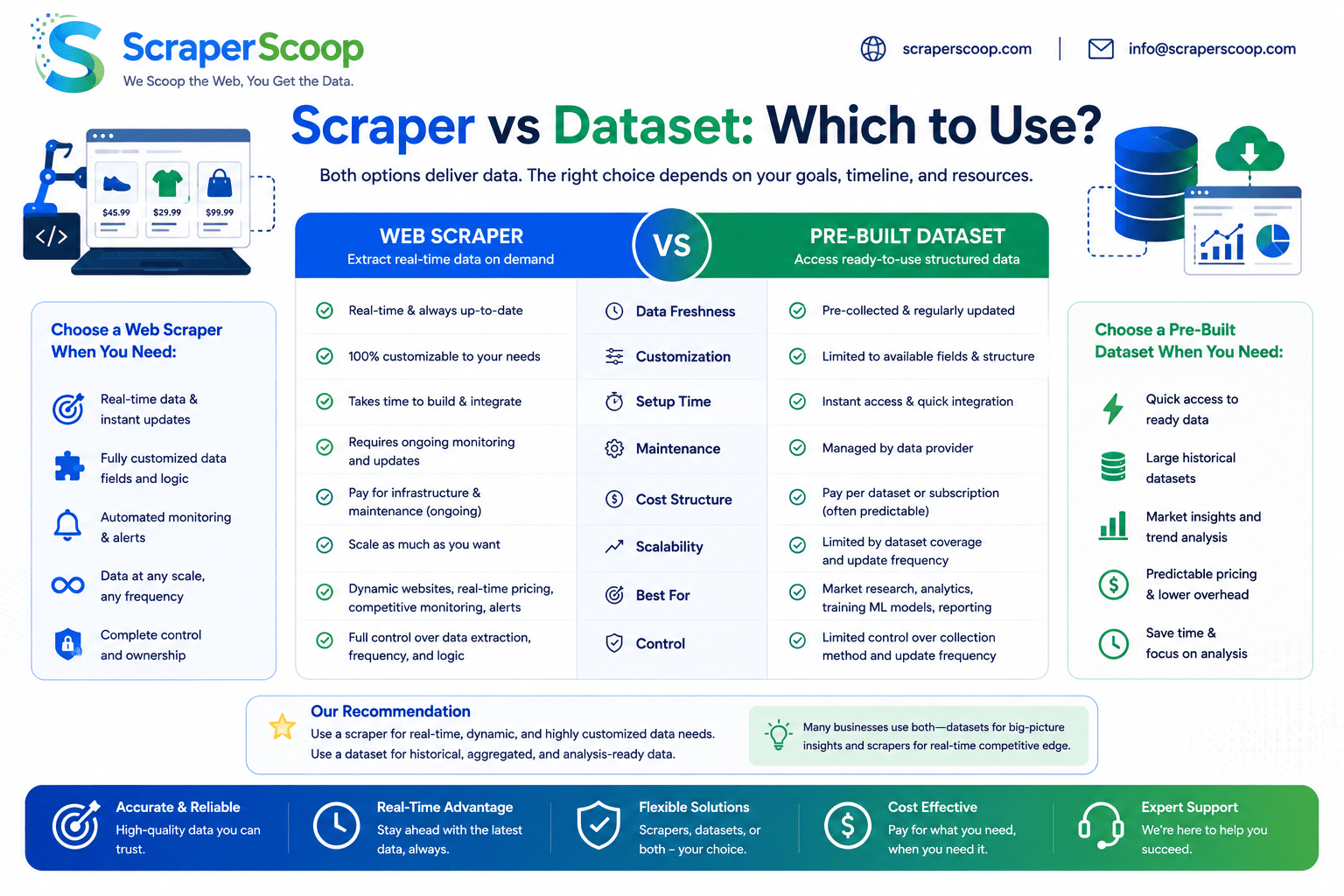
Before diving into when to use each, let's compare them across the dimensions that actually matter for business decisions:
| Factor | Custom Web Scraper | Ready‑to‑Use Dataset |
|---|---|---|
| Time to data | Medium to long (weeks to months) | Immediate to short (minutes to days) |
| Initial cost | Lower upfront, higher development cost | Higher upfront, lower ongoing |
| Ongoing costs | Maintenance, infrastructure, proxies | Subscription or per‑dataset fee |
| Customization | Fully customizable | Limited to available datasets |
| Data freshness | Real‑time or scheduled as needed | Depends on provider update frequency |
| Technical expertise | Significant engineering effort required | Minimal — no technical knowledge needed |
| Data quality | Raw, requires cleaning and validation | Pre‑cleaned, validated, and structured |
| Legal liability | Full responsibility for compliance | Partially shifted to data provider |
| Scalability | Customizable based on needs | Limited to provider offerings |
When to Build a Custom Scraper
Building a custom scraper is typically the better choice when:
You Need Highly Specific or Niche Data
If the data you need isn't available in any existing dataset — perhaps it's a niche industry, a specific set of attributes, or a unique combination of sources — a custom scraper is your only option.
You Require Real‑Time or Ultra‑Fresh Data
If your use case demands sub‑hourly or real‑time data — like dynamic pricing, stock trading, or live event monitoring — only a custom scraper can deliver that speed.
You Need Full Control Over the Data Pipeline
If you require complete customization — from which fields are extracted to how data is transformed and delivered — building your own scraper gives you that control.
You're Building a Long‑Term Data Asset
If data collection is core to your business model — and you have the engineering resources to maintain it — a custom scraper can become a strategic competitive advantage.
Pro Tip: Before committing to a custom scraper, do the math. A simple scraping project typically takes 3‑5 days minimum, complex anti‑bot sites take 2‑3 weeks, and ongoing maintenance consumes 10‑20% of the original build time per year. Multiply your initial estimate by 2.5x — if a scraper will take "one week," budget for 2.5 weeks to account for debugging, site changes, and quality issues.
When to Buy a Ready‑to‑Use Dataset
Buying a ready‑to‑use dataset is typically the better choice when:
You Need Data Immediately
If you need data within days — not weeks or months — a dataset is the fastest path. Purchased data gives you immediate access to structured, query‑ready information.
You Have Limited Engineering Resources
Building and maintaining a scraping pipeline requires significant engineering effort, legal oversight, and ongoing maintenance. If your team is small or focused on core product development, buying data is more efficient.
You Need Standardized, High‑Quality Data
Purchased data usually comes cleaned, normalized, and validated. Scraped data comes with character encoding issues, missing fields, and the occasional emoji breaking your parser. For critical use cases like financial analysis or AI training, quality matters.
Legal Compliance Is Complex
Data vendors handle the legal complexity, terms of service compliance, and relationship management with data sources. If you're in a highly regulated industry or dealing with personal data, buying from a vendor with established legal frameworks is often the safer choice.
As one data engineer put it: "I spent three weeks building a complex e‑commerce scraper for product pricing data. I was proud of my technical solution until I discovered that the exact dataset was available from a data vendor for $500. My time investment alone was worth more than $5,000."
Browse ScraperScoop's ready‑to‑use datasets for immediate access to structured data from major platforms.
The Decision Framework: How to Choose
Based on the experiences of data engineers and the research above, here's a practical framework for making the scraper‑vs‑dataset decision:
1. Time Economics
Calculate your true hourly cost — not just salary, but the opportunity cost of what else you could be building. If the data you need is standardized across multiple sources, you need historical data going back years, or you need it immediately, buying is almost always cheaper.
2. Data Quality Requirements
Evaluate completeness, accuracy, freshness, and format consistency. If you need data enrichment (demographics, sentiment, categorization) or multiple source aggregation, buying is often the better choice.
3. Legal and Compliance
If you're in a highly regulated industry, dealing with personal data, or targeting sites with explicit anti‑scraping terms, buying data from a vendor with established legal frameworks is often the safer and more cost‑effective choice.
4. Strategic Value
If data collection is core to your business model and a source of competitive advantage, building a custom scraper may be worth the investment. If data is a supporting input to your core business, buying is more efficient.
The Decision Is Economic, Not Technical: Most developers approach this as a technical problem — "Can I scrape this?" But that's the wrong question. The right question is: "Should I scrape this?"
The Hidden Costs of Scraping (That Nobody Talks About)
Building your own scraper might seem cheaper upfront, but the hidden costs add up fast. Here's what you're signing up for:
Key Insight: Teams don't usually need scraping pipelines. Instead, they need usable data. What you truly want might just be data, not a scraping system. And building an entire infrastructure just to get it is easily overkill.
The Hybrid Approach: Using Both Together
In many cases, the most effective strategy combines both approaches:
- Start with purchased data for immediate needs while developing a custom scraper for long‑term requirements.
- Supplement custom scraped data with purchased datasets for areas that are difficult or expensive to scrape.
- Use APIs when available before resorting to web scraping.
- Combine multiple approaches based on different data sources and requirements.
For example, a retail intelligence platform might buy a ready‑made e‑commerce dataset for historical pricing trends while running custom scrapers for real‑time competitor monitoring on specific SKUs. This approach gives you the best of both worlds: immediate access to baseline data plus custom flexibility where it matters most.
Need both custom scraping and ready‑to‑use datasets?
Talk to Our Data Experts →Getting Started: Your Data Acquisition Roadmap
Here's a practical step‑by‑step roadmap for choosing and implementing the right data acquisition strategy:
- Define Your Data Requirements What specific data do you need? Which fields? What sources? How fresh does it need to be? How much historical data do you require? Be as specific as possible.
- Search for Existing Datasets Before building anything, check if the data you need already exists. Browse ScraperScoop's dataset marketplace and other providers. You might find exactly what you need — already cleaned and structured.
- Evaluate Cost vs. Build Time Calculate the total cost of building and maintaining a custom scraper — including engineering time, infrastructure, proxies, and ongoing maintenance. Compare this to the cost of purchasing a dataset.
- Check Legal & Compliance Requirements Review the terms of service for your target websites. If you're in a regulated industry or dealing with personal data, buying from a vendor with established legal frameworks may be the safer choice.
- Choose Your Path Based on your evaluation, decide whether to build a custom scraper, buy a ready‑to‑use dataset, or use a hybrid approach.
- Start Small and Scale If you're building a scraper, start with a single source and a limited set of fields. Prove the concept before scaling to multiple sources and millions of records.
- Monitor and Optimize Whether you build or buy, continuously monitor data quality, freshness, and relevance. Adjust your approach as your needs evolve.
Ready to access high‑quality, structured data for your business?
Explore ScraperScoop's Solutions →Complementary Data Intelligence for Your Business
Whether you choose a scraper, a dataset, or both, these complementary capabilities can enhance your data intelligence strategy:
- Competitor Price Tracking: Monitor competitor pricing across thousands of SKUs with automated price tracking — available as both custom scraping and pre‑built datasets.
- MAP Monitoring: Protect your brand with automated MAP monitoring — detect violations across thousands of retailers and marketplaces.
- Dynamic Repricing Data: Power your repricing algorithms with real‑time pricing intelligence — delivered via API or structured datasets.
- Travel & Hotel Intelligence: Access travel datasets for hotel rates, flight fares, and Airbnb listings — or build custom travel scrapers.
- E‑Commerce Intelligence: Get e‑commerce datasets for product prices, reviews, and seller data — or deploy custom e‑commerce scrapers.
For a comprehensive view of data intelligence capabilities, explore our Price Intelligence Solutions and use cases library.
Frequently Asked Questions
Q What's the difference between a web scraper and a dataset?
A web scraper is a tool that extracts data from websites — it's a pipeline you build and maintain. A dataset is the finished product — pre‑collected, pre‑cleaned, and pre‑structured data that's ready for analysis immediately.
Q Is it cheaper to build a scraper or buy a dataset?
It depends. Building a scraper has lower upfront costs but higher long‑term costs due to maintenance, infrastructure, and engineering time. Buying a dataset has higher upfront costs but lower ongoing costs. For most business use cases, the true cost of building and maintaining a scraping pipeline at scale almost always exceeds the cost of purchasing ready‑made data.
Q When should I build a custom scraper?
Build a custom scraper when you need highly specific or niche data that isn't available in any existing dataset, when you require real‑time or ultra‑fresh data, when you need full control over the data pipeline, or when data collection is core to your business model.
Q When should I buy a ready‑to‑use dataset?
Buy a dataset when you need data immediately, when you have limited engineering resources, when you need standardized high‑quality data, when legal compliance is complex, or when data is a supporting input rather than your core business.
Q Can I use both scrapers and datasets together?
Yes. A hybrid approach is often most effective: start with purchased data for immediate needs while developing a custom scraper for long‑term requirements, supplement custom scraped data with purchased datasets for areas difficult to scrape, and combine approaches based on different data sources and requirements.
Q How long does it take to build a production‑ready scraper?
A simple scraping project typically takes 3‑5 days minimum. Complex anti‑bot sites take 2‑3 weeks. Ongoing maintenance consumes 10‑20% of the original build time per year. Most practitioners recommend multiplying initial estimates by 2.5x to account for debugging, site changes, and quality issues.
Q How do I evaluate dataset quality?
Evaluate datasets across six key dimensions: accuracy (authentic and correct data), completeness (no major missing elements), consistency (no conflicting information), freshness (current and up‑to‑date), uniformity (consistent units of measurement), and uniqueness (no duplicates). Always check the provider's update frequency and data validation processes.
Q What data can I get from ScraperScoop?
ScraperScoop provides both custom web scraping services and ready‑to‑use datasets across e‑commerce, travel, real estate, food delivery, finance, and market research. Our travel datasets include hotel rates, flight fares, and Airbnb listings. Our e‑commerce datasets include product prices, reviews, and seller data. We also offer custom scrapers via our Web Scraping API.
Conclusion: Choose the Right Tool for the Right Job
There's no universal right answer to the scraper‑vs‑dataset question — it depends on your specific needs, resources, and timeline. But the decision doesn't have to be difficult. By evaluating your requirements across time, quality, legal, and strategic dimensions, you can make a confident choice.
Remember: teams don't usually need scraping pipelines. They need usable data. If you can get clean, structured, high‑quality data from a dataset provider, you save weeks of engineering time, avoid ongoing maintenance headaches, and reduce legal risk — all while getting to insights faster.
If your needs are truly unique, real‑time, or core to your business model, building a custom scraper may be the right choice — just make sure you're accounting for the full cost of ownership, including maintenance, infrastructure, and data quality.
At ScraperScoop, we provide both options: ready‑to‑use datasets for immediate access to structured data and custom web scraping services for unique, real‑time, or highly specific requirements. Our team helps businesses across e‑commerce, travel, real estate, and finance transform public web data into actionable intelligence.
Don't let data acquisition slow you down. Talk to our data experts today and let's find the right data solution for your business.


