

Pricing Intelligence for Groceries: The Strategic Imperative for Modern Retail
The complete guide to grocery pricing intelligence — from competitive price monitoring and dynamic pricing to AI-driven optimization. Learn how retailers, brands, and analysts leverage real‑time data to protect margins, win market share, and navigate the $6.3 trillion global grocery market.
🛒 What You'll Learn in This Guide
- Why Grocery Pricing Intelligence Matters in 2026
- The Unique Pricing Challenges in Grocery Retail
- What Grocery Data Can You Scrape?
- Who Uses Grocery Pricing Intelligence?
- Competitive Pricing Strategies for Grocers
- Dynamic Pricing & AI in Grocery
- Grocery Price Scraping: How It Works
- Common Challenges & How to Overcome Them
- Getting Started: Your Grocery Pricing Roadmap
- Frequently Asked Questions
- Conclusion
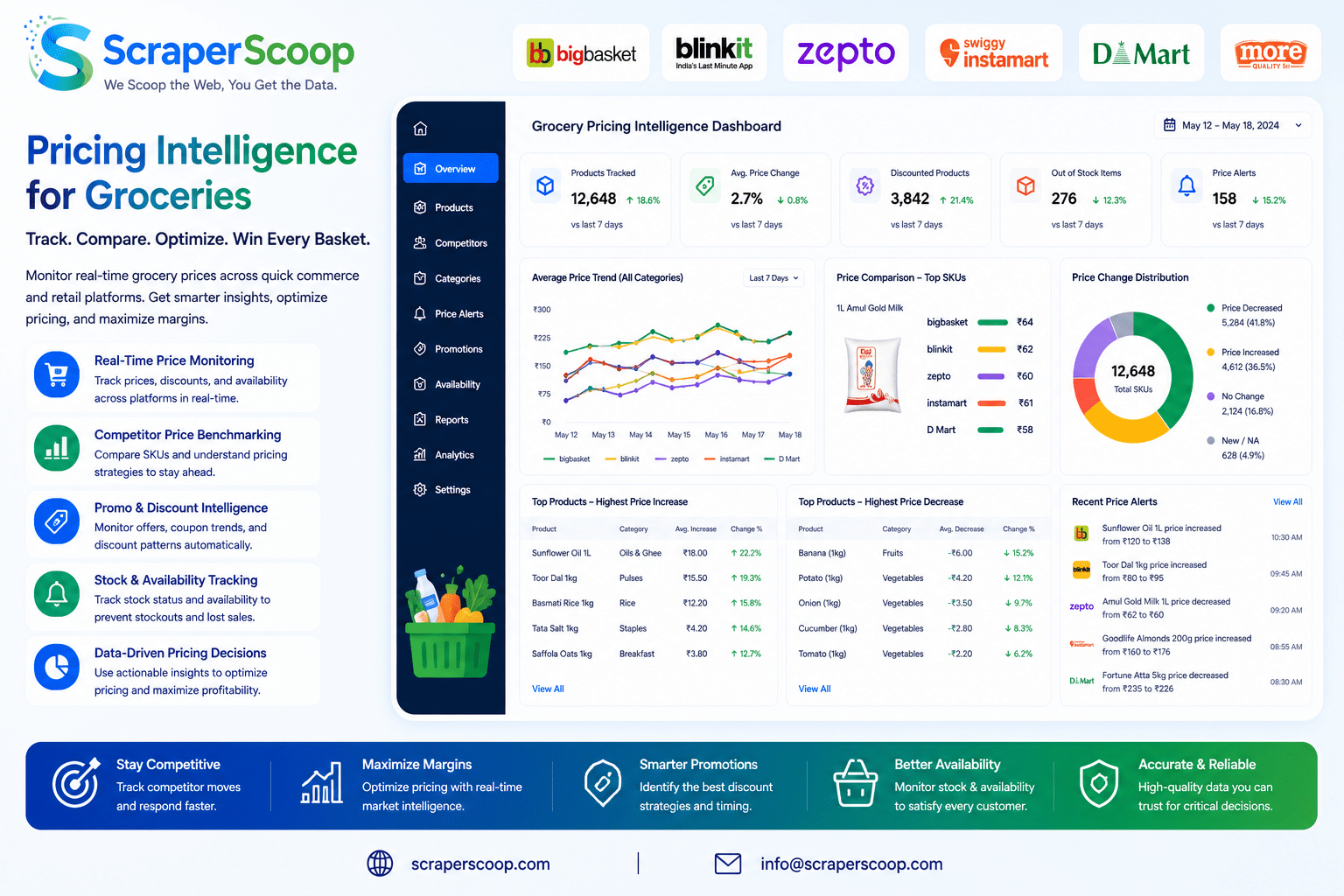
Why Grocery Pricing Intelligence Matters in 2026
Grocery retail operates on some of the thinnest margins in any industry — often measured in single digits. A pricing error of just a few percentage points can wipe out an entire quarter's profits. At the same time, consumers have never been more price‑savvy, comparing prices across stores, apps, and marketplaces in seconds. The result is a hyper‑competitive environment where pricing intelligence isn't a luxury — it's survival.
Emerging data suggests the price you pay for a cart of groceries may be less dependent on where you shop and more on when you shop. The AI revolution has fundamentally changed grocery pricing, with major retailers including Albertsons, Costco, Kroger, Safeway, Sprouts Farmers Market, and Target using AI-driven dynamic pricing models.
A joint Pennsylvania House and Senate committee hearing heard from Consumer Reports that grocery delivery company Instacart uses AI-driven dynamic pricing to charge different customers different prices for the same item — sometimes with as many as five different price points. In their investigation, about 75% of products checked were offered at different prices to different customers, with price variations as high as 23%, or $2.56 per item.
The Core Truth: In grocery, pricing perception drives loyalty. Shoppers who see consistent, fair pricing return. Those who feel exploited — by surge pricing, hidden markups, or unexplained variation — take their business elsewhere. Price integrity is the foundation of customer trust.
The Unique Pricing Challenges in Grocery Retail
Grocery pricing is structurally different from other retail categories. Several factors combine to make it especially challenging:
Extremely Large SKU Counts
Grocery retailers manage thousands or tens of thousands of SKUs across national brands, private labels, fresh produce, and perishables. Each SKU has its own pricing dynamics, competitive landscape, and demand elasticity.
Frequent Promotions & Temporary Price Reductions
Grocery is defined by constant promotional activity — weekly ad circulars, digital coupons, multi‑buy offers, and flash sales. Tracking the effective price (after promotions) is far more complex than monitoring the shelf price.
Regional & Hyperlocal Competition
Competition varies dramatically by store, market, and even pincode. In India's quick commerce market, same SKUs can differ by ₹10–50 across pincodes within 5 km. What works in one neighborhood may fail in another.
Omnichannel Pricing Expectations
Consumers expect consistent pricing across online and in‑store channels. Instacart is pushing retailers to match online and in‑store prices, noting that retailers that offer price parity outperform those that mark up prices on the platform.
Without accurate competitive intelligence, pricing teams are forced to make assumptions. Those assumptions often lead to over‑discounting, missed revenue opportunities, or uncompetitive shelf prices.
The Hidden Cost: Small pricing errors can quickly erode profitability. A regional grocery chain that relied on weekly competitor price checks missed midweek promotions by competitors, losing sales to price‑conscious shoppers. Manual price monitoring simply cannot keep pace with daily or near‑real‑time price changes.
What Grocery Data Can You Scrape?
Grocery platforms are data‑rich environments. Here's what systematic grocery data extraction delivers:
| Data Category | Specific Fields | Strategic Value |
|---|---|---|
| Product Prices | Current price, list price, sale price, unit price (price per lb/kg), multi‑buy pricing | Competitive benchmarking, repricing inputs, promotional analysis |
| Promotions & Discounts | Coupon codes, percentage discounts, BOGO offers, multi‑buy deals, loyalty pricing | Promotional strategy benchmarking, effective price tracking |
| Stock Availability | In‑stock status, backorder status, delivery estimates, inventory levels | Supply chain intelligence, competitive advantage, demand forecasting |
| Product Attributes | Brand, barcode, category, nutrition grade, country of origin, dietary labels (Halal, organic) | Assortment gap analysis, private label positioning |
| Ratings & Reviews | Average rating, review count, review text, sentiment | Product quality benchmarking, reputation monitoring |
| Hyperlocal Pricing | Pincode‑level prices, delivery radius costs, competition density, demand heat | Zone‑level pricing optimization, market‑specific strategies |
| Private Label Data | Private label pricing, positioning, assortment breadth, promotional activity | Private label strategy, competitive differentiation |
For pre‑built grocery datasets, explore ScraperScoop's grocery and retail datasets, including the Target‑Walmart Price Gap Analysis and India Quick Commerce pricing guide.
Who Uses Grocery Pricing Intelligence?
Grocery pricing intelligence serves a diverse ecosystem of stakeholders:
Grocery Retailers & Supermarkets
Monitor competitor prices across thousands of SKUs daily. Track promotions, private label positioning, and regional pricing variations. Protect margins while remaining competitive.
CPG Brands & Manufacturers
Track retail pricing of their products across chains and regions. Monitor MAP compliance, promotional execution, and competitor brand positioning. Optimize trade spend and promotional effectiveness.
Quick Commerce Platforms
In India's US$7‑8 billion quick commerce market, platforms like Blinkit, Zepto, and Jiomart change prices multiple times per day. Continuous price monitoring is mission‑critical.
Market Research & Investment Firms
Build category‑level price indices, track inflation impacts on consumer goods, analyze competitive dynamics by category, and provide pricing intelligence to institutional clients.
Competitive Pricing Strategies for Grocers
Leading grocers are moving away from broad price cuts toward targeted, data‑driven pricing, focusing discounts on key items. Here's how they're doing it:
1. Zone‑Level Precision Pricing
Price intelligence platforms now offer store and zip code level views for targeted price matching by market. This allows grocers to match competitors in specific neighborhoods where they're losing market share, while maintaining margins in less competitive areas.
2. Category‑by‑Category Competitive Analysis
A regional grocery chain that scraped 15,824 grocery products from Target and Walmart discovered that a 22% average price gap masked huge variations across departments:
- Fresh Produce: Walmart lower on 71% of items, avg gap 28% — high volume sensitivity
- Organic & Natural: Target lower on 64% of items, avg gap 18% — premium focus advantage
- Meat & Seafood: Walmart lower on 78% of items, avg gap 24% — clear Walmart leadership
- Snacks & Beverages: Target lower on 58% of items, avg gap 14% — private label competitive
Armed with this intelligence, the chain implemented strategic repricing that resulted in a 29% sales increase over 12 months.
3. Private Label Strategy
Grocers are leaning into private label and loyalty programs to deliver value in a more precise way. Aldi is investing $9 billion to expand its deep‑discount model, aiming for 4,000 compact stores focused on private labels and self‑service. Private labels often sell for less than name products by skipping middlemen and keeping packaging simple.
4. Promotional Optimization
Conventional grocers can't compete head‑to‑head on price with discounters. Instead, they're taking a more targeted approach to promotions, implementing new pricing tactics that offer more consistency and reinforcing wallet‑friendly offerings like private label goods.
Dynamic Pricing & AI in Grocery
With national grocery chains shifting to electronic price tags, the ability for retailers to deploy AI‑enabled dynamic pricing may soon be commonplace. Here's what's happening:
AI‑Powered Pricing Models
AI can ingest vast amounts of data to determine pricing recommendations, including inputs like material costs, competitor pricing, customer demand, predicted demand, inventory levels, and potential delays or disruptions in the supply chain. Without the lag of constantly updating static pricing, AI‑enabled pricing models allow companies to better capture margin on their products.
Retailers can use AI models to identify optimal price points for individual products, adjusting prices in near real‑time to maximize margins without sacrificing customer loyalty. Specialized technology vendors now provide AI solutions across pricing optimization, supply chain orchestration, and retail media platforms.
Reducing Food Waste Through Dynamic Pricing
AI‑driven dynamic pricing can help supermarkets optimize profits from perishable foods by adjusting prices based on real‑time product expiry data, thereby reducing food waste. The analysis confirms that AI‑based dynamic pricing strategies significantly positively impact waste reduction and profitability.
Regulatory & Consumer Concerns
However, the technology also creates significant concerns about algorithmic bias and price gouging. Personalized automated pricing could theoretically give consumers different prices for the same exact product at the same exact time.
Lawmakers are taking notice. Senators Elizabeth Warren and Bob Casey wrote to Kroger expressing concerns that digital price tags "may enable Kroger and other grocery chains to transition to 'dynamic pricing,' in which the price of basic household goods could surge based on the time of day, the weather, or other transitory events". States including New York, California, Colorado, and Pennsylvania are considering legislation that would ban "surveillance pricing" altogether.
Key Insight: The main barrier to charging more for groceries at busy times is not legal but reputational. Grocers must balance the profit potential of dynamic pricing against the risk of consumer backlash and regulatory scrutiny.
Grocery Price Scraping: How It Works
Price intelligence software for grocery retail is designed to monitor competitor prices continuously and convert raw data into decision‑ready insights. Here's how it works:
Real‑World Examples
- FairPrice Scraper (Singapore): Scrapes NTUC FairPrice (Singapore's largest grocery) for product names, brands, prices, original prices, discounts, promotions, unit pricing, categories, and stock.
- ASDA UK Grocery Scraper: Extracts names, prices, unit prices, brands, and sizes from groceries.asda.com.
- India Quick Commerce Scraping: Tracks real‑time prices from Zepto, Blinkit, and Jiomart across thousands of pincodes.
- Walmart Grocery Scraper: Crawls Walmart's online grocery catalog, extracting item name, price, weight, and discount information.
Common Challenges & How to Overcome Them
Grocery price scraping faces unique challenges. Here's what to watch out for:
Getting Started: Your Grocery Pricing Roadmap
Building a grocery pricing intelligence capability doesn't require a massive upfront investment. Here's the practical path:
- Define Your Competitive Set Which retailers do you need to track? Which categories and SKUs matter most? Start with your top 100‑500 SKUs and 3‑5 key competitors.
- Choose Your Data Collection Approach Three options: (1) Download pre‑built grocery datasets for immediate market analysis. (2) Deploy grocery scraping services for on‑demand data extraction. (3) Build your own custom scrapers.
- Set Up Daily or Near‑Real‑Time Monitoring Grocery prices change daily — sometimes multiple times per day. Daily automated monitoring is the minimum. For quick commerce, near‑real‑time monitoring is essential.
- Implement SKU Matching & Normalization Ensure accurate comparisons by matching products across retailers using barcodes, brands, and attributes. This is the foundation of reliable price intelligence.
- Build Dashboards & Alerts Create visual dashboards for pricing teams. Set up alerts for competitive price changes on key SKUs. Make intelligence actionable.
- Analyze & Act Use the intelligence to inform pricing decisions — whether it's matching a competitor's price, adjusting promotional calendars, or optimizing private label positioning.
- Scale & Refine Expand coverage to more SKUs, more competitors, and more categories. Refine your approach based on results and changing market dynamics.
Ready to access high‑quality grocery pricing intelligence?
Talk to Our Data Experts →Complementary Intelligence for Grocery Pricing
Grocery pricing intelligence is often part of a broader retail intelligence strategy. Here are complementary capabilities:
- Competitor Price Tracking: Monitor competitor pricing across thousands of SKUs with automated price tracking — available as both custom scraping and pre‑built datasets.
- Dynamic Repricing Data: Power your repricing algorithms with real‑time pricing intelligence — delivered via API or structured datasets.
- Retail Price Integrity: Protect your brand with MAP monitoring — detect violations across thousands of retailers and marketplaces.
- E‑Commerce Intelligence: Get e‑commerce datasets for product prices, reviews, and seller data — or deploy custom e‑commerce scrapers.
- Quick Commerce Datasets: Access quick commerce datasets for real‑time pricing and availability from platforms like Blinkit, Zepto, and Jiomart.
For a comprehensive view of price intelligence capabilities, explore our Price Intelligence Solutions and use cases library.
Frequently Asked Questions
Q What is grocery pricing intelligence?
Grocery pricing intelligence is the systematic collection, analysis, and application of competitive pricing data in the grocery sector. It enables retailers to monitor competitor prices, track promotions, optimize their own pricing, and protect margins while remaining competitive.
Q Why is grocery pricing uniquely complex?
Grocery pricing faces several unique challenges: extremely large SKU counts (thousands or tens of thousands), frequent promotions and temporary price reductions, regional and hyperlocal competition that varies by store and market, omnichannel pricing expectations, and cost volatility driven by suppliers and seasonality.
Q What data can I scrape from grocery websites?
You can extract product prices (current, list, sale, unit price), promotions and discounts, stock availability, product attributes (brand, barcode, category, nutrition grade), ratings and reviews, hyperlocal pricing by pincode, and private label data.
Q How often should I monitor grocery prices?
Grocery prices change daily — sometimes multiple times per day. Daily automated monitoring is the minimum for effective competitive intelligence. For quick commerce platforms like Zepto, Blinkit, and Jiomart, near‑real‑time monitoring is essential as prices change multiple times per day.
Q Is dynamic pricing legal in grocery?
Dynamic pricing is legal, but it's facing increasing scrutiny. Several states — including New York, California, Colorado, and Pennsylvania — are considering legislation that would ban "surveillance pricing". Lawmakers have also expressed concerns about digital price tags enabling surge pricing based on time of day or weather. The main barrier is reputational — consumers may punish retailers perceived as price‑gouging.
Q How can small grocers compete with national chains on price?
Small grocers can't compete head‑to‑head on price with national chains. Instead, they should take a more targeted approach: focus promotions on key items, leverage private label goods, offer unique assortment, create differentiated value beyond price, and use data‑driven pricing to compete where they have advantages.
Q How much does grocery price scraping cost?
Costs vary widely. Apify's Grocery Price Tracker starts with 50 free results per run, then $6.00 per 1,000 results. Enterprise‑grade solutions with custom requirements typically involve custom pricing. Contact ScraperScoop for a tailored quote.
Q Can I scrape grocery delivery platforms like Instacart?
Yes. Apify offers an Instacart Grocery Price Scraper that collects product data including prices. However, Instacart and other platforms use AI‑driven dynamic pricing that can show different prices to different customers, so scraping must account for this complexity.
Conclusion: In Grocery, Pricing Intelligence Is the Competitive Advantage
Grocery retail operates on razor‑thin margins, infinite price transparency, and increasingly informed consumers. A product priced too high loses sales to a competitor who offers better value. A promotion that misses the market's timing drives minimal incremental volume. A private label strategy without competitive intelligence leaves margin on the table.
In this environment, pricing intelligence isn't a luxury — it's survival. The grocers that outperform their markets in 2026 are the ones with the best data infrastructure, the freshest competitive intelligence, and the fastest decision‑making cycles.
From AI‑powered dynamic pricing to hyperlocal zone‑level optimization, the technology is transforming how grocers price their products. But technology alone isn't enough — success requires accurate, timely, and actionable data. And that data comes from systematic price scraping and intelligence platforms.
ScraperScoop provides enterprise‑grade grocery pricing intelligence solutions — from competitor price tracking and real‑time data feeds to grocery scraping services and ready‑to‑use grocery datasets.
The data is publicly available on every grocery platform. Competitor prices are changing right now. The question is whether you're capturing this intelligence systematically — and using it to power smarter pricing decisions.
Don't leave margin on the table. Talk to our grocery data experts today and let's build the pricing intelligence system your business needs to compete — and win — in 2026.


