

E‑Commerce Price Monitoring: How Smart Retailers Win the Dynamic Pricing Battle
The definitive playbook for scraping product prices, tracking competitor discounts, monitoring MAP compliance, and building a data‑driven pricing strategy that boosts margins and market share in the $6.3 trillion global e‑commerce economy.
🛒 What You'll Learn in This Guide
- Why E‑Commerce Price Monitoring Is Non‑Negotiable in 2026
- What E‑Commerce Data Can You Actually Scrape?
- Who Uses Price Monitoring — And What They Build
- Competitive Price Intelligence: The Retailer's Secret Weapon
- Dynamic Pricing Strategies Powered by Real‑Time Data
- MAP Monitoring & Brand Compliance
- Stock Availability & Assortment Tracking
- Product Review & Sentiment Intelligence
- Getting Started: Your Price Monitoring Roadmap
- Frequently Asked Questions
- Conclusion
Why E‑Commerce Price Monitoring Is Non‑Negotiable in 2026
E‑commerce pricing has become the single most volatile variable in modern retail. A product that sells for $49.99 on Monday can be $39.99 on Tuesday, $54.99 on Wednesday, and back to $44.99 by Friday — all driven by algorithmic repricing, flash sales, competitor reactions, and inventory pressure. Consumers have never been more price‑savvy, with 82% saying they compare prices across at least three websites before making a purchase.
This hyper‑competitive environment creates both massive opportunity and existential risk. Brands that price even 3% above their key competitors lose conversion to rivals who surface lower prices instantly. Retailers that fail to track MAP violations watch their brand equity erode as discounters cannibalize their channel. And businesses that rely on manual price checks are effectively competing with one hand tied behind their back.
The retailers winning in 2026 aren't the ones with the fanciest websites or the biggest ad budgets. They're the ones with the freshest pricing data, the broadest competitor coverage, and the smartest repricing algorithms. And that data comes from e‑commerce price monitoring.
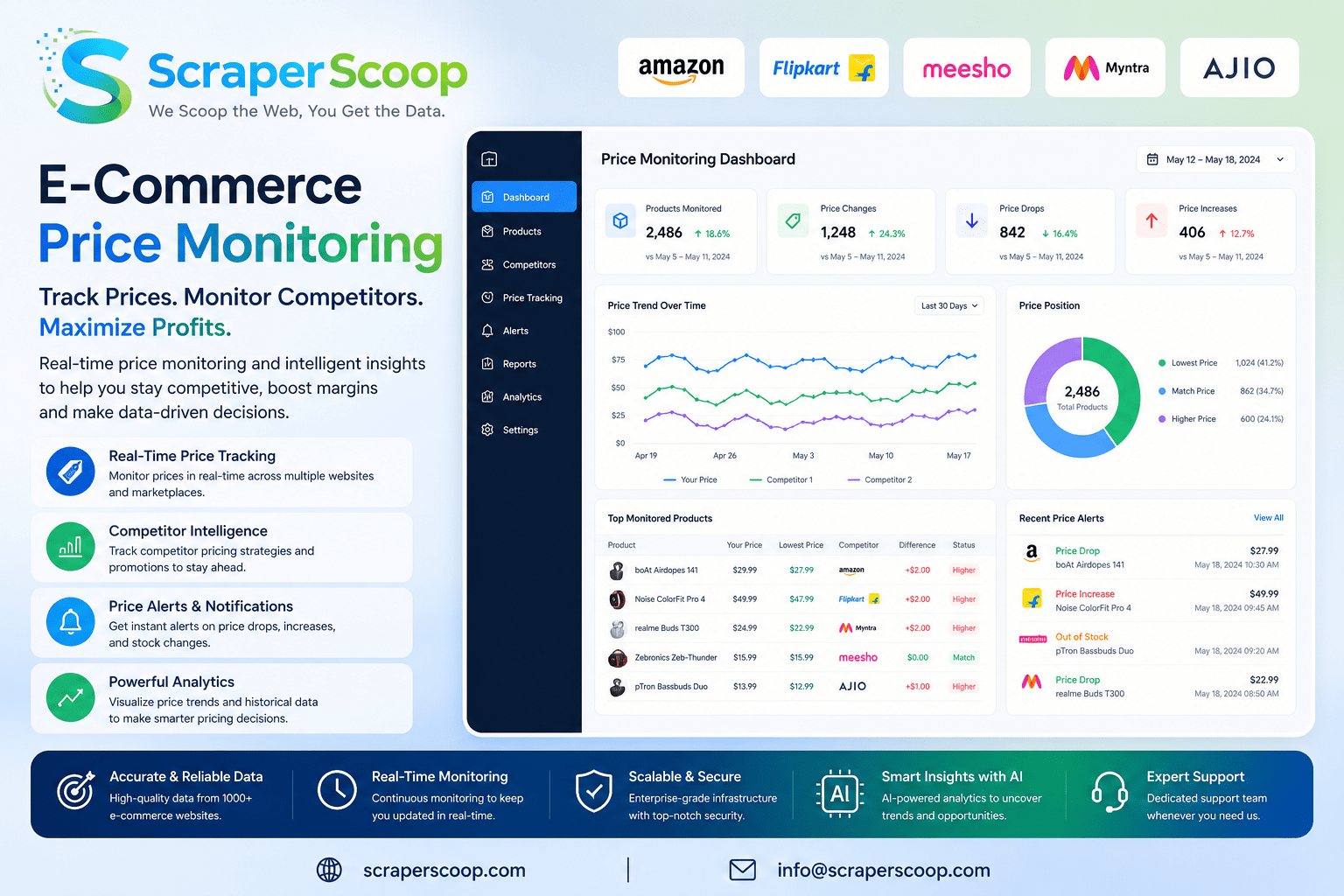
The Core Truth: In e‑commerce, price is the primary purchase driver. A product is a product — what differentiates your sales performance is how intelligently you price it relative to your competitors, demand signals, and channel dynamics. Web scraping gives you the data foundation to make every pricing decision with confidence rather than guesswork.
What E‑Commerce Data Can You Actually Scrape?
E‑commerce platforms are data goldmines. Every product page, every search result, every review contains intelligence that — when collected systematically — transforms how retailers, brands, and marketplace sellers operate. Here's the complete picture:
| Data Category | Specific Fields | Strategic Value |
|---|---|---|
| Product Prices | Current price, list price, sale price, unit price, bundle pricing, subscription pricing | Competitive benchmarking, repricing inputs, promotional analysis |
| Competitor Listings | Product title, brand, MPN, EAN/UPC, description, specifications, images | Assortment gap analysis, content optimization, SKU-level tracking |
| Stock Availability | In‑stock status, backorder status, shipping estimates, restock dates | Supply chain intelligence, competitive advantage, demand forecasting |
| Ratings & Reviews | Average rating, review count, review text, review sentiment, helpfulness votes | Product quality benchmarking, reputation monitoring, SEO content |
| Promotions & Deals | Coupon codes, percentage discounts, BOGO offers, free shipping thresholds, loyalty points | Promotional strategy benchmarking, offer calendar tracking |
| Search Rankings | Organic rank, sponsored rank, featured product badges, best‑seller labels | Visibility intelligence, Amazon SEO, marketplace optimization |
| Marketplace Data | Seller name, seller rating, fulfillment method (FBA/FBM), shipping costs, delivery speed | Seller competitive analysis, fulfillment strategy, customer experience benchmarking |
| Category Trends | Top sellers, trending items, best‑seller rank, newly listed products | Product development, category intelligence, emerging trend detection |
Explore our pre‑built e‑commerce datasets for immediate access to structured data from Amazon, Walmart, eBay, and other major platforms — ready for analysis without any technical setup.
Who Uses E‑Commerce Price Monitoring — And What They Build With It
Price monitoring serves an incredibly diverse ecosystem of retail businesses — from boutique DTC brands to global omnichannel retailers. Here's who's getting the most transformative value:
Omnichannel Retailers
Monitor competitor pricing across online and offline channels. Track price parity between your website and marketplaces. Optimize promotional calendars based on competitor activity.
Brand Manufacturers
Enforce MAP compliance across thousands of retailers and marketplaces. Identify unauthorized sellers. Protect brand equity and margin integrity across all sales channels.
Amazon Sellers & FBA Businesses
Track competitor prices, monitor Buy Box dynamics, optimize repricing strategies, and identify high‑opportunity product categories with favorable competitive dynamics.
DTC E‑Commerce Brands
Benchmark pricing against competitor DTC sites, track retail partner pricing, identify distribution channel conflicts, and optimize direct‑channel promotional strategies.
Market Research Firms
Build category‑level price indices, track inflation impacts on consumer goods, analyze promotional intensity by sector, and provide pricing intelligence to institutional clients.
Retail Investors & Private Equity
Evaluate retail investment targets using real pricing and assortment data, track portfolio company performance against competitors, and identify market share shifts before earnings reports.
Competitive Price Intelligence: The Retailer's Secret Weapon
In retail, pricing is the primary lever for conversion. A well‑priced product can outsell a poorly‑priced one by 3–5x, even when the product itself is identical. And smart pricing starts with knowing exactly what your competitors charge, for every SKU, on every channel, in real time.
That's what competitor price tracking delivers — at a scale and granularity that manual competitive shopping can never match.
What Competitor Price Monitoring Looks Like in Practice
Revenue Impact: A mid‑sized consumer electronics retailer used our competitor price tracking service to monitor 15 competitors across 3,000+ SKUs. They discovered they were consistently 4–7% above the competitive average on high‑volume items. After implementing a dynamic repricing system connected to our real‑time data feed, they increased online conversion by 18% and recovered $2.1M in annual revenue previously lost to competitor undercutting.
Need real‑time competitor price intelligence for your retail business?
Explore Competitor Price Tracking →Dynamic Pricing Strategies Powered by Real‑Time Data
Static pricing is a relic of a pre‑digital era. In 2026, the most successful retailers use dynamic pricing — automatically adjusting prices based on competitor movements, demand signals, inventory levels, and market conditions. And dynamic pricing is only as good as the data that feeds it.
Dynamic pricing data extraction provides the fuel for intelligent repricing algorithms, enabling retailers to capture margin in high‑demand periods and drive volume when demand softens.
Key Dynamic Pricing Applications
- Competitor‑based repricing: Automatically adjust your prices to maintain a target position relative to competitors — for example, always stay within 2% of the lowest price while preserving margin.
- Demand‑based pricing: Track proxies for demand — search volume, inventory depletion rates, competitor out‑of‑stock events — to increase prices when demand spikes and decrease them when demand softens.
- Inventory‑driven pricing: Clear slow‑moving inventory with aggressive price reductions while maximizing margin on high‑demand, low‑availability products.
- Time‑based pricing: Implement algorithmic price changes based on time of day, day of week, or seasonal patterns — for example, slightly higher prices on weekends when conversion intent is stronger.
- Competitive positioning optimization: Rather than just matching the lowest price, dynamic pricing algorithms can strategically position products at different price points to capture both value‑conscious and premium consumers.
Speed Matters: In competitive retail, being 30 minutes behind a competitor's price change means losing hundreds of orders to a rival who reprices faster. Our real‑time data feeds deliver competitor pricing data as fast as it changes — enabling repricing systems that respond in near real‑time.
MAP Monitoring & Brand Compliance
For brand manufacturers, Minimum Advertised Price (MAP) compliance is mission‑critical. When discounters and unauthorized sellers advertise your products below MAP, it erodes brand equity, commoditizes your category, and destroys profitability for your authorized channel partners.
MAP price monitoring systematically scrapes product prices across thousands of retailers — from mega‑marketplaces to boutique e‑commerce sites — to identify violations and protect your brand's pricing integrity.
What MAP Monitoring Reveals
- Violation detection at scale: Manually checking MAP compliance across 100+ retailers is impossible. Automated scraping checks thousands of listings daily, instantly flagging violations so your enforcement team can take action.
- Unauthorized seller identification: When a new seller appears with MAP‑violating prices, our scrapers detect it immediately — often long before it shows up in your distributor reports.
- Marketplace compliance tracking: Amazon, Walmart, eBay, and others have complex MAP enforcement dynamics. Our scrapers track the full picture, including seller‑level details, so you know exactly who is violating where.
- Historical violation records: Build a database of violation events over time — essential for taking action against repeat offenders and building a case for marketplace enforcement mechanisms.
- Competitive pricing intelligence: MAP monitoring also reveals how your products are priced relative to competitor brands, informing your own pricing strategy and channel management.
Our e‑commerce price monitoring solution includes comprehensive MAP tracking across all major platforms and retailers.
Stock Availability & Assortment Tracking
Price isn't the only factor driving e‑commerce conversion — availability is equally critical. When a competitor runs out of stock on a high‑demand product, it creates a golden opportunity for your business to capture that demand.
Scraping stock availability data reveals exactly when competitors are running low or going out of stock, allowing you to respond with targeted promotions, organic search optimization, or even strategic pricing adjustments that capture diverted demand.
Out‑of‑Stock Detection
Monitor competitor inventory levels in real time. When a key competitor goes out of stock on your top‑selling category, it's your opportunity to capture that demand with a targeted marketing push.
Assortment Gap Analysis
Map your product assortment against competitors'. Identify categories where competitors offer products you don't — potential expansion opportunities. Track when competitors introduce new products or discontinue lines.
Supply Chain Intelligence
Broad out‑of‑stock patterns across multiple retailers may signal upstream supply chain disruptions. Early detection allows you to secure inventory or adjust pricing strategies before competitors respond.
Launch Monitoring
Track when competitors launch new products — often signaled by "coming soon" or "out of stock" listings before full availability. Early detection gives you time to plan your competitive response.
Product Review & Sentiment Intelligence
In e‑commerce, reviews are the new word‑of‑mouth. Products with more reviews and higher ratings consistently outperform those with fewer or lower ratings — often regardless of price. Understanding your own reviews is table stakes. Understanding your competitors' reviews is where competitive advantage is built.
Here's what systematic review scraping reveals:
- Competitor quality benchmarks: Analyze competitor ratings, review counts, and sentiment distribution. Products with consistently higher ratings or lower negative feedback signal quality gaps you need to address.
- Feature and specification feedback: Reviews reveal what customers love and hate about competitor products — specific features they praise, problems they encounter, unmet needs they express. This is product development gold.
- Sentiment trends over time: Is a competitor's review score trending up or down? A declining rating trajectory may signal quality issues that could drive their customers to your brand — if you're positioned to capture them.
- Review velocity analysis: How quickly are competitors accumulating reviews? A high velocity suggests strong sales momentum or aggressive review acquisition strategies — both signals worth tracking.
- Content and keyword insights: Review text reveals how customers describe products and their benefits. This directly informs your listing optimization, ad copy, and even product development.
Our review and rating data extraction services capture the complete product review ecosystem across Amazon, Walmart, Best Buy, and hundreds of other retailers.
Getting Started: Your E‑Commerce Price Monitoring Roadmap
Building an e‑commerce pricing intelligence capability doesn't require a massive upfront investment or a team of data engineers. Here's the practical path from zero to actionable intelligence:
- Identify Your Highest‑Value Intelligence Gap What single piece of competitive data would most improve your pricing decisions? For most retailers, it's daily competitor price tracking on their top 100 SKUs. For brands, it's MAP compliance monitoring. For DTC companies, it's retailer price comparison. Start there.
- Choose Your Entry Point Three options: (1) Download pre‑built e‑commerce datasets for immediate market analysis. (2) Deploy our e‑commerce scraping services for on‑demand data extraction. (3) Engage our custom data scraping services for fully customized, ongoing intelligence.
- Define Your Competitive Set & Parameters Which retailers do you need to track? Which SKUs or product categories? What update frequency? Our custom data scraping services configure every parameter to your exact specification.
- Set Up Your Data Pipeline Choose how data flows to your team: API‑based delivery for your repricing system or business intelligence tools, real‑time data feeds for dynamic pricing dashboards, or batch file delivery for periodic analysis. Our data cleaning and structuring services ensure analysis‑ready delivery.
- Automate and Scale Once your initial use case delivers value, expand coverage — add more competitors, more SKUs, more marketplaces, or more data types like reviews and stock availability. Our scheduled scraping services scale effortlessly as your intelligence needs grow.
Ready‑made e‑commerce datasets for instant market analysis
Browse E‑Commerce Datasets →Cross‑Industry Intelligence That Amplifies Retail Research
The most powerful retail intelligence combines e‑commerce data with insights from adjacent industries. Here's how forward‑thinking retailers build holistic market views:
- Social Media & Influencer Intelligence: Social media data scraping reveals trending products, viral content, and influencer activity that drives demand — all early signals of upcoming sales spikes that affect pricing strategy and inventory planning.
- Food & Grocery Intelligence: For CPG brands, food delivery data and grocery data reveal consumption trends, pricing dynamics, and promotional effectiveness in the grocery channel.
- Job Market Signals: Retail hiring trends from job listing scraping on Indeed and LinkedIn signal competitor expansion, new store openings, and category focus — all valuable for strategic planning.
- Real Estate & Location Intelligence: For brick‑and‑mortar retail, real estate data scraping reveals competitor store openings, closures, and expansion patterns — essential for location strategy and market planning.
- Consumer Sentiment & Reviews: Combine e‑commerce review data with broader sentiment analysis data collection to build a complete picture of brand perception across all channels.
For a comprehensive view of cross‑industry intelligence applications, explore our Market Research & Competitive Analysis Solutions and use cases library.
Frequently Asked Questions
Q Which e‑commerce platforms can you scrape for price monitoring?
We support data extraction from all major e‑commerce platforms and marketplaces including Amazon, Walmart, eBay, Best Buy, Target, Home Depot, Lowe's, Wayfair, Etsy, AliExpress, Zalando, ASOS, and thousands of DTC brand websites. Our e‑commerce scraping services are pre‑configured for the most popular platforms, and our team can build custom scrapers for any additional source you need.
Q How frequently can you update pricing data?
For competitive price monitoring, we typically recommend daily scraping — capturing prices for your key SKUs and competitors every 24 hours. For high‑velocity categories or critical promotional periods, we can increase frequency to multiple times per day or even hourly. Our real‑time data feeds support near‑instantaneous delivery for the most time‑sensitive pricing applications.
Q Can you scrape product prices across multiple countries and currencies?
Yes. We support scraping from region‑specific domains and can handle currency conversions, local tax differences, and localized pricing strategies. This is particularly valuable for global brands tracking pricing consistency across markets or for multi‑market retailers optimizing local pricing.
Q Is it legal to scrape competitor pricing data from e‑commerce websites?
We extract only publicly displayed pricing data — the same prices any consumer sees when browsing a product page. This data is displayed publicly to attract purchases and inform shoppers. We don't access private pricing feeds, bypass login walls, or scrape data that isn't intended for public viewing. Professional retail intelligence companies have operated this way for decades, and our approach aligns with established legal precedents regarding public web data. We always recommend consulting legal counsel regarding your specific use case.
Q How do you handle complex pricing — variations, bundles, and subscription pricing?
E‑commerce pricing is often complex with product variations (size, color, style), bundle pricing, and subscription discounts. Our scrapers capture this full complexity — including variations and their associated prices, bundle components and pricing, and subscription vs. one‑time purchase pricing. Our data cleaning and structuring services normalize this into a format that's ready for analysis in your BI tools or repricing systems.
Q I'm a small retailer with a tight budget. Is price monitoring relevant for me?
Absolutely. Start with our pre‑built e‑commerce datasets to understand your competitive landscape — they're affordable and require no technical setup. Even monitoring just 20–30 of your top SKUs against 3–5 key competitors can reveal pricing opportunities that significantly impact your conversion and profitability. As your needs grow, you can scale to fully customized scraping. Contact us to discuss the right starting point for your budget.
Q Can you integrate scraped price data with our repricing or ERP system?
Yes. Our API‑based data delivery is designed for seamless integration with popular repricing tools, ERP systems, business intelligence platforms, and custom applications. We deliver data in formats compatible with virtually any system — JSON, CSV, XML, or direct database push. Our team can assist with integration architecture during your onboarding process.
Conclusion: In E‑Commerce, Pricing Intelligence Is the Competitive Advantage
E‑commerce operates on razor‑thin margins, infinite transparency, and near‑perfect price comparison. Every product that's priced too high loses sales to a competitor who offers better value. Every promotion that misses the market's timing drives minimal incremental volume. Every MAP violation that goes undetected erodes brand value and channel partner trust.
In this environment, pricing intelligence isn't a luxury — it's survival. The retailers, brands, and marketplace sellers that outperform their markets in 2026 are the ones with the best data infrastructure, the freshest competitive intelligence, and the fastest decision‑making cycles.
E‑commerce price monitoring from ScraperScoop provides the data foundation for all of this — from competitor price tracking and dynamic pricing intelligence to MAP monitoring and product review analysis.
The data is publicly available on every e‑commerce platform. Your competitors' prices are displayed right next to yours. The prices are changing right now. The only question is whether you're capturing this intelligence systematically — or competing with incomplete information while your rivals navigate with radar.
Don't leave revenue on the table. Talk to our e‑commerce data experts today and let's build the pricing intelligence system your business needs to compete — and win — in 2026.


