

Food Delivery Data Scraping in 2026: The Complete Guide to Restaurant Intelligence, Menu Extraction, Price Monitoring & Cloud Kitchen Analytics
📑 Table of Contents
- Introduction: The Food Delivery Data Revolution
- What Is Food Delivery Data Scraping?
- The Food Delivery Landscape in 2026
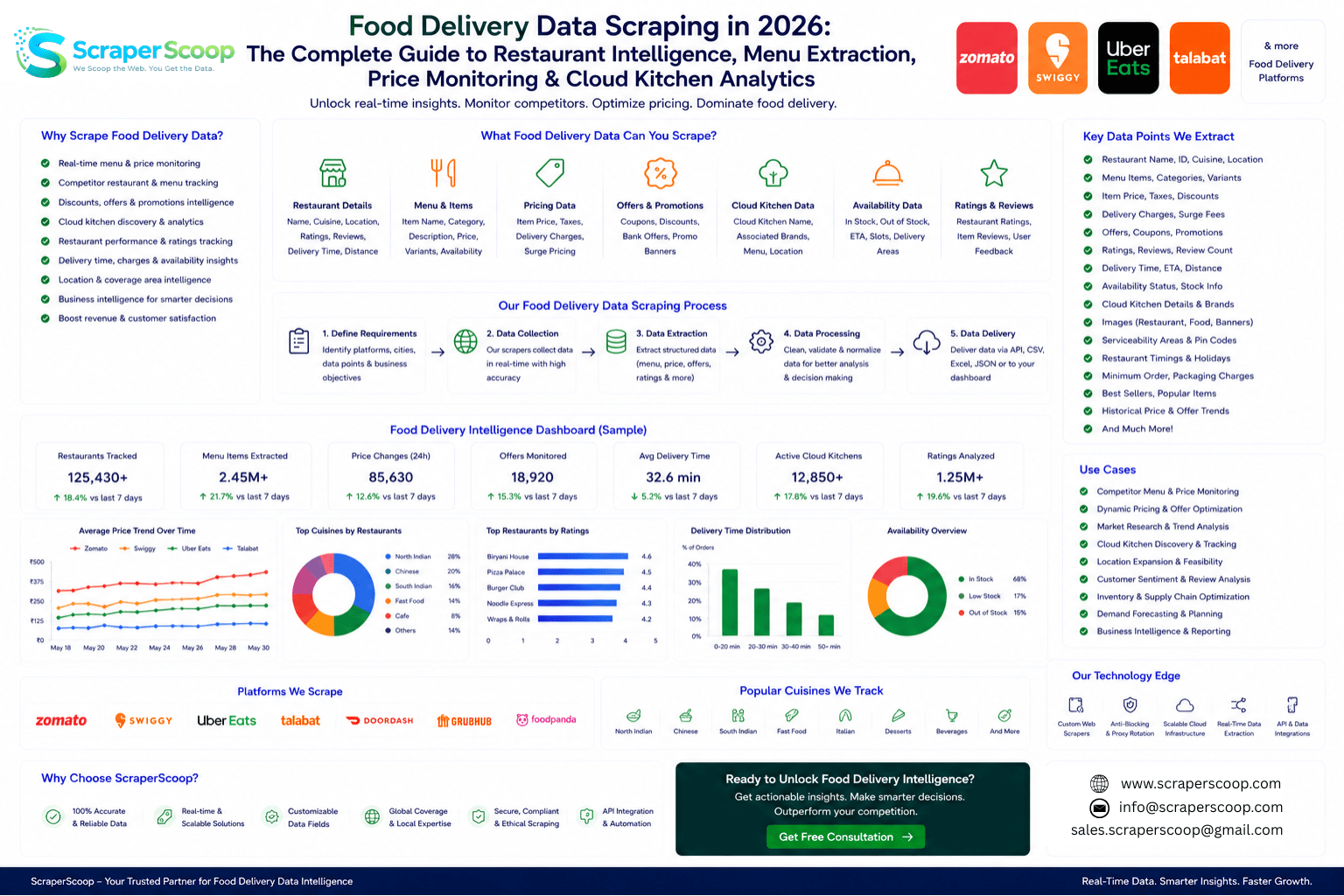
- Types of Food Delivery Data You Can Extract
- Top 10 Use Cases for Food Delivery Data Scraping
- Major Delivery Platforms Compared
- Restaurant Menu Data Extraction: Deep Dive
- Cloud Kitchen & Virtual Restaurant Intelligence
- Challenges & Solutions for Scraping Food Platforms
- Best Practices for Food Delivery Data in 2026
- Why ScraperScoop for Food Delivery Data
- Getting Started: Your Next Steps
- FAQ: Food Delivery Data Scraping
Introduction: The Food Delivery Data Revolution
Consider this: At 11:47 AM on a Tuesday, a cloud kitchen operator in Bangalore notices their chicken biryani orders on Swiggy have dropped 34% compared to last Tuesday. Before they can investigate, their dashboard shows a competitor launched a ₹99 biryani flash deal at 11:30 AM — and it's dominating the search results. The data team was alerted automatically by their food delivery data scraping system. Within five minutes, they've adjusted their pricing, launched a counter-promotion, and recovered visibility.
Now imagine another scenario: a restaurant group planning to expand into Mumbai uses scraped data from Zomato and Swiggy to analyze 5,000 existing restaurants — their cuisines, price points, ratings, delivery times, and order volumes. They identify three underserved neighborhoods with high delivery demand but limited biryani options above ₹300. They open in one of those locations and hit profitability within 8 weeks.
These aren't future scenarios — they're happening right now, every single day, across every major food delivery market in the world. The global online food delivery market is projected to exceed $1.5 trillion by 2027, and the businesses that win are the ones who treat data as their secret ingredient.
This 2000+ word comprehensive guide covers everything you need to know about food delivery data scraping in 2026. Whether you're a restaurant owner optimizing delivery performance, a cloud kitchen operator scaling operations, an investor analyzing the food tech space, or a brand monitoring distribution — this guide is your recipe for data-driven success.
What Is Food Delivery Data Scraping?
Food delivery data scraping is the automated process of extracting structured restaurant, menu, pricing, order, and review data from food delivery platforms like Swiggy, Zomato, UberEats, DoorDash, Deliveroo, and their regional counterparts. Instead of manually browsing thousands of restaurant listings and copying data into spreadsheets, specialized web scraping services use intelligent bots to collect this data at massive scale — fast, accurate, and continuously updated.
Think of it as a digital inspector that visits every restaurant on every platform in your target market, reads every menu, notes every price, records every rating, monitors every promotion, and reports back with clean, structured data — all within minutes.
The extracted data spans restaurant names and locations, full menus with item descriptions and prices, customer ratings and reviews, delivery times and fees, promotional offers, order volume estimates, cuisine classifications, dietary labels, and operational metrics. This data is then cleaned, validated, and delivered through real-time data & APIs or structured formats like CSV, JSON, and Excel.
The Food Delivery Landscape in 2026
The food delivery ecosystem in 2026 is characterized by intense platform competition, rising commission pressures on restaurants, and the explosive growth of cloud kitchens. Here's the global snapshot:
🥡 The Platform Wars Continue
Swiggy and Zomato battle for dominance in India. UberEats and DoorDash compete across North America. Deliveroo and Just Eat Takeaway lead in Europe. GrabFood and Foodpanda dominate Southeast Asia. Each platform has distinct data structures, APIs, anti-scraping measures, and restaurant ecosystems — requiring specialized extraction approaches.
🏪 The Cloud Kitchen Explosion
Cloud kitchens (dark kitchens, virtual kitchens, ghost kitchens) now represent over 25% of delivery-only restaurant listings in major markets. These digital-first operations run entirely on data — optimizing menus, pricing, packaging, and delivery zones based on platform analytics. For these operators, data isn't just useful; it's existential.
Types of Food Delivery Data You Can Extract
Restaurant Profile Data
Names, addresses, coordinates, hours, cuisine types, ratings, total reviews, delivery zones, service types (delivery, pickup, dine-in).
Menu & Item Data
Dish names, descriptions, prices, categories, add-ons/customizations, portion sizes, dietary labels (veg, non-veg, vegan, gluten-free, Jain), combo meals.
Pricing & Promo Data
Menu prices, delivery fees, platform fees, surge pricing, discount coupons, combo deals, happy hour pricing, BOGO offers, and festival promotions.
Reviews & Ratings
Average ratings, review counts, full review text with timestamps, reviewer details, sentiment trends, and rating distributions. Powers brand monitoring & review analysis.
Delivery Logistics Data
Estimated delivery times, delivery partners, minimum order values, packaging fees, distance-based pricing, and GPS delivery zone mapping.
Performance & Demand Data
Order volume estimates, peak hours, popularity rankings ("Bestseller" tags), trending items, search position, and visibility metrics.
Top 10 Use Cases for Food Delivery Data Scraping
Here are the ten most powerful ways businesses use food delivery data scraping to outperform competitors and capture market share:
Menu Pricing Intelligence & Optimization
Monitor competitor menu prices across Swiggy, Zomato, and UberEats in real time. Adjust your own pricing dynamically based on competitor moves, ingredient costs, demand signals, and promotional events. Restaurants using price intelligence & monitoring report 12-25% margin improvements.
Restaurant Menu Engineering
Analyze which dishes drive sales for top competitors, what price points convert best in each category, and which menu gaps exist in your market. Use restaurant menu data scraping to build menus that are optimized for delivery profitability.
Cloud Kitchen Site Selection
Identify optimal cloud kitchen locations by analyzing delivery demand density, existing competition, cuisine gaps, average order values, and delivery radius coverage. Data-driven site selection dramatically reduces the risk of new kitchen launches.
Competitive Benchmarking & Positioning
Track competitor ratings, review volumes, response rates, delivery times, and promotional strategies. Market research & competitive analysis through food delivery scraping reveals exactly where competitors excel and where they're vulnerable.
Customer Review Mining & Sentiment Analysis
Extract thousands of reviews from competitors to identify recurring complaints, popular dishes, service gaps, and customer preferences. Use restaurant reviews dataset services to understand what diners truly want.
Demand Forecasting & Inventory Planning
Analyze order volume trends, seasonal patterns, day-of-week variations, and weather correlations to optimize inventory. Reduce food waste while ensuring you never run out of high-demand ingredients during peak hours.
Brand Distribution & Compliance Monitoring
For restaurant chains and FMCG brands, monitor how your brand appears across delivery platforms. Track unauthorized sellers, verify pricing compliance, and ensure brand consistency across franchise locations.
Promotional Campaign Effectiveness
Track competitor promotional strategies, discount percentages, coupon codes, and festival offers. Measure how promotions impact competitor rankings and order volumes to inform your own promotional calendar.
Investment & Due Diligence
Investors and PE firms use delivery platform data to evaluate restaurant chains, cloud kitchen operators, and food tech startups. Order volumes, ratings trends, and geographic coverage provide real-time performance signals unavailable in financial reports.
New Market Entry Research
Before expanding to a new city or country, scrape local delivery platforms to understand cuisine preferences, price sensitivity, dominant competitors, delivery infrastructure, and consumer expectations.
Major Delivery Platforms Compared
Each platform has unique data characteristics, scraping challenges, and market positions:
| Platform | Region | Key Data | Difficulty |
|---|---|---|---|
| Swiggy | India | Menus, ratings, Instamart, delivery times | High |
| Zomato | India, UAE, SE Asia | Restaurants, menus, reviews, gold, events | High |
| UberEats | Global | Menus, Eats Pass, pricing, delivery fees | High |
| DoorDash | US, Canada, Australia | Menus, DashPass, ratings, group orders | High |
| Deliveroo | UK, Europe, MEA, APAC | Restaurants, Plus, ratings, cuisines | Medium |
| GrabFood | Southeast Asia | Menus, ratings, delivery, GrabUnlimited | Medium |
| Rappi | Latin America | Restaurants, groceries, Prime, delivery | Medium |
| Talabat | MENA region | Restaurants, menus, Pro, delivery | Medium |
ScraperScoop provides specialized food delivery scrapers and pre-built food delivery datasets across all major platforms. For Indian market data, explore our Swiggy data scraping service and Zomato data scraping service.
Cloud Kitchen & Virtual Restaurant Intelligence
Cloud kitchens (also called dark kitchens, ghost kitchens, or virtual kitchens) are the fastest-growing segment in food delivery. These operations run multiple virtual restaurant brands from a single kitchen space, with no physical storefront and no dine-in customers. For these businesses, delivery platform data isn't just helpful — it's how they see the world.
💡 Real-World Example: How a Cloud Kitchen Used Data to 4x Revenue
A multi-brand cloud kitchen in Delhi-NCR came to ScraperScoop wanting to optimize their 7 virtual brands across Swiggy and Zomato. We built a comprehensive monitoring system tracking 500+ competitor restaurants across 12 neighborhoods, capturing menus, prices, ratings, delivery times, and promotional strategies in real time.
The insights were transformative: (1) Their biryani brand was priced 18% below the optimum price point — raising prices actually increased orders because algorithmic ranking improved, (2) A competitor's "free delivery" offer revealed they'd raised item prices by 12% to compensate, (3) The 7-9 PM weekday slot had 40% more demand than they were capturing — extending evening hours captured this demand.
Within 6 months, revenue increased 4.2x, average order value rose 23%, and their top brand reached the Top 5 in its category on both platforms.
This is the power of cloud kitchen data intelligence — it turns intuition into evidence and evidence into growth.
Key Metrics Cloud Kitchens Track
- Same-kitchen brand cannibalization: Are your own virtual brands competing with each other? Data reveals overlap and differentiation opportunities.
- Delivery zone optimization: Which areas have the best balance of order density and delivery time? Scraped data maps demand by pin code.
- Platform algorithm factors: What drives search ranking on Swiggy vs Zomato? Ratings, delivery time, order acceptance rate, pricing, and promotions all factor in differently.
- Virtual brand performance: Track each virtual brand independently even though they share kitchen infrastructure.
Challenges & Solutions for Scraping Food Platforms
Food delivery platforms present unique technical and structural challenges:
Aggressive Anti-Bot Systems
Challenge: Major platforms use sophisticated bot detection including device fingerprinting, behavioral analysis, and CAPTCHA challenges.
Solution: Premium residential proxies with city-level targeting, advanced browser automation, and human-like interaction patterns including realistic scrolling and timing.
Dynamic Real-Time Content
Challenge: Menus, prices, availability, and delivery times update in real time. Restaurants go offline, items become unavailable, surge pricing kicks in.
Solution: High-frequency scheduled scraping with real-time data APIs that capture changes as they happen and push instant alerts.
Geographic Variation
Challenge: The same restaurant chain shows different menus and prices by location. Platforms serve different data based on delivery address.
Solution: Multi-location scraping from diverse geographic vantage points with pincode-level data capture for complete market coverage.
Multi-Language Data
Challenge: Restaurant names, menus, and reviews appear in local languages (Hindi, Arabic, Thai, Spanish, Portuguese) depending on market.
Solution: Unicode-aware extraction with proper encoding, multilingual NLP for review analysis, and language-preserving data pipelines.
Complex Data Hierarchies
Challenge: Food menus are deeply nested structures with categories, items, variants, add-ons, combo deals, and time-specific offerings.
Solution: Structured JSON/CSV output preserving full menu hierarchy with all nested relationships intact — ready for database ingestion.
Platform Terms & Compliance
Challenge: Navigating platform terms of service and local data protection laws while extracting market intelligence.
Solution: Ethical scraping focused on publicly available data, rate limiting, and GDPR-compliant data handling practices.
Best Practices for Food Delivery Data in 2026
Scrape by Pin Code / Delivery Zone
Food delivery data is inherently geographic. The same restaurant shows different data based on the delivery address. Structure your scraping around pin codes or delivery zones, not just cities. This gives you granular demand mapping.
Capture Time-Varying Data Separately
Prices change during promotions, delivery times shift during peak hours, and menus vary by meal period. Timestamp every data point and track temporal variations explicitly. Lunch menu data collected at noon is different from dinner menu data at 8 PM.
Cross-Reference Multiple Platforms
Most restaurants operate on 2-3 platforms simultaneously. The same dish might be priced differently on Swiggy vs Zomato vs UberEats. Cross-platform comparison reveals pricing strategies and platform-specific optimization tactics.
Combine Reviews with Operational Data
Ratings without context aren't enough. Combine review sentiment data with delivery times, pricing, and menu structure to understand the full picture. A 3.8 rating with fast delivery tells a different story than a 3.8 rating with 90-minute wait times.
Track Promotional Intensity, Not Just Price
Many restaurants don't change base prices — they run promotions. Monitor discount percentages, coupon codes, BOGO offers, and "free delivery" promotions separately from regular pricing to understand true competitive dynamics.
Build Historical Datasets for Trend Analysis
One-time data snapshots have limited value. Build continuous data collection to track trends over weeks, months, and quarters. Seasonal patterns, festival impacts, and competitive responses become visible only with historical data.
Why ScraperScoop for Food Delivery Data
ScraperScoop provides specialized food delivery data extraction built specifically for the complex dynamics of delivery platforms:
Platform-Specific Scrapers
Dedicated scrapers for Swiggy, Zomato, UberEats, DoorDash, Deliveroo, GrabFood, Rappi, and 20+ platforms worldwide.
Real-Time Monitoring
Sub-hourly menu, price, and availability monitoring with instant alerts for competitor changes and promotional events.
Menu-Aware Extraction
Complete menu hierarchy preservation — categories, items, variants, add-ons, combos, and time-specific menus all captured correctly.
Global Coverage
Data from 50+ countries across India, North America, Europe, Southeast Asia, MENA, and Latin America.
Ready-to-Use Datasets
Browse our food delivery datasets and featured datasets for instant download and analysis.
Cloud Kitchen Expertise
Specialized cloud kitchen data intelligence built by teams that understand multi-brand kitchen operations.
Ready to Transform Your Food Business with Data?
Whether you need menu price monitoring, restaurant competitive intelligence, cloud kitchen analytics, or a fully customized food delivery data pipeline — ScraperScoop delivers.
✅ Free sample data · ✅ No credit card required · ✅ Response within 2 hours
Getting Started: Your Next Steps
Define Your Data Goals
Are you monitoring competitor prices? Analyzing a new market? Optimizing a cloud kitchen? Researching investment opportunities? Start with the business decision, not the data points.
Identify Platforms & Geography
Which platforms matter in your market? Swiggy and Zomato for India, UberEats and DoorDash for North America? Which cities or neighborhoods? Define the scope clearly.
Choose Your Delivery Method
Ready-made datasets for instant insights? Custom data scraping services for ongoing monitoring? Real-time APIs for integration with your existing systems?
Talk to Our Food Data Experts
Contact us for a free consultation. We understand food delivery platforms because we work with them every day. Get a free sample dataset to validate quality before you commit.
FAQ: Food Delivery Data Scraping
Is it legal to scrape food delivery platforms like Swiggy and Zomato?
Scraping publicly available restaurant listings, menus, prices, and ratings from food delivery platforms is generally legal, as this data is displayed publicly to all users. However, accessing private APIs, user accounts, or personal data is not permitted. ScraperScoop focuses exclusively on publicly available data and follows ethical, GDPR-compliant scraping practices.
How frequently can food delivery data be updated?
We offer real-time updates (every 15-30 minutes) for price and availability monitoring, hourly for menu and review data, and daily or weekly for market analysis and competitive landscape tracking. Most cloud kitchen operators opt for real-time pricing alerts and daily full-catalog scrapes.
Can you extract order volume data from delivery platforms?
Platforms don't display exact order counts publicly, but we can extract strong proxy signals including "Bestseller" tags, popularity indicators, search ranking positions, review velocity, and delivery time patterns that correlate strongly with order volume. These signals, combined across multiple data points, provide reliable demand estimates.
What data formats and delivery methods do you support?
Data is delivered in CSV, JSON, Excel, and Parquet formats, plus real-time API access with webhook integrations. We can push data directly to your cloud storage (S3, GCS), data warehouse (Snowflake, BigQuery), or internal dashboard systems.
How much does food delivery data scraping cost?
Pricing varies based on platforms covered, number of restaurants tracked, update frequency, and data complexity. We offer free sample datasets for quality validation and custom quotes based on your specific needs. Contact us for a tailored proposal — we respond within 2 working hours.
🍽️ Serve Better Decisions with Better Data
Start Extracting Food Delivery Intelligence Today
Every day without food delivery data is a day your competitors are optimizing their menus, prices, and promotions. Let ScraperScoop give you the ingredient that makes all the difference.
Get Your Free Consultation Now →

