

Introduction: The Travel Industry Runs on Real-Time Data — Are You Keeping Up?
Picture this: it’s 9:43 AM on a Tuesday. A major airline on your top route quietly drops its business class fare by 18%. Three OTAs pick it up within minutes and update their listings. Your platform? Still showing yesterday’s data. By lunchtime, you’ve lost hundreds of potential bookings to competitors who responded faster — not because they have a bigger team, not because they have a better product — but because they had better, fresher data.
This scenario isn’t hypothetical. It plays out thousands of times every single day across the global travel industry. And the only antidote is a continuous, automated, real-time flow of competitive travel intelligence powered by expert-grade travel data scraping.
The scale of what’s at stake here is breathtaking. The global online travel market is projected to reach USD 761.5 billion in 2026, growing toward USD 1.4 trillion by 2035 at a CAGR of 7.4%. The Online Travel Agent market alone is valued at USD 561.30 billion in 2026, on track to reach USD 761.33 billion by 2031. And more than 70% of all global travel sales now happen online — a market where prices change by the minute, booking windows are shrinking, and customers are doing more comparison shopping than ever before.
In a market this dynamic, operating without automated data intelligence isn’t just inefficient. It’s commercially dangerous.
Whether you’re an airline managing fare classes across dozens of routes, a hotel group monitoring rate parity across hundreds of OTA channels, a travel tech startup building the next-generation booking platform, or a tour operator assembling competitive vacation packages — this guide is written for you. We’ll break down everything you need to know about travel data scraping in 2026: what it is, why it matters, what data you can collect, how the best businesses in travel use it, and exactly how ScraperScoop can power your competitive intelligence from day one.
What Is Travel Data Scraping and How Does It Work?
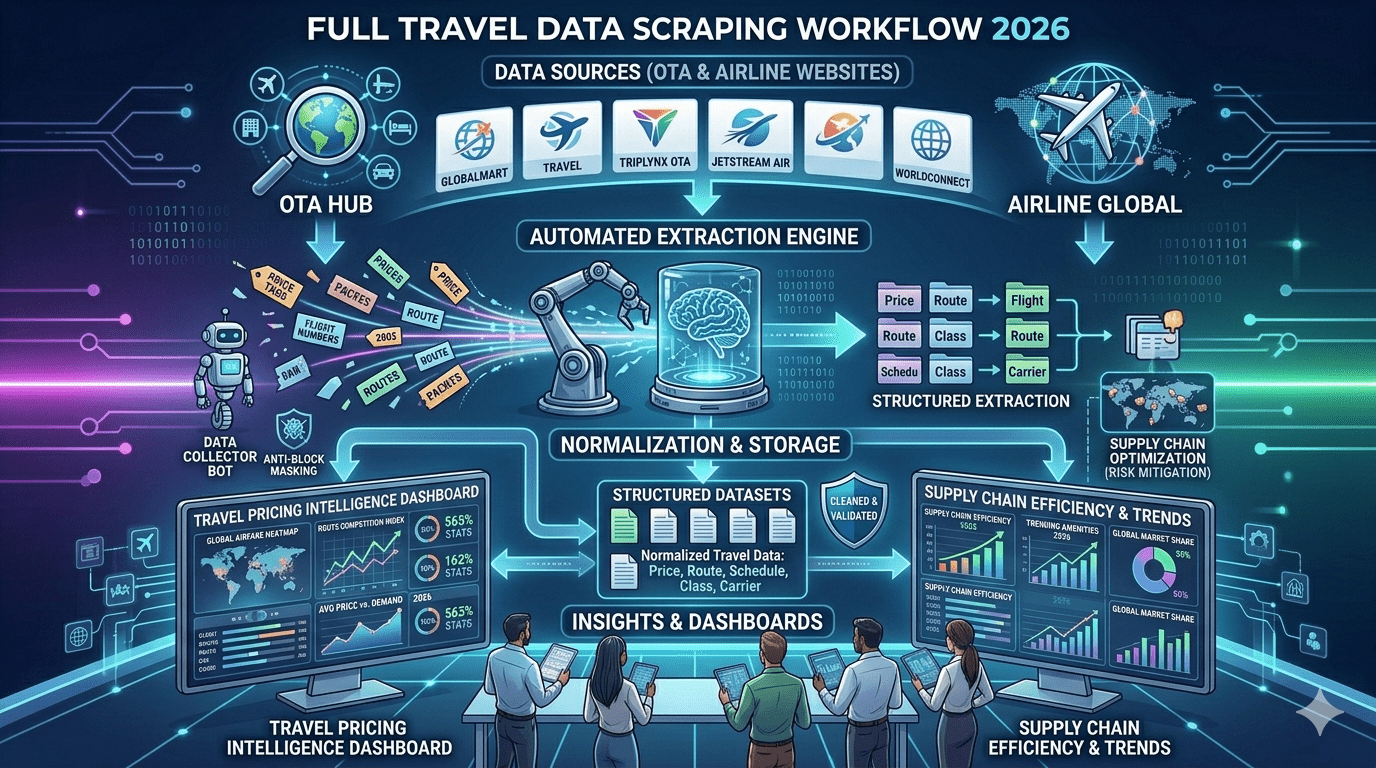
Travel data scraping — also called travel data extraction — is the programmatic collection of publicly available pricing, availability, and demand information from OTAs, airline booking engines, metasearch platforms, hotel brand websites, vacation rental portals, and review aggregators.
In plain language: automated systems visit travel websites continuously, parse out the data fields you care about — prices, availability, routes, ratings, cancellation policies, promotional offers — and deliver that information to you in a clean, structured, analysis-ready format. No manual searching. No copy-paste spreadsheets. No stale data from last week’s check.
Why the Travel Industry Is a Uniquely Data-Intensive Environment
No other industry combines the pricing velocity, inventory complexity, and consumer comparison behavior of travel. Consider just a few dimensions of what makes travel data so challenging — and so valuable:
- Pricing changes happen in real time, continuously. Airlines reprice tickets hundreds of times daily. Hotels change their room prices according to local events, occupancy levels, and competitors’ actions. Online travel agencies update package deals every few minutes. If your pricing team still relies on manual checks or slow internal reports, you’re already behind.
- Market concentration is extreme. Booking Holdings (Booking.com, Priceline, Agoda) and Expedia Group together hold approximately 65% of the global OTA market share. Understanding and monitoring how these dominant platforms price, package, and promote travel products is not optional for anyone competing in this space.
- Booking windows are compressing. Nearly 40% of all trips are booked less than a month before departure — meaning demand signals in the market are increasingly short-lived, and businesses need to respond to price and availability intelligence in hours, not days.
- Mobile has taken over. More than 63% of all online travel bookings are made via mobile devices. Airbnb reported that 64% of its Q4 2025 bookings were made via mobile apps — which means platforms need mobile-aware pricing and availability strategies informed by mobile-specific data.
- Consumers are relentless comparison shoppers. The average traveler visits multiple platforms before booking, cross-referencing prices across airlines, OTAs, and hotel direct sites. Being consistently out-of-position on price — even by a small margin — means losing bookings to competitors who are monitoring the same market more accurately.
Travel data scraping has become the backbone of modern revenue strategy — giving companies the ability to monitor thousands of data points automatically, continuously, and at scale. It is the infrastructure that powers competitive pricing, demand forecasting, package optimization, and rate parity compliance across the entire travel industry.
What Travel Data Can You Actually Scrape? A Full Breakdown
Travel websites are among the richest data environments on the internet. The scope of intelligence available through automated extraction covers virtually every commercial decision a travel business makes. Here’s what’s available — and why each data type matters.
1. Flight Data
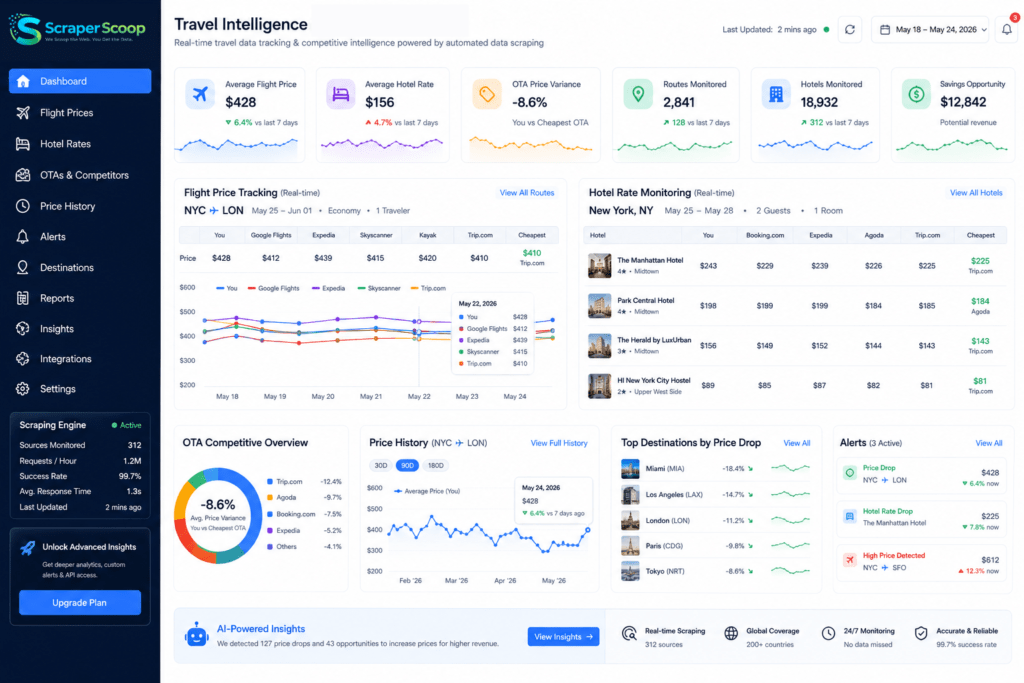
Flight data extraction covers flight schedules, pricing tiers, seat availability, fare class structures, layover details, airline names, and departure and arrival times across airlines and OTAs — enabling fare fluctuation monitoring and the data backbone for comparison engine development. This includes tracking economy, premium economy, business, and first-class pricing across routes, booking windows, and travel dates — the full matrix of fare intelligence that airlines and OTAs use to optimize yield management.
2. Hotel Rate Data
Hotel and rental intelligence covers room pricing, occupancy trend signals, amenities listings, cancellation policies, and competitor benchmarking data from both direct hotel websites and OTA channel listings. This is the foundation for dynamic pricing models, rate parity monitoring, and competitive positioning strategies for hotels and hospitality businesses of every scale.
3. Vacation Rental & Short-Term Rental Data
For Airbnb hosts, property managers, and real estate investors evaluating STR potential, scraping vacation rental platforms provides listing prices, nightly rates, availability calendars, host ratings, and property details for the short-term rental market. This data powers everything from individual host pricing optimization to investment analysis for STR acquisition strategies.
4. OTA Promotions & Deal Data
Online travel agencies update package deals and promotional pricing continuously. Systematically scraping OTA promotion pages, flash deal sections, and bundled package offers gives travel businesses the intelligence they need to respond to competitor promotions proactively — protecting market share during high-promotion periods like school holidays, major events, and peak travel seasons.
5. Guest Reviews & Sentiment Data
Guest reviews, ratings, sentiment signals, and response data from platforms like TripAdvisor, Booking.com, and Google Reviews can be collected at scale to benchmark your property or track competitors. Sentiment analysis of thousands of competitor reviews reveals the specific service dimensions your marketing can directly exploit — and the quality gaps that represent the most persuasive differentiators for your own properties.
6. Destination Trend & Tourism Demand Data
Scraped data from booking platforms, travel blogs, and metasearch engines tracks emerging destination popularity, booking volume growth by location, and seasonal demand patterns. Data-driven insights derived from millions of travel listings, reviews, pricing patterns, and booking behaviors are guiding travel business decisions about which markets to enter, which routes to launch, and which destinations to promote in marketing campaigns.
7. Car Rental & Ground Transportation Data
Car rental availability, pricing by vehicle category, location coverage, and promotional offers from major providers all represent valuable competitive intelligence for travel platforms building comprehensive trip-planning tools and for ground transportation operators monitoring their competitive position in key markets.
8. Metasearch & Aggregator Data
Metasearch platforms like Google Flights, Skyscanner, Kayak, and Trivago aggregate prices across hundreds of sources — making them extraordinarily valuable data sources for understanding the full market pricing landscape. Tracking how prices appear on metasearch engines versus direct channels is critical for both airlines and hotels managing their distribution strategy and rate consistency.
Flight Price Tracking: The Revenue Management Intelligence Airlines Can’t Afford to Ignore
Among all travel data scraping applications, flight price tracking is arguably the most commercially impactful — and the most technically demanding. Let’s dig into how it works and why it’s the heartbeat of modern airline revenue management.
Why Flight Pricing Is the Ultimate Dynamic Pricing Challenge
Airline pricing is among the most sophisticated dynamic pricing environments in any industry. A single seat on a single flight can be priced dozens of different ways depending on booking window, demand signals, competitor availability, day of week, time of day, fare class, loyalty program status, and the specific device the customer is using to search. Airlines reprice tickets hundreds of times daily — and OTAs that can monitor those changes in near real-time gain a powerful advantage in driving traffic and bookings.
What Flight Price Scraping Captures
A well-built flight data extraction system tracks flight prices across search results and route pages — capturing fares, layover details, airline names, and departure times at scale. More specifically, this means monitoring one-way and round-trip fares across every competitor airline on each route you serve, fare class breakdowns from economy through first class, baggage fee structures and ancillary pricing, seat availability signals that indicate how aggressively a competitor is pricing to fill inventory, and booking window pricing patterns that reveal competitor revenue management strategies.
Forward Demand Modeling
Beyond simple price monitoring, airlines and travel agencies combine flight fare tracking data with booking window patterns to build forward demand models that outperform internal historical averages. This is most critical during irregular periods — big sporting events, sudden route changes by competitors, or after-crisis travel recovery windows — where historical baselines are unreliable and real-time market signals are the only accurate guide.
In 2026, 57% of all travelers plan to book around sporting events, with 65% of top-searched travel dates aligning with global events like the FIFA World Cup and cultural festivals. For airlines and OTAs, detecting and responding to these demand spikes before they’re fully reflected in booking volumes is where real revenue optimization happens — and it depends entirely on fresh, continuously updated flight price data.
The OTA Perspective on Flight Data
For OTAs and flight comparison platforms, real-time flight price scraping is literally the product. Users come to these platforms expecting to see the cheapest available fare for any given route — and delivering that experience requires comprehensive, fresh data from hundreds of airline and booking sources updated continuously. Travel startups use flight data APIs to power price comparison features, booking widgets, and recommendation engines — without spending months building scrapers themselves.
Hotel Rate Monitoring: The Hospitality Industry’s Most Powerful Revenue Tool
For hotels, resorts, and hospitality groups, rate intelligence — knowing what every competitor is charging across every distribution channel, updated continuously — is the foundation of effective revenue management. And in 2026, that intelligence comes almost exclusively from automated hotel rate monitoring powered by web scraping.
The Rate Parity Challenge
For hotel groups managing dozens or hundreds of properties, rate parity — ensuring pricing consistency across all distribution channels — is both a commercial priority and a contractual requirement with many OTA partners. Hotel price scraping gives hotel brands direct visibility into whether OTA distribution partners are selling below contracted rate floors — a compliance issue that, unmonitored, erodes both direct booking revenue and brand pricing integrity.
Competitive Rate Intelligence in Practice
Revenue managers set pricing rules. The system executes them in real time without requiring manual intervention on every rate change. Hotels in event-heavy markets and those in highly competitive destination markets get the most immediate impact from this setup. The result is a pricing operation that responds to the market continuously — adjusting rates in response to competitor moves, demand signals, and occupancy patterns without burdening the revenue management team with constant manual monitoring.
The data flowing into these systems comes directly from OTA rate scraping — pulling rates, availability calendars, room types, and amenity data from the largest OTAs in real time. This enables hotels to see not just what competitors are charging today, but to analyze patterns over time: when do competitors drop rates before major holidays? How aggressively do they discount during low occupancy periods? What’s the typical lead-time between a rate change and a competitor’s response? These patterns are the raw material of superior revenue strategy.
Market Entry & Investment Analysis
Hotel rate scraping extends well beyond operational pricing decisions. Before committing capital to a new market, hotel operators extract historical rate data, competitor density figures, and occupancy proxy signals from scraped sources. Research that previously required weeks of consultant analysis now takes three to four business days with structured travel data scraping in place — a dramatic acceleration of the strategic decision cycle that delivers significant competitive advantage in fast-moving markets.
Package Pricing for Tour Operators
Travel agencies use data extracted across hotels, flights, and ancillary categories to build package offers that are competitively priced without margin sacrifice. All source data refreshes on a consistent schedule, so bundles reflect current market conditions rather than rates that were accurate last week. Tour operators combining hotel, flight, and car rental data can build optimally priced packages — consistently undercutting standalone OTA bookings while maintaining strong margins on the aggregate package value.
OTA Data Scraping: How Travel Tech Companies Build Data Moats
For Online Travel Agencies, travel tech startups, and metasearch platforms, the ability to collect, process, and act on comprehensive OTA data is not just a competitive advantage — it is the product itself.
Building a Comprehensive OTA Intelligence Stack
The top help businesses collect hotel rates, flight prices, availability data, reviews, destination insights, and competitor intelligence from OTAs across every major travel market. A comprehensive OTA intelligence stack built on systematic data scraping gives travel tech companies the following capabilities:
- Price comparison accuracy: Showing users the genuinely best available price across all platforms — not just the platforms that have paid for premium placement.
- Availability confidence: Ensuring that availability signals shown to users reflect real-time inventory, not cached or stale data that leads to frustrated booking failures.
- Promotional intelligence: Detecting and surfacing deals, flash sales, and limited-time offers the moment they appear across competitor OTAs.
- Review and reputation monitoring: Tracking sentiment patterns across competitor properties and building trust signals into the platform experience.
- Destination trend detection: Identifying emerging demand signals before they hit mainstream awareness — powering recommendation engines with fresh, data-backed destination intelligence.
Investment Intelligence via OTA Scraping
Investment firms and analysts use OTA pricing data as a leading indicator for occupancy trends, tourism demand, and hotel asset valuations across geographies. City-level occupancy and pricing trend reports, seasonal demand heatmaps for different market tiers, and historical data going back twelve or more months for trend analysis — all derived from systematically scraped and aggregated OTA data — provide a layer of alternative data intelligence that sophisticated travel investors use to gain an edge over those relying exclusively on lagging indicators.
Search Trend Correlation and Forward Signals
Pairing scraped rate data with publicly available search interest data surfaces emerging demand before it fully reaches pricing. Internal reports reflect history. These signals reflect what the market is doing right now and, more usefully, what it is likely to do next. This distinction — between descriptive intelligence and predictive intelligence — is where the most sophisticated travel data operations are building their competitive moats in 2026.
Whether you’re a travel startup looking to power your comparison engine or an established OTA aiming to stay ahead of competitors, reach out to ScraperScoop’s data experts to discuss a custom travel data scraping solution built specifically for your competitive intelligence needs.
8 High-Impact Travel Data Scraping Use Cases Driving Revenue in 2026
1. Airline Yield Management & Route Optimization
Real-time pricing data allows airline companies to understand market demand and improve demand management based on current market conditions. Scraped competitor fare data feeds directly into automated pricing engines — enabling airlines to price each seat on each flight with maximum precision, adjusting in response to competitor moves and demand signals without requiring manual revenue manager intervention on every fare change. For routes with multiple competing carriers, this intelligence is the difference between consistently strong load factors and empty seats sold at last-minute distressed rates.
2. Hotel Revenue Management & Rate Parity Compliance
Scraped competitor rate data feeds into automated pricing engines that adjust rates continuously based on real market conditions — a revenue management capability that hotels in event-heavy markets experience as immediate, measurable revenue impact. Simultaneously, rate parity monitoring ensures OTA distribution partners are selling within contracted rate floors — protecting both direct booking revenue and brand pricing integrity across all distribution channels.
3. Vacation Rental Host & Property Manager Pricing
Individual Airbnb hosts and professional short-term rental property managers use scraped competitor listing data to optimize nightly rates across seasons, local events, and demand windows. Monitoring listing prices, nightly rates, availability calendars, host ratings, and property details for the short-term rental market in their specific area provides the competitive context needed to price confidently — neither leaving money on the table during peak demand nor pricing above market during slower periods.
4. Competitive Package Pricing for Tour Operators
Travel agencies and tour operators use extracted data across hotels, flights, and ancillary categories to build package offers that are competitively priced without margin sacrifice. This allows operators to consistently undercut standalone OTA bookings on aggregate package value — a compelling differentiator that drives booking preference without requiring the scale advantages of the major OTA platforms.
5. Travel Startup & Comparison Platform Development
Travel startups use travel data APIs to power price comparison features, booking widgets, and recommendation engines — without spending months building scrapers themselves. For tech founders building in the travel space, partnering with a managed travel data scraping provider dramatically compresses the time-to-market for core product features and eliminates the ongoing engineering overhead of maintaining scrapers across dozens of frequently-changing travel platforms.
6. Destination Trend Intelligence & Tourism Marketing
By leveraging structured datasets — including booking volumes, seasonal spikes, and traveler preferences across regions — travel companies can analyze booking volumes, identify seasonal spikes, and understand traveler preference patterns across regions. Marketing teams use destination data to create targeted campaigns aligned with genuine emerging demand — not lagging indicators from last season’s reports. If a destination shows rising interest among a specific demographic, campaigns can be tailored to highlight the exact experiences and features that data shows are driving that interest.
7. Guest Review Monitoring & Reputation Intelligence
Guest reviews and ratings from across platforms like TripAdvisor, Booking.com, Expedia, and Google Reviews provide a continuous stream of competitive intelligence about service quality, amenity perceptions, and guest satisfaction trends. Collecting guest reviews, ratings, sentiment signals, and response data to benchmark your property or track competitors reveals patterns that individual review monitoring cannot surface — and informs product improvements, service investments, and marketing positioning decisions that would otherwise require expensive primary research.
8. Corporate Travel & Business Intelligence
For corporate travel management platforms and business intelligence firms, scraping comprehensive travel pricing data across hotel chains, airlines, and ground transportation providers builds the market intelligence that powers policy recommendations, preferred supplier negotiations, and travel program benchmarking. Travel data extraction supports distinct commercial functions across the corporate travel industry — from feeding automated booking recommendations to informing strategic sourcing decisions that reduce overall corporate travel costs.
Why Travel Data Scraping Is Technically Complex — And How Experts Solve It
Let’s be completely honest: travel data scraping is among the most technically challenging scraping domains that exists. The combination of sophisticated anti-bot defenses, JavaScript-heavy booking engines, location-based pricing variations, and constantly changing site structures makes travel platforms some of the hardest targets on the internet. Here’s what makes it genuinely difficult — and how professional solutions address each challenge.
Challenge 1: Sophisticated Anti-Bot Defenses
Travel portals run some of the toughest anti-bot stacks in production. Major OTAs and airline booking engines employ adaptive CAPTCHAs, IP rotation detection, behavioral fingerprinting, and browser environment validation that requires professional-grade countermeasures. Reliable travel data scraping at scale requires a purpose-built technical stack — specifically headless browser engines that handle JavaScript-dependent booking pages and rotating residential proxy networks that maintain session continuity across high-volume collection without triggering IP-based blocking.
Challenge 2: Dynamic JavaScript Rendering
Many travel websites use dynamic pricing, location-based results, JavaScript rendering, pagination, login flows, and frequent layout changes that make standard HTTP-based scraping completely ineffective. The right approach requires browser automation tools that render JavaScript and interact with dynamic pricing widgets, calendar pickers, and multi-step booking flows just as a real user would — accessing the full richness of the available data rather than just the static HTML shell.
Challenge 3: Geo-Targeted and User-Specific Pricing
Travel platforms frequently adjust results based on location, session history, and device type. A flight search from New York may return different prices than the same search from London — and prices shown to logged-in loyalty program members often differ from those shown to anonymous visitors. Advanced setups handle dynamic content loading, location-based pricing, and multi-language platforms to ensure the data collected reflects the full range of prices actually available to travelers. It is also important to account for geo-based pricing differences and simulate realistic user behaviors when collecting travel data.
Challenge 4: Data Freshness and Scheduling Complexity
Since travel websites update frequently, scraping systems often run on schedules to ensure data freshness and accuracy. Determining the right refresh cadence for each data type — real-time for flight prices on competitive routes, hourly for hotel rates during peak booking periods, daily for destination trend data — requires both technical infrastructure and domain expertise. Getting this wrong means either paying for more scraping capacity than you need, or missing price changes fast enough to impact bookings.
Challenge 5: Data Normalization Across Sources
To ensure high-quality travel datasets, it’s critical to normalize pricing formats, remove duplicates, and validate availability across multiple sources. A hotel room listed on Booking.com, Expedia, and the hotel’s direct website will likely appear with slightly different room type descriptions, price structures, and cancellation policy formats. Professional data services handle all of this normalization automatically — delivering clean, standardized, cross-source comparable datasets rather than raw data that requires hours of post-processing.
Challenge 6: Scale and Infrastructure Costs
For a travel business that needs to monitor thousands of routes, hundreds of hotel markets, or dozens of OTA platforms continuously, the infrastructure cost of building and running this in-house is substantial. As travel businesses expand across markets, they need more destinations, currencies, languages, data sources, and refresh schedules — requirements that compound rapidly and can overwhelm in-house engineering capacity. Partnering with a managed data provider eliminates this infrastructure overhead entirely.
All of these challenges explain why the most successful travel businesses across airlines, hotel groups, OTAs, and travel tech startups are moving rapidly toward managed travel data scraping services rather than maintaining complex in-house scraping infrastructure. Get in touch with ScraperScoop today — our team has built the infrastructure, solved all the hard technical problems, and delivers ready-to-use travel datasets so you can focus entirely on competitive strategy and revenue optimization.
Key Travel Platforms and Data Sources You Should Be Monitoring
Understanding which travel platforms carry the most strategic weight for your specific business model is essential for building an effective competitive intelligence strategy. Here’s the landscape of key data sources for travel market intelligence in 2026.
OTA Giants: Booking Holdings & Expedia Group
Booking Holdings (Booking.com, Priceline, Agoda) and Expedia Group together hold approximately 65% of the global OTA market share. Monitoring pricing, availability, promotional strategies, and customer review patterns across these platforms is not optional for any travel business — it’s the baseline. These platforms set the effective market price for most accommodation and flight categories globally, making them the primary reference point for any competitive pricing strategy.
Airbnb & Vacation Rental Platforms
Airbnb operates in 220+ countries across 7+ million listings and is one of the most downloaded travel apps globally. For anyone competing in the short-term rental or alternative accommodation market, monitoring Airbnb pricing, availability, host ratings, and property features is essential competitive intelligence. The platform’s mobile dominance — with 64% of Q4 2025 bookings made via mobile apps — makes mobile-aware rate monitoring particularly important.
Metasearch Platforms
Google Flights, Skyscanner, Kayak, and Trivago aggregate prices across hundreds of sources and represent how most price-comparison-savvy travelers see the market. Monitoring how your prices appear on metasearch versus how competitor prices appear provides critical distribution intelligence that informs both pricing strategy and channel management decisions.
Review Aggregators
TripAdvisor, Google Reviews, and platform-specific review sections (Booking.com reviews, Expedia verified reviews) are the primary sources for hospitality sentiment intelligence. Over 80% of travelers in 2025 used social media platforms to research destinations and share experiences — making review and social sentiment data increasingly important for understanding competitive positioning and identifying service improvement priorities.
Direct Airline and Hotel Websites
Direct channel monitoring is often overlooked in favor of OTA scraping, but it’s critically important. Hotels and airlines are increasingly pulling customers toward direct bookings through perks like exclusive rates and loyalty rewards — and the pricing strategies deployed on direct channels often differ significantly from OTA channel pricing. Understanding direct channel pricing across competitors is essential for a complete market intelligence picture.
Regional and Emerging OTAs
Trip.com Group (dominant across Asia), MakeMyTrip (India), Klook (Southeast Asia), and dozens of regional specialists are gaining share in high-growth markets. Asia Pacific held 38.3% of the online travel agency market share in 2025 and is projected to grow at 6.8% through 2031 — making regional OTA intelligence increasingly important for travel businesses with international ambitions.
The Proven ROI of Travel Data Scraping: Where the Value Gets Created
For a market where every percentage point of occupancy, every fraction of a percentage point of yield improvement, and every basis point of market share matters enormously — the financial case for travel data scraping is exceptionally strong. Here’s how the value gets created across different travel business models:
For Airlines
- Yield optimization: Real-time competitor fare monitoring enables dynamic pricing responses that consistently improve revenue per available seat mile — the fundamental metric of airline financial performance.
- Demand forecasting: Combining flight fare tracking data with booking window patterns to build forward demand models that outperform internal historical averages — particularly critical during irregular demand periods around major events.
- Route strategy: Scraped competitive data reveals where competitors are aggressively pricing to build market share, where they’re pulling back, and which routes represent the best opportunities for expansion or tactical pricing to protect share.
For Hotels & Hospitality Groups
- Revenue per available room (RevPAR) improvement: Continuous competitive rate monitoring enables pricing decisions that consistently position properties at optimal rates relative to the market — maximizing both occupancy and average daily rate simultaneously.
- Rate parity compliance: Automated OTA rate monitoring eliminates the revenue leakage that occurs when distribution partners sell below contracted floors — protecting direct booking revenue and maintaining brand pricing integrity.
- Faster market entry: Research that previously required weeks of consultant analysis now takes three to four business days with structured travel data scraping in place — dramatically accelerating capital allocation decisions for new market entry.
For OTAs and Travel Tech Startups
- Product speed-to-market: Using managed travel data APIs to power core platform features eliminates months of scraper development and ongoing maintenance overhead — letting engineering teams focus on product differentiation rather than data infrastructure.
- User experience quality: Fresh, comprehensive, accurately normalized pricing data directly improves user satisfaction, booking conversion rates, and platform retention metrics — the metrics that determine long-term platform success.
- Competitive positioning: Investment firms and analysts use scraped OTA pricing data as a leading indicator for occupancy trends, tourism demand, and hotel asset valuations — a premium intelligence use case that commands significant market value.
For Tour Operators & Travel Agencies
- Package margin optimization: Real-time access to hotel, flight, and ancillary pricing data enables package pricing that is consistently competitive without sacrificing margin — a sustained commercial advantage over operators relying on periodic manual rate checks.
- Promotional intelligence: Detecting competitor promotional campaigns as they launch — rather than after they’ve already impacted your bookings — enables proactive rather than reactive commercial responses.
Travel Data Scraping Best Practices: Building an Intelligence Operation That Lasts
1. Define Commercial Objectives Before Any Data Collection Begins
The most valuable travel data operations are built backward from specific commercial decisions — not forward from available data. Before designing a scraping strategy, define precisely: which competitor pricing moves are costing you revenue? Which markets require better intelligence for investment decisions? Which OTA distribution channels need rate parity monitoring? Every data pipeline should trace directly to a revenue or margin decision. If it doesn’t, it’s overhead.
2. Match Data Refresh Rates to Market Velocity
The travel industry runs on real-time intelligence. But not all travel data needs to be real-time. Match your data refresh rate to how quickly competitive changes actually affect your commercial position. Flight prices on competitive routes may need monitoring every fifteen minutes. Hotel rates in event-heavy markets may require hourly updates. Destination trend data might only need weekly refreshes. Right-sizing your refresh cadence controls infrastructure costs while ensuring you never miss a commercially significant price movement.
3. Build Multi-Platform Coverage from Day One
Your competitors distribute across dozens of channels. Your intelligence operation should monitor all of them. Single-platform monitoring gives you a dangerously incomplete competitive picture — a hotel that appears well-priced on Booking.com may be significantly out-of-position on Expedia or its own direct website. As travel businesses expand across markets, they need more destinations, currencies, languages, data sources, and refresh schedules — build your monitoring architecture to scale from the beginning.
4. Account for Geo-Based and User-Based Price Variation
Travel platforms frequently adjust results based on location and session. It is essential to simulate real user behavior during collection and account for geo-based pricing differences. This means monitoring prices as seen from the specific geographies and user segments that matter most to your business — not assuming that a single price point represents the full market landscape.
5. Validate and Normalize Data Rigorously
Raw scraped travel data from multiple sources arrives in inconsistent formats, with different unit conventions, currency representations, and room or fare type nomenclature. Implement rigorous normalization pipelines — normalizing pricing formats, removing duplicates, and validating availability across multiple sources — before any data reaches your pricing or analytics systems. The commercial decisions this data informs are only as good as the data quality it’s built on.
6. Operate With Full Ethical and Legal Compliance
The collection of travel data from websites should always be done based on ethical principles. This means complying with robot.txt instructions for considered commercial activity, never accessing data behind authentication without permission, never retaining personally identifiable information about travelers, and complying with local data privacy regulations such as GDPR and CCPA. Responsible scraping is not just ethically sound — it’s the only approach that’s commercially sustainable over the long term. Partnering with a compliance-first data provider like ScraperScoop ensures your intelligence operations are built on solid legal and ethical foundations.
The Future of Travel Data Scraping: Trends Shaping 2026 and Beyond
AI-Powered Demand Prediction
The next evolution of travel data scraping is not just about gathering data — it’s about using it to forecast trends, demand spikes, and emerging market threats before they happen. Machine learning models trained on comprehensive historical scraped pricing data are becoming increasingly capable of predicting fare movements and occupancy patterns before they’re reflected in booking volumes — shifting the competitive advantage from those who react fastest to those who anticipate most accurately.
Event-Driven Real-Time Intelligence
With 57% of travelers in 2026 planning to book around sporting events and cultural festivals, the ability to detect and respond to event-driven demand spikes with precision is becoming a major competitive differentiator. Next-generation travel data systems will integrate event calendar data with real-time price monitoring to automatically detect and respond to demand signals — enabling revenue managers to pre-position pricing before the spike rather than reacting after it.
Personalization and Traveler Intent Signals
As AI personalization becomes central to travel platform strategy — with Expedia launching its AI-powered travel browser Comet in October 2025 and major platforms embedding AI-driven recommendations across their services — scraped behavioral and intent data will increasingly feed into personalization engines that adjust not just prices but the entire travel discovery and booking experience for individual traveler segments.
Hyper-Local and Cross-Border Intelligence
Asia Pacific is anticipated to be the fastest-growing online travel market, with China, India, and Japan leading regional expansion and mobile-first booking behaviors shaping platform requirements. Cross-border travel data scraping — monitoring regional specialist OTAs in their native languages, accounting for local pricing conventions and payment preferences, and tracking regulatory developments that affect market access — will become increasingly important as travel businesses pursue international growth.
Sustainability Data Integration
Over half of travelers now consider sustainability when booking online — pushing OTAs to highlight eco-friendly accommodations. Travel data scraping will increasingly extend to tracking eco-certification status, sustainability ratings, carbon offset offerings, and ESG positioning across competitor properties — competitive intelligence dimensions that are becoming commercially significant as sustainability preferences influence booking decisions.
How ScraperScoop Powers Travel Intelligence for the Full Industry Ecosystem
At ScraperScoop, we’ve built our travel data capabilities around one guiding principle: the best travel intelligence isn’t just fast — it’s accurate, normalized, compliant, and immediately actionable.
Here’s what ScraperScoop delivers specifically for travel industry clients:
- ✅ Custom Flight Price Scrapers: Purpose-built scrapers for your target routes, fare classes, booking windows, and competitor airlines — delivering the precise flight pricing intelligence your revenue management team needs, on the refresh cadence that matches your market’s velocity.
- ✅ Hotel Rate Monitoring Solutions: Comprehensive OTA and direct channel hotel rate scraping covering room types, cancellation policies, promotional rates, and availability signals — with rate parity alerting for multi-channel distribution compliance.
- ✅ Vacation Rental Intelligence: STR platform scraping across Airbnb, Vrbo, and regional vacation rental portals — providing nightly rate benchmarks, availability pattern analysis, and host rating intelligence for property managers and investment analysts.
- ✅ OTA Package & Promotion Tracking: Real-time monitoring of competitor promotional pricing, flash deals, and package offers across major OTA platforms — so you never miss a competitive move that’s impacting your bookings.
- ✅ Guest Review & Sentiment Data: Comprehensive review scraping from TripAdvisor, Booking.com, Expedia, and Google Reviews — with structured sentiment analysis that surfaces actionable competitive intelligence rather than raw comment volumes.
- ✅ Ready-Made Travel Datasets: Need data immediately? Our pre-built travel datasets across flights, hotels, vacation rentals, and destination trends give you instant access to structured market intelligence without development lead time.
- ✅ Travel Data APIs: Integrate our continuously updated travel intelligence feeds directly into your revenue management system, booking platform, pricing engine, or analytics dashboard — with clean, normalized data delivered in the format your stack requires.
- ✅ Analytics Dashboards: Visual intelligence dashboards that transform raw scraped travel data into clear competitive insights — pricing position maps, trend charts, rate parity alerts, and sentiment summaries your entire commercial team can act on.
- ✅ Compliance-First Operations: All ScraperScoop travel data collection operates within ethical and legal frameworks — respecting platform policies, data privacy regulations, and sustainable access patterns that protect your operations long-term.
- ✅ Scalable Multi-Market Coverage: Whether you need data for a single market or across dozens of geographies simultaneously, our infrastructure scales seamlessly with your business growth and market expansion ambitions.
Ready to Win the Travel Intelligence Battle? Let’s Build Your Data Advantage
The online travel market is growing toward USD 1.4 trillion by 2035. Pricing changes happen hundreds of times a day. Booking windows are compressing. Consumers are comparing more platforms than ever before. And your competitors are already collecting real-time intelligence on your pricing strategy.
In a market this fast and this competitive, the businesses that win are not the ones with the biggest marketing budgets or the most brand recognition. They are the ones who see the market more clearly, respond faster, and make smarter decisions backed by fresher data than everyone else.
At ScraperScoop, we deliver:
- ✅ Custom Flight Price Scrapers engineered for your routes, fare classes, and competitive set
- ✅ Real-Time Hotel Rate Monitoring across OTA channels and direct booking sites
- ✅ Vacation Rental Intelligence for STR pricing optimization and investment analysis
- ✅ OTA Competitive Data — promotions, packages, and availability tracked continuously
- ✅ Ready-Made Travel Datasets for instant market intelligence deployment
- ✅ Travel Data APIs for seamless integration with your revenue management stack
- ✅ Guest Review & Sentiment Data from all major travel review platforms
- ✅ Analytics Dashboards that turn raw travel data into clear commercial insights
- ✅ Compliance-First, Ethical Scraping you can trust for sustainable long-term use
✈️ Let’s Build Your Travel Data Advantage — Starting Today
The market moves fast. Your data intelligence should move faster.
Contact ScraperScoop today for your free consultation → Tell us which platforms you need to monitor, which markets matter most to your business, and what commercial decisions you need to make better — and we’ll design the perfect travel intelligence solution for your specific needs.
Conclusion: In 2026, Travel Intelligence Is the Ticket to Market Leadership
The travel industry in 2026 is a real-time market. Prices change by the hour. Demand spikes around events materialize in days. Booking windows compress into weeks. Consumer comparison behavior across platforms is relentless. And the businesses winning — airlines consistently optimizing yield, hotels maximizing RevPAR, OTAs capturing conversion from every demand signal — all share one critical infrastructure investment: comprehensive, continuous, automated travel data intelligence.
Travel data scraping is the engine that makes all of it possible. From flight fare tracking that feeds airline pricing engines, to hotel rate monitoring that powers RevPAR optimization, to OTA scraping that builds the data foundations of travel tech products — the applications are vast, the ROI is proven, and the competitive disadvantage of operating without this intelligence is growing every quarter.
The technology is mature. The data sources are rich. The competitive advantages are real and measurable. And the right partner — one who has solved all the technical complexity, built the compliance framework, and delivered travel data intelligence across multiple clients and markets — makes implementation far faster and more cost-effective than building from scratch.
ScraperScoop is that partner. Accurate, structured, continuously updated travel data — tailored to your business, delivered at the speed the market demands.
👉 Get in touch with ScraperScoop now — and let’s turn travel web data into your most powerful competitive advantage.
Frequently Asked Questions About Travel Data Scraping
What is travel data scraping?
Travel data scraping is the programmatic collection of publicly available pricing, availability, and market intelligence data from OTAs, airline booking engines, metasearch platforms, hotel websites, vacation rental portals, and review aggregators. It enables airlines, hotels, OTAs, and travel tech companies to monitor competitor pricing, track availability, analyze customer sentiment, and make faster, more informed revenue and commercial decisions.
Is scraping travel websites like Booking.com, Expedia, or Airbnb legal?
Scraping publicly visible travel pricing and availability data is generally legal in most jurisdictions. It is important to comply with platform terms of service, avoid accessing data behind authentication without permission, never retain personally identifiable information about travelers, and comply with data privacy regulations like GDPR and CCPA. ScraperScoop operates with a compliance-first approach to ensure all data collection is ethical and legally sound.
How often should travel pricing data be scraped?
The ideal refresh frequency depends on your use case. Flight prices on competitive routes may need monitoring every 15–30 minutes. Hotel rates in event-heavy markets may require hourly updates. OTA promotional tracking might need daily refreshes. Destination trend analysis may only require weekly data pulls. The key principle is matching your scraping cadence to how quickly competitive changes actually impact your bookings or revenue position.
What travel data can ScraperScoop collect for my business?
ScraperScoop can collect flight prices, fare class data, seat availability, hotel room rates, availability calendars, OTA promotional pricing, vacation rental nightly rates, guest reviews and sentiment data, destination trend signals, metasearch pricing, and more — all delivered as structured, normalized, analysis-ready datasets through APIs, CSV, JSON, or custom dashboard integrations. Contact us to discuss your specific requirements.
How can hotel rate scraping help with revenue management?
Hotel rate scraping provides continuous visibility into competitor pricing across all distribution channels — OTAs, direct booking sites, and metasearch platforms. This data feeds automated pricing engines that adjust your rates in real time based on market conditions, ensuring optimal positioning for both occupancy and average daily rate. It also enables rate parity compliance monitoring, ensuring distribution partners sell within contracted rate floors and protecting your direct booking revenue.
Can travel data scraping help a travel tech startup build faster?
Absolutely. Travel startups use managed travel data APIs to power price comparison features, booking widgets, and recommendation engines — without spending months building scrapers themselves. Partnering with ScraperScoop for managed travel data eliminates the engineering overhead of building and maintaining scrapers across dozens of complex, frequently-changing travel platforms — letting your team focus entirely on product differentiation and growth.
Why choose ScraperScoop for travel data scraping over building in-house?
Building and maintaining travel data scraping infrastructure in-house requires significant investment in anti-bot navigation, JavaScript rendering, proxy infrastructure, data normalization pipelines, compliance frameworks, and ongoing maintenance as target platforms evolve. ScraperScoop has already built all of this infrastructure and delivered it across multiple travel industry clients — offering faster deployment, lower total cost, higher reliability, and full compliance than in-house builds can typically achieve. Contact us for a free consultation.


