

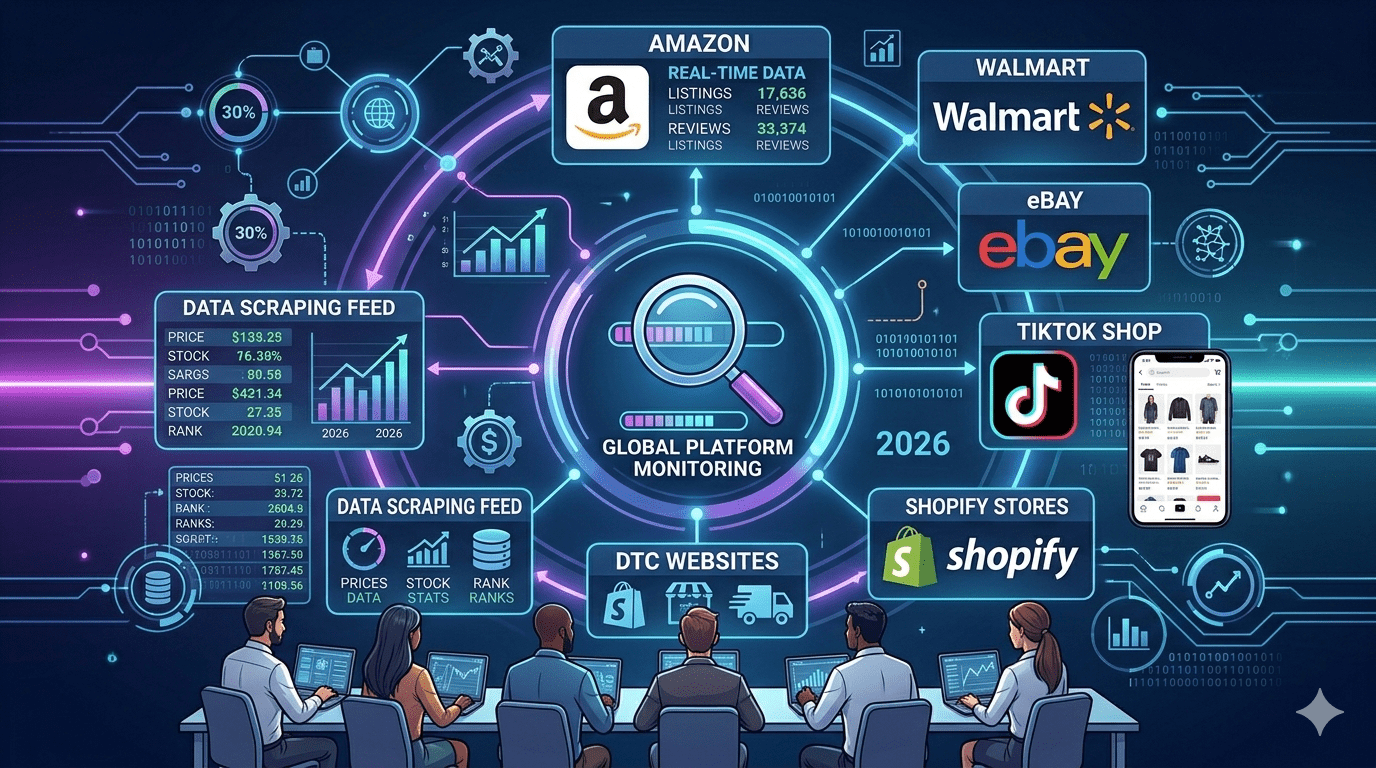
Introduction: The eCommerce Battlefield Has a New Secret Weapon
Here’s a scenario that might sound familiar: You spend weeks optimizing your product listings, fine-tuning your ad campaigns, and crafting the perfect pricing strategy. Then, almost overnight, a competitor drops their prices by 15% across your top-selling categories. Your conversion rate dips. Your Buy Box win rate tanks. And by the time you realize what happened — it’s already cost you thousands of dollars in lost sales.
Now imagine a different scenario: You know about that competitor’s price drop within minutes of it happening. Your repricing engine automatically adjusts. Your Buy Box win rate not only holds — it climbs. You respond to market changes before they ever dent your revenue.
That’s not wishful thinking. That’s exactly what eCommerce data scraping makes possible — and in 2026, it’s the baseline standard for every serious online retailer, marketplace seller, and digital-first brand.
The numbers tell the full story of just how massive and competitive this market has become. The global eCommerce market is worth an estimated $6.88 trillion in 2026 — a 7.2% increase over 2025. There are 2.86 billion online shoppers globally as of 2026, representing 33% of the world’s entire population. And in the United States alone, U.S. retail eCommerce sales for Q1 2026 reached $326.7 billion — an increase of 2.7% from Q4 2025.
In a market this large and this fast-moving, the retailers winning are not necessarily the ones with the biggest budgets or the most products. They’re the ones who move fastest on the most accurate, most current market data. And eCommerce data scraping is the engine that powers that speed.
In this comprehensive guide, we’ll walk you through everything you need to know about eCommerce data scraping in 2026 — what it is, why it matters, what data you should be collecting, how to use it across every critical dimension of your retail strategy, and how ScraperScoop can power your entire data intelligence operation from day one.
What Is eCommerce Data Scraping and Why Does It Matter Now More Than Ever?
eCommerce data scraping is the automated process of extracting product information, pricing, reviews, inventory status, and other publicly available data from online retail websites and marketplaces. Businesses use this data to monitor competitor pricing, track product availability, analyze customer sentiment, and make faster, more informed commercial decisions — making it the backbone of modern competitive intelligence in online retail.
In simpler terms: instead of manually visiting hundreds of competitor product pages and copy-pasting data into spreadsheets — a process so slow it’s practically useless in fast-moving markets — automated scraping solutions do all of that work continuously, at scale, and with far greater accuracy and speed than any human team could achieve.
The Scale of the Pricing Intelligence Opportunity
Consider just one dimension of this: competitive pricing. A single price snapshot is meaningless in a market where Amazon prices change 2.5 million times a day. Amazon reportedly adjusts prices approximately every 10 minutes, using dynamic pricing algorithms that respond to competitor movements, demand signals, and inventory levels in near real-time — an approach that has helped the company increase profits by an estimated 25% through pricing optimization alone.
For smaller and mid-size retailers, those numbers are both intimidating and deeply instructive. You don’t need to match Amazon’s infrastructure to benefit from pricing intelligence — but you absolutely cannot afford to ignore it. In retail and eCommerce, pricing is the single most powerful lever for profitability. Research shows that a 1% improvement in pricing generates an average 11.1% increase in profit — making pricing optimization more impactful than nearly any other business initiative.
And yet, most businesses still rely on manual price checks, outdated spreadsheets, and gut instincts to set their prices. Competitor price monitoring changes this equation entirely — by systematically tracking what rivals charge across thousands of products and marketplaces, businesses gain the intelligence needed to price strategically rather than reactively.
The Market Reflects the Demand
The industry growth validates just how essential this data has become. The competitor price monitoring market is growing from $1.2 billion in 2024 to a projected $2.5 billion by 2033, with a 9.2% compound annual growth rate. Meanwhile, retail and eCommerce already represent the largest segment of the web scraping market, accounting for approximately 37% of total market activity.
The message is clear: competitive eCommerce data intelligence isn’t a niche capability anymore — it’s mainstream business infrastructure.
What eCommerce Data Can You Actually Scrape? A Complete Breakdown
One of the most common misconceptions about eCommerce data scraping is that it’s limited to just competitor prices. In reality, the breadth of actionable data available through automated extraction is enormous — and each data type unlocks a different dimension of competitive intelligence.
1. Competitor Pricing Data
The most widely used and most immediately impactful data type. Web scrapers visit competitor product pages on a schedule — hourly, daily, or weekly — and extract the live selling price for every SKU you care about, resulting in a continuously updated map of your competitive pricing landscape. This includes regular prices, promotional prices, bundle pricing, flash sale prices, and marketplace-specific pricing variations across platforms like Amazon, Walmart, eBay, and direct-to-consumer storefronts.
2. Product Catalog & Assortment Data
Online catalogs change rapidly — new products launch, old products are discontinued, and seasonal assortments shift. Scraping competitor product catalogs helps businesses identify gaps in their own assortment, spot emerging product trends before they peak, and understand how competitors position similar products. This is particularly powerful for category managers and merchandising teams who need continuous visibility into how their assortment compares to the market.
3. Customer Reviews & Sentiment Data
Scraping thousands of product reviews and analyzing them systematically reveals patterns that individual review reading never captures. Businesses use review scraping to track customer satisfaction trends over time, identify the most praised and most criticized product features, compare sentiment for their products versus competitor offerings, discover unmet customer needs and feature requests, and monitor for product quality issues that emerge gradually.
One practical application: eCommerce brands have used scraped review data to identify sizing inconsistencies in clothing products, enabling them to update size guides and reduce return rates — a direct revenue and margin impact from what might seem like qualitative customer feedback data.
4. Inventory & Stock Availability Data
Tracking competitor inventory levels in real time reveals opportunities that price data alone cannot. When a major competitor goes out of stock on a high-demand product, that’s a window to capture their demand — but only if you know about it fast enough to act. Inability to monitor competitor inventory levels leads to poor reactive stock adjustments — and in fast-moving categories, even a 24-hour delay in recognizing a competitive stockout can mean thousands in missed revenue.
5. Promotional & Discount Tracking
Knowing when competitors are running promotions — and how deep those discounts go — is critical for campaign planning and margin protection. Systematic scraping of promotional pages, coupon offers, bundle deals, and flash sale schedules gives your marketing team the competitive context it needs to time campaigns effectively and protect market share during aggressive competitor promotional periods.
6. Seller Rankings & Marketplace Data
For marketplace sellers, tracking search ranking positions, sponsored placement patterns, and Buy Box ownership rates across product categories provides a layer of competitive intelligence that goes far beyond simple price comparison. An Amazon seller in the home goods category used scraped competitor pricing data to feed their automated repricing tool — and by staying within a competitive price band while protecting a minimum margin floor, their Buy Box win rate increased from 54% to 81% over 60 days.
7. Product Specifications & Feature Data
Scraping product specifications, materials, dimensions, and feature lists from competitor listings enables detailed product benchmarking that informs everything from R&D decisions to listing optimization. When you can see exactly how competitors describe and position their products, you can optimize your own listings to highlight the features that matter most to buyers — and identify the specification gaps where you can differentiate.
Competitive Pricing Intelligence: The Core of eCommerce Data Scraping
If there is one application of eCommerce data scraping that delivers immediate, measurable, bottom-line impact — it is competitive pricing intelligence. Let’s dig into how it actually works and why it’s the foundation of winning pricing strategies in 2026.
How Pricing Intelligence Through Scraping Actually Works
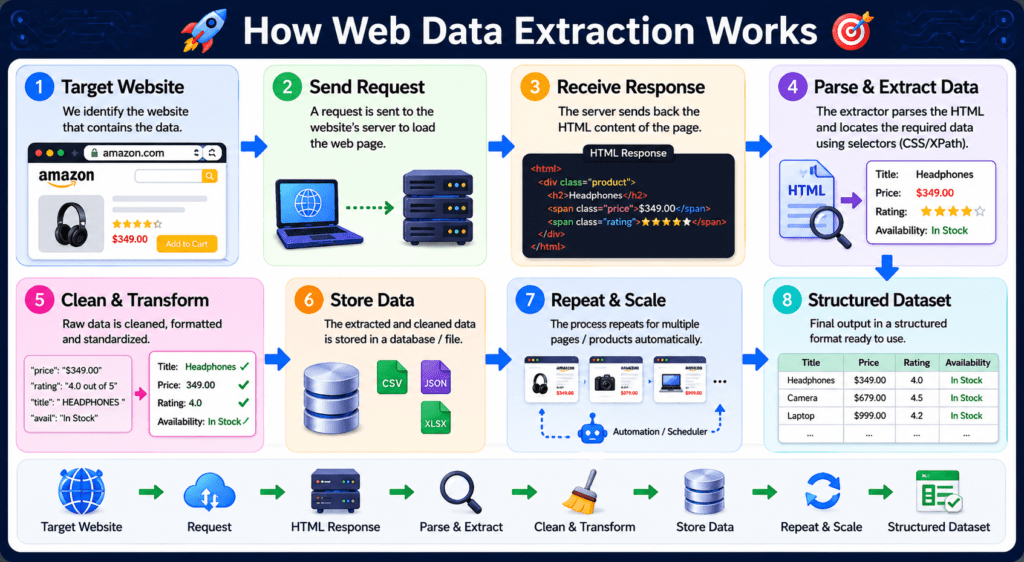
Price scraping typically works by sending automated requests to competitor product pages, parsing the HTML or JavaScript responses to extract relevant data fields, and storing results in structured formats for analysis. Modern scrapers must handle dynamic content rendered by JavaScript, navigate pagination across large catalogs, and manage rate limits to avoid blocking.
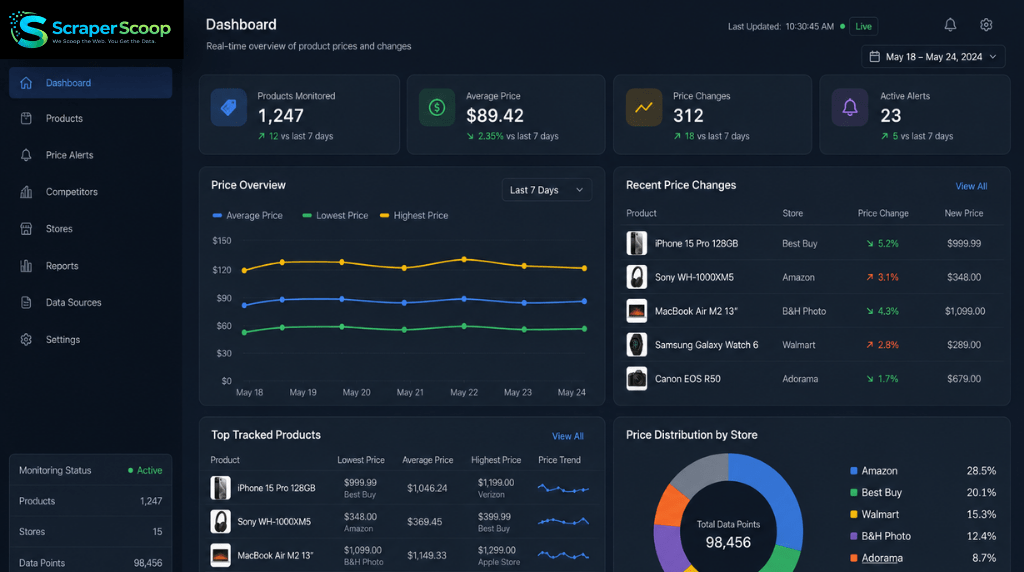
The output is a time-stamped pricing dataset that captures not just the current price but the full history of price changes — revealing seasonal patterns, promotional cycles, and the quiet pricing adjustments your competitors make hoping you won’t notice. That history is where the real strategic intelligence lives.
From Reactive to Predictive Pricing
The retailers winning on price are not necessarily the ones with the lowest prices — they are the ones who always know what the right price is, and act before their competitors do. This distinction is everything. Reactive pricing — responding after you’ve already lost sales — is far less effective than predictive pricing intelligence that anticipates market moves.
Dynamic pricing eCommerce strategies use real-time competitor data to automatically adjust prices based on market conditions — and web scraping feeds the live data that makes this automation possible. It means you can set a pricing rule like “always sit 2% below the lowest competitor” and let the data drive the execution automatically, without a human checking a spreadsheet.
The Financial Impact Is Proven
The ROI of pricing intelligence is not theoretical — it’s documented and measurable. Competitor price monitoring with web scraping drives 10–25% profit increases for businesses that implement it systematically. And organizations that shift from static datasets to eCommerce web scraping services report precision demand forecasting improvements of 23–60% by ingesting real-time competitor pricing and inventory velocity into their algorithms.
Consider also the broader context: consumers routinely compare prices across multiple sites before purchasing, with 83% of people researching products online before visiting stores. In a market where your buyers are already doing competitive pricing research themselves, not having that same intelligence on your side isn’t just a missed opportunity — it’s a genuine competitive disadvantage.
9 High-Impact eCommerce Data Scraping Use Cases Driving Revenue in 2026
1. Dynamic Repricing for Marketplace Sellers
For Amazon, Walmart Marketplace, and eBay sellers, dynamic repricing is the most direct path from scraped data to revenue impact. Continuous competitor price feeds power automated repricing tools that keep you competitive without sacrificing margin floors. Live price tracking through eCommerce web scraping provides the raw signal for repricing engines, allowing you to reclaim the Buy Box instantly. In categories where Buy Box ownership determines the vast majority of sales volume, this alone justifies the entire scraping investment.
2. MAP (Minimum Advertised Price) Compliance Monitoring
Manufacturers scrape third-party resellers to ensure they aren’t selling products below the Minimum Advertised Price (MAP). Automated tools also scan marketplaces like eBay and Alibaba for counterfeit goods that use the brand’s intellectual property. For brands managing large distributor networks, automated MAP monitoring through scraping is the only way to achieve comprehensive compliance visibility at scale — protecting both brand value and authorized reseller relationships.
3. Product Assortment Gap Analysis
Scraping competitor product catalogs helps businesses identify gaps in their own assortment, spot emerging product trends before they peak, and understand how competitors position similar products. For eCommerce managers responsible for category strategy, scraped product data provides a continuous feed of competitive intelligence that would be impossible to gather manually across dozens or hundreds of competitor websites. Identifying the products your competitors are successfully selling that you don’t yet carry is one of the fastest paths to revenue expansion.
4. Customer Sentiment & Review Intelligence
Your competitors’ customer reviews are one of the most underutilized sources of product and market intelligence available. Systematically scraping and analyzing review data reveals exactly what customers love and hate about competing products — intelligence that directly informs your product development roadmap, listing copy, and customer service improvements. Difficulty in extracting customer sentiment insights from millions of unstructured reviews is a challenge that proper scraping and NLP tools solve automatically, turning qualitative feedback into quantitative strategic intelligence.
5. Social Commerce & Marketplace Trend Tracking
The rise of social commerce has created entirely new data streams for eCommerce businesses to monitor. Global social commerce sales will exceed $1.63 trillion in 2026, growing at a CAGR above 30%, driven by in-app shopping and creator-led sales. Scraping trending product data, viral listing patterns, and influencer-driven demand signals from social commerce platforms like TikTok Shop enables brands to spot and capitalize on emerging trends before they hit mainstream marketplace saturation.
6. Supply Chain & Inventory Intelligence
Moving from reactive to immediate detection of supply chain signals, automated scrapers identify global stockouts and grey market leakages instantly — protecting brand integrity before margin dilution occurs. Tracking competitor inventory patterns also reveals demand signals and supply constraints that inform your own purchasing and inventory allocation decisions.
7. Cross-Border & Global Market Intelligence
For brands expanding internationally, the global cross-border eCommerce market will reach $636.34 billion in 2026, growing at a CAGR of 15.44%, and over 57% of online shoppers have purchased from overseas retailers. Scraping pricing, product, and regulatory data from international marketplaces enables smarter market entry decisions, competitive positioning strategies, and localized pricing optimization across different geographies.
8. Mobile Commerce Data Collection
Mobile commerce will account for nearly 60% of total online retail sales ($4.01 trillion) in 2026. As more transactions shift to mobile-first platforms and apps, the complexity of accessing data from non-web interfaces highlights the utility of mobile app scraping services for holistic market coverage. Brands that can track competitor pricing and product data across both web and mobile-first platforms have a more complete competitive picture.
9. AI Training Data Collection
Beyond competitive intelligence, eCommerce scraping is increasingly used to build proprietary training datasets for AI-powered retail applications. Retailers that have fully embedded AI into their customer journey are reporting a 15% to 25% increase in revenue, and market leaders are using AI-driven predictive analytics to reduce inventory holdings by 20% to 30%. Structured, scraped eCommerce data is the raw material that fuels these AI applications — from demand forecasting models to personalization engines.
How AI Is Transforming eCommerce Data Scraping in 2026
If competitive pricing intelligence was the “why” of eCommerce scraping, artificial intelligence is rapidly becoming the “how” — and the gap between AI-native approaches and traditional methods is widening every quarter. Here’s what AI has changed, and why it matters for your data strategy.
Visual-First AI Parsing
Instead of relying on brittle code selectors, Vision-LLM agents “see” the price or “add to cart” button just as a human does — rendering code changes irrelevant. This is a fundamental architectural shift that eliminates the most common point of failure in traditional scrapers: layout changes breaking extraction logic. When a retailer redesigns their product page, an AI-powered scraper adapts automatically — no engineering intervention required.
Self-Healing Data Pipelines
AI agents monitor the website’s layout continuously — if a class changes, the AI detects the pattern shift and automatically adjusts the parsing logic. This self-healing capability transforms what used to be a constant maintenance burden into a “set it and forget it” data infrastructure that keeps delivering even as target websites evolve. For eCommerce data operations monitoring hundreds of competitor sites, this is a game-changing operational efficiency.
Speed and Accuracy at Scale
The performance improvements are measurable and significant. AI-powered scraping delivers 30–40% faster data extraction times — speed that is critical when working with time-sensitive datasets like price tracking. Faster extractions mean fresher insights and quicker decision-making. And AI-based scrapers can achieve accuracy rates of up to 99.5% when handling dynamic, JavaScript-heavy websites — improving element detection and reducing errors that require post-processing.
From Descriptive to Predictive Intelligence
The next phase of competitor price scraping is powered by artificial intelligence — machine learning algorithms analyze millions of data points to automatically determine the optimal price for every product. AI-driven repricing allows businesses to adjust instantly to market shifts whether it’s competitor discounts, stock shortages, or demand spikes.
Machine learning models are moving beyond rule-based repricing. AI pricing engines now predict optimal price points based on elasticity modelling, competitor behaviour patterns, and demand forecasting. The shift from “what are competitors charging now” to “where are prices heading and how do I get there first” represents a quantum leap in competitive advantage.
Synthetic Data and LLM Integration
By 2026, Gartner estimates that synthetic data will account for a significant share of AI training data. In market intelligence, companies are using scraped data as a “seed” to generate synthetic customer personas — for example, a retailer scrapes 10,000 real reviews, then uses AI to generate 1,000,000 synthetic “simulated consumers” to test how a new pricing strategy might be received across different demographics. This is eCommerce intelligence at a scale and depth that was simply impossible just two years ago.
eCommerce Data Scraping Challenges — And How Professional Services Solve Them
eCommerce data scraping sounds straightforward in concept, but the execution is genuinely complex. Modern retail websites are among the most technically sophisticated and actively defended data sources on the internet. Here’s what makes it hard — and how the right partner makes it seamless.
Challenge 1: Anti-Bot Defenses
The technical challenges have grown substantially. Websites now employ sophisticated bot detection including adaptive CAPTCHAs, IP rotation detection, and behavioral fingerprinting. Eighty-two percent of automated traffic can be blocked by advanced bot-management systems, forcing price monitoring operations to invest in proxy networks, browser fingerprint rotation, and AI-driven evasion techniques. Building and maintaining this infrastructure in-house is expensive, technically demanding, and requires continuous maintenance as platforms evolve their defenses.
Challenge 2: JavaScript-Rendered Dynamic Content
The era of fragile, selector-based scraping is over. Static HTML scraping fails on modern, dynamic platforms. The 2026 standard is the Autonomic Data Mesh — a self-healing infrastructure driven by AI that renders JavaScript, handles lazy-loaded content, and processes complex single-page applications the way a real browser does. Without this capability, you’ll consistently miss the most valuable data points on modern retail platforms.
Challenge 3: Data Freshness at Scale
The value of price intelligence depends heavily on freshness and coverage. For fast-moving categories like electronics or fashion, hourly updates may be necessary to catch competitor price movements before they impact sales. Building a scraping infrastructure capable of monitoring thousands of products across dozens of platforms at hourly intervals requires substantial engineering and infrastructure investment — the kind that only makes sense if data collection is your core business, not a supporting function.
Challenge 4: Data Quality and Normalization
The success of eCommerce price scraping depends on data quality. Clean, structured data ensures accurate comparisons, better decision-making, and more reliable forecasting. Poorly formatted or inconsistent data can lead to incorrect pricing decisions and lost revenue opportunities. Raw scraped data from multiple competitor sources arrives in different formats, uses inconsistent terminology, and contains inevitable errors that require systematic cleaning before it’s analysis-ready.
Challenge 5: Legal and Ethical Compliance
While scraping price data is generally legal when it involves publicly available information, businesses must comply with fair use policies, site terms of service, and data privacy regulations. Partnering with a reputable eCommerce price scraping provider ensures that data collection is compliant, secure, and transparent. As regulatory scrutiny around automated data collection continues to increase, working with a compliance-first provider is not just good practice — it’s essential risk management.
All of these challenges explain why competitor price monitoring has evolved from a nice-to-have competitive practice into essential business infrastructure, and the companies winning in modern retail and eCommerce have moved beyond manual price checking to systematic, automated intelligence that informs pricing decisions in near real-time.
This is precisely why thousands of eCommerce businesses partner with specialist providers rather than building and maintaining complex scraping infrastructure in-house. Talk to ScraperScoop’s team today — we handle every technical complexity, from anti-bot navigation to data normalization and freshness management, so you can focus on strategy and growth.
Key eCommerce Platforms and Data Sources You Should Be Monitoring
Not all eCommerce data sources deliver equal intelligence value. Understanding which platforms carry the most strategic weight for your specific business model is the first step in building an effective competitive monitoring strategy.
Amazon
The undisputed center of gravity for eCommerce pricing intelligence. Amazon accounted for 37% of all U.S. online sales in 2024, making it the benchmark for pricing across virtually every product category. Monitoring Amazon pricing, Buy Box ownership, seller rankings, review patterns, and sponsored placement data is essential for any brand competing in the U.S. marketplace.
Walmart
U.S. eCommerce retail marketplaces collectively generated an estimated $477.7 billion in 2025, up 11.5% YoY, with eCommerce retail marketplace sales expected to reach $536.1 billion in 2026. Walmart’s aggressive eCommerce expansion makes it an increasingly critical platform to monitor for pricing intelligence, product availability data, and category trend analysis alongside Amazon.
DTC & Brand Storefronts
Major brands’ own eCommerce websites often reveal promotional strategies and pricing decisions before those changes propagate to marketplace listings. Monitoring DTC storefronts in your category provides early warning of competitor promotions, new product launches, and strategic pricing pivots — often days before marketplace adjustments catch up.
Social Commerce Platforms
TikTok Shop will generate $23.41 billion in US sales in 2026 — a 48% increase year-over-year, giving TikTok a larger eCommerce business than Target or Costco. Monitoring trending products, pricing patterns, and engagement signals across social commerce platforms provides early intelligence on demand trends that will eventually hit traditional marketplaces.
Review Platforms
G2, Trustpilot, Google Reviews, and category-specific review aggregators are goldmines of competitive sentiment data. Systematic scraping of competitor review profiles over time reveals product quality trends, customer service patterns, and the specific pain points that your marketing can directly address.
International Marketplaces
For brands operating globally or planning international expansion, monitoring pricing and product data on platforms like Alibaba, Rakuten, Mercado Libre, and regional marketplace leaders provides the competitive intelligence needed for effective international market entry and pricing localization.
The Proven ROI of eCommerce Data Scraping: Numbers That Make the Case
Let’s talk dollars and sense. Here’s how eCommerce data scraping delivers measurable, documented return on investment across every level of retail operations:
- Profit Growth through Pricing Optimization: A 1% improvement in pricing generates an average 11.1% increase in profit — and systematic competitive price intelligence consistently enables those improvements through data-backed repricing decisions.
- Demand Forecasting Accuracy: Organizations that shift from static datasets to eCommerce web scraping services report precision demand forecasting improvements of 23–60% — directly reducing both stockout losses and excess inventory costs.
- Buy Box Win Rate Improvements: An Amazon seller using scraped competitor pricing data to feed their automated repricing tool saw their Buy Box win rate increase from 54% to 81% over 60 days — a transformative improvement in sales volume from a single data intelligence upgrade.
- Inventory Reduction: Market leaders using AI-driven predictive analytics — powered by scraped eCommerce data — are reducing inventory holdings by 20% to 30%, freeing working capital while improving service levels.
- Revenue Growth from AI Integration: Retailers that have fully embedded AI into their customer journey — fueled by scraped market data — are reporting a 15% to 25% increase in revenue.
- Faster Market Response: In industries like retail, travel, and electronics, speed is everything — with eCommerce price scraping feeding real-time insights into analytics dashboards, pricing managers can make strategic decisions in hours, not days.
The pattern is consistent across every metric: businesses that invest in continuous, automated eCommerce data intelligence outperform those relying on manual research or periodic data snapshots — on pricing, inventory, demand forecasting, and customer intelligence simultaneously.
eCommerce Data Scraping Best Practices: How to Build an Intelligence Operation That Scales
1. Start with Business Outcomes, Not Data Points
The most common mistake in eCommerce data scraping is collecting data first and then figuring out what to do with it. Flip that approach entirely. Define the specific pricing decisions, assortment choices, or marketing strategies you want to inform with data — then design your scraping strategy to deliver exactly that intelligence. Every data field you collect should trace directly to a business decision. If it doesn’t, it’s overhead, not intelligence.
2. Match Data Freshness to Decision Speed
Choose monitoring frequency appropriate to your category dynamics. Fast-moving consumer goods may need hourly updates; durable goods might only require daily checks. Match frequency to how quickly competitive changes actually affect your sales. Over-investing in real-time monitoring for slow-moving categories wastes resources; under-investing in fast-moving categories costs sales. Right-size your refresh rates.
3. Build for Multi-Platform Coverage from Day One
Your competitors sell everywhere. Your intelligence operation should monitor everywhere. Building single-platform monitoring (Amazon-only, for example) gives you a dangerously incomplete competitive picture. The brands with the most sustainable competitive pricing advantages monitor pricing and product data across all relevant channels simultaneously — marketplace listings, DTC sites, and emerging social commerce platforms included.
4. Invest in Data Quality Infrastructure
As web scraping becomes more central to business intelligence, companies are prioritizing reliability, compliance, and scalability in their data collection strategies — the focus is shifting from “just getting the data” to getting the right data, at the right time, in the right way. Implement schema validation, duplicate detection, and cross-source verification from the beginning. Clean data that drives good decisions is infinitely more valuable than vast quantities of noisy data that can’t be trusted.
5. Integrate Data Into Your Existing Workflows
Plan for data integration from the start. Price monitoring data delivers maximum value when connected to your eCommerce platform, pricing engine, or business intelligence system. Even simple spreadsheet workflows should have clear paths from raw data to actionable insight. Scraped data that lives in isolation from your operational systems drives very little actual action.
6. Operate Ethically and Compliantly at All Times
Responsible eCommerce data scraping means respecting platform terms of service, implementing reasonable request rates that don’t burden target servers, avoiding the collection of personal or private data, and staying current with evolving data privacy regulations. Not only is this the right approach ethically — it’s the only approach that’s sustainable commercially. Short-term scrapers that ignore compliance build on sand; compliant data operations build for the long term.
How ScraperScoop Powers eCommerce Intelligence for Online Retailers
At ScraperScoop, we’ve built our entire platform around one core belief: eCommerce businesses shouldn’t have to choose between investing in scraping infrastructure and investing in growth. With the right data partner, you get both — world-class data intelligence and the freedom to focus your team’s energy on strategy, marketing, and product.
Here’s what we deliver for eCommerce businesses specifically:
- ✅ Custom eCommerce Scraping Solutions: Built specifically for your target platforms, competitor set, product categories, and data requirements. Whether you’re monitoring 50 SKUs or 500,000, we engineer the right solution for your scale.
- ✅ Real-Time Competitive Pricing Data: Continuously updated competitor price feeds that power your repricing engines, margin monitoring tools, and pricing strategy decisions — delivered at the freshness level your category demands.
- ✅ Ready-Made eCommerce Datasets: Need product, pricing, or review data fast? Our pre-built eCommerce datasets give you instant access to structured, validated market intelligence across major platforms without any development wait time.
- ✅ eCommerce Data APIs: Integrate our competitive intelligence feeds directly into your existing technology stack — repricing tools, ERP systems, analytics platforms, or custom dashboards — for seamless, real-time data access.
- ✅ Analytics Dashboards: Don’t just collect competitive data — understand it. Our visual dashboards surface the pricing patterns, trend signals, and competitive moves that matter most, in a format your entire team can act on.
- ✅ Review & Sentiment Data: Comprehensive competitor review scraping and sentiment analysis that turns customer feedback into product intelligence, marketing insights, and competitive positioning opportunities.
- ✅ Inventory & Availability Monitoring: Real-time competitor stock tracking that alerts you to competitive stockout opportunities and supply constraint signals before they impact your market position.
- ✅ Compliance-First Operations: Everything we do is built on ethical, legally sound data collection practices — so you get the intelligence you need without the compliance risks.
The Future of eCommerce Data Scraping: What’s Coming in 2026 and Beyond
Agentic AI Pricing Systems
Successfully scraping eCommerce data transforms scattered, unstructured noise into a structured intelligence stream, enabling enterprises to move from “reactive monitoring” to “predictive dominance.” The next evolution of this is fully agentic AI systems that don’t just collect pricing data but autonomously execute pricing strategies — setting prices, testing elasticity, running promotional scenarios, and optimizing margin across thousands of SKUs simultaneously without human intervention.
Real-Time Streaming Intelligence
Real-time dynamic strategy is moving from weekly reports to streaming intelligence. Dynamic pricing means eCommerce giants use scrapers to adjust prices every few minutes based on competitor stock levels and shifts in sentiment. The infrastructure supporting this shift — high-frequency scraping, real-time data pipelines, and sub-minute pricing responses — will become standard across all tiers of online retail, not just enterprise platforms.
Intent Detection and Behavioral Intelligence
Sales teams will increasingly scrape professional platforms to gain real-time insights into prospects’ current pain points, enabling “market-of-one” outreach — and the same principle applies to consumer market intelligence. Next-generation eCommerce scrapers will detect not just prices but buyer intent signals, competitor marketing pivots, and demand shift patterns before they manifest in sales data.
Cross-Channel Data Unification
As eCommerce continues fragmenting across platforms — marketplaces, DTC sites, social commerce, live streaming, and mobile apps — businesses are investing in infrastructure that can collect data from multiple geographies simultaneously, with geo-targeted data being essential for market-specific insights, competitive pricing, and localized trend analysis. The winners will be those who can unify intelligence across all of these channels into a single, coherent competitive view.
Ready to Win the eCommerce Pricing Intelligence Battle?
In 2026, eCommerce competition is sharper than ever. Pricing is no longer a quarterly or even weekly decision — it’s a real-time battlefield. Businesses that fail to monitor market movements risk losing customers to competitors who adjust prices instantly.
The technology is mature. The ROI is proven. The only question is whether you’re going to be the one with the competitive data advantage — or the one your better-informed competitors are outmaneuvering.
At ScraperScoop, we deliver:
- ✅ Custom eCommerce Scrapers engineered for your specific competitive intelligence needs
- ✅ Real-Time Competitive Pricing Feeds that power your repricing and margin strategy
- ✅ Ready-Made Product & Pricing Datasets for instant market intelligence
- ✅ eCommerce APIs for seamless integration with your tech stack
- ✅ Analytics Dashboards that surface actionable insights from your competitor data
- ✅ Review & Inventory Intelligence across all major platforms
- ✅ Expert Support from a team that lives and breathes eCommerce data
🛒 Let’s Build Your eCommerce Data Advantage
Your competitors are already collecting data on your prices. It’s time to return the favor — and go much further.
Contact ScraperScoop today for your free consultation → Tell us which platforms you want to monitor, which competitors matter most, and what pricing decisions you need to make better — and we’ll design the perfect data intelligence solution for your business.
Conclusion: In 2026, Data Is Your Most Valuable eCommerce Inventory
You manage product inventory. You optimize your supply chain. You invest in marketing. But in 2026, the most valuable inventory you can hold is competitive intelligence — and the most efficient way to build it is through automated eCommerce data scraping.
Organizations that shift from static datasets to eCommerce web scraping services unlock specific financial breakthroughs. The competitive edge in 2026 comes from interpretation — successfully scraping eCommerce data transforms scattered, unstructured noise into a structured intelligence stream.
Whether you’re a marketplace seller trying to own the Buy Box, a brand protecting MAP compliance across hundreds of resellers, a category manager identifying assortment gaps, or a retail executive building a data-driven pricing culture — the path forward runs through high-quality, continuously updated eCommerce data intelligence.
ScraperScoop is the partner that makes it happen — with custom scraping solutions, ready-made datasets, powerful APIs, and analytics dashboards that turn the web’s eCommerce data into your most powerful competitive weapon.
The data is there. Your competitors may already be using it. The question is: when do you start?
👉 Get in touch with ScraperScoop now — and let’s turn eCommerce data into your biggest competitive advantage.
Frequently Asked Questions About eCommerce Data Scraping
What is eCommerce data scraping?
eCommerce data scraping is the automated extraction of product information, pricing, reviews, inventory status, and competitive intelligence from online retail websites and marketplaces. Businesses use it to monitor competitor pricing, track product availability, analyze customer sentiment, and make faster, more informed commercial decisions.
How does competitive pricing intelligence through web scraping work?
Automated scrapers visit competitor product pages on a schedule — hourly, daily, or weekly — and extract the live selling price for every SKU you care about. This creates a continuously updated map of your competitive pricing landscape that feeds directly into repricing engines, pricing strategy decisions, and margin monitoring systems.
Is eCommerce price scraping legal?
Scraping publicly available pricing and product data from eCommerce websites is generally legal, provided you comply with platform terms of service, data privacy regulations like GDPR and CCPA, and operate at reasonable request rates. Partnering with a reputable eCommerce scraping service like ScraperScoop ensures compliant, ethical data collection. Always consult legal counsel for specific commercial use cases.
Which eCommerce platforms can be scraped for competitive intelligence?
Major platforms including Amazon, Walmart, eBay, Shopify stores, TikTok Shop, Alibaba, and hundreds of DTC brand websites can be monitored through eCommerce data scraping. The specific technical approach varies by platform based on their structure and anti-bot defenses. A professional scraping partner like ScraperScoop navigates these complexities reliably at scale.
How much can pricing intelligence improve my eCommerce profit margin?
Research shows that a 1% improvement in pricing generates an average 11.1% increase in profit — more impactful than nearly any other business initiative. Businesses using systematic competitive pricing intelligence typically see 10–25% profit increases, with demand forecasting accuracy improvements of 23–60%. Individual results vary by category and implementation quality.
Why should I choose ScraperScoop for eCommerce data scraping?
ScraperScoop provides custom eCommerce scraping solutions, ready-made product and pricing datasets, real-time APIs, and analytics dashboards built specifically for online retailers. We handle all technical complexity — anti-bot navigation, JavaScript rendering, data normalization, compliance — so your team can focus on strategy and growth. Contact us for a free consultation.
How often should I scrape competitor eCommerce pricing data?
The ideal frequency depends on your product category. Fast-moving categories like electronics, fashion, and consumables may need hourly price monitoring. Slower categories may only require daily or weekly scraping. The key principle is matching your data refresh rate to how quickly competitive price changes actually impact your sales volume and conversion rates.


