

Imagine this: your competitor drops their prices by 15% at 3:47 AM. How long does it take you to know about it? An hour? A day? A week?
Now imagine this: your competitor drops their prices, and within 30 seconds, your system has detected it, analyzed the impact, adjusted your pricing strategy, and updated your website. Automatically. While you’re sleeping.
That’s not science fiction. That’s real-time web scraping in 2025. And it’s becoming the difference between market leaders and everyone else.
The web scraping industry has evolved from batch processing—scraping websites once daily or weekly—to continuous, real-time monitoring that operates at millisecond speeds. Companies that master this technology don’t just have better data. They have faster decisions, quicker reactions, and competitive advantages that compound over time.
Why Real-Time Data Changed the Game
Here’s a truth that will reshape how you think about business intelligence: in most industries today, yesterday’s data is already outdated. Prices change hourly. Inventory fluctuates constantly. News breaks and sentiment shifts in minutes. Market opportunities open and close faster than traditional data collection can capture them.
Research shows that real-time data capabilities directly correlate with revenue growth. Companies using real-time competitive intelligence report 40% faster decision-making and 25% improvement in pricing optimization. That’s real money, not abstract metrics.
The Shift From Batch to Streaming
Traditional web scraping worked like this: schedule a scraper to run nightly, collect data, process it in the morning, and make decisions based on yesterday’s information. This model is dying fast.
Real-time scraping flips the script. Instead of scheduled runs, you set up continuous monitoring. Instead of collecting everything periodically, you detect specific events and trigger immediate collection. Instead of batch processing, you stream data directly into decision systems.
The technical term is “event-driven scraping”—and it’s exploding in adoption because it solves a fundamental problem: the time gap between something happening and you knowing about it.
How Real-Time Web Scraping Actually Works
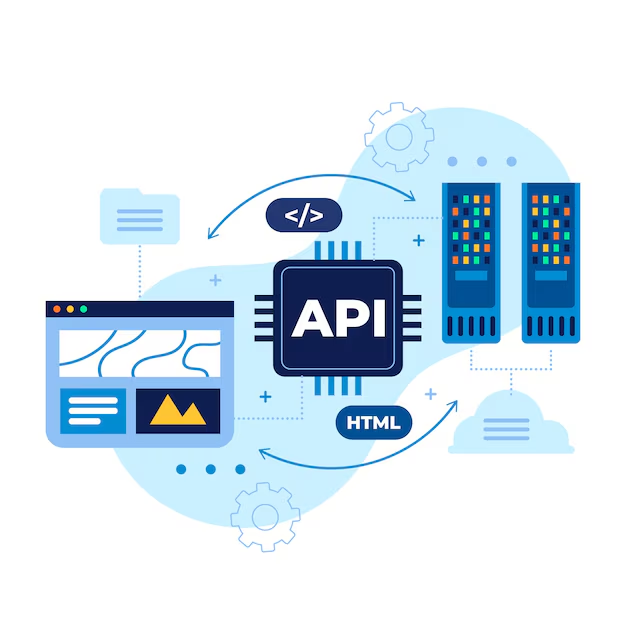
Real-time scraping isn’t just running your scraper faster. It’s a completely different architectural approach. Let me break down the key components:
Change Detection Algorithms
The foundation of real-time scraping is knowing when something changes. Your system needs to constantly monitor target websites and detect changes the moment they occur. Modern solutions use DOM diffing algorithms that compare page structures, content hashing to detect text changes, and visual regression testing to spot layout modifications.
When a change is detected—a price update, a new product listing, a modified description—the system immediately triggers data extraction for just that changed element. You’re not re-scraping entire pages unnecessarily. You’re surgically extracting what changed.
WebSocket and Server-Sent Events
For certain websites, especially financial platforms and live dashboards, data updates happen through WebSocket connections or server-sent events rather than page reloads. Your scraping system needs to tap into these real-time data streams.
This is more advanced than traditional HTTP scraping. You’re maintaining persistent connections, listening for data pushes from the server, and parsing updates as they stream in. Tools like Puppeteer and Playwright support WebSocket interception, letting you capture this real-time data flow.
Distributed Monitoring Networks
To achieve true real-time performance at scale, you need distributed systems. A single scraper can’t monitor thousands of websites with sub-second latency. You need clusters of workers distributed geographically, load-balanced scraping infrastructure, and edge computing to process data near the source.
Cloud platforms make this achievable without massive infrastructure investment. Services like AWS Lambda, Google Cloud Functions, and specialized scraping platforms provide the distributed architecture out of the box.
Real-Time Use Cases Driving ROI
Let me show you exactly how real-time scraping translates to competitive advantage:
Dynamic Pricing for E-commerce
An online electronics retailer implemented real-time competitor price monitoring across 50 competitors for their top 1,000 products. Their system checks prices every 5 minutes and automatically adjusts their own pricing within defined margins.
Before real-time scraping, they updated prices weekly based on manual research. They were consistently underpricing or overpricing, leaving money on the table or losing sales. After implementation, they saw 18% increase in profit margins and 23% increase in conversion rates. The system paid for itself in 6 weeks.
Here’s the kicker: during peak shopping periods like Black Friday, their system detected and responded to competitor price changes within 3 minutes on average. Their competitors were still using daily updates. That speed advantage meant capturing price-sensitive customers before competitors could react.
Breaking News and Content Publishing
A financial news aggregator uses real-time scraping to monitor hundreds of news sources simultaneously. When breaking news hits—earnings announcements, regulatory filings, major events—their system detects it within seconds and publishes aggregated coverage before competitors.
Speed matters enormously in news. Being 30 seconds faster means showing up first in Google News, capturing social shares, and establishing authority. Their traffic during breaking news events is 300% higher than competitors because of their real-time scraping infrastructure.
They also scrape social media sentiment in real-time, identifying trending stories before they go mainstream. This gives their editorial team a 15-30 minute head start on creating in-depth coverage.
Stock Trading and Market Intelligence
A quantitative trading firm scrapes financial data, news sentiment, and social media discussions in real-time to inform trading algorithms. They monitor SEC filings, earnings call transcripts, news wires, and retail investor forums simultaneously.
Their system processes incoming data streams, runs sentiment analysis, identifies anomalies, and generates trading signals—all in under 500 milliseconds from data collection to signal generation. In high-frequency trading, those milliseconds matter.
The competitive advantage isn’t just speed—it’s comprehensiveness. While other firms might monitor a few key sources, their real-time scraping infrastructure aggregates signals from dozens of sources simultaneously, creating a more complete picture of market sentiment.
Inventory and Supply Chain Monitoring
A dropshipping platform uses real-time scraping to monitor supplier inventory levels across multiple wholesale websites. When products go out of stock, their system immediately knows and updates availability on their own platform.
Before real-time monitoring, they’d occasionally sell products that suppliers no longer had in stock, leading to order cancellations and angry customers. Now, their inventory accuracy is 99.7%, and customer satisfaction scores jumped 34%.
They also detect when suppliers add new products or change prices, automatically syncing these changes to their platform. This automation saves 40+ hours per week of manual catalog management.
Technical Architecture for Real-Time Scraping
Building a real-time scraping system requires thinking differently about architecture. You’re not just scaling up batch scraping—you’re building a streaming data pipeline.
The Core Components
Monitoring Layer: This continuously checks target websites for changes. You can use headless browsers for complex sites or lightweight HTTP clients for simpler pages. The key is polling frequency—typically every 30 seconds to 5 minutes depending on how quickly data changes.
Event Queue: When changes are detected, they’re pushed to a message queue like RabbitMQ, Apache Kafka, or AWS SQS. This decouples detection from processing, allowing you to handle traffic spikes without losing data.
Processing Workers: These consume events from the queue and extract detailed data. They run in parallel, allowing you to process multiple changes simultaneously. Auto-scaling ensures you have enough workers during peak times.
Data Pipeline: Extracted data flows through validation, cleaning, and enrichment stages before landing in your database or analytics platform. This needs to happen in near-real-time to maintain the speed advantage.
Action Triggers: The final piece connects data to decisions. When certain thresholds are met—a competitor price drops below yours, inventory falls below a limit, sentiment turns negative—automated actions trigger. This could be price adjustments, inventory orders, or alerts to human decision-makers.
Optimizing for Speed
Real-time scraping is all about reducing latency at every step. Use CDN-hosted proxies close to target websites to reduce network latency. Cache unchanged content to avoid unnecessary requests. Implement smart polling that increases frequency for frequently-changing data and decreases for stable data. Process data at the edge before sending to central systems.
Every millisecond you shave off your pipeline is a millisecond of competitive advantage. One client reduced their end-to-end latency from 5 minutes to 30 seconds through architectural optimization. That 4.5-minute advantage meant being first to market with pricing changes.
Handling the Challenges of Real-Time Scraping
Real-time scraping is powerful, but it comes with unique challenges. Let’s talk about the big ones:
Rate Limiting and Getting Blocked
Real-time monitoring means frequent requests to target websites. Do this wrong, and you’ll get blocked fast. The solution is intelligent request management. Implement exponential backoff when you detect rate limiting. Use rotating proxies from residential IP pools. Distribute monitoring across multiple IP addresses. Monitor your success rates and adjust polling frequency automatically.
Some websites are simply too aggressive with anti-bot measures for real-time scraping. In those cases, you might need to fall back to less frequent monitoring or use official APIs if available.
Cost Management
Real-time scraping is more expensive than batch scraping. You’re making more requests, using more infrastructure, and processing more data. A system that checks 1,000 websites every minute makes 1.44 million requests daily. At scale, proxy costs, compute costs, and storage costs add up fast.
The key is optimization. Don’t monitor everything in real-time—prioritize high-value targets. Implement smart polling that adjusts frequency based on how often pages actually change. Use caching aggressively to avoid redundant requests. Monitor your cost per data point and optimize continuously.
That said, the ROI often justifies the cost. One client spends $5,000/month on real-time scraping infrastructure but gains $50,000/month in additional revenue from faster pricing decisions. That’s a no-brainer investment.
Data Quality at Speed
When you’re processing data in real-time, there’s less opportunity for manual quality checks. You need automated validation that ensures data accuracy without slowing your pipeline. Implement schema validation to catch malformed data immediately. Use statistical anomaly detection to flag suspicious values. Compare scraped data against multiple sources for cross-validation. Build in redundancy—if one scraper fails, others provide backup.
Real-time data that’s wrong is worse than no data. You’ll make bad decisions fast, compounding errors. Quality assurance can’t be an afterthought in real-time systems.
Emerging Technologies Pushing Real-Time Further
Real-time scraping is still evolving. Here’s what’s on the horizon:
Edge Computing for Millisecond Latency
The next frontier is pushing scraping and processing to the edge—distributed nodes located geographically close to target websites. This reduces network latency to single-digit milliseconds. Imagine scraping a competitor’s website and having processed data ready for decision-making in under 100 milliseconds total.
CDN providers like Cloudflare and Fastly are enabling edge compute capabilities that make this possible. Early adopters are already seeing sub-second end-to-end pipelines.
AI-Powered Predictive Scraping
Machine learning models can predict when websites are likely to change based on historical patterns. Instead of constant polling, your system can increase monitoring frequency just before expected changes and reduce it during stable periods.
For example, e-commerce sites often update prices on specific days or times. AI models learn these patterns and optimize polling schedules, reducing unnecessary requests while maintaining real-time responsiveness for actual changes.
Blockchain for Data Provenance
Some enterprises are experimenting with blockchain-based systems that provide immutable records of scraped data—timestamps, sources, and changes. This creates verifiable data provenance for regulatory compliance and builds trust in real-time data feeds.
While still early, this could become important in regulated industries like finance where data accuracy and audit trails are critical.
Building Your Real-Time Scraping Strategy
Ready to implement real-time scraping? Here’s your step-by-step approach:
Step 1: Identify High-Value Use Cases. Don’t try to make everything real-time. Focus on scenarios where speed creates significant competitive advantage. Price-sensitive products, breaking news, market opportunities—these justify the investment. Low-priority data can remain on batch schedules.
Step 2: Start with Pilot Implementation. Choose one high-value use case and build a real-time system for it. This lets you learn the challenges, optimize your architecture, and prove ROI before scaling. Start with maybe 10-50 targets before expanding to thousands.
Step 3: Build Monitoring and Alerting. Real-time systems need real-time oversight. Build dashboards showing latency, success rates, data quality metrics, and cost per data point. Set up alerts for anomalies—when scrapers fail, when latency spikes, when data quality drops. You need to know about problems immediately.
Step 4: Connect to Decision Systems. Data collection is worthless without action. Build integrations that automatically trigger responses when conditions are met. Price changes should update your systems automatically. Inventory changes should adjust availability. News should trigger content creation workflows. The power of real-time scraping is in real-time action.
Step 5: Iterate and Optimize. Real-time systems require continuous optimization. Monitor costs and look for efficiency improvements. Track latency and identify bottlenecks. Analyze which data sources provide the most value and prioritize those. Treat this as an ongoing investment, not a one-time project.
The Cost-Benefit Reality Check
Let’s be honest about costs. Real-time scraping isn’t cheap. You’ll pay for cloud infrastructure, proxy services, storage, and monitoring tools. A serious real-time scraping system might cost $2,000-$10,000+ per month depending on scale.
But compare that to the value. If real-time competitive intelligence helps you capture just 1% more market share, or optimize pricing to improve margins by 5%, or detect opportunities worth thousands of dollars—the ROI is obvious.
One metric I use: calculate the value of time. If knowing about a competitor price change 6 hours sooner is worth $100, and you monitor 100 competitors, and prices change twice per week on average, that’s $10,000+ per month in value. Suddenly, a $3,000/month scraping system looks like a bargain.
The companies winning in 2025 aren’t asking if they can afford real-time scraping. They’re asking if they can afford not to have it while their competitors do.
The Future is Instantaneous
Real-time web scraping represents a fundamental shift in how businesses use data. We’re moving from periodic snapshots to continuous intelligence. From reactive to proactive. From delayed to instantaneous.
The technology will only get faster, cheaper, and more accessible. What requires custom infrastructure today will be turnkey solutions tomorrow. Early adopters are building advantages that will compound over years.
If your industry involves rapidly changing data—prices, inventory, news, sentiment, opportunities—real-time scraping isn’t a nice-to-have. It’s becoming table stakes.
The question isn’t whether real-time data matters. It clearly does. The question is whether you’ll build these capabilities before or after your competitors gain the advantage.
The clock is ticking. Literally. Every second you wait is another second of competitive intelligence you’re missing.
Ready to Build Real-Time Intelligence?
Get our comprehensive guide: “Building Real-Time Web Scraping Systems: Architecture, Tools & Best Practices” — includes system design templates, code examples, cost calculators, and case studies from companies processing millions of real-time data points daily.
Plus: Get our free real-time scraping ROI calculator to determine if real-time monitoring makes financial sense for your use cases.
Real-Time Web Scraping Services
Ready to unlock the power of data?


