

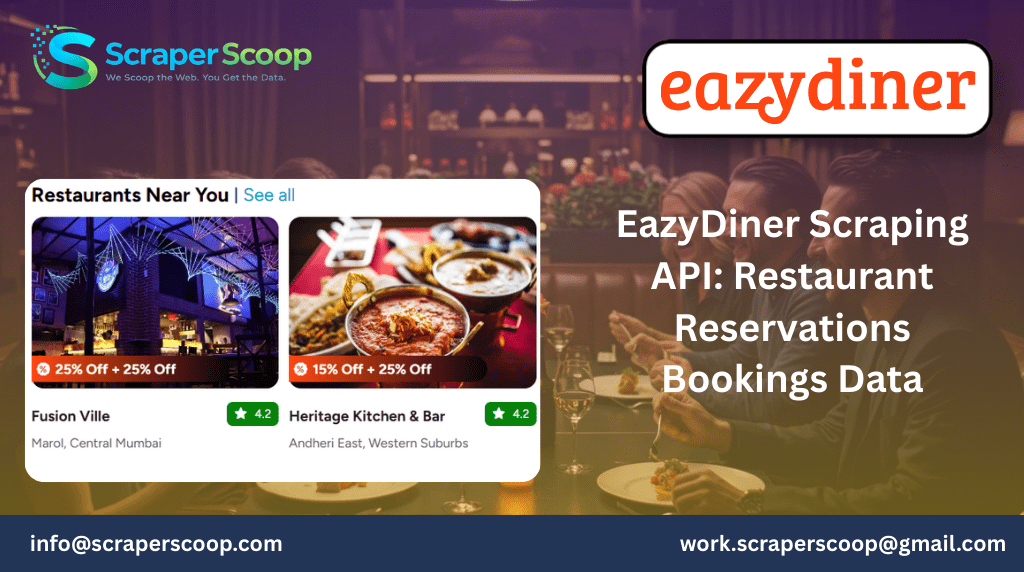
If you’ve ever searched for a good restaurant in India, there’s a good chance you’ve come across EazyDiner. Whether it’s finding a fine-dining restaurant in Mumbai, checking deals for brunch in Delhi, or booking a table in Bangalore for a special occasion, EazyDiner has become one of the go-to platforms for discovering restaurants and making reservations.
But beyond helping diners find great places to eat, platforms like EazyDiner also contain a massive amount of valuable restaurant data.
Think about it.
Every restaurant listing contains information such as:
- Restaurant name
- Location and neighborhood
- Cuisine type
- Menu highlights
- Ratings and reviews
- Table availability
- Reservation slots
- Deals and dining discounts
For food-tech companies, restaurant aggregators, travel platforms, and market researchers, this data can provide deep insights into restaurant trends, reservation demand, and customer behavior.
This is where an EazyDiner Restaurant Data Scraping API becomes extremely useful.
By extracting structured restaurant data automatically, businesses can build powerful datasets that reveal patterns in reservations, dining preferences, and restaurant performance.
In this guide, we’ll explore how EazyDiner data scraping works, what information can be collected, and how it supports restaurant analytics and reservation platforms.
Why Restaurant Reservation Data Is So Valuable
A few months ago, I spoke with a startup building a restaurant recommendation app for travelers. Their idea was simple: help users discover great restaurants near hotels and tourist attractions.
But they quickly ran into a challenge.
They needed a large, reliable dataset of restaurants including ratings, availability, and reservation options.
Manually collecting restaurant information city by city was impossible.
Once they began extracting structured data from reservation platforms, they suddenly had access to:
- thousands of restaurant listings
- table availability information
- user ratings and reviews
- dining offers and discounts
That data became the foundation of their recommendation engine.
Restaurant reservation data is valuable because it reflects real dining behavior.
Unlike static directories, reservation platforms show:
- which restaurants are popular
- which time slots are in demand
- how pricing and offers affect bookings
For businesses analyzing the food industry, this information is incredibly powerful.
What Is an EazyDiner Data Scraping API?
An EazyDiner scraping API is a system that automatically extracts restaurant data from the EazyDiner platform and delivers it in a structured format such as:
- JSON
- CSV
- Excel
- Database feeds
Instead of manually browsing restaurant pages, developers can retrieve data programmatically.
The API typically collects information like:
- restaurant listings
- reservation slots
- dining deals
- restaurant ratings
- cuisine categories
- location-based restaurant availability
This allows businesses to integrate restaurant intelligence directly into their applications.
What Data Can Be Extracted from EazyDiner
Restaurant listing pages contain a rich set of structured information.
Let’s explore the most commonly extracted data points.
Restaurant Information
Basic restaurant details include:
- Restaurant name
- Restaurant ID
- Address
- City
- Area or locality
- Restaurant description
These fields help build comprehensive restaurant directories.
Cuisine and Category Data
Cuisine information is extremely valuable for food analytics.
Common fields include:
- Cuisine types (Indian, Italian, Asian, etc.)
- Dining category (fine dining, casual dining, café)
- Meal types (breakfast, brunch, dinner)
This helps businesses analyze food trends across cities.
Reservation and Booking Data
Reservation information is one of the most important datasets.
This includes:
- Available booking slots
- Reservation dates
- Table availability
- guest capacity
- booking restrictions
Analyzing reservation slots can reveal peak dining hours and demand patterns.
Dining Deals and Discounts
EazyDiner is well known for offering dining deals.
Data may include:
- discount percentages
- buffet offers
- special promotions
- member-exclusive deals
Restaurants often use discounts to attract customers during low-demand hours.
Tracking these offers helps analyze pricing strategies in the restaurant industry.
Ratings and Reviews
Customer feedback provides insight into restaurant performance.
Typical review data includes:
- rating scores
- number of reviews
- review snippets
- customer feedback themes
Restaurants with consistently high ratings often attract more reservations.
Menu and Food Highlights
Some listings also include menu information such as:
- popular dishes
- chef recommendations
- menu categories
This data is useful for food recommendation systems.
How EazyDiner Data Scraping Works
Now let’s break down how a typical scraping pipeline collects restaurant data.
Step 1: Discover Restaurant Listings
The process begins by collecting restaurant listing pages for different cities.
Examples include:
- restaurants in Delhi
- restaurants in Mumbai
- restaurants in Bangalore
- restaurants in Hyderabad
Each page contains dozens of restaurant listings.
The scraper extracts restaurant URLs from these listings.
Step 2: Extract Restaurant Details
The scraper then visits each restaurant page to collect detailed information such as:
- restaurant name
- cuisine type
- ratings
- dining offers
- contact information
This forms the core restaurant dataset.
Step 3: Capture Reservation Availability
Reservation data often requires analyzing booking calendars.
The scraper checks:
- available dates
- available time slots
- guest capacity
This step is important for understanding reservation demand patterns.
Step 4: Collect Deals and Offers
Promotional offers are extracted to track discount strategies.
Restaurants frequently update deals to attract customers during off-peak hours.
Step 5: Structure and Store Data
The collected data is stored in structured formats.
Businesses typically use:
- databases
- analytics dashboards
- internal APIs
This allows teams to analyze restaurant performance at scale.
Real-World Applications of EazyDiner Data
Restaurant reservation data can support a wide range of applications.
Restaurant Discovery Platforms
Travel apps and food guides use scraped data to build restaurant directories.
Users can browse:
- cuisine types
- ratings
- reservation availability
Food Delivery & Dining Apps
Startups building dining platforms often rely on restaurant data to power their apps.
Reservation insights help create smart restaurant recommendations.
Hospitality Market Research
Market research firms analyze restaurant data to understand trends such as:
- cuisine popularity
- city-specific dining preferences
- restaurant growth patterns
Competitor Monitoring
Restaurant chains track competitor listings to understand:
- pricing strategies
- promotional offers
- customer reviews
Travel and Tourism Platforms
Tourism websites often integrate restaurant recommendations into travel guides.
Dining data enhances the travel experience.
Challenges in Scraping Restaurant Platforms
Collecting restaurant data at scale can present several technical challenges.
Some common obstacles include:
Anti-Bot Protections
Platforms often implement systems to detect automated scraping.
Solutions may involve:
- rotating IP addresses
- request throttling
- session management
Dynamic Reservation Systems
Reservation availability often loads dynamically through APIs.
Scrapers must capture these requests to retrieve booking data.
Frequent Website Updates
Restaurant platforms frequently update layouts and APIs.
Scraping systems must be maintained regularly.
Best Practices for Restaurant Data Extraction
Based on real-world scraping projects, here are some useful practices.
Use Structured Data Sources
Many restaurant pages include embedded structured data that simplifies extraction.
Schedule Regular Data Updates
Restaurant listings and offers change frequently.
Daily or weekly scraping schedules help keep datasets fresh.
Store Historical Data
Historical data helps identify long-term trends such as:
- restaurant popularity growth
- pricing changes
- seasonal dining demand
The Future of Restaurant Data Intelligence
The restaurant industry is becoming increasingly data-driven.
Platforms like EazyDiner generate massive datasets that reveal:
- dining preferences
- reservation trends
- restaurant performance
- pricing strategies
As food-tech companies and hospitality startups grow, the demand for restaurant intelligence data will continue to rise.
Businesses that can collect and analyze this data effectively will gain a major competitive advantage.
Final Thoughts
EazyDiner is more than just a restaurant booking platform — it’s a rich source of dining data that can power analytics, restaurant discovery platforms, and hospitality research.
By building an EazyDiner Restaurant Data Scraping API, businesses can automatically extract valuable information such as:
- restaurant listings
- reservation availability
- dining deals
- ratings and reviews
- cuisine trends
With the right data pipeline in place, companies can transform restaurant data into powerful insights that improve decision-making across the food industry.
Join the Conversation
Have you ever used restaurant data to build a food-tech product or analyze dining trends?
Or are you exploring restaurant scraping for reservation insights?
Share your thoughts or questions in the comments — I’d love to hear your perspective.
Need Help Extracting Restaurant Reservation Data?
If you’re looking to build an EazyDiner restaurant data scraping API or extract reservation and booking data, our team can help.
We specialize in scalable data extraction solutions for:
- restaurant analytics
- reservation monitoring
- food-tech platforms
- hospitality market intelligence
Let’s turn restaurant data into actionable business insights.
Request a free consultation
Ready to unlock the power of data?