

If you’ve ever ordered groceries online, chances are you’ve noticed something interesting.
You open a grocery delivery app, type in your ZIP code, and suddenly the entire catalog changes. Some products appear, others disappear, and prices may even be different.
The same milk, the same cereal, the same snack — but depending on where you live, the availability and pricing can change.
That’s the magic of hyperlocal e-commerce.
Platforms like Instacart are redefining how online shopping works by connecting customers with nearby stores and tailoring product availability based on their location. Instead of showing the same catalog to everyone, the system maps products at the ZIP code level, ensuring customers only see items that can actually be delivered to them.
For businesses, analysts, and data-driven retailers, this shift is opening up an entirely new world of eCommerce intelligence.
In this guide, we’ll explore:
- What hyperlocal eCommerce really means
- How ZIP code–based product mapping works on Instacart
- Why it’s becoming the future of online retail
- What businesses can learn from location-based grocery data
- How web scraping and data analysis unlock hyperlocal insights
Let’s dive in.
Understanding Hyperlocal E-Commerce
Before talking about ZIP codes and data mapping, it’s important to understand what hyperlocal commerce actually is.
Hyperlocal eCommerce refers to digital marketplaces that connect customers with nearby local stores and vendors, enabling fast delivery and location-specific shopping experiences.
Instead of operating like traditional eCommerce platforms that ship products from centralized warehouses, hyperlocal platforms focus on:
- Local inventory
- Nearby stores
- Fast delivery
- Location-specific availability
The goal is simple:
Deliver what people need from stores around them, often within hours.
Hyperlocal systems typically operate within small geographic zones such as neighborhoods, cities, or ZIP codes, making them extremely location-focused.
And that’s exactly where Instacart excels.
How Instacart’s ZIP Code System Works
When you open Instacart for the first time, the platform immediately asks for one thing:
Your ZIP code.
That single piece of information determines your entire shopping experience.
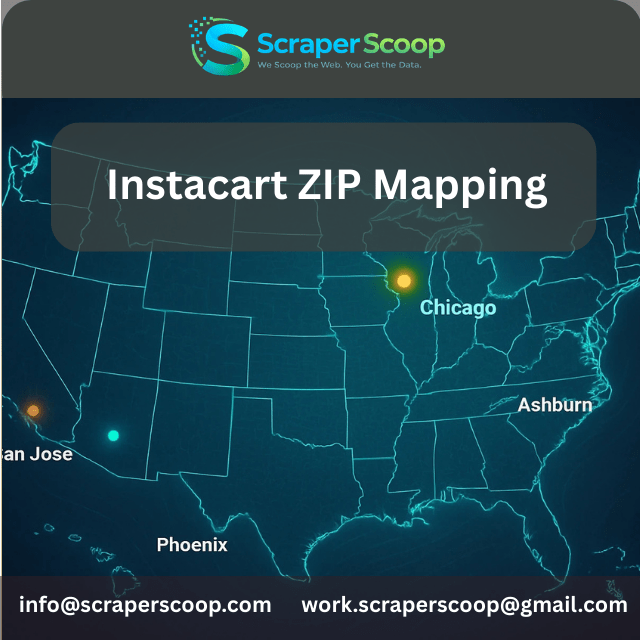
Once a ZIP code is entered, Instacart identifies nearby partner stores and displays products that are available from those locations.
This means:
- A product available in Los Angeles may not appear in Chicago
- A grocery item in downtown Toronto might be out of stock in nearby suburbs
- Prices may vary depending on local store pricing
Instacart then assigns a personal shopper to collect items from the selected store and deliver them to the customer.
But behind this simple interface lies a complex system of inventory estimation and machine learning.
Because store inventory changes constantly, Instacart uses predictive models to estimate whether an item will likely be available in-store.
In other words:
The platform isn’t just showing products — it’s predicting availability based on data.
Why ZIP Code Product Mapping Is a Game Changer
Traditional eCommerce operates with national or regional catalogs.
Hyperlocal platforms operate with micro-markets.
This difference has huge implications.
Instead of analyzing demand across entire countries, companies can analyze shopping behavior at the neighborhood level.
ZIP code mapping enables insights like:
- Which areas buy organic products
- Where certain brands dominate
- Which neighborhoods prefer bulk items
- Local pricing trends
Even within the same city, buying patterns can vary dramatically.
For example:
A suburban ZIP code might show high demand for family-size grocery packs, while an urban neighborhood might prefer single-serving or ready-to-eat meals.
This level of granularity simply didn’t exist in traditional retail analytics.
The Power of Location-Based Grocery Data
Let me share a simple example.
A grocery analytics client once wanted to understand why their sales were inconsistent across cities.
Initially, they assumed the issue was national pricing strategy.
But after analyzing ZIP code-level marketplace data, the real reason became obvious.
Certain products were popular only in specific neighborhoods.
For instance:
- Organic almond milk was selling strongly in affluent urban ZIP codes.
- Value-brand milk dominated suburban areas.
- Specialty vegan snacks were trending in tech hubs.
Without ZIP code-level data, these patterns would have remained invisible.
This is why hyperlocal data is becoming a goldmine for retailers and brands.
What Data Can Be Extracted from Instacart
For businesses analyzing hyperlocal markets, Instacart provides incredibly rich datasets.
When collecting ZIP code–based product data, analysts typically extract:
Product Information
- Product name
- Brand
- Category
- Size/variant
- Description
Pricing Data
- Product price
- Discount price
- Promotional offers
Availability Data
- In-stock status
- Out-of-stock indicators
- Replacement suggestions
Store-Level Data
- Store name
- Store location
- Delivery time
Product Media
- Product images
- Image URLs
When collected across hundreds or thousands of ZIP codes, this dataset becomes extremely powerful.
Businesses can analyze:
- Regional demand patterns
- Store-specific pricing
- Product availability gaps
- Competitor positioning
Real Business Use Cases for ZIP Code Data
Let’s explore how companies actually use hyperlocal grocery data.
Price Intelligence
Prices often vary across locations.
By tracking Instacart prices across ZIP codes, retailers can identify:
- Regional price differences
- Promotional strategies
- Competitor discounts
This helps brands maintain competitive pricing strategies.
Product Demand Analysis
ZIP code data reveals what products are trending locally.
For example:
- Keto products in fitness-focused areas
- Organic food in high-income neighborhoods
- Budget grocery brands in price-sensitive markets
Brands can use this insight to tailor inventory and marketing campaigns.
Supply Chain Optimization
Retailers can use location data to identify:
- Areas with frequent stockouts
- Stores with high product demand
- Regions requiring more inventory
This leads to more efficient supply chains.
Localized Marketing Campaigns
Hyperlocal data allows marketers to run geo-targeted campaigns.
Instead of promoting products nationally, brands can focus on:
- Neighborhood-level promotions
- Store-specific deals
- Location-based discounts
This improves marketing ROI significantly.
Why Hyperlocal Data Is the Future of Retail
The shift toward hyperlocal commerce isn’t just a trend — it’s becoming the standard.
Consumers increasingly expect:
- Faster delivery
- Local availability
- Personalized shopping experiences
Hyperlocal platforms deliver exactly that.
The model connects consumers with nearby stores and fulfills orders quickly from local inventory.
And as logistics technology improves, hyperlocal commerce will likely expand beyond groceries into:
- Pharmacy
- Convenience stores
- Electronics
- Household essentials
Retail is becoming more local, more dynamic, and more data-driven.
Challenges of ZIP Code-Based Product Mapping
Of course, working with hyperlocal data isn’t always easy.
Here are some common challenges.
Constant Inventory Changes
Unlike warehouse-based eCommerce, grocery store inventory changes constantly.
Items can sell out within minutes.
Platforms must estimate availability using predictive systems.
Store-Level Variability
Two stores from the same chain may have completely different inventory.
ZIP code data must account for these differences.
Dynamic Pricing
Prices can change based on:
- Store policies
- Promotions
- Supplier pricing
- Local competition
This makes real-time data tracking essential.
A Small Insight That Changed My Perspective
I once ran a simple experiment with Instacart.
I checked the same product in three different ZIP codes.
The results were surprising.
- In one ZIP code, the product was available from five stores.
- In another, it was only available from one store.
- In the third, it was completely unavailable.
Same product.
Same platform.
Completely different experience.
That moment made me realize something important:
Online retail isn’t global anymore — it’s hyperlocal.
Final Thoughts
Hyperlocal eCommerce is transforming the way consumers shop and how businesses analyze markets.
By mapping products at the ZIP code level, platforms like Instacart are creating highly personalized shopping experiences that reflect real-world inventory and local demand.
For businesses, this opens the door to powerful insights:
- Neighborhood-level demand patterns
- Regional pricing differences
- Local inventory gaps
- Consumer behavior trends
As hyperlocal commerce continues to grow, ZIP code-based data will become one of the most valuable assets in retail analytics.
Companies that learn to leverage this data early will gain a serious competitive advantage.
Join the Conversation
Have you noticed differences in product availability or pricing when shopping online based on your location?
Or are you exploring hyperlocal data for market intelligence?
I’d love to hear your thoughts and experiences — feel free to share them in the comments!
Need Help Collecting Hyperlocal E-Commerce Data?
If you’re interested in extracting ZIP code–based product data from platforms like Instacart for market intelligence, we can help.
Our team specializes in building scalable data pipelines for:
- Grocery marketplace scraping
- Price monitoring
- Product availability tracking
- Hyperlocal retail analytics
Let’s transform hyperlocal retail data into powerful business insights.
Request a free consultation
Ready to unlock the power of data?