

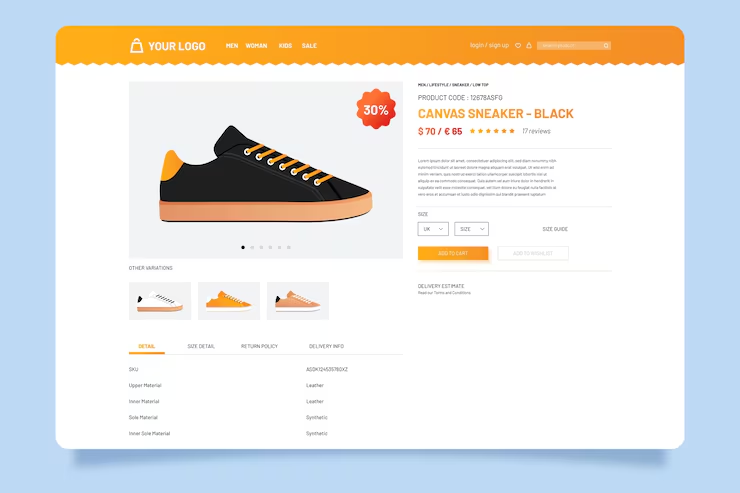
Product Review & Rating Scraping is rapidly becoming a strategic capability for product teams, marketers, and data analysts. This guide delves into how to approach scraping in a professional, compliant, and scalable way, turning raw review and rating data into actionable data insights. You’ll learn about data extraction techniques, governance practices, and how to leverage platforms like ScraperScoop to streamline workflows. By the end, you’ll have a clear blueprint for building robust pipelines that deliver reliable, timely, and ethically sourced feedback across multiple channels.
Why Product Review & Rating Scraping Matters in Today’s Business Landscape
In a marketplace saturated with choices, customer opinions drive purchase decisions, feature prioritization, and brand perception. Product Review & Rating Scraping enables organizations to systematically collect reviews and ratings from diverse sources, creating a comprehensive view of product sentiment, feature requests, and pain points. This practice supports faster decision-making, competitive benchmarking, and early detection of issues before they escalate.
Key benefits include:
Competitive intelligence: Compare sentiment, feature requests, and rating trajectories across competitors.
Product optimization: Link feedback to roadmap decisions, aligning development with customer needs.
Marketing and content strategy: Surface authentic customer experiences to inform messaging and asset creation.
Risk mitigation: Identify potential compliance or safety concerns raised by users in reviews. To execute these benefits effectively, teams must couple scraping with rigorous data extraction and governance practices, ensuring data quality and ethical sourcing.
Core Concepts: Data Extraction and Data Insights
Data Extraction and Data Insights are the twin pillars of a successful scraping initiative. Data Extraction is the process of collecting unstructured review content, ratings, timestamps, reviewer metadata, and related attributes from disparate sources. Data Insights are the actionable conclusions you draw from that data—trends, anomalies, correlations, and quantified impact on business metrics.
Data Extraction: The Building Blocks
Sourcing: Identify where reviews and ratings live (e-commerce product pages, app stores, review portals, social mentions).
Crawling vs. API access: Decide when to crawl HTML pages or leverage official APIs, noting rate limits and terms of service.
Parsing: Extract product identifiers, review text, star rating, date, reviewer location, helpful votes, and verified purchase flags.
Normalization: Standardize date formats, rating scales, and field names across sources to enable unified analysis.
Deduplication: Detect and remove duplicate reviews that can skew insights.
Storage: Load data into a data warehouse or data lake with a consistent schema.
Data Insights: Turning Data into Value
Sentiment and emotion: Use sentiment scoring to gauge overall tone and identify polarity shifts over time.
Rating trends: Track average rating trajectories and identify inflection points after updates, pricing changes, or feature launches.
Feature requests: Cluster recurring themes to prioritize product backlog items.
Influencer and reviewer analysis: Evaluate impact by reviewer credibility, geographic distribution, and review helpfulness.
Compliance and risk signals: Flag content that raises legal or policy concerns (false claims, counterfeit claims, or safety issues).

ScraperScoop: A Modern Lens on WebScrapping and Data Aggregation
ScraperScoop is a platform popular among product teams and data practitioners for orchestrating complex scraping tasks, data normalization, and governance workflows. When implementing Product Review & Rating Scraping, leveraging a capable platform like ScraperScoop can reduce time-to-value, enforce data standards, and provide built-in connectors to data insights dashboards. The combination of a solid scraping backbone with a centralized data layer enables scalable, repeatable analyses across products and markets. In practice, ScraperScoop helps organizations:
Centralize sources: Manage sources from e-commerce, app stores, and review portals in one place.
Standardize schemas: Enforce consistent field definitions (product_id, reviewer_id, rating, date, text).
Monitor quality: Implement automated validation checks and alerting on anomalies.
Accelerate delivery: Orchestrate pipelines, scheduling, and error handling with minimal downtime.
Deliver insights: Connect to BI tools and dashboards to visualize sentiment, trends, and feature requests.
Data Sources and Methodologies: From WebScrapping to API-first Approaches
A robust Product Review & Rating Scraping program blends multiple data collection methods to maximize coverage while minimizing risk.
Primary Data Sources
E-commerce product pages: Core source of reviews and ratings with structured markup and customer comments.
App stores (iOS/Android): Ratings, reviews, and metadata such as version or device info.
Review portals and aggregators: Niche sites that surface topical feedback beyond the primary retailer.
Social media and forums: Public mentions and discussions that reveal sentiment, complaints, and feature requests.
Manufacturer or brand-owned pages: Official reviews and testimonials that complement third-party data.
Techniques and Tools for Collection
HTML parsing and DOM navigation: Extract structured data from page elements, ensuring robust selectors that survive layout changes.
API access: Where available, utilize official APIs for structured data, rate limits, and stable data contracts.
Dynamic content handling: Use headless browsers (Selenium, Playwright) to render JavaScript-driven reviews.
Data extraction pipelines: Implement ETL processes so raw text, metadata, and structured fields flow into analytics systems.
Data normalization: Normalize text cases, date formats, and rating scales for cross-source comparability.
WebScrapping: The Language of Data Collection
WebScrapping remains a broad term describing the process of collecting information from the web. In practice, the most effective programs combine careful crawling, respectful pacing, and robust data validation. From a strategic standpoint, WebScrapping should be paired with explicit governance policies and compliance checks to mitigate legal and ethical risks.
Quality, Governance, and Compliance: Ethical Scraping and Responsible Data Use
Respecting terms of service, robots.txt directives, and rate limits is essential. A responsible approach minimizes disruption to target sites and protects your organization from legal exposure and reputational risk. Key governance practices include:
Source attribution and terms review: Confirm that scraping is permitted and understand any usage restrictions.
Rate limiting and polite crawling: Space requests to avoid harm to target sites and reduce IP blocking risk.
Data minimization: Collect only what is necessary for insights, avoiding sensitive or personally identifiable information unless legally justified.
Consent and privacy: Follow privacy laws and platform policies when collecting user-generated content.
Data handling and retention: Define retention periods and secure storage for review data.
Data Quality, Validation, and Data Integrity
A high-quality dataset is the backbone of reliable insights. Implement multi-layer validation such as:
Syntax validation: Ensure fields exist and conform to expected types (e.g., rating as a numeric value).
Consistency checks: Cross-source agreement on product identifiers and versioning.
Deduplication: Remove duplicates using canonicalization rules (review text hash, reviewer_id, date).
Temporal validation: Ensure timestamps are current and reflect the relevant review window.
Completeness scoring: Track a completeness score for each record to identify gaps.
From Data to Insights: Analytics Techniques for Actionable Outcomes
Descriptive analytics: Summarize volumes, average ratings, sentiment distributions, and top review themes.
Exploratory data analysis: Discover hidden patterns such as seasonal effects or regional differences.
Sentiment analysis and topic modeling: Identify prevailing topics, pain points, and praise across reviews.
Temporal analysis: Examine how sentiment and ratings evolve after product updates or marketing campaigns.
Correlation and causation considerations: Connect rating changes with product changes, pricing, or external events.
Architecture for a Robust Scraping Pipeline
A dependable architecture supports scale, reliability, and governance.
Core Components
Crawler/Spider: Navigates target sites, respects robots.txt and rate limits.
Scraper: Extracts raw data fields with fault-tolerant logic to handle page changes.
Parser and Normalizer: Converts raw arrays into a uniform schema suitable for analysis.
Validation Layer: Applies quality checks and highlights anomalies.
Storage Layer: A data warehouse or data lake that supports indexing and fast querying.
Orchestration and Scheduling: Manages pipeline runs, retries, and dependencies.
Monitoring and Alerts: Tracks failures, performance metrics, and data quality signals.
Best Practices for Reliability
Modular design: Separate scraping logic from parsing and validation.
Versioned schemas: Track schema changes to avoid breaking downstream analytics.
Incremental updates: Use delta pulls to update only new or changed data.
Error handling: Implement retry logic with exponential backoffs and clear alerts.
CI/CD for data pipelines: Apply software development practices to data workflows.
Tools and Technologies: A Pragmatic Tech Stack
A modern stack for Product Review & Rating Scraping blends scripting, automation, and data engineering. Consider these components:
Programming languages: Python remains a versatile choice for data extraction and analysis.
Libraries and frameworks: BeautifulSoup, lxml, and requests for parsing; Scrapy or a custom framework for large-scale crawling.
Browser automation: Selenium or Playwright for dynamic content and anti-scraping defenses.
Data storage: Relational databases for structured records, plus columnar stores (Parquet) in data lakes for analytics.
Data orchestration: Airflow, Prefect, or similar tools to schedule, monitor, and retry jobs.
Data visualization and BI: Tableau, Power BI, or Looker to translate data into dashboards.
WebScrapping and data governance platforms: ScraperScoop and similar solutions to enforce standards, lineage, and quality controls.
Industry Use Cases: Scenarios Where Scraping Delivers Value
Consumer electronics: Track sentiment on new releases and identify recurring complaints across regions.
Apps and software: Monitor reviews after updates to validate feature delivery and stability.
Retail and marketplaces: Compare rating distributions across product categories and sellers.
Travel and hospitality: Gather guest feedback to inform service improvements and marketing messaging.
B2B products: Surface enterprise feedback about integrations, reliability, and support.
Semantic Enrichment and SEO Synergy: From Data to Content Strategy
Beyond analytics, scraped review data can enrich content strategies and SEO efforts:
Content ideas: Use real user questions and pain points to craft FAQs and buying guides.
Semantic enrichment: Map review themes to LSI keywords and related searches to improve content relevance.
Authority signals: Publish data-driven reports highlighting market trends, which can attract backlinks and improve domain authority.
Content cadence: Regularly update insights to reflect recent sentiment shifts, improving your site’s freshness signals.
Practical Tips and Common Pitfalls
Start small, scale thoughtfully: Begin with a narrow data scope, validate quality, then expand to more sources.
Respect terms of service: Ensure compliance to avoid legal or reputational risk.
Handle anti-scraping measures gracefully: Use respectful crawling, rotate user agents, and manage IP rotation ethically.
Maintain data lineage: Record where data came from, when it was collected, and how it was processed.
Automate governance: Implement automated checks for data quality, schema consistency, and privacy constraints.
Plan for data updates: Establish a cadence for refreshing data to keep insights current.
Ethics, Privacy, and Risk Management in Scraping
Responsible scraping includes transparency about data sources, respecting user privacy, and adhering to applicable laws. Document data usage policies and ensure that any sensitive information is handled with care. A proactive risk management approach minimizes potential controversies and supports long-term data utility.
ROI, Measuring Success, and Business Impact
Time-to-insight: Quantify how quickly teams can move from data collection to actionable decisions.
Data quality uplift: Track improvements in completeness, accuracy, and deduplication rates.
Decision velocity: Measure how insights shorten product iteration cycles and guide roadmap prioritization.
Cross-functional value: Demonstrate benefits across product, marketing, and customer support teams.
Competitive advantage: Monitor competitor sentiment and feature gaps to inform strategic planning.
Best Practices for Data Extraction Projects: A Quick Playbook
Define your target sources and success criteria up front.
Establish a consistent data model that supports cross-source aggregation.
Build reusable components (parsers, validators, connectors) to reduce maintenance costs.
Implement robust logging, observability, and alerting to detect data quality issues early.
Maintain an ethics and compliance checklist for every source you add.
Invest in data governance: lineage, access controls, and documentation for stakeholders.
Case Studies and Real-World Insights
Case Study A: A consumer electronics brand used Product Review & Rating Scraping to map feature requests to a product roadmap, reducing time-to-implement by 30% and increasing NPS after two quarters.
Case Study B: A software-as-a-service company implemented a data extraction pipeline with sentiment analysis, enabling proactive support by identifying recurring issues before a major release.
Case Study C: An e-commerce retailer consolidated review data from multiple marketplaces to identify regional sentiment differences, informing localized product messaging and pricing.
Next Steps: Implementing Your Program Today
Assess your data needs: Determine which sources, data fields, and timeframes matter most for your business goals.
Define success metrics: Establish clear KPIs for data quality, timeliness, and impact on decision-making.
Choose a tooling approach: Decide between building in-house pipelines or adopting a platform like ScraperScoop for governance and scalability.
Pilot and iterate: Run a focused pilot, gather feedback, and refine schemas, parsing logic, and validation rules.
Scale thoughtfully: Expand source coverage, automate validation, and integrate insights into BI dashboards and product workflows.
Clear Calls to Action
Ready to unlock data-driven product decisions? Request a live demo of ScraperScoop to see how it can accelerate your Product Review & Rating Scraping initiatives.
Want a practical checklist for governance and data quality? Download our Data Extraction and Governance Playbook.
Subscribe to updates on the latest trends in Data Insights, Sentiment Analysis, and review-driven product optimization.
Key Takeaways for Successful Product Review & Rating Scraping
A successful program combines meticulous data extraction, rigorous validation, and strong governance.
Data Insights derived from reviews and ratings empower product and marketing teams to make informed decisions faster.
Platforms like ScraperScoop support scalable, compliant, and transparent data workflows, bridging the gap between raw data and meaningful outcomes.
Ethical and legal considerations should be embedded in every scraping initiative to protect your organization and maintain trust with users and partners.
Final Thoughts: Elevate Your Product Strategy with Data-Driven Review Insights
Product Review & Rating Scraping is not just about collecting opinions; it’s about transforming unstructured feedback into strategic, measurable outcomes. By focusing on high-quality Data Extraction, robust Data Insights, and ethical, governance-forward practices, teams can unlock a competitive edge, align product roadmaps with customer needs, and craft compelling, data-backed narratives for stakeholders. The combination of a strong methodology, a scalable pipeline, and a thoughtful toolset—including ScraperScoop—paves the way for sustainable success in today’s data-driven environment.
Appendix: Glossary of Terms and Concepts
Product Review & Rating Scraping: The process of collecting reviews and ratings from multiple sources for analysis.
Data Extraction: The technical process of pulling data from sources into a structured format.
Data Insights: Actionable conclusions drawn from analyzed data.
ScraperScoop: A platform that supports scraping, data governance, and insights delivery.
WebScrapping: The practice of collecting information from the web (note the spelling used here).
Data Governance: Policies and processes to manage data quality, privacy, and usage.
ETL: Extract, Transform, Load processes used to move data into a data warehouse.
Sentiment Analysis: Techniques to determine the sentiment expressed in reviews.
Deduplication: Removing duplicate records to ensure data quality.
Compliance: The act of adhering to legal and policy requirements when collecting data.
Additional Resources and References
Data Extraction Best Practices for Large-Scale Scraping
Sentiment Analysis Techniques for Review Data
Governance Frameworks for Data Pipelines
Case Studies: Data-Driven Product Decisions from Real-World Scraping Projects
If you’d like personalized guidance, feel free to reach out for a strategy session or to schedule a product tour of ScraperScoop. Our team can help tailor a robust Product Review & Rating Scraping program aligned with your business goals and compliance requirements.
Product Review & Rating Scraping
Ready to unlock data-driven product decisions