

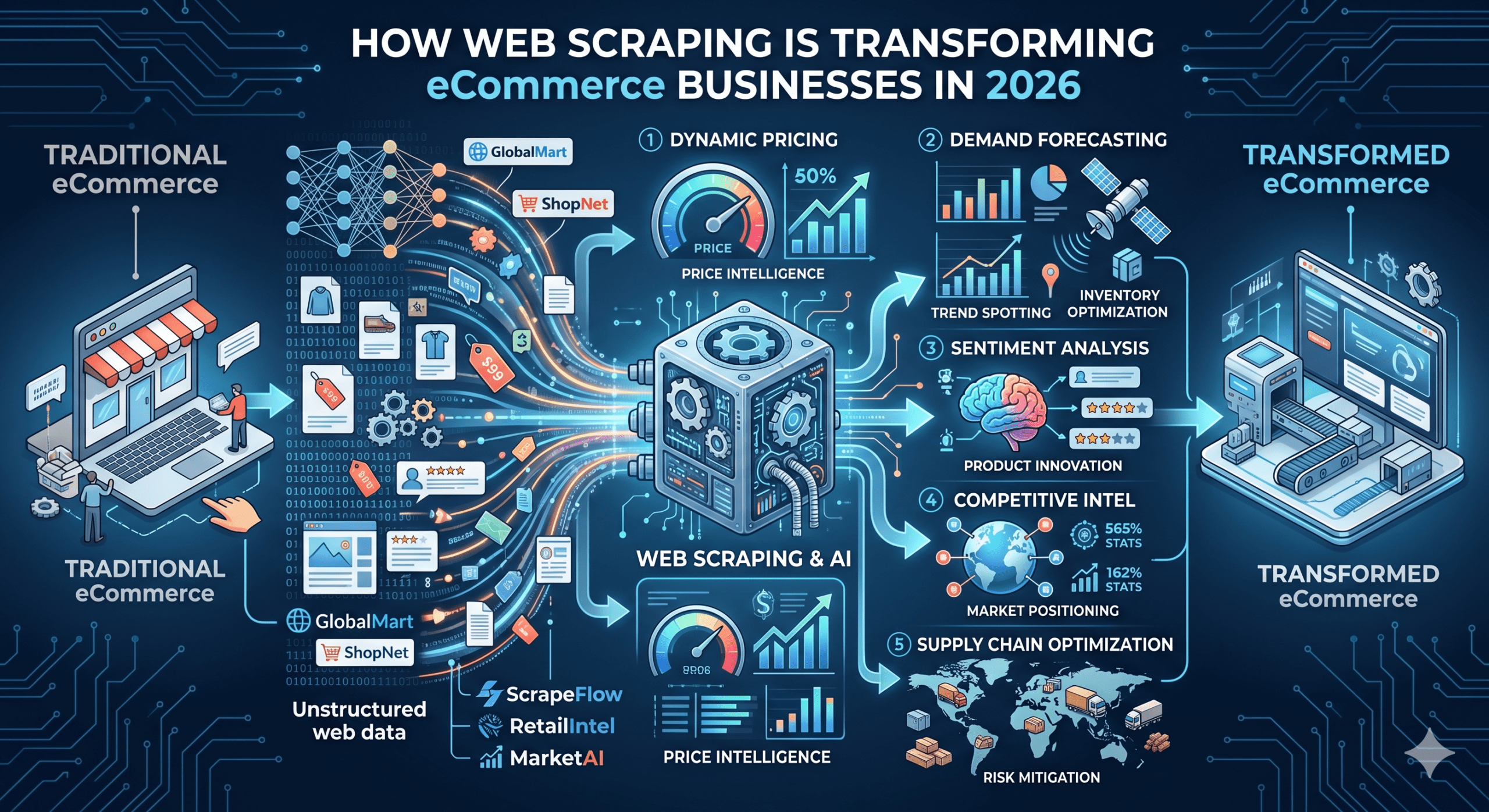
If you’re running an eCommerce business in 2026, you already know how competitive the landscape has become. New products launch daily, prices change by the hour, and your competitors are constantly tweaking their strategies. In this kind of environment, making decisions based on gut feeling just doesn’t cut it anymore. What you really need is accurate, real-time data — and that’s exactly where web scraping for eCommerce comes in.
Web scraping has gone from being a niche technical capability to a core business intelligence tool used by brands of all sizes. Whether you’re a solo Shopify seller or a large-scale marketplace operator, extracting the right data at the right time can be the difference between growing your revenue or watching your margins shrink.
In this blog, we’re going to break down everything you need to know about web scraping for eCommerce — from what it is, to how it’s actually used, to why so many growing businesses are partnering with professional scraping services like ScraperScoop to stay ahead of the curve.
What Is Web Scraping and Why Does It Matter for eCommerce?
Web scraping, in simple terms, is the automated process of extracting data from websites. Think of it like having a super-powered assistant who can browse thousands of web pages simultaneously, pull out the information you need — prices, product names, reviews, availability, images — and organize it into clean, structured formats like spreadsheets, JSON files, or database-ready tables.
For eCommerce businesses, this is gold. Here’s why:
- You can monitor your competitors’ prices in real time.
- You can track product availability trends across multiple platforms.
- You can analyze customer reviews to understand what people love or hate about products in your niche.
- You can discover new product opportunities by studying what’s trending on marketplaces like Amazon, eBay, or Etsy.
- You can enrich your own product catalog with accurate descriptions, images, and specifications.
This kind of data-driven decision-making used to be reserved for enterprise-level brands with big analytics teams. Today, thanks to services like ScraperScoop, even small and mid-sized eCommerce businesses can access the same quality of data at a fraction of the cost.
Top Ways eCommerce Businesses Are Using Web Scraping in 2026
1. Competitor Price Monitoring
This is probably the most popular use case. Pricing is one of the most powerful levers in eCommerce — customers compare prices before buying almost every time. If your competitor drops their price by $5 and you don’t know about it for three days, you’re losing sales you could have protected.
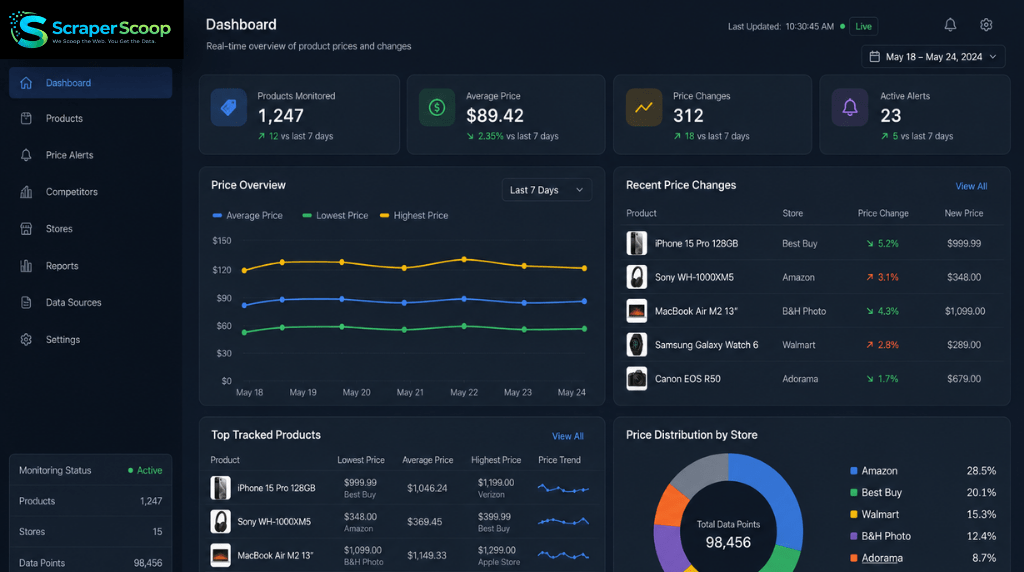
With automated web scraping, you can set up continuous price monitoring across competitor websites and marketplaces. Every time a price changes, you get the update. You can then make intelligent decisions: match the price, undercut it slightly, or choose to compete on value instead. Either way, you’re making an informed decision rather than a blind one.
ScraperScoop offers custom price monitoring scrapers that pull competitor product pricing data on a daily, hourly, or even real-time basis depending on your needs. Check out how our solutions work at ScraperScoop.com.
2. Product Catalog Enrichment
If you’re running a marketplace or aggregator platform, maintaining a rich, complete product catalog is crucial. Scraping manufacturer websites, distributor catalogs, and supplier portals lets you automatically populate your catalog with accurate product titles, descriptions, specifications, images, and SKUs.
This eliminates the tedious manual data entry process and ensures your catalog is always up-to-date. When a manufacturer updates a product spec or changes an image, your scraper catches it automatically.
3. Review and Sentiment Analysis
Customer reviews are one of the most valuable data sources for any eCommerce business — not just your own reviews, but your competitors’ too. By scraping reviews from platforms like Amazon, Trustpilot, Google Shopping, and Walmart, you can conduct sentiment analysis to identify:
- What customers consistently complain about in competing products
- Which features are most praised across your product category
- Gaps in the market that your product could fill
- Common keywords customers use, which can inform your SEO and PPC strategy
This kind of voice-of-customer data is absolutely priceless when you’re developing new products or refining your marketing messaging.
4. Trend and Demand Forecasting
Scraping trend data from sources like Google Shopping, Amazon Best Sellers, social commerce platforms, and niche marketplaces gives you a real-time view of what’s selling and what’s not. This is especially critical for inventory management — overstocking costs money, and understocking means lost sales.
By analyzing scraped trend data over time, you can build demand forecasting models that make your inventory and procurement decisions far more precise.
5. MAP (Minimum Advertised Price) Compliance Monitoring
For brands that sell through third-party resellers, MAP violations are a constant headache. Unauthorized sellers frequently discount your products below MAP, which can damage brand perception and upset your legitimate retail partners.
Web scraping lets you continuously monitor every corner of the internet — from Amazon to small dropshipping stores — to catch MAP violations early and take action quickly.

The Challenges of DIY Web Scraping for eCommerce
At this point, you might be thinking: “This sounds great. I’ll just build a scraper myself.” And sure, if you have a strong engineering team with experience in Python, Selenium, proxy management, and anti-bot circumvention — go for it. But for most eCommerce businesses, DIY scraping quickly becomes a nightmare.
Here’s what typically happens:
- Websites block your IP: Most major eCommerce sites have aggressive anti-bot measures. Your scraper gets blocked almost immediately without proper proxy rotation and fingerprinting management.
- Sites change their structure: A single HTML structure change on the target site can break your entire scraper. Maintaining scrapers is a full-time job.
- JavaScript-heavy sites require headless browsers: Modern eCommerce sites are often built with React, Vue, or Angular, which means simple HTTP request scrapers won’t work. You need headless browser automation, which is significantly more complex and resource-intensive.
- Data cleaning takes forever: Raw scraped data is messy. Deduplication, normalization, and validation are time-consuming tasks that require dedicated pipelines.
- Scaling is expensive: Scraping millions of products across hundreds of sites requires serious infrastructure.
This is exactly why partnering with a professional web scraping service makes far more sense for most businesses. Instead of spending your engineering resources on scraper maintenance, you can focus on what you actually do best — running your eCommerce business.
Why ScraperScoop Is the Right Partner for Your eCommerce Data Needs
At ScraperScoop, we specialize in delivering custom, reliable, and scalable web scraping solutions built specifically for eCommerce businesses. Here’s what sets us apart:
✅ Custom Scrapers Built for Your Exact Use Case
We don’t offer a one-size-fits-all solution. Our team works closely with you to understand exactly what data you need, from which sources, in what format, and on what schedule. Then we build a scraper that fits your workflow perfectly.
✅ Ready-Made eCommerce Datasets
Need data fast? We offer pre-built, ready-to-download eCommerce datasets covering product listings, pricing histories, reviews, and more from major platforms. These are great for market research, machine learning model training, or quick competitive analysis.
✅ APIs for Real-Time Data Access
For businesses that need live data integration into their own platforms, our eCommerce data APIs deliver fresh, structured data directly into your systems via simple API calls. No scraper maintenance, no infrastructure headaches — just clean data on demand.
✅ Analytics Dashboards
We don’t just give you raw data — we help you make sense of it. Our analytics dashboards turn scraped eCommerce data into visual insights: price trend charts, competitor comparison tables, review sentiment graphs, and more.
✅ Reliable, Scalable, and Always-On
Our infrastructure is built to handle millions of data points across thousands of sources. Whether you need daily snapshots or real-time streams, our systems are always running, always delivering.
Real-World Use Cases: How Businesses Are Winning with eCommerce Data Scraping
Case Study Style Example 1: Online Electronics Retailer
Imagine an online electronics retailer selling laptops and accessories. They were losing sales to competitors almost every weekend without understanding why. By implementing price monitoring scraping across five major competitor sites, they discovered that their main competitors systematically dropped prices by 8–15% every Friday afternoon. Armed with this data, they were able to match those promotions proactively — and saw their weekend conversion rate improve significantly within just a few months.
Case Study Style Example 2: Fashion Marketplace
A growing fashion marketplace needed to expand their product catalog from 10,000 to 100,000 SKUs. Manual data entry would have taken months. Using ScraperScoop’s product catalog enrichment scraping service, they populated their entire expanded catalog in under two weeks — with accurate product titles, descriptions, images, and size guides — all automatically extracted and formatted to their specification.
Case Study Style Example 3: Private Label Brand
A private label seller on Amazon wanted to identify white-space opportunities in the home goods category. By scraping review data across hundreds of competing products, they identified a consistent complaint about a specific feature gap. They developed a product that addressed that gap, launched it with marketing copy that directly spoke to that pain point, and ranked on page one within 60 days of launch.
Is Web Scraping Legal for eCommerce?
This is a question we get a lot, and it’s a fair one. The short answer is: scraping publicly available data is generally legal in most jurisdictions, particularly following the landmark hiQ Labs v. LinkedIn case in the US which ruled that scraping publicly accessible data does not violate the Computer Fraud and Abuse Act.
That said, it’s always important to operate within ethical and legal boundaries:
- Never scrape data that requires bypassing authentication (logging in without permission).
- Respect robots.txt files and rate limits to avoid overloading target servers.
- Don’t use scraped personal data in ways that violate GDPR, CCPA, or other privacy regulations.
- Always check the terms of service of target websites.
At ScraperScoop, we operate with full compliance awareness and can guide you through the legal considerations relevant to your specific use case.
How to Get Started with eCommerce Web Scraping
Getting started is simpler than you might think. Here’s a quick roadmap:
- Define your data needs: What specific data do you need? From which sites? How often?
- Choose between custom scrapers, APIs, or ready-made datasets: Depending on your use case, one option will fit better than others.
- Decide on output format: CSV, JSON, XML, direct database feeds, or API endpoints?
- Set your delivery schedule: Real-time, hourly, daily, or weekly?
- Partner with professionals: Unless you have a dedicated engineering team, working with an expert service ensures reliability, compliance, and quality.
Ready to take the next step? Our team at ScraperScoop is ready to discuss your exact requirements and propose a tailored solution. Contact us today and let’s talk data.
The Future of Web Scraping in eCommerce
The future of eCommerce data scraping is incredibly exciting. We’re already seeing AI-powered scrapers that can adapt to website structure changes automatically, reducing maintenance overhead dramatically. Natural language processing is making sentiment analysis from scraped reviews faster and more accurate than ever. And the rise of multimodal AI means scrapers can now extract insights from product images, not just text.
As eCommerce continues to grow globally — with worldwide online retail sales projected to exceed $8 trillion in the coming years — the businesses that will win are those that make the best use of data. Web scraping is no longer optional for serious eCommerce players. It’s a competitive necessity.
Final Thoughts
Web scraping for eCommerce is one of the highest-ROI investments you can make in your business intelligence stack. From price monitoring and catalog enrichment to review analysis and trend forecasting, the data you can extract and analyze gives you a real competitive advantage in an increasingly crowded market.
Whether you’re just starting to explore web scraping or you’re ready to scale your data operations to the next level, ScraperScoop has the expertise, infrastructure, and custom solutions to make it happen.
Don’t get left behind while your competitors are making smarter, data-driven decisions. Reach out to our team today and let’s build your eCommerce data advantage together.


