

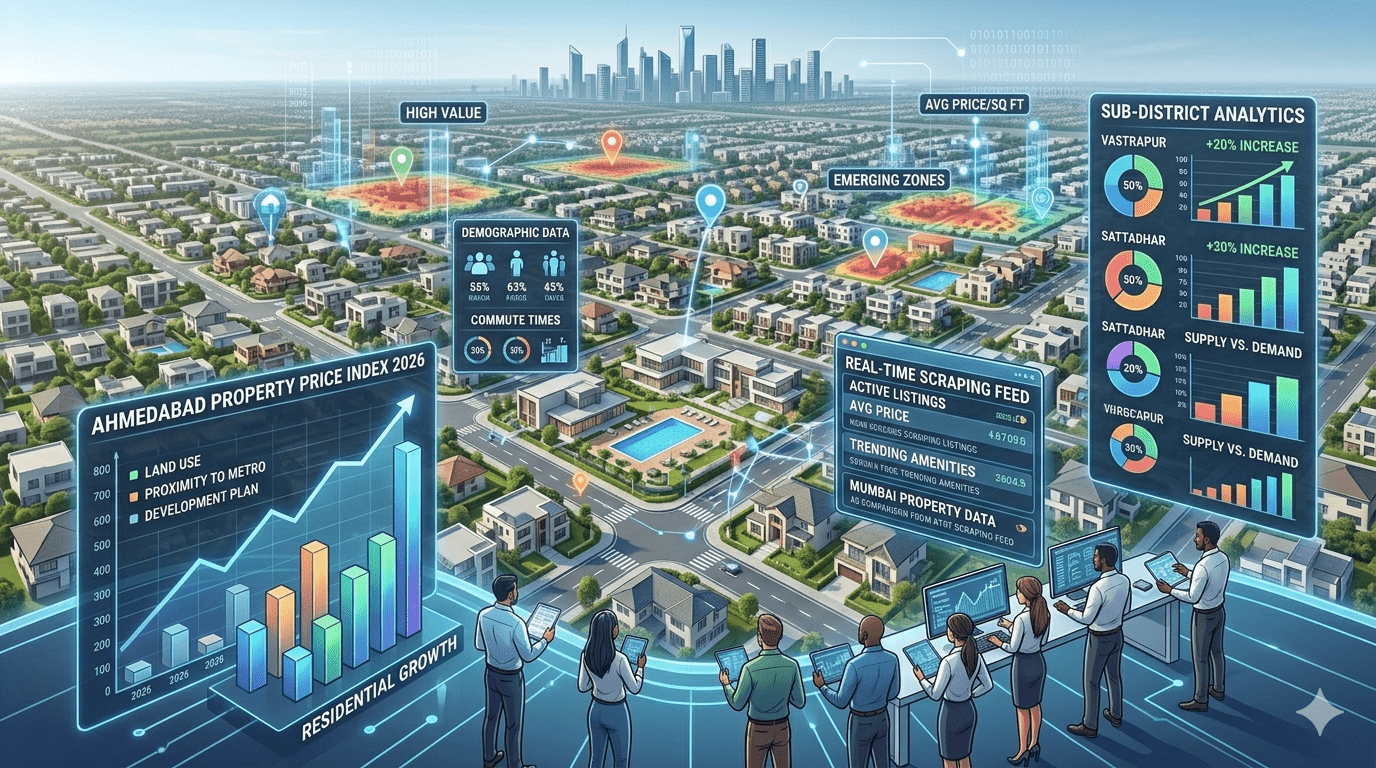
Introduction: Why Real Estate Data Scraping Is No Longer Optional
Let’s start with a simple truth: the real estate market does not wait for you. Prices shift overnight. New listings disappear within hours. Neighborhoods that were undervalued last quarter are suddenly buzzing with activity. And if you’re still relying on manual research, spreadsheets, or outdated reports to make property investment decisions, you’re already playing catch-up.
The professionals and businesses that are winning in today’s real estate market share one thing in common: they treat data as infrastructure, not as a nice-to-have. And the most powerful way to collect that data at scale, in real time, and at a fraction of the cost of traditional research? Real estate data scraping.
Consider the scale of this opportunity. In January 2026, there were over 1.65 million homes for sale in the United States alone, with the median home price reaching $423,261. That’s an enormous sea of data — spread across dozens of listing portals, agency websites, rental platforms, and public records — all of it constantly changing, and all of it accessible to anyone with the right data extraction strategy.
Whether you’re a real estate investor hunting for undervalued properties, an agent trying to stay ahead of the market, or a proptech company building the next data-driven platform, this guide is for you. We’ll cover everything: what real estate data scraping is, why it matters, what data you can extract, how to use it to drive real results — and how ScraperScoop can power your entire data strategy.
What Is Real Estate Data Scraping and How Does It Work?
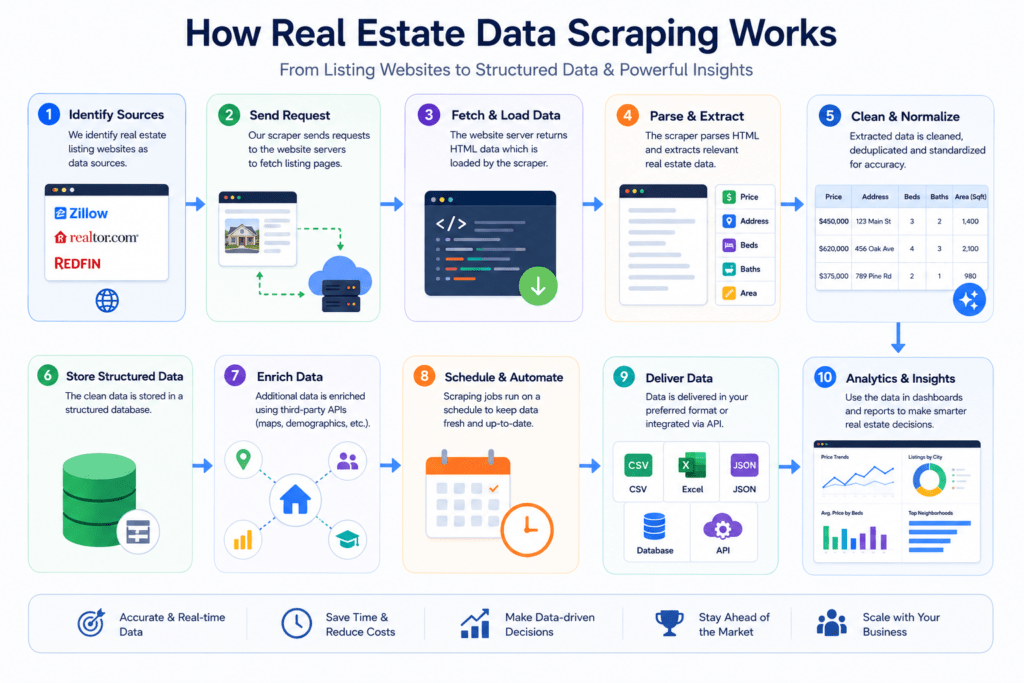
At its core, real estate data scraping is the automated process of extracting structured property data from websites and online platforms. Think of it as deploying intelligent digital agents that can visit hundreds or thousands of property listing pages simultaneously — pulling out the specific data points you need and delivering them to you in a clean, usable format.
Instead of manually visiting Zillow, Redfin, Realtor.com, or local MLS-aggregated portals and copy-pasting information into a spreadsheet — a process that’s slow, error-prone, and simply doesn’t scale — a well-built scraping solution does all of that work automatically, continuously, and with far greater accuracy.
The real estate industry has always been data-intensive. But as platforms like Zillow (which now tracks over 110 million U.S. properties) and Redfin (publishing weekly market data across thousands of neighborhoods) have expanded, the volume and velocity of available property data has exploded. Manual research simply cannot keep pace anymore.
What Types of Real Estate Data Can Be Scraped?
The breadth of data available through automated property scraping is remarkable. Here’s what a well-structured real estate scraping solution can extract:
- Property Listings: Address, price, number of bedrooms/bathrooms, square footage, lot size, property type (single-family, condo, multi-unit), listing status (active, pending, sold)
- Price History: Historical price changes, days on market, price-per-square-foot trends over time
- Rental Data: Monthly rental rates, occupancy rates, rental yield metrics, lease duration patterns
- Market Statistics: Median sale prices, inventory levels, sale-to-list price ratios, demand indexes by neighborhood or zip code
- Agent & Broker Data: Agent profiles, transaction volumes, brokerage affiliations, market dominance by area
- Neighborhood Intelligence: School ratings, crime statistics, transportation access, walkability scores, proximity to amenities
- Investment Metrics: Cap rates, ROI estimates, foreclosure listings, auction results, distressed property flags
- Commercial Property Data: Vacancy rates, lease prices, office/retail/industrial listing data, market absorption rates
Why Real Estate Data Scraping Is a Game-Changer in 2026
Here’s the competitive reality that every real estate professional needs to understand right now: the investors who win in 2026 are not necessarily the ones with the most capital — they are the ones who find the best deals first.
By the time a “great deal” becomes common knowledge across major portals, it’s often already under contract. The best opportunities go to the professionals who see the data faster, analyze it more deeply, and act more decisively than everyone else. That’s exactly what real estate data scraping enables.
The Problem with Traditional Real Estate Research
Traditional methods of researching properties — manually comparing prices, analyzing neighborhoods, and tracking market shifts — are slow, often riddled with errors, and can cost enormous amounts of time and money. Relying only on spreadsheets or manual research is simply no longer sufficient to stay competitive in today’s fast-moving market.
Here’s what that looks like in practice for different property professionals:
- Investors miss undervalued properties because by the time they manually gather and compare data, the opportunity is gone.
- Real estate agents struggle to set accurate asking prices because they don’t have real-time visibility into what similar properties are actually selling for — not just listing for.
- PropTech companies waste engineering resources building fragile, one-off scraping pipelines instead of focusing on their core product differentiation.
- Property managers lack the rental market visibility they need to price units optimally and track vacancy rate patterns.
Real estate data scraping solves all of these problems simultaneously — by automating data collection at scale, delivering structured and validated datasets, and enabling the kind of continuous market monitoring that used to require large research teams.
7 Powerful Use Cases: How Professionals Use Real Estate Data Scraping
1. Investment Property Discovery & Undervalued Listing Detection
This is arguably the highest-value application of property data scraping for individual investors. Rather than manually browsing listings, a custom scraping solution can scan the entire market continuously — every hour if needed — flagging properties that meet specific investment criteria before they attract widespread attention.
Data-driven insights reveal undervalued properties, high-growth neighborhoods, and rental opportunities optimized for ROI — giving investors an advantage over competitors relying on guesswork or slow manual research. You’re not reacting to the market. You’re staying ahead of it.
2. Competitive Market Analysis (CMA) for Real Estate Agents
Accurate pricing is the difference between a listing that sells in days and one that sits on the market for months. By scraping comparable property data across multiple platforms, agents gain a real-time, multi-source view of what similar properties are actually selling for in any given area — not just what they’re listed at.
Professionals in this space use scraped data to analyze neighborhood price trends, study competitor listings, monitor inventory changes, and identify underpriced or overvalued properties. This data also helps agents set accurate asking prices, improve listing visibility, and ultimately close deals faster.
3. Rental Yield Calculation & Rental Market Monitoring
For income property investors, rental yield is the number that matters most. By scraping both for-sale data and rental listing data for the same geographic area, investors can automatically calculate expected rental yields and identify areas where rental demand is rising but property prices haven’t caught up yet — the classic early-investor sweet spot.
Real estate investors can calculate rental yields, monitor price fluctuations, and forecast ROI based on location, demand, and seasonal shifts using this type of structured scraped data. Historical pricing data and rental trends also help identify upcoming hotspots and distressed properties with high growth potential.
4. Price History Tracking & Market Trend Analysis
A single price snapshot tells you very little. But a 12-24 month history of price movements for properties in a specific neighborhood? That tells a story. Tracking how a neighborhood’s median price has changed over time provides context that point-in-time snapshots simply cannot offer.
Platforms like Redfin publish weekly updates on inventory, pricing, and market dynamics. Scraping and aggregating this data over time enables the kind of trend analysis that helps investors anticipate market shifts rather than react to them after the fact — and that distinction is everything.
5. Neighborhood Intelligence & Location-Based Investment Analysis
Smart real estate investment isn’t just about the property — it’s about where the property is. Neighborhood-level data including school ratings, crime statistics, transportation accessibility, and nearby facilities all play a critical role in both investment value and rental demand.
Machine learning models can integrate scraped data points — including comparative sales, neighborhood characteristics, and property features — to generate multi-factor property valuation estimates that go far beyond simple square footage and bedroom count comparisons.
6. Agent & Brokerage Intelligence
For proptech platforms, real estate franchises, and market research firms, understanding which agents and brokerages dominate specific neighborhoods and price segments is extremely valuable. Building comprehensive agent databases from scraped listing data enables market share analysis that drives smarter decisions around recruiting, partnership discussions, and competitive strategy.
Real estate data scraping services help extract agent profiles, recent sales data, and commission structures — providing firms with a genuine competitive intelligence advantage that’s impossible to build manually at scale.
7. Commercial Real Estate Monitoring
The commercial real estate sector has its own unique data needs. Systematic monitoring of commercial property markets — including office spaces, retail locations, and industrial complexes — involves tracking vacancy rates, lease prices, and market absorption data that signals where opportunities and risks are emerging.
Aggregating and analyzing geospatial data is particularly crucial for real estate developers, who use scraped data to monitor zone information, land use regulations, potential development sites, demographic shifts, and urban planning trends to inform strategic land acquisition and project planning.
Key Real Estate Data Sources You Can Scrape
Not all real estate data sources are created equal. Understanding where to find the most reliable, comprehensive, and timely property data is essential for building an effective scraping strategy. Here are the primary platforms and sources that power professional real estate data operations:
Major Listing Portals
Zillow tracks over 110 million U.S. properties, making it one of the most data-rich real estate platforms available. Redfin distinguishes itself through data transparency — their Data Center provides downloadable market statistics at national, metro, city, and zip code levels. Realtor.com pulls listing data directly from over 800 MLS databases, meaning listings often appear there faster than on aggregator platforms. These are the foundational data sources for any serious real estate scraping operation.
Rental Platforms
For rental yield analysis and income property investment, platforms like Apartments.com and Zillow Rentals provide comprehensive rental rate data by neighborhood, property type, and bedroom count. Scraping and correlating for-sale data with rental data from the same areas is the foundation of accurate yield calculation.
Vacation Rental & Short-Term Rental Markets
For investors considering short-term rental (STR) strategies, platforms like Airbnb provide valuable data on nightly rates, occupancy patterns, and host revenue by market — all of which feed into more nuanced investment analysis beyond simple long-term rental yields.
Public Records & Government Data
Tax records, property ownership data, zoning information, and foreclosure filings are all accessible through various public government databases. Integrating this data with listing portal data creates a far more comprehensive property intelligence profile than either source could provide alone.
Local & Regional Platforms
Investors targeting specific markets benefit enormously from scraping local real estate agency websites, regional listing platforms, and neighborhood-specific portals that capture hyperlocal data points that national platforms sometimes miss or aggregate too broadly.
The Real ROI of Real Estate Data Scraping: What the Numbers Say
Let’s be direct: investing in real estate data scraping services isn’t a cost — it’s a revenue-generating decision. Here’s how the ROI breaks down across different stakeholders:
For Real Estate Investors
- Faster deal discovery: Automated property scanning can flag investment opportunities the moment they’re listed — before widespread competition drives up the price. The investors who win in 2026 are those who find the best deals first, not those with the deepest pockets.
- Better yield forecasting: Companies using data-driven pricing strategies consistently see measurable margin improvements and revenue increases — the same principle applies to real estate investment decisions backed by accurate, structured data.
- Reduced risk: Structured datasets allow for proper valuation modeling and risk assessment. Accurate, reliable data helps determine potential returns and highlight risks before making investment decisions — turning what was previously guesswork into evidence-based strategy.
For Real Estate Agents & Brokerages
- Faster, more accurate pricing: Real-time comparable sales data means more precise CMAs and asking prices that align with actual market conditions — leading to faster listings-to-contracts timelines.
- Competitive differentiation: Agents armed with deeper market intelligence can provide significantly more value to clients than those relying on standard MLS reports — a genuine differentiator in a crowded market.
- Better recruitment & partnership intelligence: For brokerages, data on agent transaction volumes and market share by neighborhood informs smarter hiring and partnership decisions.
For PropTech Companies
- Engineering cost savings: Partnering with a managed real estate data scraping service eliminates the ongoing engineering overhead of building and maintaining fragile in-house scrapers — freeing your team to focus on product innovation instead.
- Richer product features: Ready-made, structured property datasets power better search experiences, valuation tools, neighborhood analytics, and investment calculators — all without the data pipeline complexity.
- Scalability: A business may start with one city or property type, but later need data across multiple countries, listing platforms, property categories, and market segments. The right data partner scales seamlessly with those expanding needs.
Real Estate Scraping Challenges — And How to Overcome Them
Let’s be honest: real estate data scraping is not simple. Unlike scraping a basic eCommerce product page, property data extraction comes with a unique set of technical and operational challenges that require real expertise to navigate. Here’s what makes it complex — and how professional scraping services solve each problem.
Challenge 1: JavaScript-Rendered Content
Many modern real estate platforms load property details, price histories, and interactive maps dynamically using JavaScript. Traditional HTML-based scrapers can’t access this content — they only see the raw HTML shell, missing the most valuable data points. Modern AI scrapers use headless browsers to render JavaScript before extraction — handling single-page apps, dynamically loaded prices, and lazy-loaded images seamlessly, because the AI works on the rendered DOM rather than raw HTML.
Challenge 2: Anti-Bot Measures & Rate Limiting
Real estate portals are notoriously difficult to scrape at scale because they actively deploy anti-bot systems, rate limiting, IP blocking, and CAPTCHAs to prevent automated access. Overcoming these measures reliably requires sophisticated infrastructure — including intelligent proxy rotation, session management, and adaptive request pacing — that goes well beyond what in-house teams typically build.
Challenge 3: Result Pagination & Search Limits
Real estate portals often limit the number of results per search to 500–1,000, making comprehensive market coverage technically complex. Professional scraping solutions break geographic searches down into granular units — individual zip codes, neighborhoods, or map polygons — and iterate through them systematically to achieve complete market coverage without hitting pagination walls.
Challenge 4: Data Quality & Normalization
Raw scraped real estate data often requires significant processing before it’s analysis-ready. Addresses may be formatted inconsistently across platforms. Prices appear in different formats. Bedroom and bathroom counts use non-standard notation. Property types are categorized differently by different portals. Professional data services handle all of this normalization — delivering clean, standardized, analysis-ready datasets rather than raw HTML dumps.
Challenge 5: Keeping Data Fresh
The real estate market changes constantly. Prices can rise or fall within days, and rental yields fluctuate based on demand. A dataset that was accurate last week may already be stale. Automated tools that track price indices, rental data, and listings in real time — feeding data directly into analytics dashboards — ensure your intelligence is always current and actionable.
Challenge 6: Legal & Ethical Compliance
Data privacy regulations, platform terms of service, and evolving legal standards around automated data collection require careful navigation. Responsible scraping — respecting robots.txt, avoiding personal data collection without authorization, honoring reasonable request rates, and maintaining transparent data usage policies — isn’t just ethical, it’s essential for sustainable, long-term data operations.
All of these challenges explain why more investment analysts, market researchers, and real estate teams are turning to professional managed data services rather than attempting to build and maintain complex scraping infrastructure in-house. Talk to our team at ScraperScoop — we’ve built the infrastructure, solved the hard problems, and deliver ready-to-use real estate datasets so you can focus on analysis and decision-making, not data engineering.
How ScraperScoop Powers Real Estate Intelligence
At ScraperScoop, we specialize in delivering structured real estate data that turns the world’s property portals into your personal intelligence engine. Whether you need a one-time dataset for a specific market, an ongoing data pipeline for continuous monitoring, or a fully custom scraping solution built around your platform’s unique requirements — we’ve got you covered.
What ScraperScoop Delivers for Real Estate:
- ✅ Custom Property Listing Scrapers: Built specifically for your target platforms, geographic markets, and data requirements — delivering the exact fields you need in the format that works for your workflow (JSON, CSV, API, database).
- ✅ Ready-Made Real Estate Datasets: Need data fast? Our pre-built property datasets cover major listing platforms and rental markets, giving you instant access to structured, validated real estate intelligence without any development time.
- ✅ Price History & Market Trend Data: Track median prices, days on market, sale-to-list ratios, and inventory levels over time — the historical context that makes point-in-time data actually meaningful.
- ✅ Rental Yield Intelligence: Cross-platform rental and for-sale data combined into unified datasets that enable accurate yield calculations and rental market analysis by neighborhood, zip code, or city.
- ✅ Real Estate APIs: Integrate our real estate data feeds directly into your PropTech platform, investment analysis software, or CRM for seamless, real-time data access without maintaining your own scraping infrastructure.
- ✅ Analytics Dashboards: Don’t just collect property data — understand it. Our visual dashboards transform raw scraped data into clear market intelligence that drives faster, more confident decisions.
- ✅ Multi-Platform Coverage: From major national portals to regional and local platforms, we cover the full spectrum of real estate data sources your business needs.
- ✅ Compliance-First Approach: All our scraping solutions operate within ethical and legal boundaries — respecting platform policies, data privacy regulations, and sustainable access patterns.
Who Needs Real Estate Data Scraping? (Hint: Probably You)
🏠 Real Estate Investors
Individual and institutional investors rely on scraped property data to discover undervalued listings faster, analyze rental yields accurately, track neighborhood growth signals early, and build investment models backed by comprehensive market data rather than anecdotal observations. In 2026, leveraging automated data collection powered by AI and ETL pipelines isn’t a luxury for serious property investors — it’s a baseline requirement.
🏢 Real Estate Agents & Brokerages
Agents use scraped data to power better CMAs, set more accurate listing prices, monitor competitor activity in their markets, and provide clients with deeper, more credible market insights. Brokerages use it for strategic market analysis, agent performance benchmarking, and identifying expansion opportunities in underserved neighborhoods.
💻 PropTech Companies & Platforms
PropTech startups and scale-ups building property search platforms, valuation tools, investment analysis software, or market intelligence products depend on comprehensive, continuously updated real estate datasets to power their core product features. Rather than diverting engineering resources to building and maintaining scrapers, partnering with a managed data provider like ScraperScoop lets teams focus on building the product differentiation that actually matters.
🏘️ Property Managers & Landlords
Property managers use rental market data to optimize pricing across their portfolios, monitor vacancy rate trends, track local rental competition, and ensure they’re responding to market shifts quickly enough to minimize empty unit days. For property managers, real estate data scraping is essential for tracking vacancy rates, lease durations, and local rental competition — all of which directly impact portfolio profitability.
📊 Market Research Firms & Analysts
Research firms producing housing market reports, real estate investment guides, and industry forecasts use structured scraped data as the foundation for their analysis. The scale and accuracy of automated data collection far exceeds what manual research can produce — enabling richer, more granular insights that clients genuinely value.
Real Estate Data Scraping Best Practices for 2026
Whether you’re building your own scraping infrastructure or evaluating a managed data service, these best practices separate high-quality, sustainable real estate data operations from brittle, risky ones:
1. Define Your Data Objectives Before You Scrape Anything
Effective real estate data collection starts with clear objectives. Different use cases require different data sources, update frequencies, and quality thresholds. Are you performing investment analysis, competitive agent intelligence, or aggregate market research? Each requires a different approach. Start by specifying exactly what data you need and how it will drive specific business decisions — without that clarity, you’ll end up collecting a lot of data and acting on almost none of it.
2. Prioritize Data Freshness
The real estate market moves fast. Stale data doesn’t just fail to help — it actively leads to wrong decisions and missed opportunities. Implement freshness SLAs for your data pipelines and schedule scraping at intervals appropriate to your use case. Investors monitoring active listing changes may need hourly updates. Market trend analysts may only need weekly refreshes. Match your data refresh rate to the decision speed your business operates at.
3. Validate and Clean Data Rigorously
Practical data quality methods like schema validation, coverage checks, and structured cleaning workflows keep datasets dependable over time. Flag listings with obviously incorrect values, normalize address formats across platforms, and implement cross-source verification where possible. Clean data is the foundation of accurate analysis — investing in data quality upfront saves enormous time during analysis.
4. Cover Multiple Platforms for Complete Market Views
No single real estate portal has complete market coverage. Building a comprehensive market view requires aggregating data from multiple sources — major national portals for breadth, regional platforms for hyperlocal detail, rental platforms for yield analysis, and public records for ownership and tax data. Cross-source verification also improves accuracy by flagging discrepancies that indicate data quality issues.
5. Operate Ethically and Compliantly
Responsible scraping is not just good practice — it’s essential for sustainable growth. Honor robots.txt files, avoid scraping personal or identity-related information, use reasonable request rates that don’t overload platform servers, and consult legal counsel before deploying commercial redistribution of scraped data. Compliance protects your operation from legal risk and ensures long-term viability.
6. Integrate Data with Your Existing Workflows
Raw data that sits in isolated files doesn’t drive decisions. The most effective real estate data operations integrate scraped property data directly into analytics dashboards, investment modeling tools, CRM systems, and reporting platforms. Connect your data pipeline to the tools your team already uses — and watch your decision-making speed transform.
The Future of Real Estate Data Scraping: What’s Coming Next
The technology behind real estate data scraping is evolving rapidly, and the capabilities coming in the next 2–3 years will make today’s tools look primitive by comparison. Here’s what forward-thinking real estate professionals and PropTech companies should be preparing for:
Predictive Market Intelligence
The future of real estate data scraping isn’t just about gathering data — it’s about using it to forecast trends, demand spikes, and emerging market threats before they happen. In 2026, reacting quickly is no longer enough — you need to anticipate shifts. Next-generation scraping solutions combined with predictive analytics models will deliver this capability as a standard feature, not a premium add-on.
LLM Integration for Automated Analysis
Pairing data scraping with Large Language Models will allow businesses to auto-summarize competitive intelligence, write investment reports, and even suggest strategies based on raw web data — transforming scraping from a data collection tool into a true decision-support system. Imagine receiving not just a dataset of comparable properties, but a structured analysis of what those comparables mean for your investment thesis.
Intent Detection & Sentiment Analysis
Next-gen scrapers will not only extract data but also interpret intent — detecting signals like a competitor’s property rebranding, tone shifts in neighborhood reviews, or emerging buyer sentiment patterns from forum discussions and social media. This moves real estate intelligence from descriptive to truly predictive.
Hyper-Local & Cross-Border Data
As investors and PropTech companies expand globally, scraping in native languages with cultural context and regulatory awareness will become key to local market relevance. Cross-border real estate data scraping — tracking property markets across different countries, analyzing foreign investment regulations, and monitoring currency fluctuations alongside local pricing trends — will become standard practice for internationally-minded real estate businesses.
Ready to Transform Your Real Estate Strategy with Smarter Data?
The gap between real estate professionals who leverage structured data and those who rely on manual research is widening every single month. The question is which side of that gap you want to be on.
At ScraperScoop, we deliver:
- ✅ Custom Property Listing Scrapers built for your exact platforms and data needs
- ✅ Ready-Made Real Estate Datasets for instant market intelligence
- ✅ Real Estate Data APIs for seamless PropTech integration
- ✅ Analytics Dashboards that turn raw property data into clear investment insights
- ✅ Rental Market Data for accurate yield calculation and rental strategy
- ✅ Compliance-First, Ethical Scraping you can trust for long-term use
- ✅ Dedicated Expert Support from a team that understands real estate data deeply
Whether you’re an individual investor looking for your next deal, an agent building a data-driven practice, or a PropTech company that needs a reliable data backbone — we’re here to make it happen.
🏡 Let’s Build Your Real Estate Data Advantage
Don’t let slower competitors outmaneuver you with better data. Contact ScraperScoop today for a free consultation → Tell us what data you need, which markets you’re targeting, and what decisions you’re trying to make — and we’ll design a custom solution that delivers exactly that.
Conclusion: In Real Estate, Data Is the New Location
The old rule in real estate was “location, location, location.” In 2026, there’s a new rule: data, data, data.
The professionals and businesses winning in today’s property market aren’t necessarily the ones with the biggest budgets or the most experience. They’re the ones who see more data, see it faster, and use it more intelligently than their competition. Real estate data scraping is the engine that makes all of that possible.
From finding undervalued investment properties before they’re widely known, to setting listing prices with real-time market precision, to powering PropTech products with comprehensive structured property datasets — the applications are vast and the competitive advantages are real.
The technology is mature, the data sources are rich, and the ROI is proven. All that’s left is making the decision to invest in better data — and choosing the right partner to deliver it.
ScraperScoop is ready to be that partner. Accurate, structured real estate data, tailored to your business needs, delivered at the speed your market demands.
👉 Get in touch with ScraperScoop — and let’s turn real estate web data into your biggest competitive advantage.
Frequently Asked Questions About Real Estate Data Scraping
What is real estate data scraping?
Real estate data scraping is the automated extraction of property data — including listings, prices, rental rates, agent information, and market statistics — from real estate websites and portals. It enables investors, agents, and proptech companies to collect comprehensive market intelligence at scale without manual research.
Is scraping real estate websites legal?
Scraping publicly available real estate data is generally legal, though it’s important to respect platform terms of service, avoid scraping personal data without authorization, and comply with regulations like GDPR and CCPA. Professional services like ScraperScoop operate with a compliance-first approach. Always consult legal counsel for specific commercial use cases.
Which real estate platforms can be scraped for data?
Major platforms including Zillow, Redfin, Realtor.com, Apartments.com, Airbnb, and many regional listing portals can be scraped for property data. The specific technical approach varies by platform based on their structure and anti-bot measures. A professional scraping service can navigate these complexities reliably.
How often should real estate data be scraped?
The ideal scraping frequency depends on your use case. Active listing monitoring for investment discovery may require hourly or daily scraping. Rental yield analysis may need weekly refreshes. Market trend reporting may only require monthly data pulls. The key is matching your data refresh rate to the speed at which your business decisions need to be made.
Why should I choose ScraperScoop for real estate data scraping?
ScraperScoop provides custom real estate scraping solutions, ready-made property datasets, APIs, and analytics dashboards tailored to your specific business needs. We handle all the technical complexity — anti-bot navigation, data normalization, freshness management, and compliance — so you can focus on making great investment and business decisions. Contact us to discuss your specific data needs.
Can real estate data scraping help with rental yield analysis?
Absolutely. By scraping both for-sale listing data and rental market data for the same geographic areas, investors can calculate expected rental yields automatically — identifying neighborhoods where rental demand is rising but property prices haven’t fully adjusted yet, which represents prime investment timing opportunities.


