

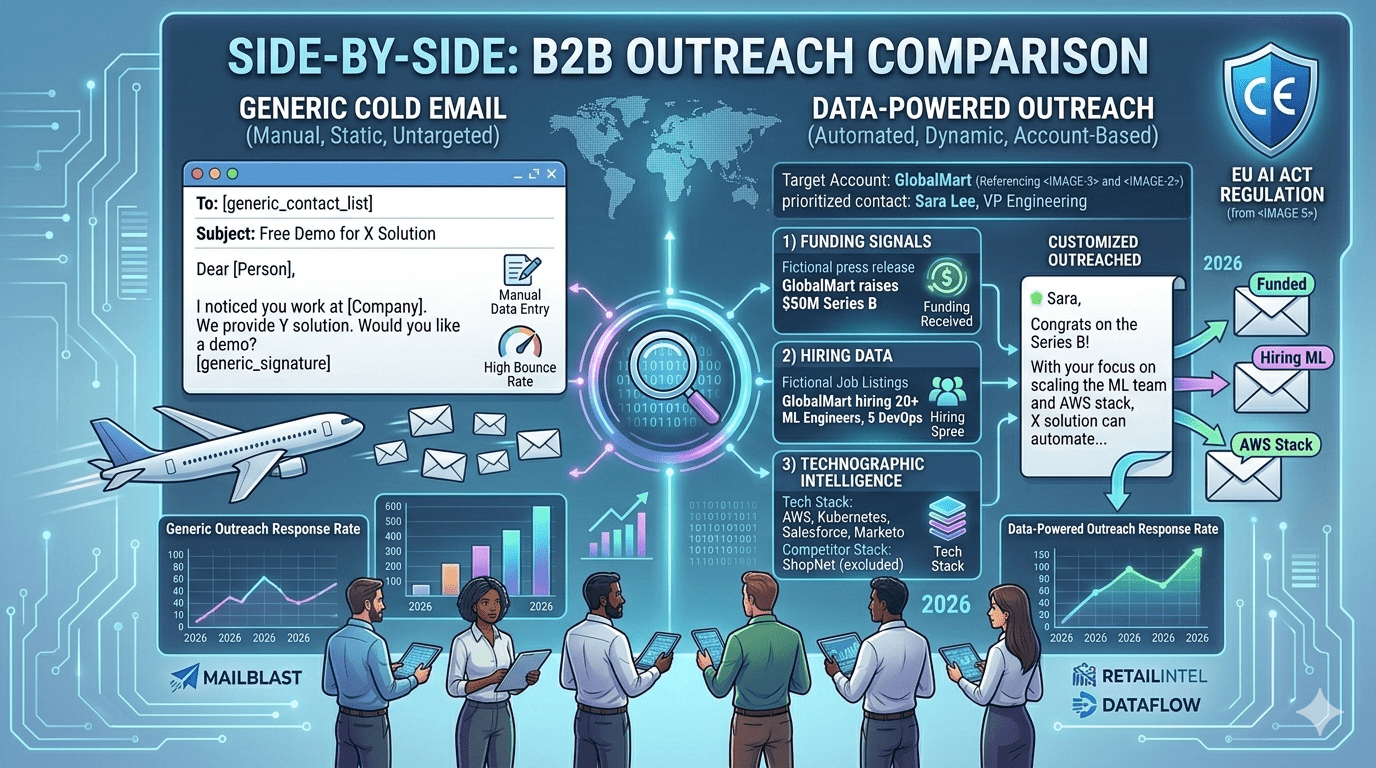
Introduction: Your Sales Pipeline Is Only as Strong as Your Data
Here’s a scenario that every B2B sales leader knows intimately: your team is talented, your product is strong, your pricing is competitive — and yet the pipeline feels like it’s constantly running dry. Reps spend hours manually researching prospects on LinkedIn, copying contact details into spreadsheets, qualifying leads one by one, and still end up working from lists that are 30% outdated before the first email goes out.
The problem isn’t your sales team. The problem is your data.
In 2026, B2B buying has transformed fundamentally. Buyers are more informed, more selective, and harder to reach through generic outreach than at any point in sales history. The bar for relevance in cold outreach has never been higher. And the businesses that are consistently breaking through — filling their pipelines with genuinely qualified prospects, landing meetings with exactly the right decision-makers, and shortening sales cycles from months to weeks — are the ones who’ve solved the data problem at its root.
Their secret weapon? B2B lead generation data scraping.
The global B2B e-commerce market has reached USD 18.97 trillion in 2025 and is projected to grow at a CAGR of 14.5% through 2030. The B2B data market itself — covering the tools, services, and platforms that provide business intelligence for sales and marketing — is on a similarly explosive trajectory, driven by the insatiable demand for accurate, targeted, and timely prospect intelligence that helps sales teams cut through the noise and reach the right buyers.
In this comprehensive guide, we’ll cover everything you need to know about B2B lead generation data scraping in 2026: what it is, what data you can collect, how the most successful sales and marketing teams are using it, the technical realities of doing it right, and exactly how ScraperScoop can build a custom lead generation data operation that transforms your pipeline from anemic to unstoppable.
What Is B2B Lead Generation Data Scraping and Why Does It Matter Now?
B2B lead generation data scraping is the automated process of extracting publicly available business information from websites, online directories, professional networks, company listing platforms, job boards, news sites, and industry publications — and structuring that raw web data into actionable, targeted prospect profiles that sales and marketing teams can immediately use.
Think of it as deploying an always-on digital research team that continuously scans the web for businesses that match your ideal customer profile — extracting their contact details, company information, technology usage, hiring signals, funding events, and decision-maker profiles — and delivering that intelligence to your CRM, sales engagement platform, or marketing automation tool in a clean, structured format.
The B2B Lead Generation Crisis — and Why Data Is the Answer
B2B lead generation is one of the most universal business challenges that exists. Consider the scale of the problem:
- 61% of marketers say generating high-quality leads is their biggest challenge — making lead quality the number one marketing pain point globally.
- The average cost per B2B lead ranges from $31 to over $60 depending on industry and channel — meaning that wasting outreach budget on poorly qualified or outdated contact data is an extremely expensive operational problem.
- B2B contact data decays at approximately 22.5% per year. Purchased contact lists that were accurate when bought become increasingly unreliable over time — leading to bounced emails, misdirected calls, and damaged sender reputation that undermines the entire outreach investment.
- The average B2B sales cycle has grown longer and more complex, with multiple stakeholders involved in purchase decisions across industries — making the quality and depth of prospect intelligence even more critical to sales success.
- Buyer expectations for relevance in outreach have risen dramatically. Generic cold emails with no personalization are deleted immediately. Only outreach that demonstrates genuine understanding of a prospect’s specific situation, challenges, and context earns a response — and building that context at scale requires deep, current, structured data.
These challenges converge on a single insight: the fundamental constraint on B2B sales and marketing performance is not effort — it’s data quality. Sales teams working from accurate, fresh, deeply structured prospect data consistently outperform equally talented teams working from generic purchased lists or manually researched contacts. Web scraping is the technology that makes that data quality advantage achievable at scale.
Web Scraping vs. Buying Lead Lists — Why Fresh Data Wins Every Time
The traditional alternative to scraping-powered lead generation is buying contact lists from data vendors. These lists have several structural weaknesses that make them increasingly ineffective in the modern B2B selling environment:
- Freshness: Purchased lists are snapshots — accurate at a point in time that may be months or years before you receive them. People change jobs. Companies pivot. Decision-makers move on. By the time you’re outreaching from a purchased list, a significant percentage of the contacts are already outdated.
- Exclusivity: The same contact lists are sold to dozens or hundreds of other businesses — meaning your prospects have often already received outreach from multiple companies using the same data, dramatically reducing receptivity.
- Relevance: Generic purchased lists are rarely built around your specific ideal customer profile criteria. They’re segmented by broad industry and job title categories that don’t capture the nuanced firmographic, technographic, and behavioral signals that distinguish your genuine target market from the broader universe.
- Depth: Purchased contact data typically provides basic information — name, email, company, job title — without the contextual intelligence (recent funding, technology stack, hiring patterns, news mentions, growth signals) that enables genuinely personalized, relevant outreach.
Custom web scraping solves all of these problems simultaneously. Scraped lead data is fresh — extracted from live sources at the time of collection. It’s exclusive — built specifically for your ideal customer profile criteria. It’s relevant — targeting the exact business characteristics that define your best customers. And it’s deep — enriched with contextual signals that power personalized outreach that actually converts.
What B2B Lead Data Can You Actually Scrape? A Complete Intelligence Breakdown
The breadth of B2B intelligence available through automated web scraping is far greater than most sales and marketing teams realize. Far beyond basic contact information, modern lead generation scraping captures a rich, multidimensional picture of every prospect — enabling outreach that’s not just targeted but genuinely contextual and personalized.
1. Contact-Level Data
The foundational layer of B2B lead generation data. This includes full names, job titles, seniority levels, department affiliations, professional email addresses, phone numbers where publicly available, and professional profile URLs. Contact-level scraping from business directories, company websites, professional association member pages, conference speaker lists, and publication author pages builds direct access to the specific individuals with purchasing authority or influence for your solution.
The quality distinction here is critical: scraped contact data pulled directly from the prospect’s own professional profile or company website is materially more accurate and current than the same contact sourced from a months-old purchased database. Recency matters enormously in B2B contact data — and scraping delivers it.
2. Company Firmographic Data
Company-level intelligence includes business name, registered address, industry category, employee count range, annual revenue estimates, years in business, ownership structure, subsidiary and parent company relationships, and geographic presence. This firmographic data is the foundation for ideal customer profile matching — filtering the universe of potential prospects down to the companies that genuinely fit your target market parameters before any human time is invested in individual qualification.
3. Technology Stack & Technographic Data
For SaaS companies, technology consultancies, and solution providers of every type, knowing what technology a prospect company currently uses is extraordinarily powerful intelligence. Technographic data — scraped from company websites, job posting technology requirements, developer forums, and technology detection sources — reveals the software, platforms, and infrastructure a company relies on. This intelligence enables you to identify prospects who use competitor solutions (displacement opportunities), companies whose tech stack is complementary to yours (integration opportunities), and businesses whose technology signals indicate readiness for your solution category.
4. Hiring Signals & Job Posting Data
Job postings are one of the most powerful and underutilized sources of B2B buying intent intelligence available. When a company posts a job for a Head of Revenue Operations, they’re almost certainly evaluating CRM and sales engagement platforms. When they post for a Data Engineer, they’re likely investing in data infrastructure. When they post multiple cybersecurity roles simultaneously, a security solution conversation just became significantly more timely. Systematically scraping job posting data from major job boards and company career pages transforms public hiring activity into precise, real-time buying intent signals.
5. Funding & Investment Intelligence
A company that has just closed a Series B funding round is in an active investment and growth phase — making them more receptive to solutions that support scaling, more likely to have budget available for new vendor relationships, and almost certainly under pressure to deploy that capital productively within a specific window. Scraping funding announcement data from startup news sources, investment databases, press release platforms, and business news publications provides a continuous stream of precisely-timed outreach triggers that dramatically improve contact timing and receptivity.
6. Company News & Trigger Events
Leadership changes, office expansions, product launches, regulatory developments, award announcements, partnership deals, and acquisition events all represent outreach triggers that create natural conversation openers and signal organizational change that may create buying windows. Systematically scraping and monitoring news sources, press release platforms, business journals, and industry publications for prospect company mentions delivers a continuous feed of contextual intelligence that powers timely, relevant outreach.
7. Social Presence & Digital Footprint Data
Social media activity, content publication patterns, community platform participation, and speaking engagement histories all provide intelligence about a prospect’s professional interests, content consumption patterns, and current business focus areas. This contextual data enriches contact profiles with the kind of personalization hooks — referencing a piece of content they published, a conference they spoke at, a business challenge they publicly discussed — that separate genuinely personalized outreach from mass spray-and-pray campaigns.
8. Review & Reputation Intelligence
Scraping reviews that prospect companies have written about current vendors on platforms like G2, Capterra, and Trustpilot reveals their exact pain points, the features they value most in vendor relationships, their technology buying process, and the specific gaps in their current solutions. A prospect who has left a G2 review complaining that their current CRM doesn’t integrate with their marketing automation platform is telling you precisely how to position your competing solution — intelligence that transforms generic outreach into surgical, hyper-relevant engagement.
9. Industry Directory & Association Data
Industry trade associations, professional membership directories, conference attendee lists, award program participant lists, and certification databases all contain highly targeted contact and company data for specific professional communities. Scraping these industry-specific sources provides access to verified, community-validated professional contacts that broad platform scraping might miss — and carries the implicit credibility of shared professional context in outreach.
Key Data Sources for B2B Lead Generation Scraping in 2026
Not all data sources deliver equal lead intelligence value. Building a high-performing B2B lead generation scraping strategy means understanding which sources provide the richest, most reliable, most current intelligence for your specific target market — and architecting your collection strategy around those sources.
Company Websites & Career Pages
A company’s own website is the most authoritative source for its current business information — contact details, team members, product offerings, technology stack signals, culture indicators, and operational details. Career pages in particular are intelligence goldmines, surfacing hiring signals, growth priorities, technology requirements, and organizational structure details that no third-party database can match for currency and specificity. Systematically scraping company websites and career pages within your target market provides the freshest, most reliable firmographic and technographic data available.
Business Directories & B2B Platforms
Platforms like Crunchbase, AngelList, G2, Clutch, Yelp Business, and Google Business Profiles aggregate enormous volumes of verified business information — company details, team data, funding histories, customer reviews, and industry classifications — that provide structured starting points for lead list construction. Each platform offers different coverage advantages: Crunchbase excels for startup and funding data, G2 for technology company intelligence, Clutch for professional services firm data, and Google Business Profiles for local business coverage.
Job Boards & Professional Platforms
Indeed, Glassdoor, LinkedIn job listings, and company-specific career portals collectively represent one of the richest sources of business intent intelligence available. The job requirements listed in postings reveal technology stacks, team structures, growth priorities, and operational challenges in extraordinary detail — all of it publicly available and continuously updated as companies evolve their hiring needs. For B2B solution providers whose ideal customers are identifiable through hiring patterns, job board scraping is among the highest-ROI data collection activities available.
News & Press Release Platforms
Business Wire, PR Newswire, TechCrunch, industry trade publications, and regional business journals publish a continuous stream of company announcements that represent outreach triggers — funding rounds, executive appointments, office expansions, product launches, partnerships, and regulatory approvals. Monitoring and scraping these sources for mentions of companies matching your ideal customer profile provides a real-time feed of perfectly-timed sales triggers that dramatically improve outreach relevance and receptivity.
Review & Feedback Platforms
G2, Capterra, TrustRadius, and software review aggregators provide dual-layer intelligence value: firstly, they’re directories of companies in specific technology categories (excellent for competitor displacement prospecting), and secondly, the reviews written by companies reveal detailed intelligence about their current vendor relationships, pain points, and technology buying criteria that power deeply personalized outreach.
Industry-Specific Sources
Trade association membership directories, conference attendee and speaker lists, certification body databases, award program participant lists, and regulatory filing databases all provide highly targeted access to professional communities in specific industries. For solution providers with industry-specific offerings, scraping these specialized sources delivers contact data with significantly higher ideal-customer-profile match rates than general-purpose directory scraping.
E-commerce & Marketplace Platforms
For businesses selling solutions to online retailers, Shopify app store listings, Amazon seller profiles, and marketplace seller directories provide structured access to active eCommerce businesses — with data on platform, product category, scale indicators, and technology usage that enables highly targeted outreach to the right online merchants.
10 High-Impact B2B Lead Generation Data Scraping Use Cases Driving Pipeline Growth
1. Ideal Customer Profile (ICP) List Building at Scale
The most foundational application — and for most B2B businesses, the highest-impact. Rather than purchasing generic segmented lists and hoping enough prospects match your ICP to justify the investment, custom web scraping builds prospect lists that meet your exact ICP criteria from the start: specific industry verticals, employee count ranges, revenue brackets, geographic markets, technology usage, growth stage, and any other firmographic or behavioral signals that define your best-fit customers.
This precision has a compounding effect on the entire sales operation. Higher ICP match rates in the prospect list mean better email open rates, higher meeting conversion rates, shorter qualification cycles, and ultimately faster deals that require less sales cycle time to close. Every incremental improvement in list quality cascades through the entire funnel.
2. Technographic Prospecting for SaaS & Tech Companies
For SaaS companies, technology consultancies, integration providers, and IT solution vendors, technographic intelligence — knowing what technology a prospect currently uses — is the most powerful targeting signal available. Scraping technographic data reveals companies currently using competitor solutions (ideal displacement candidates), businesses whose existing tech stack is the perfect foundation for your integration, and organizations whose technology absence in your category signals they haven’t yet invested — making them either early-stage opportunities or prospects for a category education conversation.
B2B companies using data-driven prospect targeting — including technographic signals — consistently report significant improvements in win rates and sales cycle length compared to those relying on demographic targeting alone. Technology context transforms cold outreach from generic to surgically relevant.
3. Funding Event Trigger Outreach
A freshly-funded company is one of the most universally receptive B2B prospect categories that exists. They have capital to deploy. They’re in growth mode. They’re evaluating new vendors across multiple categories. They’re under pressure to show progress. And they’re making infrastructure and tooling decisions that will define their operations for years to come. Systematically scraping funding announcement data — from news platforms, startup directories, and investor portfolio pages — and triggering outreach within days of a funding event consistently delivers dramatically higher response rates than cold outreach to non-trigger companies.
4. Competitive Displacement Campaigns
Scraping review platforms, job postings, and technology detection sources to identify companies currently using direct competitor solutions builds highly targeted displacement prospect lists. These prospects already understand the category, have already made a budget allocation for a solution like yours, and — if they’re expressing any dissatisfaction signals through reviews or replacement job postings — are actively considering alternatives. Combined with competitive battle cards, this intelligence enables outreach that speaks directly and credibly to the specific pain points your solution solves better than the incumbent.
5. Hiring Signal Prospecting
A company posting multiple roles in a specific function is investing in that area — which creates buying windows for solutions that support it. A company hiring aggressively in sales is evaluating sales engagement tools, CRM platforms, and pipeline intelligence solutions. A company adding data science roles is investing in analytics infrastructure. Systematically scraping job board data and mapping hiring patterns to solution categories creates a continuous stream of precisely-timed, intent-qualified prospects — people who are not just a good demographic fit but who are actively building in the area your solution addresses.
6. Event-Driven & Conference Lead Generation
Industry conferences, trade shows, webinars, and virtual events concentrate exactly the professional communities you want to reach. Scraping conference speaker lists, sponsor directories, exhibitor registrations, and publicly available attendee profiles from event websites provides access to a self-selected community of engaged professionals — all validated as active in your target industry by the very act of participating in the event. Post-event outreach referencing shared participation carries a powerful credibility signal that dramatically improves response rates over purely cold outreach.
7. Geographic Market Expansion Research
When planning expansion into new geographic markets — new cities, new states, or new countries — scraped business directory data provides the market intelligence needed to understand potential customer density, competition landscape, and ideal entry approach before committing resources. How many ICP-fit companies exist in the target market? How are they distributed across sub-segments? Who are the dominant local solution providers they currently use? Scraped market mapping answers all of these questions with data-backed precision before a single sales hire is made or office lease is signed.
8. Account-Based Marketing (ABM) Intelligence
Account-Based Marketing strategies require deep, current intelligence on a carefully curated set of target accounts — not broad market coverage, but deep firmographic, technographic, organizational structure, and trigger event intelligence on each specific target company. Web scraping powers the continuous intelligence refresh that keeps ABM account profiles current and action-ready — surfacing the organizational changes, technology signals, and trigger events that indicate when each target account is moving into an active buying window.
9. Partner & Reseller Network Development
Building distribution and channel partnerships requires finding businesses whose customer base, technology focus, and service offerings make them ideal route-to-market partners. Scraping partner directory listings, technology marketplace profiles, integration ecosystem databases, and consultant certification platforms identifies potential channel partners with a specificity and scale that manual networking cannot approach — building partnership pipeline with the same data-driven rigor that the best companies apply to customer prospecting.
10. Talent Intelligence for Recruiting & HR Tech
For recruiting firms, HR technology vendors, and staffing companies, scraping professional profiles, company career page data, and job board activity provides both the candidate intelligence and the employer intelligence needed to build talent solutions. Understanding which companies are actively hiring (and in what roles), which industries are experiencing talent demand spikes, and which professional communities are most active in specific skill areas transforms the recruiting process from reactive to proactively data-driven.
Building Your Ideal Customer Profile with Web Scraping Data: A Practical Framework
Having access to vast amounts of B2B web data is only as valuable as your ability to use it precisely. The businesses that get the most from lead generation data scraping are those that have invested in defining their Ideal Customer Profile (ICP) with enough specificity to translate it into concrete data collection parameters. Here’s a practical framework for doing exactly that.
Step 1: Define Your ICP Firmographic Parameters
Start with the company-level characteristics that define your best-fit customers: industry verticals (be specific — not just “technology” but “SaaS companies in HR tech”), employee count ranges (the size range that gets maximum value from your solution), geographic markets (which regions or countries you can serve effectively), revenue ranges (if relevant to your solution’s pricing and value proposition), and business model characteristics (B2B vs. B2C, enterprise vs. SMB, product vs. services).
Each of these parameters translates directly into a data collection filter — telling your scraping infrastructure which companies to extract from directory sources and which to skip. The specificity of your ICP definition directly determines the relevance of your prospect list. Vague ICP parameters produce large but poorly-qualified lists. Precise parameters produce smaller but dramatically higher-converting prospect pools.
Step 2: Layer in Technographic Signals
Identify the technology usage patterns that characterize your best customers. Which platforms do they typically use that signal readiness for your solution? Which competitor or adjacent solutions do they commonly have in place? Are there technology absence signals — categories where your best customers haven’t yet invested — that represent opportunity indicators? These technographic criteria become additional scraping filters that dramatically improve ICP match rates.
Step 3: Identify Behavioral and Intent Signals
What actions do companies take that signal they’re entering a buying window for your solution category? Hiring specific roles? Raising funding? Publishing content about challenges you solve? Attending specific conferences? Reviewing competitor solutions on G2? Each of these behavioral signals can be monitored through targeted scraping — creating a continuous stream of intent-qualified outreach triggers that put your sales team in the right conversation at the right moment.
Step 4: Map Contact-Level Targeting Criteria
Within ICP-fit companies, who are the specific individuals with purchasing authority or influence for your solution? Define your target personas by job title, seniority level, department, and functional responsibility. These contact-level criteria define which individuals to extract from company websites, directories, and professional platforms — building prospect profiles that enable outreach directly to the right person, not just the right company.
Step 5: Build a Data Freshness Strategy
B2B contact and company data decays rapidly. People change jobs, companies pivot, funding events happen, and technology stacks evolve. A static list built once and used for months will deteriorate in quality with every passing week. Build a data refresh cadence into your scraping strategy from the start — monitoring key trigger sources continuously, re-validating contact data on a regular schedule, and enriching existing records with new intelligence as it becomes available.
Not sure how to translate your ICP into a concrete scraping strategy? Talk to ScraperScoop’s data experts — we’ve helped businesses across every industry build custom lead generation data operations that consistently deliver high-quality, ICP-matched prospect lists at scale.
From Data to Deals: How Scraped Intelligence Powers Personalized B2B Outreach That Actually Converts
Collecting high-quality B2B lead data is only half the value equation. The other half is using that data to power outreach that’s genuinely relevant, timely, and personalized — outreach that demonstrates you’ve done your homework, understand the prospect’s situation, and have something specific and valuable to offer. Here’s how the best B2B sales teams are using scraped intelligence to transform their outreach from generic to irresistible.
Trigger-Based Outreach Sequences
The single most powerful application of scraped B2B intelligence is triggering outreach at the precise moment a prospect is most receptive. When a scraping system detects that a target company has just announced a funding round, appointed a new CTO, posted multiple roles that signal a technology investment, or published content that addresses a challenge your solution solves — an automated trigger fires a perfectly-timed, contextually-relevant outreach sequence. This is not mass email marketing. This is surgical, data-driven engagement that feels personally researched because it effectively is — except the research was done automatically, at scale, by an automated intelligence system.
Hyper-Personalized First Lines
The first line of a cold email determines whether the rest of it gets read. Scraped intelligence provides an endless supply of genuine personalization hooks: a specific piece of content the prospect recently published, a hiring pattern that’s contextually relevant to your solution, a funding event that creates a natural conversation opener, a G2 review they left that reveals exactly the pain point your solution addresses. These personalization hooks are not artificial — they’re genuine demonstrations of awareness that immediately differentiate your outreach from the dozens of generic messages in a prospect’s inbox every day.
Account-Based Personalization at Scale
For ABM programs targeting specific high-value accounts, scraped intelligence enables the kind of deep account personalization that was previously only achievable by dedicating individual research time to each account. Automated scraping continuously monitors target accounts for news mentions, technology changes, organizational developments, and trigger events — keeping account profiles current and equipping sales reps with fresh, relevant talking points for every outreach touchpoint without requiring manual research.
Multi-Channel Coordinated Outreach
The most effective B2B outreach in 2026 coordinates messaging across email, phone, professional social platforms, and content engagement channels. Scraped intelligence powers this coordination by providing the full contact and behavioral profile needed to design multi-touch sequences that build familiarity and relevance progressively — increasing the probability that the prospect engages with your message across at least one channel through multiple contextually-consistent touchpoints.
B2B Data Scraping Technical Challenges — And How Professional Services Solve Them
Building a high-quality B2B lead generation scraping operation is genuinely complex — more so than it might appear from the outside. Here’s an honest breakdown of the technical and operational challenges involved, and how professional data services address each one.
Challenge 1: Anti-Bot Protection on Major Platforms
The most valuable B2B data sources — professional networking platforms, business directories, and job boards — all deploy sophisticated anti-bot measures that make large-scale automated data collection technically challenging. These include rate limiting, CAPTCHA systems, IP-based blocking, behavioral fingerprinting, and session invalidation that are specifically engineered to prevent automated data extraction at scale. Professional scraping infrastructure addresses these challenges through intelligent proxy rotation, realistic request pacing, browser fingerprint management, and continuous adaptation to evolving defensive measures — delivering reliable data access that in-house teams rarely achieve consistently.
Challenge 2: Data Accuracy and Freshness Validation
Raw scraped contact data inevitably contains errors, outdated information, and formatting inconsistencies that must be identified and corrected before the data is sales-ready. Email address validation — distinguishing live, deliverable addresses from bounced or invalid ones — is particularly important for outbound email sequences, where high bounce rates damage sender reputation and reduce deliverability across the entire domain. Professional data services implement multi-layer validation pipelines that catch and resolve these issues systematically, delivering verified, deliverable contact data rather than raw, uncleaned extracts.
Challenge 3: Deduplication Across Multiple Sources
B2B lead generation typically involves scraping multiple sources — directories, job boards, news platforms, company websites — and aggregating the results into unified prospect profiles. The same company or contact often appears across multiple sources with slightly different name formats, address variations, or contact details. Identifying and deduplicating these duplicate records requires sophisticated entity resolution logic that goes well beyond simple string matching — and getting it wrong results in either duplicate outreach (damaging prospect relationships) or lost records (missing prospects).
Challenge 4: Data Structure Normalization
Business information scraped from different sources arrives in radically different formats. Job titles use non-standard nomenclature. Company size categories differ between platforms. Industry classifications are inconsistent. Phone numbers appear in multiple formats across geographies. Normalizing all of this raw data into a consistent, structured schema that’s compatible with your CRM or sales engagement platform requires systematic transformation logic that must be maintained as source formats evolve.
Challenge 5: Legal and Compliance Navigation
B2B data collection operates in a complex legal and regulatory environment that varies significantly by geography. GDPR in Europe, CCPA in California, and evolving data protection regulations across other jurisdictions all have implications for collecting, storing, and using business contact data. The line between publicly available professional contact information and protected personal data requires careful navigation — particularly for contacts in European markets where GDPR applies broadly to individual professional contact data.
Operating within these constraints requires both legal expertise and technical implementation of consent, storage, and data subject rights management — capabilities that are well beyond the scope of most in-house scraping operations and are built into the operational standards of professional managed data services.
Challenge 6: Scale, Speed, and Infrastructure Cost
Building the infrastructure needed to scrape B2B data at meaningful scale — across multiple sources, multiple geographies, on a continuous refresh schedule — requires substantial engineering investment and ongoing operational overhead. For most businesses, this infrastructure investment is not justified by the marginal benefit of running proprietary scrapers versus partnering with a specialist provider who has already built and optimized that infrastructure across multiple clients. The engineering resources consumed by maintaining in-house scraping operations are almost always more productively deployed on core business differentiation.
All of these challenges reinforce the same conclusion: for most B2B businesses, partnering with a specialist managed data provider delivers dramatically better results at lower total cost than attempting to build and maintain complex scraping infrastructure in-house. Reach out to ScraperScoop today — we’ve solved all of these technical challenges across dozens of B2B client engagements and deliver clean, validated, CRM-ready lead data that your sales team can start using immediately.
The Proven ROI of B2B Lead Generation Data Scraping: Where the Revenue Gets Created
For B2B businesses, the ROI of investing in high-quality lead generation data is among the most directly measurable in the entire marketing and sales technology stack. Here’s where the value gets created — with specific, documented impact metrics:
Pipeline Volume and Coverage
The most immediate impact of automated lead generation data scraping is simply having more of the right prospects in the pipeline. Automated scraping can identify and qualify thousands of ICP-fit companies and contacts that manual research would never surface — dramatically expanding the universe of potential deals without proportionally expanding the headcount required to manage research and qualification. Sales organizations that implement systematic data-driven prospecting consistently report significant pipeline coverage improvements — more total opportunities, more in the right stage, and more aligned with genuine ideal customer profile criteria.
Lead-to-Meeting Conversion Rate Improvements
When outreach is based on fresh, deeply-structured intelligence that enables genuine personalization and perfectly-timed trigger-based engagement, conversion rates from initial outreach to first meeting improve substantially. Personalized email campaigns drive significantly higher reply rates compared to generic cold outreach — and trigger-based outreach timed to specific buyer intent signals (funding events, hiring patterns, technology signals) consistently outperforms even the best personalized cold outreach.
Sales Cycle Compression
Deeper intelligence about prospects before the first conversation enables sales reps to qualify more quickly, position more relevantly, and navigate objections more effectively from the very first touchpoint. Understanding a prospect’s current technology stack, recent business developments, and organizational context before the discovery call means that discovery itself is faster and more substantive — compressing the time from initial contact to qualified opportunity, and from qualified opportunity to closed deal.
Cost Per Qualified Lead Reduction
The economics of data-driven lead generation consistently outperform both purchased list programs and purely manual research approaches. Custom scraped prospect lists eliminate the waste inherent in generic purchased databases — where a significant percentage of contacts are outside ICP parameters, outdated, or duplicated. Better-targeted outreach to ICP-matched, intent-qualified prospects delivers more qualified leads per outreach dollar invested — directly reducing the cost per qualified lead that ultimately determines the commercial efficiency of your entire go-to-market operation.
Revenue Impact of Data Quality on Close Rates
Companies using data-driven sales intelligence report higher win rates across comparable deal sizes — a direct consequence of better prospect qualification, more relevant positioning, and more effective objection handling enabled by deep pre-sale intelligence. The cumulative commercial impact of consistently closing a higher percentage of opportunities — compounded across an entire sales team and a full fiscal year — represents one of the highest-leverage investments a B2B business can make.
The question for B2B businesses in 2026 is not whether investing in high-quality lead generation data delivers ROI — the evidence is overwhelming that it does. The question is how to build a data operation that delivers consistently high-quality, current, ICP-matched prospect intelligence at a cost and operational overhead that makes sense for your business. That’s exactly the problem ScraperScoop is built to solve.
B2B Data Scraping, GDPR, CCPA & Compliance: What You Need to Know
Any serious discussion of B2B lead generation data scraping must address the legal and ethical framework within which it operates. This is not a minor footnote — it’s a genuinely complex area that requires careful attention, particularly for businesses operating in or reaching prospects in European and California markets.
What Data Is Generally Fair Game for B2B Scraping
Publicly available professional information that individuals have deliberately published in a professional context — business email addresses listed on company websites, job titles on professional profiles, company information in business directories — occupies different legal territory than personal consumer data. In many jurisdictions, this type of deliberately-published professional contact information is considered fair game for B2B outreach purposes.
However, the legal landscape is nuanced and jurisdiction-specific, and the appropriate collection, storage, and use of even publicly available professional data is subject to regulatory frameworks that vary significantly across markets.
GDPR Considerations for European Prospect Data
GDPR applies to the personal data of individuals in European Economic Area countries — and professional contact information (work email addresses, direct phone numbers) is generally considered personal data under GDPR. This creates legitimate interest requirements for B2B outreach, data minimization obligations, right-to-be-forgotten compliance infrastructure, and transparency requirements about how data was collected and how it will be used. Operating a B2B lead generation program that reaches European prospects without a compliant data governance framework is a significant regulatory risk.
CCPA and U.S. State Privacy Law Considerations
California’s Consumer Privacy Act (CCPA) and the evolving landscape of U.S. state privacy legislation create opt-out and disclosure obligations for businesses collecting and using personal information of California residents. While CCPA’s application to B2B contact data has specific nuances, the trend across U.S. state legislation is toward broader data subject rights — making compliance infrastructure increasingly important for U.S.-market lead generation operations.
Building a Compliance-First B2B Data Operation
The practical steps for responsible B2B data scraping compliance include: collecting only data that is genuinely publicly available and professionally published, maintaining records of data sources and collection dates for transparency and audit purposes, implementing opt-out and data deletion request handling infrastructure, applying data minimization principles — collecting only the specific fields needed for legitimate outreach purposes, and consulting legal counsel on jurisdiction-specific requirements before deploying B2B contact data collection programs at scale.
At ScraperScoop, compliance is not an afterthought — it’s built into every data collection operation we design and execute. Our compliance-first approach ensures that the B2B lead data we deliver is collected responsibly, documented appropriately, and suitable for use within legally sound outreach programs.
How AI Is Supercharging B2B Lead Generation Data Scraping in 2026
The integration of artificial intelligence into B2B lead generation data collection and qualification is accelerating at a pace that’s making 2024-era approaches look primitive. Here’s what AI has changed — and why it matters fundamentally for the quality and efficiency of data-driven B2B prospecting.
AI-Powered Lead Scoring and Qualification
Machine learning models trained on historical conversion data can automatically score scraped prospect data — assigning probability-of-conversion estimates based on the combination of firmographic, technographic, and behavioral signals associated with closed deals. This automated scoring enables sales teams to prioritize outreach effort toward the highest-probability opportunities rather than working through prospect lists sequentially — dramatically improving the efficiency of every rep-hour invested in outreach.
Natural Language Processing for Intent Detection
NLP models applied to scraped text data — job postings, news articles, blog content, review text, social media posts — can detect buying intent signals that are invisible to keyword-based filtering. A company doesn’t need to say “we’re evaluating CRM platforms” for NLP analysis to detect signals that suggest precisely that — the combination of specific role descriptions, technology mentions, and content topics that collectively indicate an active evaluation process. This intent detection capability transforms the raw volume of text data available through web scraping into a refined stream of high-probability opportunities.
Automated Data Enrichment
AI-powered enrichment pipelines automatically augment basic scraped contact and company data with additional intelligence from multiple sources — social profiles, news mentions, technology signals, funding data — building richer prospect profiles without manual research. What previously required a research analyst to manually enrich each record across multiple tools is now handled automatically by intelligent enrichment pipelines that run continuously, keeping prospect profiles current as new information becomes available.
Predictive Pipeline Intelligence
The next generation of AI-powered B2B data tools goes beyond enriching existing prospect profiles to predictively identifying companies that are most likely to enter a buying window in the coming weeks or months — before those companies have shown obvious intent signals. This forward-looking intelligence — derived from pattern recognition across historical conversion data, market trend analysis, and real-time trigger monitoring — represents the cutting edge of competitive advantage in B2B sales and marketing.
Generative AI for Outreach Personalization
Combining scraped prospect intelligence with generative AI enables automated creation of genuinely personalized outreach messages at scale — drafting first lines, subject lines, and full email sequences that reference specific, accurate details about each prospect’s situation. This capability bridges the gap between the quality of bespoke manual outreach and the scale of automated campaigns — enabling sales teams to maintain personalization standards across thousands of simultaneous outreach sequences without proportional increases in rep time investment.
B2B Lead Generation Data Scraping Best Practices: Building a Pipeline Machine That Scales
1. Define ICP Criteria with Surgical Specificity
Generic ICP definitions produce generic lead lists. Before designing any scraping strategy, invest the time to define your ideal customer profile with genuine specificity — the exact industry sub-verticals, employee count ranges, technology characteristics, growth stage signals, and geographic parameters that describe your best current customers. The more precisely you define the ICP, the more relevant every scraped lead will be — compounding positive effects across the entire funnel from outreach open rates to ultimate close rates.
2. Build Multi-Source Coverage from the Start
No single data source provides complete coverage of your target market. Relying on a single directory or platform produces incomplete lists that miss significant percentages of ICP-fit prospects. Build your data collection architecture to pull from multiple complementary sources — combining directory coverage, job board intent signals, news trigger monitoring, and review platform intelligence into a unified, multi-dimensional prospect intelligence stream from day one.
3. Implement Continuous Freshness Management
B2B contact data decays at approximately 22.5% per year — meaning that a list built once and used for twelve months will be significantly degraded in accuracy by the time it’s exhausted. Build data refresh cycles into your lead generation operation from the beginning: re-validating email addresses, monitoring for job change signals that indicate contact data updates, and continuously adding newly-identified ICP-fit prospects to replace attrited records. Fresh data is profitable data. Stale data wastes sales effort and damages sender reputation.
4. Validate Before You Outreach
Email validation — confirming that scraped addresses are deliverable before including them in outreach sequences — is a non-negotiable operational standard for maintaining healthy sender reputation and deliverability across your entire domain. A single batch of outreach to a large volume of invalid addresses can permanently damage the deliverability of your entire email domain — undermining your entire outreach program, not just the bad batch.
5. Segment Intelligently Before Activating
Not all ICP-fit prospects warrant identical outreach. Segment your scraped prospect lists by relevant differentiating signals — technology stack, growth stage, trigger event type, seniority level, intent signal strength — and craft outreach messaging tailored to each segment’s specific context. The same product solves slightly different problems for a Series A startup versus a 500-person enterprise, and outreach that acknowledges that contextual difference converts at dramatically higher rates than one-size-fits-all messaging.
6. Integrate Data Directly Into Your Sales Stack
Lead data that lives in spreadsheet files disconnected from your sales workflow drives minimal action. Connect scraped lead intelligence directly to your CRM, sales engagement platform, or marketing automation tool — enabling sales reps to act on new leads immediately, trigger sequences automatically based on data signals, and keep prospect profiles current without manual data entry overhead. The easier it is to act on scraped intelligence, the more consistently your team will do so.
7. Measure, Iterate, and Continuously Optimize
Track conversion rates at every stage of the funnel — from scraped record to outreach, from outreach to response, from response to meeting, from meeting to qualified opportunity — broken down by data source, prospect segment, and outreach approach. These metrics reveal which data sources produce the highest-quality leads, which ICP criteria most strongly predict conversion, and which outreach strategies perform best with different prospect profiles. Continuous iteration based on conversion data compounds lead quality improvements over time into a sustainable pipeline advantage.
How ScraperScoop Powers B2B Lead Generation for Sales Teams & Growth Companies
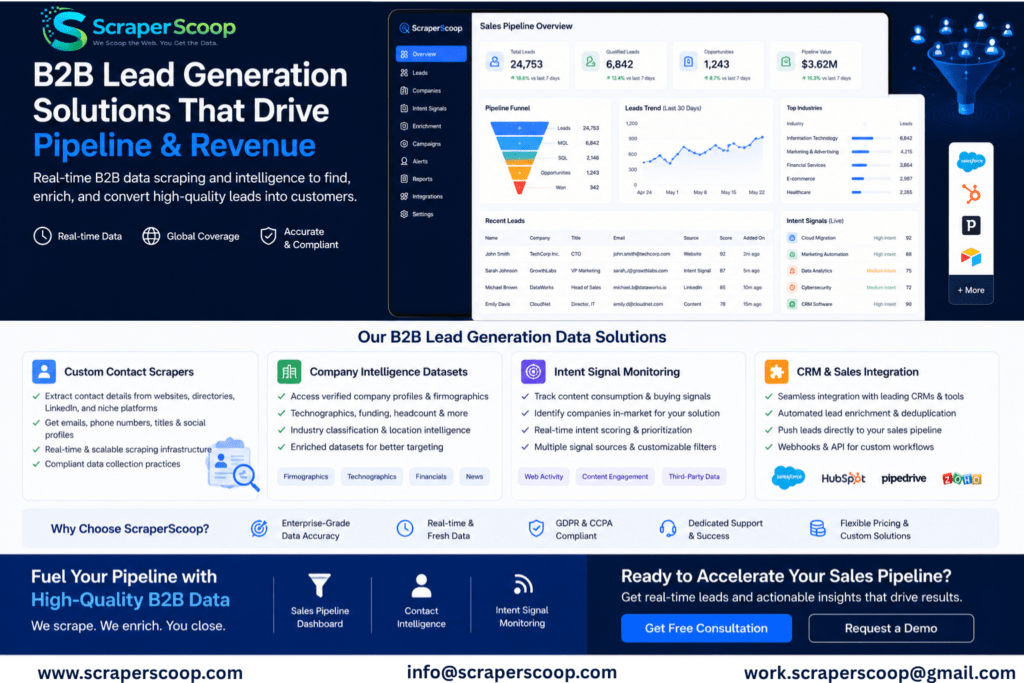
At ScraperScoop, we believe that every B2B business — regardless of size or budget — deserves access to the same quality of prospect intelligence that enterprise sales organizations have traditionally enjoyed.
Here’s precisely what ScraperScoop delivers for B2B lead generation clients:
- ✅ Custom ICP-Targeted Lead Scrapers: Purpose-built data extractors designed around your exact ideal customer profile parameters — industry, company size, geography, technology stack, and any other firmographic or technographic criteria that define your target market — delivering pre-qualified prospect lists from day one.
- ✅ Multi-Source Contact Intelligence: Comprehensive contact data collection across business directories, company websites, job boards, industry platforms, and news sources — building unified, multi-dimensional prospect profiles that enable genuinely personalized outreach.
- ✅ Intent Signal Monitoring: Continuous monitoring of funding events, hiring patterns, leadership changes, technology adoption signals, and news triggers across your target account universe — delivering a real-time stream of perfectly-timed outreach triggers.
- ✅ Technographic Intelligence: Technology stack detection and competitor usage monitoring that powers displacement campaigns, integration opportunity prospecting, and technology-context personalization for SaaS and tech solution providers.
- ✅ Ready-Made B2B Datasets: Need qualified prospect data fast? Our pre-built B2B datasets across major industries, company size segments, and geographic markets give you immediate access to validated contact intelligence without development lead time.
- ✅ Lead Enrichment APIs: Integrate our enrichment feeds directly into your CRM or sales engagement platform — automatically augmenting existing prospect records with fresh firmographic, technographic, and trigger event intelligence.
- ✅ Email Validation & Data Quality: Built-in validation pipelines that verify email deliverability, identify duplicates, and normalize data formats before delivery — ensuring your outreach sequences start with clean, ready-to-use contact data.
- ✅ Analytics Dashboards: Visual intelligence dashboards that show prospect pipeline composition, data quality metrics, intent signal distributions, and lead source performance — giving your sales leadership complete visibility into the health and quality of your prospecting data operation.
- ✅ Custom Delivery Formats: CSV, JSON, CRM-native imports, API delivery, or direct database integration — we deliver data in whatever format slots seamlessly into your existing sales and marketing technology stack.
- ✅ Compliance-First Operations: All ScraperScoop B2B data collection is conducted on publicly available professional information, within ethical and legally sound operational frameworks, with full documentation of data provenance and collection methodology.
- ✅ Ongoing Freshness Management: Not a one-time delivery — a continuous data partnership. We refresh your prospect data on schedules matched to your outreach cadence, ensuring your pipeline is always working from the most current available intelligence.
Ready to Fill Your B2B Pipeline with High-Quality, Data-Driven Leads?
Your competitors’ sales teams are already working from better data than you think. They’re identifying ICP-fit prospects before you. They’re reaching decision-makers with perfectly-timed, trigger-based outreach while you’re still sending generic cold emails. They’re closing deals faster because they know more about every prospect before the first conversation starts.
The intelligence gap is real. And it compounds every single month.
B2B businesses that invest in high-quality, continuously-refreshed, ICP-targeted prospect data consistently outperform those relying on purchased lists, manual research, or outdated databases — across pipeline volume, conversion rates, sales cycle length, and ultimately revenue growth.
At ScraperScoop, we deliver:
- ✅ Custom ICP-Targeted Prospect Lists built to your exact ideal customer profile criteria
- ✅ Real-Time Intent Signal Monitoring across funding events, hiring patterns & news triggers
- ✅ Technographic Intelligence for SaaS displacement and integration prospecting
- ✅ Validated, Deliverable Contact Data ready for immediate outreach activation
- ✅ Multi-Source Intelligence from directories, job boards, news, and review platforms
- ✅ Ready-Made B2B Datasets for instant pipeline building
- ✅ Lead Enrichment APIs for seamless CRM integration
- ✅ Analytics Dashboards with full pipeline and data quality visibility
- ✅ Continuous Data Freshness matched to your outreach cadence
- ✅ Compliance-First Operations for sustainable, long-term lead generation
🚀 Let’s Build Your B2B Pipeline Advantage — Starting Right Now
Stop working from stale lists and generic purchased data. Start closing deals with intelligence that actually works.
Contact ScraperScoop today for your free consultation → Tell us about your ideal customer profile, your target markets, the sales triggers that matter most to your business, and what pipeline goals you’re working toward — and we’ll design a custom B2B lead generation data solution that delivers results from day one.
Conclusion: In 2026, Pipeline Quality Is a Data Problem — Solve It with Web Scraping
The B2B sales and marketing landscape in 2026 is more competitive, more data-intensive, and more demanding of outreach relevance than at any point in history. Buyers are better informed and harder to reach. Generic outreach gets deleted instantly. And the sales teams winning consistently — filling pipelines with qualified opportunities, shortening cycles, and closing at higher rates — are the ones who’ve fundamentally solved the data problem at the core of their go-to-market operation.
B2B lead generation data scraping is how they’ve done it. Custom-built ICP-targeted prospect lists that are fresh, deeply structured, and enriched with intent signals. Trigger-based outreach that reaches decision-makers at precisely the right moment. Technographic intelligence that enables competitive displacement and integration positioning. Multi-source account intelligence that powers ABM programs with continuous, current data refresh.
The technology is mature. The ROI is proven. The competitive advantage of operating from better data than your competitors compounds every single quarter. And the right partner — one who has solved all the technical complexity of building and maintaining reliable, compliant, high-quality B2B data pipelines — makes implementation far faster and more cost-effective than building from scratch.
ScraperScoop is that partner. Accurate, validated, ICP-targeted B2B lead intelligence — delivered continuously, at scale, tailored to your exact business needs.
👉 Get in touch with ScraperScoop now — and let’s turn B2B web data into your most powerful pipeline growth engine.
Frequently Asked Questions About B2B Lead Generation Data Scraping
What is B2B lead generation data scraping?
B2B lead generation data scraping is the automated process of extracting publicly available business information — contact details, company firmographics, technographic signals, hiring patterns, funding events, and trigger data — from websites, business directories, job boards, news platforms, and professional databases. This structured intelligence is used by sales and marketing teams to build targeted prospect lists, power personalized outreach campaigns, and fill B2B sales pipelines with high-quality, ICP-matched leads.
Is B2B lead generation data scraping legal?
Scraping publicly available professional contact and company information is generally legal in many jurisdictions, but it operates in a complex regulatory environment. GDPR in Europe, CCPA in California, and evolving data protection regulations across other markets all have implications for collecting, storing, and using business contact data. ScraperScoop operates with a compliance-first approach, collecting only publicly available professional information and helping clients navigate relevant regulatory requirements. Always consult legal counsel for your specific use case and target markets.
How is web scraping for B2B leads better than buying contact lists?
Custom web scraping delivers fresher, more targeted, more exclusive, and more contextually rich prospect intelligence than purchased contact lists. Scraped data is built specifically around your ICP criteria, collected from live sources at the time of extraction, not shared with other buyers, and enriched with intent signals and contextual intelligence that enables genuinely personalized outreach. Purchased lists are typically months old, broadly segmented, sold to multiple buyers, and lacking the depth of intelligence that drives high outreach conversion rates.
What types of B2B businesses benefit most from lead generation data scraping?
Virtually every B2B business benefits from high-quality prospect data, but the highest-impact users include SaaS and technology companies (technographic prospecting and competitive displacement), professional services firms (firmographic targeting and event-driven outreach), startups and scale-ups (efficient pipeline building with limited sales resources), enterprise sales organizations (ABM account intelligence), and recruiting and HR technology companies (hiring signal and talent market intelligence). If your business sells to other businesses, data-driven prospecting improves your results.
How can technographic data improve my B2B outreach?
Technographic data — knowing what technology a prospect company currently uses — enables you to target the prospects most likely to buy your solution: companies using competitor tools (displacement opportunities), businesses whose existing tech stack integrates with yours (integration opportunities), and organizations whose technology gaps signal readiness for your solution category. This technology context allows you to craft outreach that speaks directly to a prospect’s specific situation rather than generic benefits, dramatically improving relevance and conversion rates.
What are the most powerful B2B sales trigger signals to monitor through scraping?
The highest-value B2B sales triggers include funding announcements (freshly-funded companies are in active investment mode), leadership changes (new decision-makers evaluate vendors in the first 90 days), hiring patterns that signal investment in areas your solution addresses, technology changes that create integration or displacement opportunities, and news events like expansions, product launches, or regulatory developments that create natural conversation openers. Monitoring these triggers through continuous web scraping and activating outreach within days consistently delivers significantly higher response rates.
How often should B2B lead data be refreshed through scraping?
B2B contact data decays at approximately 22.5% per year — meaning continuous refresh is essential for maintaining data quality. For trigger monitoring (funding events, hiring signals, news), real-time or daily scraping is ideal. For contact data validation and firmographic refresh, monthly or quarterly cycles typically maintain acceptable quality. For building new prospect lists in specific target segments, triggered collection aligned with sales campaign planning cycles works well. ScraperScoop helps design the optimal refresh strategy for your specific outreach cadence and data quality requirements.
Why should I choose ScraperScoop for B2B lead generation data?
ScraperScoop provides custom ICP-targeted B2B contact data scrapers, ready-made prospect datasets, intent signal monitoring, technographic intelligence, lead enrichment APIs, and analytics dashboards — all built around your specific ideal customer profile and sales intelligence needs. We handle all the technical complexity of multi-source data collection, validation, normalization, and compliance, delivering clean, CRM-ready prospect data that your sales team can start using immediately. Contact us for a free consultation.


