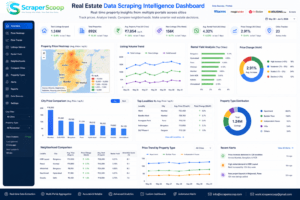
Crawl the web at any scale — millions of URLs, zero servers to manage
Discover and download web pages across thousands of domains with our managed, distributed crawler. Built‑in politeness, duplicate filtering, and incremental recrawling keep your dataset fresh — while you stay focused on the data, not the infrastructure.
domains: "news-sites.txt"
max_urls: 50000000
politeness_delay: "2s per domain"
dedup: simhash + url‑canonicalization
delivery: "s3://acme‑crawls/news/"
12.4M URLs queued
2s per domain active
Trusted data from leading platforms







Massive crawling, simplified
Large‑scale web crawling is the automated process of discovering and fetching web pages at immense volume — from a single domain to the entire open web. Our managed crawler handles URL discovery (sitemaps, RSS feeds, link following), enforces politeness policies, deduplicates content, and delivers either raw HTML or structured extracts to your data lake. No server clusters to maintain, no Scrapy config to debug, no queue management.
Whether you need a fresh snapshot of 10,000 news sites every hour, or a deep crawl of an entire industry vertical, our infrastructure scales horizontally to match your throughput — automatically — while staying friendly to the sites you crawl.
- Discover URLs from sitemaps, RSS, and link graphs
- Respects robots.txt and site‑specific crawl delays
- Duplicate detection via SimHash and canonical URL mapping
- Incremental recrawling with ETag/Last‑Modified support
- Delivered to S3, Snowflake, BigQuery, or your own storage
Why building your own crawler becomes a full‑time job
What starts as a simple script quickly turns into an ops nightmare when scale, politeness, and data quality collide.
URL discovery is a fractal problem
Finding every page on a site requires parsing sitemaps, following links, handling infinite scroll, and respecting crawl budgets. A basic wget misses most of the content.
Politeness at scale is hard
Overloading a small site can get your IP banned. Juggling delays across thousands of domains requires a sophisticated, distributed scheduler — not a simple sleep() call.
Duplicate content wastes storage and compute
Without near‑duplicate detection, up to 30% of crawled pages are identical or boilerplate. Our SimHash and canonical‑URL filters strip them before delivery.
A production‑grade crawler you never have to build
Every feature below runs inside our infrastructure, maintained 24/7.
Intelligent URL discovery
Ingest seed lists, sitemaps, RSS feeds, and link‑frontier traversal to build a comprehensive crawl frontier — automatically expanding to cover every relevant page.
Politeness & compliance engine
Respects robots.txt, Crawl‑Delay, and site‑specific rate limits. Concurrency and delays are enforced per domain, and we use diverse IP pools to spread load.
Near‑duplicate detection
SimHash and canonical‑URL filtering remove boilerplate, identical pages, and mirrors — reducing storage costs and keeping your dataset signal‑rich.
Incremental recrawl
After the initial crawl, we re‑fetch only pages that have changed (based on ETag, Last‑Modified, or content hash) — keeping your dataset fresh without re‑crawling the entire web.
{
"queued_urls": 12400000,
"discovered_today": 820000,
"duplicates_removed": 142000,
"politeness_mode": "per‑domain (2s delay)"
}
From seed URLs to a complete dataset
Seed & scope definition
We agree on seed domains, crawl depth, exclusions, and politeness settings — producing a crawl specification document.
Crawler configuration & dry run
Our team provisions the crawl infrastructure, runs a limited test, and delivers a sample of fetched pages for your review.
Full‑scale crawl execution
The crawl runs at your target throughput. Data is delivered incrementally to your storage, with live monitoring of frontier size and success rate.
Incremental refresh & ongoing management
We switch to scheduled incremental recrawls. Our team monitors site changes, updates politeness rules, and ensures data freshness.
Deliverables at each stage of a crawl project
Crawl specification & seed list
A document defining the seed URLs, crawl rules, politeness constraints, and output format — reviewed and approved by your team.
Sample crawl dataset (10K pages)
A representative subset of crawled pages delivered in your chosen format and location. You validate data quality and completeness.
Full‑scale crawl + delivery runbook
All target URLs crawled and delivered. A runbook covers incremental refresh cadence, duplicate handling, and politeness settings.
Weekly crawl health report
Summary of URLs discovered, fetched, deduplicated, and any site‑side changes that required politeness adjustments — proactively shared.
Pay for the URLs you need, not the servers you imagine
One‑Time Crawl
For a one‑off bulk download of a defined set of domains — ideal for research or baseline datasets.
- Fixed scope & price
- Single delivery of all pages
- Includes dedup & politeness
Managed Crawl Pipeline
Ongoing crawling with scheduled recrawls, incremental updates, and full maintenance — hands‑off for your team.
- Weekly or daily recrawls
- Incremental change detection
- Dedup & politeness managed
Enterprise Crawl Program
For massive crawl volumes, custom discovery rules, private storage delivery, and dedicated support.
- Unlimited domains & URLs
- Custom discovery & politeness rules
- SSO, audit logs, quarterly reviews
Teams that build products or models on web data
News & Media Monitoring
Crawl 100,000 news domains every few minutes — feed raw HTML into NLP pipelines for sentiment and trend analysis.
AI & Machine Learning
Gather massive training corpora from the open web — filtered, deduplicated, and delivered in a clean, ML‑ready format.
Search & Discovery
Power your own search index by crawling relevant verticals — fresh, comprehensive, and compliant with robots.txt.
Competitive Intelligence
Monitor competitors' entire websites — track content changes, new pages, and SEO updates automatically.
Large‑scale crawling vs. DIY approaches
| Capability | Managed Large‑Scale Crawling | Self‑Built Crawler (Scrapy, etc.) | Self‑Serve API (no discovery) |
|---|---|---|---|
| URL discovery (sitemaps, RSS, links) | |||
| Politeness & robots.txt compliance | |||
| Near‑duplicate detection | |||
| Incremental recrawl support | |||
| Infrastructure to manage | None | Full cluster | None |
| Time to first complete crawl | 2–3 weeks | Months | N/A (no discovery) |
“Our crawl coverage doubled, and our infrastructure costs halved”
"We needed to crawl 50,000 news sites every 15 minutes. Building that in‑house would have required a team of 3 and a fleet of servers. ScraperScoop had it running in two weeks — and the data quality is better than our old Scrapy cluster."
"The SimHash deduplication alone saved us 40 TB of storage. We didn't realise how much boilerplate we were downloading — now our dataset is clean and our training costs have dropped."
"The politeness engine is what sold us. We'd been blocked by several sites using our own crawler. Their team set domain‑specific delays and proxy pools — now we crawl everything without a single block."
Crawled data delivered to your storage — no extra tools needed
Raw HTML, WARC files, or structured extracts — delivered directly to your cloud storage or warehouse.
Get a scoped estimate for your crawl project
Share your seed domains and the crawl depth — we'll return a cost and timeline within two business days.
Questions about large‑scale crawling
Your first million URLs crawled — free, no commitment
Send us a list of seed domains and we'll crawl a sample and deliver the data to your S3 bucket. See the quality, coverage, and deduplication before you commit.
Most crawl pipelines deliver the first full dataset within 2–3 weeks.