

Real Estate Data Scraping in 2026: The Complete Guide to Property Intelligence, Price Monitoring, Market Analysis & Investment Insights
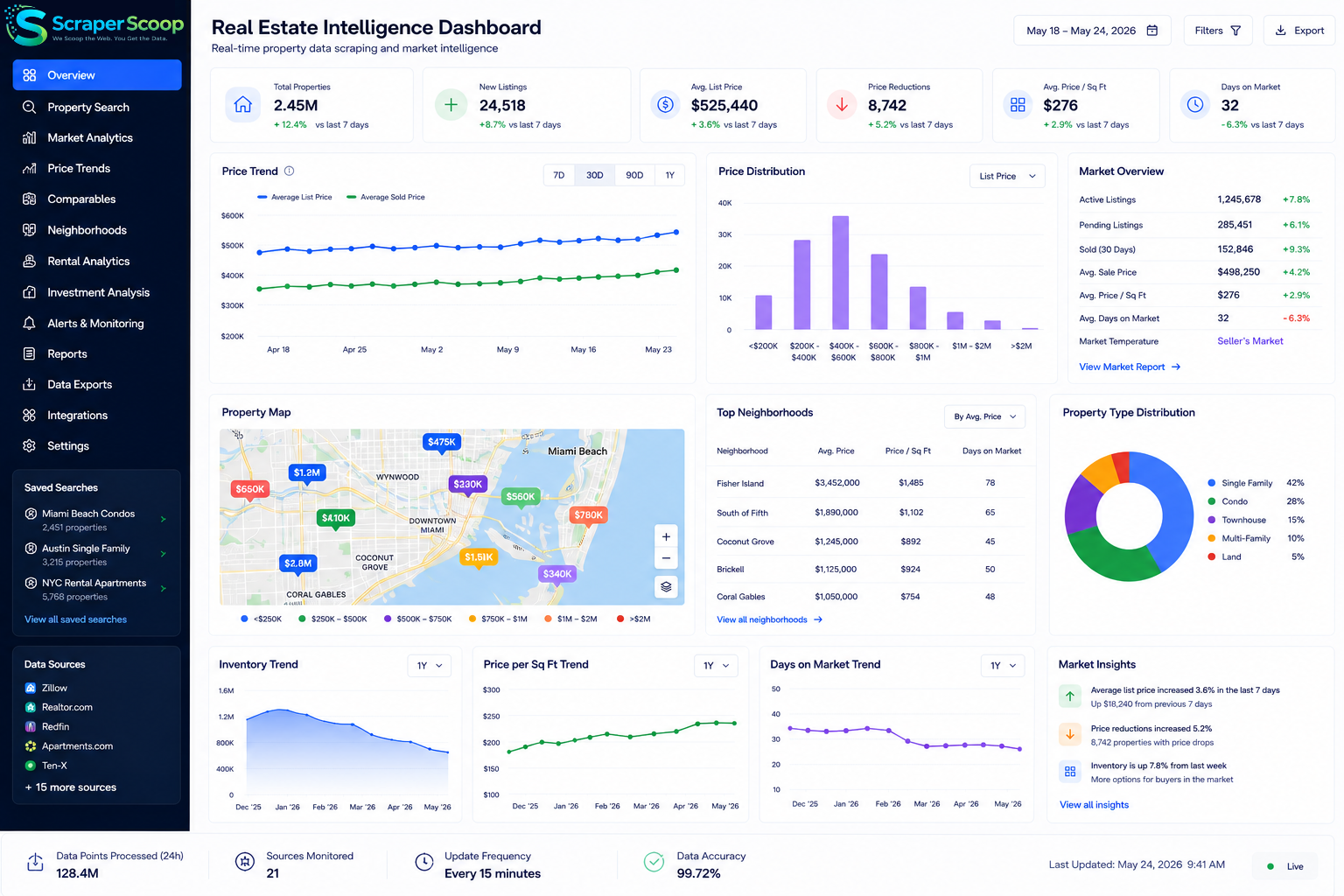
📑 Table of Contents
- Introduction: Why Real Estate Data Is the New Gold Rush
- What Is Real Estate Data Scraping?
- Why Property Data Scraping Matters in 2026
- Types of Real Estate Data You Can Extract
- Top 10 Use Cases for Real Estate Data Scraping
- Major Platforms for Property Data Extraction
- Property Price Monitoring: A Deep Dive
- Building Investment Intelligence with Scraped Data
- Common Challenges & How to Overcome Them
- Best Practices for Real Estate Data Scraping in 2026
- Why ScraperScoop for Real Estate Data
- Getting Started: Your Next Steps
- FAQ: Real Estate Data Scraping
Introduction: Why Real Estate Data Is the New Gold Rush
Picture this: A real estate investment firm in New York spots a pricing anomaly in the Phoenix housing market at 6:47 AM on a Monday. By 9 AM, they've made offers on 12 undervalued properties — all identified through automated real estate data scraping systems that monitor 50,000+ listings across the Southwest in real time. By the time competitors notice the opportunity, it's already gone.
This isn't science fiction. It's happening right now, every single day, across every major real estate market in the world. The firms that win aren't necessarily the ones with the most capital — they're the ones with the best data.
In 2026, the global real estate market is valued at over $380 trillion — the largest asset class on Earth. With millions of properties changing hands annually and prices fluctuating by the hour in hot markets, the margin between a great investment and a missed opportunity often comes down to one thing: who has better property intelligence.
That's exactly what this comprehensive guide is about. Whether you're a real estate investor hunting for deals, a PropTech startup building market analytics, a mortgage lender assessing risk, or an agent looking to serve clients better — this 2000+ word deep dive will show you exactly how real estate data scraping can transform your business in 2026 and beyond.
What Is Real Estate Data Scraping?
Real estate data scraping is the automated process of extracting structured property information from online sources — listing portals, MLS databases, county records, rental platforms, and more. Instead of manually browsing thousands of listings and copying data into spreadsheets (an impossible task at scale), specialized web scraping services deploy intelligent bots that collect this data automatically, accurately, and at massive scale.
Think of it as giving your real estate operation X-ray vision: the ability to see every listing, every price change, every market shift across your entire target geography — updated continuously, structured in clean formats, and ready for analysis.
The data extracted typically includes property addresses, listing prices (asking and sold), square footage, bedrooms/bathrooms, lot size, property type, year built, listing history, days on market, agent information, photos, neighborhood data, school ratings, and much more. This raw data is then cleaned, validated, and delivered through real-time data & APIs or structured file formats like CSV and JSON.
Why Property Data Scraping Matters in 2026
The real estate landscape in 2026 is fundamentally different from even five years ago. Here's why property data extraction has become non-negotiable for serious players:
🔹 Markets Move Faster Than Ever
In competitive markets, properties receive multiple offers within hours of listing. Institutional buyers using automated systems can identify and bid on properties before individual investors even see them. Real estate price data extraction at scale is the only way to compete.
🔹 iBuyers & PropTech Have Raised the Bar
Companies like Opendoor, Offerpad, and Zillow's former iBuying operation proved that data-driven real estate at scale is possible. Now every serious investor needs similar capabilities. The question isn't whether to use data — it's whether you have better data than your competitors.
🔹 Alternative Data Drives Alpha
Traditional real estate data (MLS listings, public records) is available to everyone. The edge comes from combining it with alternative data sources — rental yields, neighborhood sentiment, permit filings, economic indicators — all extracted through market research & competitive analysis scraping.
🔹 Remote & Cross-Market Investing Is the Norm
Investors increasingly buy properties in markets they've never visited. Data replaces boots-on-the-ground knowledge. Comprehensive scraped data from local listing sites, rental platforms, and neighborhood resources makes remote due diligence possible at scale.
Types of Real Estate Data You Can Extract
Understanding what data is available is the first step to building a powerful property intelligence system. Here are the most valuable categories of real estate data that businesses extract in 2026:
Property Listing Data
Addresses, prices, photos, descriptions, bed/bath counts, square footage, lot size, property type, year built, and listing status. The foundation of property listings data extraction.
Pricing & Valuation Data
Asking prices, sold prices, price per square foot, price history, days on market, price reductions, and automated valuation estimates (AVMs).
Rental & Income Data
Rental listings, monthly rents, lease terms, vacancy rates, rental yield calculations, and short-term rental performance. Essential for rental data scraping services.
Location & Neighborhood Data
School ratings, crime statistics, walkability scores, nearby amenities, demographic data, and neighborhood trends.
Agent & Brokerage Data
Agent names, contact information, transaction history, listings managed, brokerage affiliations, and performance metrics.
Public Records Data
Ownership records, tax assessments, permit history, liens, foreclosure filings, and transaction history from county databases.
Top 10 Use Cases for Real Estate Data Scraping
Let's get specific. Here are the ten most powerful ways businesses are using real estate data scraping services to find deals, reduce risk, and outsmart competitors:
Deal Flow & Opportunity Identification
Monitor thousands of listings across multiple platforms simultaneously. Identify underpriced properties, motivated sellers (price reductions, high days on market), and off-market opportunities before competitors see them. Automated alerts notify your team the moment a matching property hits the market.
Comparative Market Analysis (CMA)
Generate accurate property valuations by analyzing comparable sales, active listings, and pending transactions in real time. Agents use this for pricing recommendations; investors use it for offer calculations. Scraped data ensures your CMAs use the freshest available information.
Rental Yield & Cash Flow Analysis
Combine property listing prices with rental data to calculate potential yields instantly. Rental data scraping from platforms like Zillow Rentals, Apartments.com, and Craigslist provides the rental side of the equation across any market.
Short-Term Rental (STR) Investment Analysis
Extract performance data from Airbnb, VRBO, and Booking.com to estimate potential STR income for any property. Our Airbnb data scraping service provides occupancy rates, nightly rates, reviews, and revenue estimates by neighborhood.
Market Trend & Cycle Analysis
Track macro market indicators over time — median prices, inventory levels, days on market, listing-to-sale ratios — to identify market cycles and time your investments. Historical scraped data reveals patterns invisible in monthly reports.
Commercial Property Intelligence
Extract data on commercial listings, cap rates, tenant information, lease terms, and property financials from platforms like LoopNet and CoStar alternatives. Commercial property data scraping opens opportunities in office, retail, industrial, and multifamily sectors.
Lead Generation for Agents & Brokerages
Identify FSBO (For Sale By Owner) listings, expired listings, and properties with motivated sellers. Build targeted prospect lists with owner contact information extracted from public records. Turn data into pipeline.
Mortgage & Lending Risk Assessment
Lenders use property data to validate appraisals, assess collateral risk, and monitor portfolio exposure by geography. Scraped market data provides real-time signals on neighborhood health and price trajectory.
PropTech Product Development
PropTech startups building valuation tools, search engines, or market analytics platforms need massive amounts of property data. Scraping provides the raw material that powers innovative real estate technology products.
Academic & Economic Research
Researchers studying housing affordability, urban development, gentrification patterns, and economic indicators rely on comprehensive property data. Scraped datasets provide the granularity and coverage that public datasets often lack.
Major Platforms for Property Data Extraction
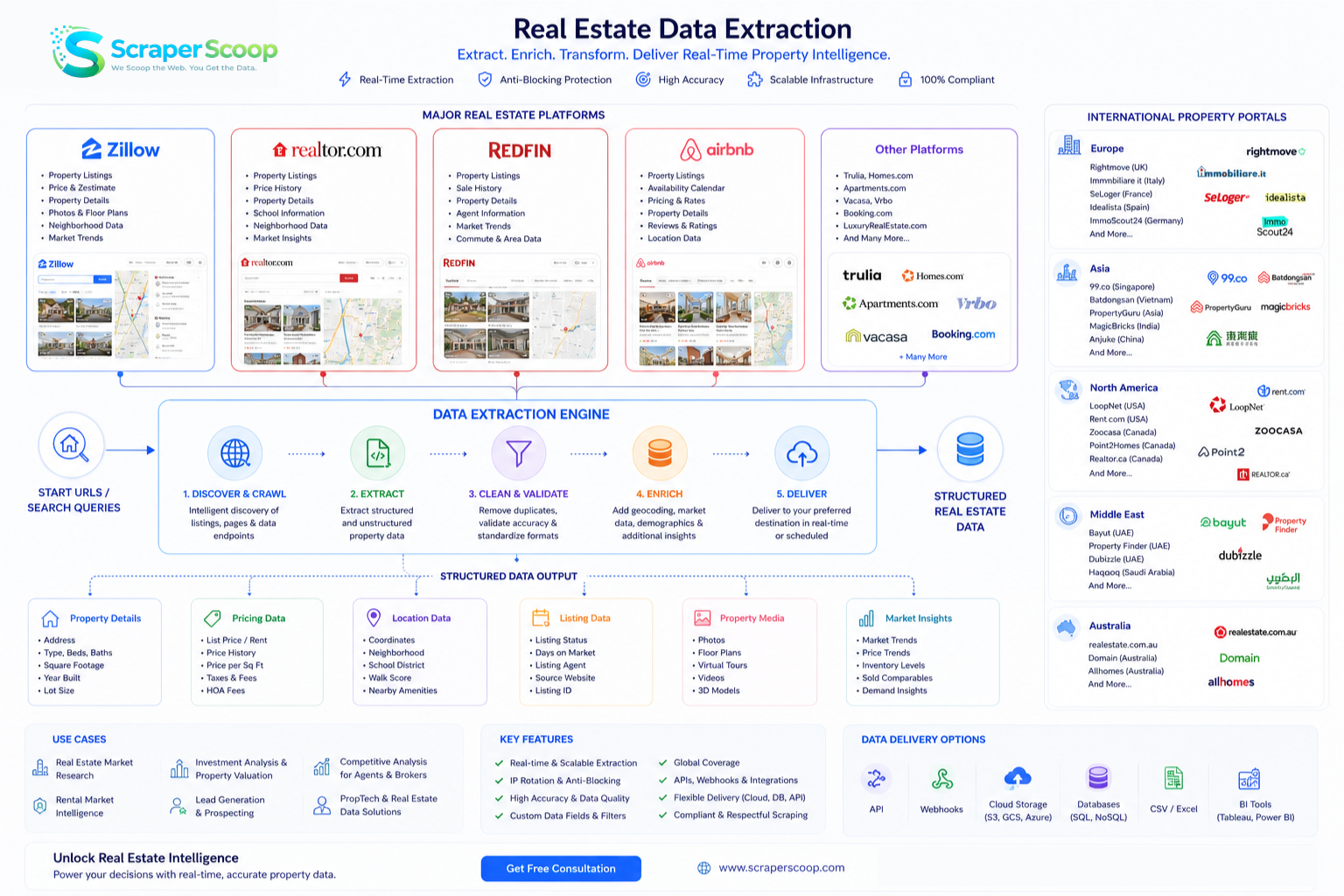
Each real estate platform presents unique data opportunities and technical challenges. Here's how the major platforms stack up in 2026:
| Platform | Key Data Points | Complexity | Coverage |
|---|---|---|---|
| Zillow | Listings, Zestimates, rental data, sold history, neighborhood stats | High | US nationwide |
| Realtor.com | MLS-sourced listings, open houses, agent info, market trends | High | US nationwide |
| Redfin | Listings, sold data, agent reviews, market insights | Medium | US major markets |
| Airbnb | STR listings, nightly rates, availability, reviews, host info | High | Global |
| Apartments.com | Rental listings, amenities, pricing, availability | Medium | US nationwide |
| LoopNet | Commercial listings, cap rates, tenant info, financials | High | US commercial |
| Rightmove (UK) | UK property listings, prices, sold data, agents | Medium | UK nationwide |
| 99acres (India) | Indian property listings, new projects, rentals | Medium | India nationwide |
Beyond individual platforms, ScraperScoop provides comprehensive real estate datasets that aggregate data across multiple sources, giving you a unified view of any market. For custom extraction needs, explore our real estate scrapers collection.
Property Price Monitoring: A Deep Dive
If there's one use case that delivers the fastest ROI from real estate data scraping, it's price monitoring. Here's why — and how to do it right.
The Power of Real-Time Price Intelligence
Real estate prices aren't static. In active markets, a listing might be reduced 3-4 times before sale. Sellers test the market, get feedback, and adjust. These price movements contain valuable signals:
- Price reductions indicate motivated sellers and potential negotiation opportunities
- Price increases signal strong demand and competitive bidding
- Days on market trends reveal market velocity and buyer sentiment
- Listing removals may indicate pending sales or withdrawn inventory
- New listing velocity shows supply trends and seasonal patterns
Our real estate price data extraction systems capture these changes in real time, enabling you to act on opportunities while they're still available.
What a World-Class Property Monitoring System Looks Like
- Multi-platform tracking: Monitor Zillow, Realtor, Redfin, and local MLS portals simultaneously
- Instant change detection: Get alerts within minutes of price changes, new listings, or status updates
- Historical analytics: Track price trends over weeks, months, and years to identify cycles
- Custom filters: Define your investment criteria (price range, location, property type) for targeted monitoring
- Comparative alerts: Automatically flag properties priced below neighborhood comparables
- API integration: Push data directly into your CRM, deal management, or analysis tools
Building Investment Intelligence with Scraped Data
Price monitoring is just one dimension. The real magic happens when you combine pricing data with comprehensive property intelligence — a 360-degree understanding of properties, neighborhoods, and market dynamics.
💡 Real-World Example: How a REIT Used Scraped Data to Find Hidden Value
A mid-size REIT focused on multifamily properties came to ScraperScoop wanting to expand into new markets efficiently. We built a custom scraping system that monitored apartment listings, rental rates, occupancy signals, permit filings, and economic indicators across 25 target metros.
The system identified a emerging neighborhood in Austin where new tech company relocations were announced, but rental rates hadn't yet adjusted. The REIT acquired three apartment complexes at pre-appreciation prices. Within 18 months, property values increased 34% and rental income rose 28%.
This kind of intelligence — combining multiple data sources to spot trends before they're obvious — is what separates sophisticated investors from the crowd. Our custom data scraping services make it possible.
Key Components of Property Investment Intelligence
- Supply/Demand Indicators: Track inventory levels, new construction permits, and absorption rates
- Rental Market Analysis: Monitor rental rates, vacancy signals, and tenant demand by neighborhood
- Neighborhood Trajectory: Identify gentrifying areas through permit data, new business openings, and demographic shifts
- Comparable Sales Analysis: Automated comp identification and price-per-square-foot benchmarking
- Risk Indicators: Track foreclosure filings, days on market increases, and price decline patterns
Common Challenges & How to Overcome Them
Real estate data scraping isn't without its hurdles. Here are the most common challenges businesses face — and how professional services overcome them:
Anti-Scraping Defenses
Challenge: Major portals use CAPTCHAs, rate limiting, and bot detection.
Solution: Rotating residential proxies, browser fingerprint randomization, and human-like request patterns.
Frequent Site Changes
Challenge: Real estate sites update layouts regularly, breaking scrapers.
Solution: AI-powered adaptive scrapers with self-healing selectors that detect and adjust automatically.
Data Quality Issues
Challenge: Raw scraped data contains duplicates, missing fields, and inconsistent formatting.
Solution: Robust data cleaning & structuring pipelines with validation rules.
Geographic Coverage
Challenge: Real estate data is fragmented across regional platforms and local MLS systems.
Solution: Multi-source aggregation combining national portals with local listing sites for complete coverage.
Real-Time Requirements
Challenge: Hot markets require near-instant data to compete for deals.
Solution: Distributed scraping infrastructure with sub-hourly update frequencies and webhook-based alerts.
Legal & Compliance
Challenge: Navigating terms of service and data protection regulations.
Solution: Ethical scraping practices focused on publicly available data, with GDPR/CCPA compliance built in.
Best Practices for Real Estate Data Scraping in 2026
Whether you're building an in-house scraping solution or partnering with a professional service, these best practices will ensure you get maximum value from your property data:
Start with Clear Investment Criteria
Define exactly what you're looking for before you start scraping. Property types, price ranges, geographies, yield thresholds — clear criteria make data actionable. Scraping everything is expensive and overwhelming; scraping what matters is powerful.
Combine Multiple Data Sources
No single platform has complete data. The best property intelligence combines listing portals, rental sites, public records, permit databases, and alternative data sources into a unified view. That's the ScraperScoop approach.
Prioritize Data Freshness Over Volume
In fast-moving markets, yesterday's data is ancient history. Build systems that prioritize real-time or near-real-time updates for active listings, even if historical data updates less frequently.
Invest in Data Quality & Validation
Bad data leads to bad investments. Implement validation rules, deduplication logic, and quality monitoring. A smaller dataset of clean, accurate data beats a massive dataset full of noise.
Integrate Data Into Your Workflow
Data sitting in a spreadsheet doesn't make money. Integrate scraped data into your deal management systems, CRM, underwriting tools, and alerting infrastructure for immediate action.
Partner with Specialists
Building and maintaining real estate scraping infrastructure is complex and resource-intensive. For most investors and companies, partnering with specialized real estate data scraping services delivers faster results at lower total cost.
Why ScraperScoop for Real Estate Data
At ScraperScoop, real estate data is one of our core specializations. We've built enterprise-grade property data extraction systems that power investment decisions, market analytics, and PropTech products for clients worldwide.
99.9% Data Accuracy
Multi-layer validation ensures every property record is accurate, complete, and investment-ready.
Real-Time Updates
Monitor listings with updates as frequent as every 15 minutes across all major platforms.
Global Coverage
Property data from 50+ countries including US, UK, Canada, Australia, India, and Europe.
Custom Solutions
Every investor's criteria are different. We build tailored extraction pipelines for your specific needs.
Ready-to-Use Datasets
Don't want to wait? Browse our library of pre-built property datasets for instant download.
Expert Support
Dedicated data engineers and real estate data specialists ensure your projects run smoothly.
Ready to Transform Your Real Estate Strategy with Data?
Whether you need a one-time property data dump, ongoing market monitoring, or a fully customized data pipeline — ScraperScoop has you covered. Our real estate data experts will design the perfect solution for your investment or business needs.
✅ Free sample data · ✅ No credit card required · ✅ Response within 2 hours
Getting Started: Your Next Steps
Ready to harness the power of real estate data scraping for your investments or business? Here's a simple roadmap to get started:
Define Your Investment or Business Goals
What decisions will this data inform? Deal sourcing? Market analysis? Competitive intelligence? Start with the outcome, not the data.
Identify Your Target Markets & Data Sources
Which geographies and platforms matter most? Prioritize the data that will have the highest impact on your decisions.
Choose Your Approach
Ready-made datasets for instant insights? Custom data scraping services for tailored, ongoing extraction? Or both?
Talk to Our Real Estate Data Experts
Contact us for a free consultation. We'll assess your requirements and recommend the most effective solution — with a free sample to validate quality before you commit.
FAQ: Real Estate Data Scraping
Is scraping real estate listing data legal?
Scraping publicly available real estate listing data is generally legal in most jurisdictions. Court rulings (like hiQ Labs v. LinkedIn) have affirmed the right to access public data. However, it's important to respect terms of service where reasonable, avoid accessing private data, and comply with data protection regulations. ScraperScoop follows ethical, legally compliant scraping practices focused exclusively on public property information.
How often can real estate data be updated?
We offer flexible update frequencies — from real-time (every 15-30 minutes) for active listing monitoring, to daily or weekly updates for market analytics and historical data. For hot markets where deals move fast, most clients prefer hourly or real-time updates for new listings and price changes.
What formats do you deliver real estate data in?
We deliver data in CSV, JSON, Excel, Parquet, and through API-based data delivery. We can also push data directly to your cloud storage (S3, GCS, Azure), data warehouse (Snowflake, BigQuery), CRM, or custom applications via webhooks.
Can you scrape MLS data directly?
Direct MLS access typically requires membership and licensing agreements. However, we can scrape MLS-sourced data from public-facing portals like Realtor.com, Redfin, and broker websites where listings are publicly displayed. This provides comprehensive coverage without the licensing complexity.
How much does real estate data scraping cost?
Pricing depends on the volume of data, number of platforms, geographic coverage, update frequency, and level of customization required. We offer flexible plans starting from free sample datasets. Contact us for a custom quote tailored to your specific requirements — we'll respond within 2 working hours.
🚀 Don't Let Competitors Out-Data You
Start Extracting Property Intelligence Today
Every day without comprehensive property data is a day your competitors are finding better deals. Let ScraperScoop give you the data advantage you need to win.
Get Your Free Consultation Now →

