

📑 Table of Contents
- Introduction: Why E-Commerce Data Matters More Than Ever
- What Is E-Commerce Data Scraping?
- Why Businesses Need E-Commerce Data Scraping in 2026
- Key Data Points You Can Extract
- Real-World Use Cases Across Industries
- How E-Commerce Data Scraping Works: Step by Step
- Price Monitoring & Competitive Intelligence
- Choosing the Right Data Scraping Partner
- Pre-Built Datasets vs. Custom Scraping
- Frequently Asked Questions
- Conclusion
Introduction: Why E-Commerce Data Matters More Than Ever
The global e-commerce market is projected to surpass $7.4 trillion by the end of 2026. With millions of products listed across platforms like Amazon, Walmart, Flipkart, and Shopify stores, the amount of publicly available product data is staggering. But here's the thing — raw data sitting on competitor websites doesn't help your business. It needs to be collected, structured, and analyzed.
That's exactly where e-commerce data scraping comes in. Whether you're a D2C brand trying to understand pricing trends, a market researcher analyzing consumer preferences, or an investor evaluating category performance, web scraping gives you the edge that manual research simply cannot match.
In this guide, we'll walk you through everything you need to know about e-commerce data scraping — what it is, why it matters, how it works, and how businesses like yours are already using it to drive real revenue growth in 2026.
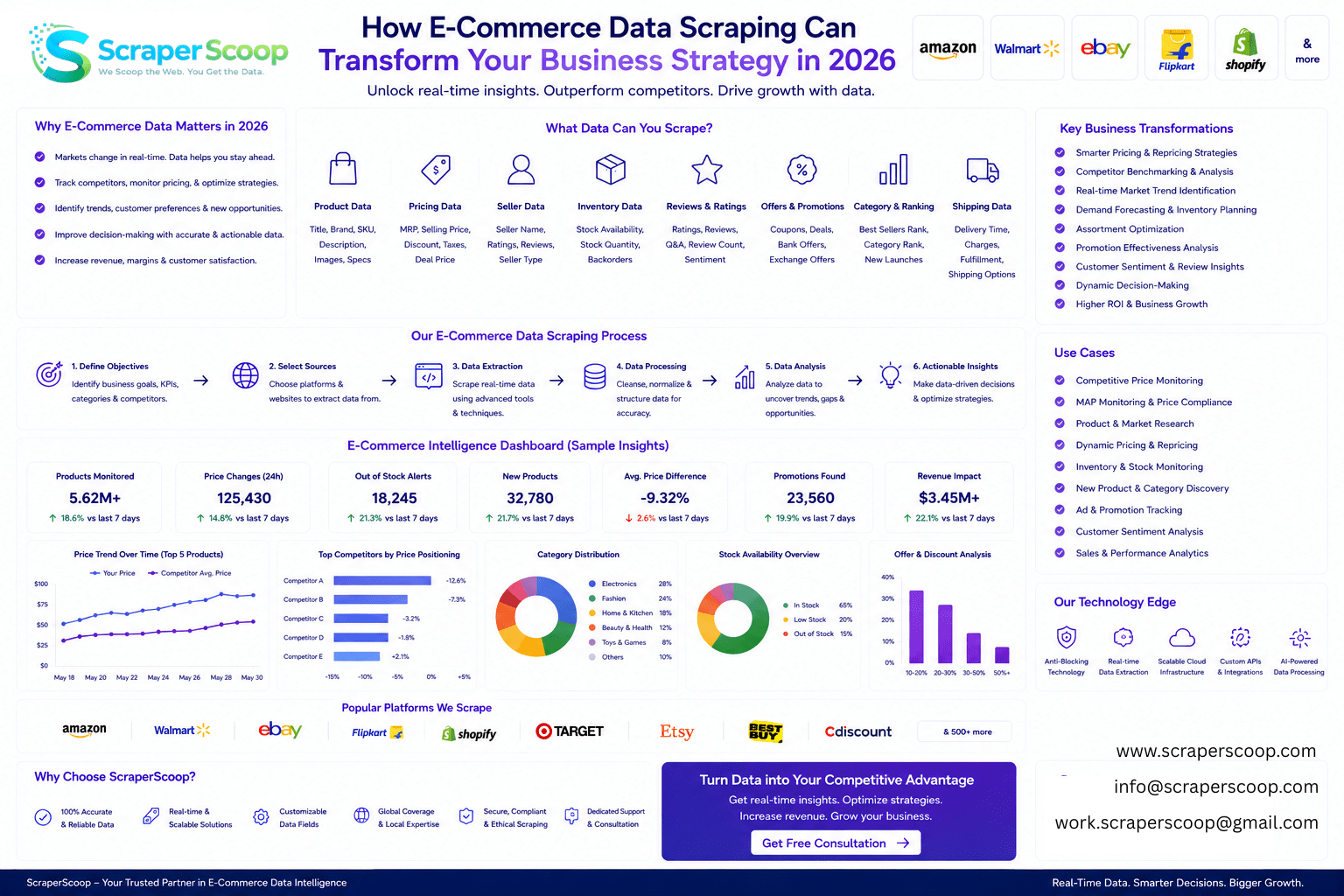
What Is E-Commerce Data Scraping?
E-commerce data scraping is the automated process of extracting publicly available information from online retail websites. Instead of manually visiting thousands of product pages, copying prices, reading reviews, and tracking inventory — scraping tools and services handle all of that at scale, in minutes rather than months.
The data typically gets delivered in structured formats like CSV, JSON, Excel, or directly through real-time APIs that integrate with your existing business systems.
Think of it this way: every e-commerce platform is essentially a massive, constantly updating database. Data scraping simply reads that public information and organizes it so you can actually use it for decision-making.
💡 Key Insight: E-commerce data scraping isn't about accessing private or restricted information. It focuses entirely on publicly displayed data — the same product details, prices, and reviews any visitor can see by browsing the website.
Why Businesses Need E-Commerce Data Scraping in 2026
The online retail landscape has changed dramatically. Price wars happen in real time. Consumer preferences shift overnight. New competitors pop up weekly. If you're making decisions based on quarterly reports or gut feelings, you're already behind.
Here's why forward-thinking businesses are investing heavily in e-commerce product data extraction:
1. Real-Time Price Intelligence
Your competitors change prices multiple times a day. Without automated price monitoring, you're flying blind. Scraping lets you track competitor prices hourly or daily, so you can adjust your pricing strategy to stay competitive without sacrificing margins.
2. Product Catalog Intelligence
Understanding what products your competitors are listing, what categories they're expanding into, and which SKUs they're discontinuing gives you a massive strategic advantage. This level of competitive analysis simply isn't possible manually.
3. Consumer Sentiment Analysis
Product reviews and ratings are gold mines of customer feedback. By scraping and analyzing product reviews and ratings at scale, you can identify what customers love, what they hate, and where the market gaps exist.
4. Market Entry Decisions
Planning to launch in a new category or geography? Scraped data helps you understand market saturation, price points, dominant brands, and customer expectations before you invest a single dollar.
Key Data Points You Can Extract from E-Commerce Platforms
Not all data is created equal. Knowing exactly what to scrape — and why — is what separates valuable intelligence from noise. Here are the critical data points businesses typically extract:
| Data Category | Specific Fields | Business Use |
|---|---|---|
| Product Information | Title, description, SKU, brand, images, specifications | Catalog mapping, content optimization |
| Pricing Data | Current price, MRP, discount %, price history | Dynamic pricing, margin optimization |
| Availability | Stock status, inventory levels, seller count | Supply chain planning, demand forecasting |
| Reviews & Ratings | Star ratings, review text, reviewer info, date | Sentiment analysis, product improvement |
| Seller Information | Seller name, rating, fulfillment type, location | Marketplace intelligence, partner evaluation |
| Category Rankings | Best seller rank, category position, search rank | SEO strategy, visibility tracking |
If you're looking for ready-to-use data, explore our e-commerce datasets that cover major platforms including Amazon and Flipkart.
Real-World Use Cases Across Industries
E-commerce data scraping isn't limited to online retailers. The applications stretch across industries — and the results are often transformative. Here are some real-world scenarios:
D2C Brands: Winning the Price War
A direct-to-consumer skincare brand used our price monitoring and competitor tracking service to track 2,000+ competing products across Amazon and Navi Mumbai-based e-commerce stores. Within three months, they optimized their pricing strategy and saw a 22% increase in conversion rates.
Market Research Firms: Faster Industry Reports
A consulting firm needed to analyze the Indian quick commerce landscape. Using our quick commerce datasets, they completed a comprehensive market report in 2 weeks instead of the typical 2 months.
Investment Firms: Due Diligence at Scale
Private equity firms use scraped e-commerce data to evaluate potential investments. By analyzing product inventory data and sales velocity indicators, they can assess brand health before committing capital.
Food & Restaurant Industry
Restaurant chains and cloud kitchens rely on food delivery data scraping to track competitor menu pricing, customer reviews, and delivery performance across Zomato and Swiggy. Our Zomato Analytics Dashboard provides a live view into these insights.
Travel & Hospitality
Hotel chains and OTA platforms leverage travel data scraping to monitor room rates, seasonal pricing patterns, and guest review sentiments across Booking.com, Airbnb, and MakeMyTrip.
Looking for industry-specific data solutions?
Explore our Market Research & Competitive Analysis Solutions →How E-Commerce Data Scraping Works: Step by Step
If you're new to data scraping, the process might seem technical. But with the right partner, it's remarkably straightforward. Here's how a typical custom data scraping engagement works:
- Define Your Requirements — You tell us which platforms, product categories, data fields, and frequency you need. Whether it's daily Amazon pricing data or weekly Flipkart inventory snapshots, clarity here saves time later.
- Scraper Configuration — Our engineering team builds custom scrapers tailored to your target websites. These aren't generic tools — they're precision-built to handle each platform's unique structure, pagination, and anti-bot measures.
- Data Extraction & Cleaning — The scrapers run on schedule, collecting raw data. Our data cleaning and structuring services then transform it into analysis-ready formats — removing duplicates, standardizing fields, and filling gaps.
- Quality Assurance — Every dataset goes through validation checks. We verify accuracy, completeness, and freshness before delivery.
- Delivery — Data is delivered via your preferred method — flat files, cloud storage, database integration, or API-based delivery for real-time access.
- Ongoing Monitoring & Support — Websites change their structures frequently. Our scheduled data scraping services include ongoing maintenance to ensure uninterrupted data flow.
Price Monitoring & Competitive Intelligence: The Killer Application
If there's one use case that delivers the fastest ROI, it's price intelligence and monitoring. Here's why it's so powerful:
In most competitive e-commerce categories, price is the single biggest factor influencing purchase decisions. A product priced even 5% higher than a comparable alternative can lose significant market share. But pricing too low destroys margins.
The sweet spot? Dynamic pricing informed by real-time competitive data.
With continuous price monitoring, you can:
- Track competitor price changes across hundreds or thousands of SKUs in real time
- Identify pricing patterns — when competitors run flash sales, seasonal discounts, or quietly raise prices
- Optimize your own pricing to maximize both volume and margins
- Monitor MAP (Minimum Advertised Price) compliance across your reseller network
- Detect unauthorized sellers undercutting your pricing on marketplaces
Our clients using ecommerce data scraping services for price monitoring typically report a 15-30% improvement in pricing efficiency within the first quarter.
📊 Case in Point: A consumer electronics brand used our Amazon and Walmart price scraping data to identify that their main competitor dropped prices every Tuesday evening. By adjusting their own promotional calendar to match, they captured an additional 18% of category traffic during peak shopping hours.
Choosing the Right Data Scraping Partner
Not all scraping services are created equal. The difference between a good provider and a great one often comes down to reliability, data quality, and the ability to handle scale. Here's what to look for:
Data Accuracy & Freshness
Stale data is worse than no data — it leads to wrong decisions. Look for providers that offer verifiable accuracy rates above 95% and can deliver data on the schedule your business demands, whether that's hourly, daily, or weekly.
Scalability
You might start with 500 products today, but next quarter you'll need 50,000. Your scraping partner should scale effortlessly without compromising quality or timelines.
Custom Delivery Options
Every business has different infrastructure. The best providers offer flexible delivery — from simple CSV downloads to sophisticated API integrations. At ScraperScoop, we provide everything from downloadable datasets to real-time data feeds and streaming APIs.
Domain Expertise
Scraping Amazon requires completely different technical approaches than scraping a Shopify store or a real estate portal. Choose a partner with proven experience across your target platforms.
Compliance & Ethics
Professional scraping services operate within legal boundaries, respecting robots.txt, rate limits, and focusing exclusively on publicly available data.
At ScraperScoop, we've built our reputation on all five pillars. Our web scraping services are trusted by brands, research firms, and enterprises across the globe.
Pre-Built Datasets vs. Custom Scraping: Which Is Right for You?
This is one of the most common questions we get, and the honest answer is: it depends on your use case.
| Factor | Pre-Built Datasets | Custom Scraping |
|---|---|---|
| Speed | Instant download — ready to use | 1-2 weeks setup time |
| Cost | Lower upfront cost | Higher, but tailored to your needs |
| Customization | Fixed data fields and sources | Fully customizable fields, sources, frequency |
| Freshness | Periodically updated | Real-time or on your schedule |
| Best For | Exploratory research, POC, academic | Production systems, competitive monitoring, ongoing needs |
For quick market research or proof-of-concept projects, our featured datasets provide immediate value. We offer pre-built datasets across categories including social media, real estate, restaurants, and travel.
For ongoing competitive intelligence or integration with your business systems, custom data scraping services are the way to go. You define the sources, fields, frequency, and delivery method — we handle the rest.
Want to explore all available options? Check out our complete dataset catalog or browse our web scrapers and data extraction APIs.
Platform-Specific Scraping Services
We also offer dedicated scraping services for individual platforms, each fine-tuned for that platform's unique data structure:
- Amazon Data Scraping Service — Products, pricing, reviews, seller data, BSR rankings
- Walmart Data Scraping Service — Complete product catalog, pricing, availability data
- eBay Data Scraping Service — Auction data, buy-it-now listings, seller metrics
- Flipkart Data Scraping Service — India-focused e-commerce intelligence
- Shopify Data Scraping Service — D2C store monitoring across thousands of Shopify brands
- Meesho Data Scraping Service — Social commerce product and pricing data
Ready to Turn E-Commerce Data Into Your Competitive Advantage?
Whether you need a one-time dataset or ongoing competitive intelligence, our team is ready to build a solution tailored to your business.
Talk to Our Data Experts →Beyond E-Commerce: Other Industries Leveraging Web Scraping
While this guide focuses on e-commerce, the same scraping infrastructure powers intelligence across many other sectors. If your business operates in any of these spaces, data scraping can deliver similar advantages:
- Real Estate: Property data scraping for pricing analysis, rental market monitoring, and commercial property intelligence
- Travel & Hospitality: Hotel price scraping, flight fare extraction, and Airbnb data services
- Food Delivery: Restaurant and delivery platform data, including cloud kitchen intelligence
- Job Market: Job listings data from platforms like Indeed, LinkedIn, and Naukri
- Social Media: Social media data scraping for brand monitoring, sentiment analysis, and influencer research
You can explore our complete range of scraping solutions organized by industry under our use cases section.
Frequently Asked Questions
Is e-commerce data scraping legal?
Yes, scraping publicly available data from e-commerce websites is generally legal. Professional scraping services like ScraperScoop focus exclusively on publicly accessible data — the same information any visitor can see by browsing the website. We respect robots.txt directives and implement rate limiting to ensure responsible data collection.
How fresh is the scraped data?
Freshness depends on your chosen plan. Our scheduled scraping services can deliver data hourly, daily, weekly, or on any custom schedule. For mission-critical applications like price monitoring, we also offer real-time data feeds via streaming APIs.
What formats do you deliver data in?
We deliver data in CSV, JSON, Excel, XML, and database-ready formats. For programmatic access, our API-based delivery lets you integrate scraped data directly into your applications, dashboards, or data warehouses.
Can you scrape data from any e-commerce website?
We can scrape publicly available data from the vast majority of e-commerce platforms including Amazon, Walmart, eBay, Flipkart, Shopify stores, Meesho, and many more. Each platform requires specialized scrapers — which is exactly why working with an experienced provider like ScraperScoop ensures reliable, accurate results.
How much does e-commerce data scraping cost?
Pricing varies based on the scale (number of products/pages), frequency, number of data fields, and delivery method. Pre-built datasets start at accessible price points for smaller needs, while enterprise-grade custom scraping solutions are tailored to your specific requirements. Contact us for a personalized quote.
Do I need technical knowledge to use your services?
Not at all. Our team handles all the technical complexity — from scraper development to data cleaning and delivery. You simply tell us what data you need, and we deliver it in a format you can immediately use in Excel, Google Sheets, your BI tools, or your custom applications.
Conclusion: Data Is the New Competitive Moat
In 2026, the businesses that win aren't necessarily the ones with the biggest budgets or the flashiest products. They're the ones with the best data and the ability to act on it quickly.
E-commerce data scraping has evolved from a niche technical capability into a fundamental business tool. Whether you're tracking competitor prices on Amazon, analyzing product trends on Flipkart, monitoring seller activity on Walmart, or studying consumer sentiment across review platforms — structured, timely, and accurate data is what separates market leaders from the rest.
The real question isn't whether you should be scraping e-commerce data. It's whether you can afford not to.
At ScraperScoop, we've built an entire ecosystem around making web data accessible, reliable, and actionable — from ready-made datasets and web scrapers to fully customized scraping services and industry-specific solutions.
🚀 Take the First Step: Whether you're exploring data scraping for the first time or looking to upgrade your existing data infrastructure, our team is here to help. Get in touch with our data experts today and let's discuss how we can power your business decisions with the right data.


