

Real Estate Data Scraping: The Complete Guide to Property Intelligence & Market Analysis
How investors, developers, brokerages, and proptech companies use scraped property data to track prices, analyze rental markets, monitor listings, and make smarter real estate decisions — faster than the competition.
🏗️ What's Inside This Guide
- Why Real Estate Data Scraping Is Reshaping the Property Industry
- What Data Can You Scrape from Real Estate Platforms?
- Who Uses Property Data Scraping — And What They Build With It
- Residential Property Intelligence: Buying, Selling & Investing Smarter
- Rental Market Intelligence: The Landlord's & Investor's Edge
- Commercial Property Data: The Enterprise Advantage
- Property Price Tracking: Building a Market Pulse System
- Getting Started: Your Real Estate Data Roadmap
- Cross-Industry Intelligence That Amplifies Property Research
- Frequently Asked Questions
- Conclusion
Why Real Estate Data Scraping Is Reshaping the Property Industry
Real estate has always been a data-intensive industry. Location, pricing, comparable sales, rental yields, neighborhood demographics — every successful property decision is ultimately grounded in data. But historically, that data has been fragmented, expensive, and maddeningly slow to access.
Consider the traditional research process: a real estate investor interested in a new market spends weeks manually browsing listing portals, compiling spreadsheets, calling brokers for pricing details, and cross-referencing government records. By the time they have a usable dataset, market conditions have already shifted and the best deals have been snapped up.
Real estate data scraping eliminates this bottleneck entirely. Instead of weeks of manual research, automated scrapers can extract thousands of property listings — complete with prices, specifications, photos, agent details, and location data — in hours. And they can do it continuously, keeping your intelligence fresh as the market moves.
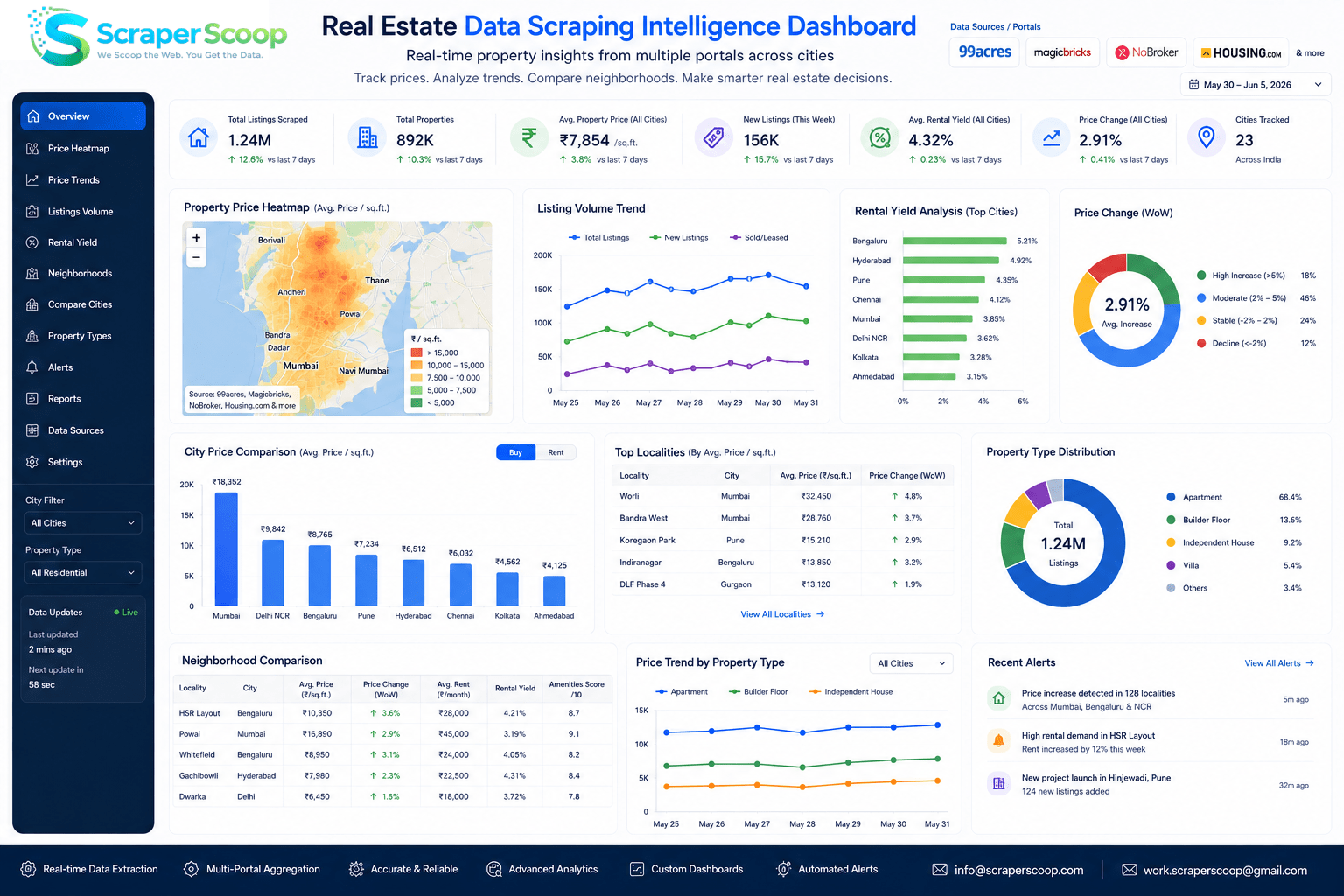
The numbers tell the story of why this matters now more than ever:
The Paradigm Shift: In 2026, the real estate professionals who win aren't the ones with the best "gut feel" — they're the ones with the best data infrastructure. Property portals like Zillow, Realtor.com, 99acres, MagicBricks, and Rightmove are essentially massive, publicly accessible databases. Scraping unlocks that data for systematic analysis at a scale and speed that transforms every aspect of property decision-making.
What Data Can You Scrape from Real Estate Platforms?
Property listing portals are extraordinarily information-rich. A single listing page can contain 40+ data points. When you multiply that across millions of listings across multiple platforms, you're looking at one of the most granular market intelligence resources available in any industry.
| Data Category | Specific Fields | Strategic Value |
|---|---|---|
| Property Details | Address, type (apartment/house/villa), bedrooms, bathrooms, carpet area, built-up area, floor number, age of property | Inventory mapping, property comparison, portfolio analysis |
| Pricing | Listed price, price per sq ft, price history, price drops, negotiability indicators | Valuation models, price trend analysis, deal identification |
| Rental Data | Monthly rent, security deposit, lease terms, furnished status, maintenance charges | Rental yield calculation, rental market analysis |
| Location Intelligence | GPS coordinates, neighborhood, locality, city, proximity to transit/schools/hospitals | Location scoring, catchment analysis, micro-market identification |
| Amenities | Parking, gym, pool, security, elevator, power backup, garden, clubhouse | Premium analysis, buyer preference modeling |
| Agent/Developer | Listing agent name, agency, developer/builder name, contact info, verification status | Brokerage intelligence, developer tracking, lead generation |
| Listing Metadata | Listing date, last updated, views/engagement metrics, featured status, photo count | Market velocity, demand indicators, listing quality benchmarking |
| Project/Society | Project name, total units, builder reputation, RERA registration, completion status | New project tracking, developer due diligence |
For ready-to-use structured datasets, explore our real estate datasets covering major property platforms and cities — available for immediate download.
Need automated extraction at scale? Our real estate scrapers are pre-configured for the most popular property portals worldwide.
Who Uses Property Data Scraping — And What They Build With It
Real estate data scraping serves a remarkably diverse set of users — from individual investors analyzing a single neighborhood to enterprise proptech platforms processing millions of listings daily. Here's who's extracting the most value:
Real Estate Investors
Build property valuation models, identify underpriced listings before competitors, track price appreciation trends across neighborhoods, and calculate rental yields with real market data instead of broker estimates.
Property Developers
Analyze competitor project pricing, track absorption rates for new developments, identify demand hotspots for future launches, and benchmark amenities and pricing tiers against active projects in the same micro-market.
Brokerages & Agents
Monitor competitive listings in real time, generate comprehensive comparable market analyses (CMAs), identify new listing opportunities, and provide clients with data-backed pricing recommendations.
Proptech Startups
Power valuation algorithms, build property search engines, create market analytics dashboards, and train ML models for price prediction — all requiring massive volumes of structured property data.
Market Research Firms
Produce city-level and neighborhood-level real estate market reports, track inventory trends, analyze supply-demand dynamics, and deliver data-driven insights to institutional clients.
Financial Institutions
Validate property valuations for mortgage underwriting, monitor collateral values, assess market risk exposure, and build portfolio-level real estate analytics capabilities.
Explore our complete real estate data solutions
Real Estate Data Scraping Services →Residential Property Intelligence: Buying, Selling & Investing Smarter
The residential property market is where most real estate data scraping activity is concentrated — and for good reason. Whether you're buying your first home, building a rental portfolio, or flipping properties, the quality of your data directly determines the quality of your outcomes.
Comparable Market Analysis (CMA) at Scale
The foundation of every property valuation is the comparable market analysis — what similar properties in the same area have sold or listed for recently. Traditionally, agents compile CMAs manually, looking at 3–5 comparable properties. With property listing data extraction, you can analyze hundreds of comparables instantly, producing valuations that are statistically robust rather than anecdotally supported.
Price Trend Monitoring
Real estate prices don't move in straight lines. They're influenced by seasons, interest rate changes, infrastructure developments, policy decisions, and market sentiment. Real estate price data extraction — conducted continuously over time — reveals these trends at a granularity that quarterly reports simply can't match.
Imagine knowing that properties in a specific pin code have shown 2.3% price growth over the last 60 days, while the adjacent pin code has seen 1.8% decline. That kind of micro-market insight is only possible with ongoing, automated data collection.
Inventory & Supply Analysis
How many active listings exist in your target market? Is inventory growing (a buyer's market signal) or shrinking (a seller's market signal)? Are new listings coming online faster than properties are being sold? By scraping listing creation and removal data over time, you build a real-time supply-demand picture that's far more actionable than lagging government statistics.
Investor Example: A residential property investor in Bangalore used our real estate scraping service to track 15,000 listings across 99acres and MagicBricks over 6 months. They identified three micro-markets where listed prices had risen 8–12% but listed inventory had dropped by 40% — a classic indicator of undersupply. By purchasing in these areas early, they captured 15% appreciation within 9 months, significantly outperforming the broader market.
Rental Market Intelligence: The Landlord's & Investor's Edge
Rental market analysis is one of the most powerful — and underutilized — applications of real estate data scraping. Whether you're a landlord setting rent prices, an investor calculating rental yields, or a property management company benchmarking your portfolio, rental data scraping transforms how you operate.
What Rental Data Intelligence Looks Like in Practice
Commercial Property Data: The Enterprise Advantage
Commercial property data scraping serves a different but equally valuable set of use cases. Retail chains, corporate real estate teams, coworking operators, and commercial investors use this data to make location, expansion, and investment decisions worth millions.
Key Commercial Property Use Cases
- Retail site selection: Scrape commercial listings, rental rates, and nearby business data to identify optimal store locations based on foot traffic proxies, competitor presence, and lease economics.
- Office market analysis: Track office space availability, per-square-foot rates, and amenity offerings across commercial portals to benchmark your own offerings or negotiate better lease terms.
- Coworking competitor intelligence: Monitor coworking space listings, pricing tiers, locations, and capacity across WeWork, Awfis, 91springboard, and independent operators.
- Warehouse & industrial tracking: With the rise of e-commerce and quick commerce, warehouse space is increasingly valuable. Scrape industrial property listings to identify supply trends and pricing shifts in logistics real estate.
- Developer portfolio analysis: Track how much commercial inventory a competitor developer has listed, at what prices, and how quickly it's being absorbed — a powerful due diligence input for investment decisions.
Enterprise Example: A national retail chain used our commercial property data scraping service to monitor 8,000+ commercial listings across 12 Indian cities. By cross-referencing commercial rental rates with quick commerce delivery data (showing neighborhoods with high delivery demand), they identified 23 underserved locations where a physical store could capture walk-in customers underserved by existing retail infrastructure.
Property Price Tracking: Building a Real-Time Market Pulse System
Perhaps the most transformative application of real estate scraping is continuous price tracking. Unlike stocks or commodities, real estate prices don't have a centralized exchange reporting real-time values. Instead, market prices are revealed through individual listing events — and tracking those events systematically creates something extraordinarily valuable: a real-time property market pulse.
Here's how to build one with real estate price data extraction:
- Define Your Target Markets Select the cities, neighborhoods, and property types you want to track. Be specific — "3BHK apartments in South Mumbai" is more actionable than "Mumbai real estate." Our custom data scraping services configure scrapers for any geographic and property scope.
- Establish Baseline Data Scrape all active listings in your target markets to create a comprehensive baseline. This initial snapshot captures current pricing, inventory levels, and listing characteristics across your competitive landscape.
- Set Up Continuous Monitoring Configure scheduled scraping to re-scrape your target markets on a regular cadence — daily for active markets, weekly for slower-moving areas. Each run captures new listings, price changes, and delisted properties.
- Clean and Normalize Data Property data is notoriously messy — inconsistent area measurements, ambiguous location names, duplicated listings across platforms. Our data cleaning and structuring services handle normalization, deduplication, and standardization automatically.
- Build Your Analytics Layer Transform raw data into intelligence: median price per sq ft by neighborhood, inventory growth/decline rates, days-on-market distributions, and price-to-rent ratios. Deliver via API-based delivery to your BI tools or as downloadable reports.
- Alert on Market Signals Set up automated alerts for significant events: a new listing below market value, a neighborhood where prices dropped 5% in a week, or a developer launching a new project at an aggressive price point. Our real-time data feeds enable this level of responsiveness.
Ready-made real estate datasets for instant analysis
Browse Real Estate Datasets →Getting Started: Your Real Estate Data Roadmap
Whether you're a solo investor, a brokerage with 50 agents, or a proptech company building a platform, here's the practical path to real estate data intelligence with ScraperScoop:
Option 1: Pre-Built Real Estate Datasets
Best for: Market research, academic analysis, proof-of-concept, one-time competitive analysis.
Our real estate datasets provide structured, ready-to-analyze property data from major listing platforms. Download, open in Excel or your analytics tool, and start extracting insights immediately. No setup, no technical work, no waiting.
Option 2: Self-Service Real Estate Scrapers
Best for: Tech-savvy teams who want to run their own extraction on demand.
Our real estate scrapers are pre-built tools configured for major property portals. Select your target platform, define your parameters, and extract data on your own schedule.
Option 3: Fully Managed Custom Scraping
Best for: Ongoing competitive intelligence, production applications, enterprise-grade requirements.
Our real estate data scraping services handle everything end-to-end — scraper development, data collection, cleaning, structuring, and delivery in your preferred format. Includes property listing extraction, price data extraction, rental data scraping, and commercial property data.
Not sure which option fits your needs? Talk to our data experts — we'll recommend the optimal approach based on your specific goals, budget, and technical capabilities.
Cross-Industry Intelligence That Amplifies Property Research
Real estate doesn't exist in a vacuum. Property values are influenced by nearby businesses, transportation infrastructure, food delivery demand density, job market growth, and tourism patterns. The most sophisticated property intelligence operations combine real estate data with scraped data from adjacent industries:
- Food Delivery as a Demand Proxy: Neighborhoods with high food delivery data scraping volumes from Zomato and Swiggy indicate high population density and disposable income — both strong predictors of residential property demand.
- E-Commerce & Warehouse Demand: Track e-commerce growth data across Amazon and Flipkart to predict warehouse and logistics real estate demand in different regions.
- Job Market Intelligence: Neighborhoods where companies are hiring aggressively (tracked via job listing data scraping from Indeed, LinkedIn, and Naukri) typically see rental demand increases within 6–12 months.
- Travel & Short-Term Rental: Airbnb data scraping reveals short-term rental pricing and occupancy patterns — essential intelligence for investors evaluating vacation rental potential in tourist markets.
- Quick Commerce Expansion: Where quick commerce platforms are opening dark stores signals emerging residential density — a leading indicator for property demand that most investors miss entirely.
- Restaurant & Retail Density: Business directory data scraping reveals commercial activity density — areas with thriving retail and restaurant ecosystems tend to command premium residential values.
- Social Media Sentiment: What are people saying about specific neighborhoods on social media? Sentiment analysis of location-tagged posts reveals emerging "hot" neighborhoods before they show up in price data.
For a comprehensive overview of how different data types combine to create holistic market intelligence, explore our Market Research & Competitive Analysis Solutions or browse our use cases library.
Pro Tip: The biggest edge in real estate comes from combining data sources that your competitors don't. While everyone has access to listing portals, almost nobody is systematically cross-referencing property data with food delivery demand, job market growth, and quick commerce expansion. This cross-industry intelligence creates an unfair advantage that compounds over time.
Frequently Asked Questions
Q Which real estate platforms can you scrape?
We support data extraction from all major property listing portals including Zillow, Realtor.com, Redfin, Trulia (US), Rightmove, Zoopla (UK), 99acres, MagicBricks, Housing.com, NoBroker (India), Domain, REA Group (Australia), and many others. Our real estate scrapers are pre-configured for the most popular platforms, and our team can build custom scrapers for any additional portal you need.
Q Is scraping property listing data legal?
We scrape only publicly accessible property listing data — the same information any visitor sees when browsing these portals without logging in. This aligns with established legal precedents regarding public web data. We don't access private accounts, bypass authentication, or collect personal data beyond what's publicly displayed on listing pages. We always recommend consulting your legal counsel for jurisdiction-specific guidance.
Q How many property listings can you scrape, and how quickly?
Our infrastructure routinely handles extractions of 500,000+ property listings in a single run. For a major Indian metro, a complete scrape across 99acres and MagicBricks typically completes within 12–24 hours. Smaller, targeted extractions (specific neighborhoods or property types) can be done in hours. Contact us with your specific scope for a detailed timeline and quote.
Q Can you track property price changes over time?
Absolutely — this is one of our most popular use cases. Our scheduled scraping services capture listing snapshots at whatever frequency you need — daily, weekly, or monthly. Each snapshot is timestamped, enabling you to track individual listing price changes, neighborhood-level price trends, and market-wide pricing dynamics over weeks, months, or years.
Q What format do you deliver real estate data in?
We deliver in CSV, JSON, Excel, and database-ready formats. For production applications and dashboards, our API-based data delivery integrates directly with your analytics tools, BI platforms, or custom applications. For real-time alerting on new listings or price drops, our real-time data feeds push data as it's collected.
Q Can I get both sale and rental listing data from the same service?
Yes. Our real estate data scraping services cover both sale and rental listings. In fact, combining the two datasets is exactly how you calculate rental yields — one of the most valuable metrics for property investors. We can deliver sale data, rental data, and commercial property data as separate datasets or unified into a single analytical framework.
Q I'm a small investor, not a big company. Is this service relevant for me?
Absolutely. Start with our pre-built real estate datasets — they're affordable, immediately available, and require zero technical setup. Even a one-time dataset purchase for your target neighborhood gives you more comparative market data than most agents work with in a month. As your needs grow, you can upgrade to custom scraping services.
Conclusion: The Data-Driven Real Estate Advantage Is Here
Real estate has always rewarded people with better information. In the pre-internet era, that meant having the right broker connections. In the early internet era, it meant knowing which portals to browse. In 2026, it means having systematic, automated access to property data at scale — the kind that only web scraping can provide.
The property professionals who will outperform over the next decade aren't the ones with the biggest budgets or the most years of experience. They're the ones who've built data infrastructure that lets them see market movements in real time, identify opportunities before they're obvious, and make decisions grounded in thousands of data points rather than a handful of anecdotes.
Whether you need property listing extraction for a one-time market analysis, ongoing price tracking for your investment portfolio, rental market intelligence for your property management business, or commercial property data for your corporate real estate strategy — ScraperScoop delivers the data that transforms how you operate.
The market is moving right now. The listings are updating. The prices are shifting. The opportunities are appearing and disappearing. The only question is: will your data infrastructure keep up?
Talk to our real estate data experts today — let's build the property intelligence system your business deserves.


