

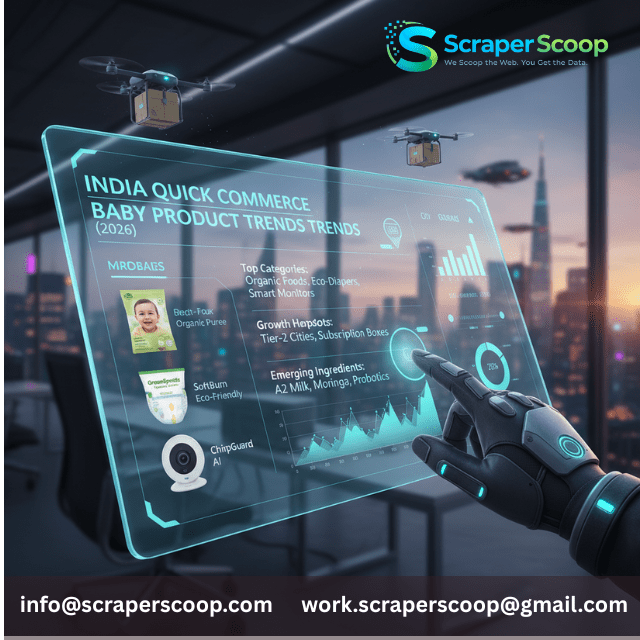
India’s baby care products market is experiencing explosive growth, driven by rising birth rates, increasing disposable incomes, and a shift toward premium, health-focused products. According to Technavio, the market is expected to grow by USD 40.84 billion from 2026-2030, expanding at a CAGR of 24.3% during the forecast period. IMARC Group projects the market to reach USD 10.62 billion by 2034, growing at a CAGR of 9.17% from 2026-2034. Mordor Intelligence estimates the market at USD 5.57 billion in 2026, projected to reach USD 9.72 billion by 2031 at a CAGR of 11.78%. Quick commerce platforms like Zepto, Blinkit, and Swiggy Instamart are at the forefront, enabling 10-30 minute deliveries of diapers, baby food, skincare, and more, catering to busy urban parents.
At ScraperScoop, we specialize in ethical web scraping to extract real-time data from these platforms, providing brands, retailers, and analysts with actionable insights on pricing, availability, promotions, and consumer preferences. This comprehensive guide delves into the market dynamics, key data points for scraping, platform-specific behaviors, compliance best practices, advanced analytics techniques, strategic applications, case studies, and future outlook—all backed by the latest projections. With the market’s hyperlocal nature—higher demand for organic products in Ahmedabad’s affluent areas like Satellite or Vastrapur—scraping is essential for targeted strategies.
The Surge in Baby Care Demand: 2026 Market Overview
The baby care sector in India is booming due to demographic shifts: approximately 26 million annual births, rapid urbanization (over 40% urban population by 2030), and growing middle-class incomes. Grand View Research notes the global baby products market at USD 320.65 billion in 2023, projected to USD 475.15 billion by 2030 at 5.9% CAGR, with India as a key growth driver. Locally, Expert Market Research values the market at USD 8.42 billion in 2025, forecasting USD 34.96 billion by 2035 at 15.30% CAGR. Verified Market Research estimates USD 5.8 billion in 2024, reaching USD 15.5 billion by 2032 at 13.78% CAGR.
Quick commerce amplifies this: platforms stock everything from diapers (27.6% market share) to baby food (25.62% share), with e-commerce penetration rising due to convenience. In Ahmedabad, quick deliveries address urban parents’ needs amid Gujarat’s growing economy. Scraping reveals trends like organic skincare surges during festivals or summer demand for hydrating lotions.
Why Scrape Baby Products Data? Strategic Imperatives
Traditional data lags; real-time scraping provides edge:
- Pricing Dynamics: Track flash deals on diapers, where prices vary 10-20% by pincode.
- Assortment Gaps: Identify missing organic variants in competitors’ listings.
- Demand Forecasting: Predict spikes in baby food during monsoon-related health concerns.
- Competitor Benchmarking: Compare ratings for skincare, where “clean beauty” trends drive 12.59% CAGR.
- Hyperlocal Insights: In Ahmedabad, premium products sell faster in areas like Bodakdev.
| Segment | 2025 Value (USD B) | 2030/32 Projection (USD B) | CAGR (%) | Source |
|---|---|---|---|---|
| Overall Market | 4.82 | 10.62 (2034) | 9.17 | IMARC |
| Baby Food | 9.97 | 17.52 (2035) | 5.8 | Towards FnB |
| Diapers | ~1.6 (est.) | ~4.3 (2032) | 13.78 | VMR |
| Skincare | ~1.2 (est.) | ~3.1 (2031) | 12.59 | VMR |
Platform-Specific Trends: Zepto vs. Blinkit vs. Instamart
Zepto: Aggressive on premiums, frequent rotations—ideal for scraping short-term spikes in baby food.
Blinkit: Wider catalogs, stable pricing—strong for diapers, with 27.6% segment dominance.
Instamart: Bundle-focused, tying baby products to groceries—hyperlocal in Ahmedabad’s suburbs.
Key Data Points to Scrape for Maximum Value
Focus on:
- Product Name/Brand: Track organic vs. conventional shifts (organic gaining 15.3% CAGR).
- Pricing/Discounts: Elasticity analysis—10% discounts boost sales 20-30%.
- Stock Availability: Pincode-level, e.g., stockouts in Ahmedabad during peaks.
- Ratings/Reviews: Sentiment for reformulations, with AI tools analyzing 1000s of reviews.
- Delivery ETAs: Influence conversions in quick commerce.
- Promotional Tags: Flash sales, banners—reveal platform biases.
Ethical Scraping Techniques and Compliance in 2026
Under DPDPA, use rotating proxies, rate-limiting (e.g., 1 request/sec), and API-style extraction. Respect robots.txt, avoid personal data. In Ahmedabad, comply with local data norms for sustainable operations.
Advanced Analytics: Turning Data into Forecasts
Combine scraped data with ML: Predict demand using historical trends (e.g., baby food spikes post-monsoon). Price elasticity models show sensitivity in segments like diapers. Hyperlocal in Ahmedabad: Use pincode data for targeted inventory.

Strategic Applications for Brands and Retailers
Brands: Dynamic pricing, launch timing—e.g., organic skincare in summer. Distributors: Inventory optimization, reducing waste 25%. Marketing: Promo uplift analysis. Investors: Track momentum without quarterly waits. Case: Ahmedabad brand used data for 18% uplift in diaper sales.
Role of Real-Time Dashboards in Baby Care Intelligence
Dashboards visualize trends: Alerts for stockouts, visualizations of price wars. Custom for Ahmedabad markets, enabling proactive decisions.
Future of Baby Products Market Intelligence in India
By 2035, USD 34.96B market; quick commerce to capture 30-40% share. Scraping with AI will differentiate leaders.
Request a free consultation
Ready to unlock the power of data?
Published: February 2026 | Category: Baby Care, Quick Commerce Scraping


