

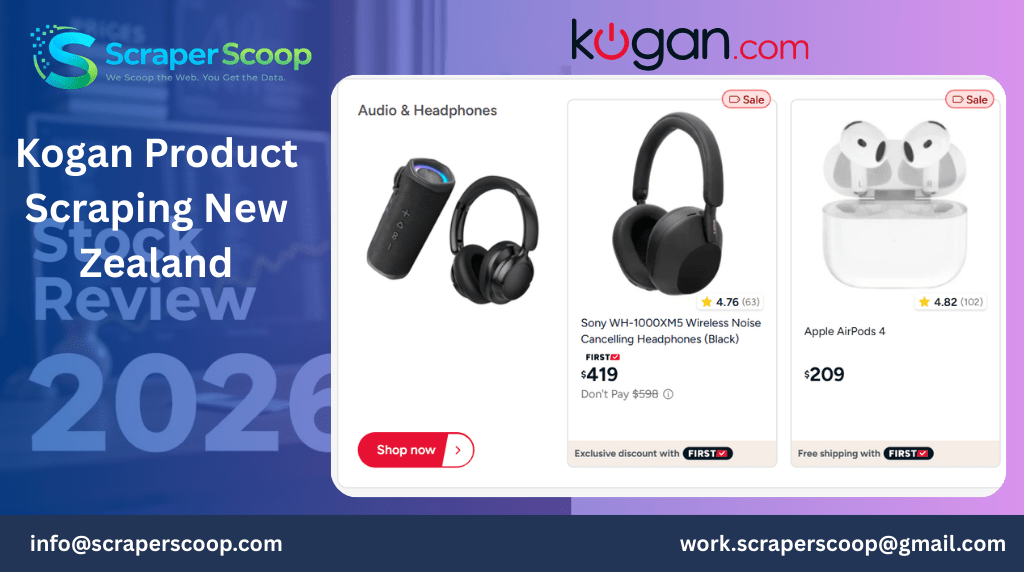
If you’ve ever researched online electronics or home appliances in Australia or New Zealand, there’s a good chance you’ve come across Kogan. It’s one of the most popular online retail platforms in the region, offering everything from TVs and laptops to kitchen appliances and smart home devices.
Now imagine you’re running an eCommerce store or working on a market intelligence project. You want to answer questions like:
- What products are trending on Kogan New Zealand?
- How do prices compare across categories?
- Which brands dominate certain product segments?
- Which items frequently go out of stock?
Manually browsing hundreds or thousands of product pages to gather this information would take days — maybe weeks.
That’s where web scraping comes in.
By scraping Kogan New Zealand product data, businesses can automatically collect structured datasets containing product listings, pricing information, availability signals, and competitor insights. These datasets are incredibly valuable for retailers, analysts, and brands trying to understand market trends.
In this guide, we’ll walk through how to scrape Kogan New Zealand product data, what information you can extract, and how companies use this data for eCommerce intelligence.
Why Businesses Scrape Kogan New Zealand Data
Before diving into the technical side, let’s talk about why companies collect Kogan marketplace data in the first place.
A few months ago, I worked with a client analyzing consumer electronics pricing across multiple marketplaces. They were expanding into Australia and New Zealand and wanted to understand how their products compared with competitors.
Their first instinct was to manually track product listings.
After a couple of hours of browsing Kogan’s website, they quickly realized something:
There were thousands of products across dozens of categories, and prices changed frequently.
Once we built an automated scraping pipeline, they suddenly had access to a full dataset of:
- Product listings
- Brand distributions
- Pricing differences
- Category demand signals
That dataset helped them refine their pricing strategy before launching in the region.
Here are the most common reasons businesses scrape Kogan product data.
Competitive Price Monitoring
Retail pricing changes constantly.
Marketplaces like Kogan frequently run:
- flash sales
- bundle deals
- seasonal discounts
- clearance promotions
Scraping product prices allows businesses to monitor competitors and adjust pricing strategies accordingly.
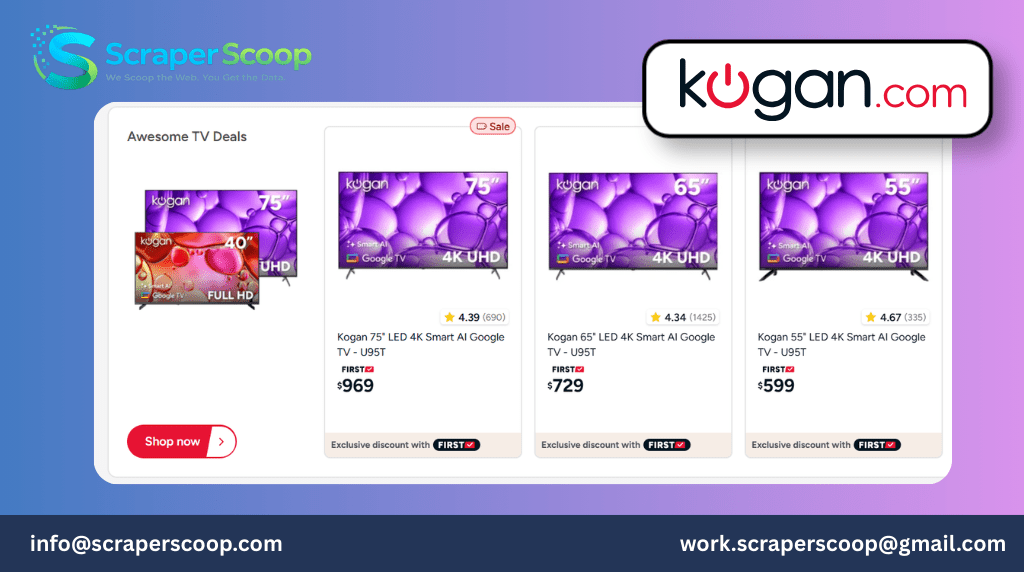
For example, tracking price differences across similar products can reveal:
| Product | Brand | Price | Availability |
|---|---|---|---|
| 55″ Smart TV | Samsung | $899 | In Stock |
| 55″ Smart TV | LG | $879 | In Stock |
| 55″ Smart TV | Kogan Brand | $699 | Limited |
This kind of data helps retailers understand where they stand in the market.
Product Catalog Intelligence
Another common use case is product discovery.
Retailers entering a new market often want to know:
- Which brands dominate a category
- What products are trending
- Which price segments are most competitive
Scraping Kogan’s catalog provides a clear picture of the marketplace landscape.
Availability and Inventory Signals
Stock availability tells a powerful story.
Products that frequently go out of stock often indicate:
- strong consumer demand
- limited supply
- trending items
Monitoring availability across categories helps businesses identify high-demand products worth stocking.
Market Trend Analysis
By collecting data regularly, companies can analyze trends such as:
- price fluctuations over time
- new product launches
- brand growth in specific categories
Historical datasets are especially valuable for market research and forecasting.
What Data Can Be Extracted from Kogan Product Pages
Kogan product listings contain a large amount of structured information.
When scraping product pages, businesses typically extract the following fields.
Product Information
- Product name
- Product ID
- Category
- Brand
- Product description
Pricing Data
- Current price
- Discount price
- Original price
- Promotional labels
Availability Signals
- In-stock status
- Out-of-stock indicators
- shipping availability
Product Media
- product images
- image URLs
- thumbnail previews
Customer Signals
Some product pages also include:
- ratings
- reviews
- popularity indicators
Product Variants
Some items include variants such as:
- different colors
- storage sizes
- bundle options
Capturing these variations is important when building accurate datasets.
Step-by-Step: How to Scrape Kogan Product Data
Let’s break down the typical scraping workflow.
Step 1: Identify Product Categories
The first step is collecting product listing pages.
Kogan organizes products into categories such as:
- Electronics
- Computers
- Smartphones
- Home appliances
- Kitchenware
- Gaming
Each category page contains multiple product listings.
The scraper navigates these pages to collect product URLs.
Step 2: Handle Pagination
Category pages usually contain dozens of results.
Pagination allows users to browse multiple pages of listings.
A scraper must automatically navigate through:
- page 1
- page 2
- page 3
- and so on
Without pagination handling, only a small portion of the catalog would be captured.
Step 3: Extract Product Listing Data
From listing pages, the scraper collects basic information such as:
- product title
- product URL
- price
- thumbnail image
These details act as the first layer of the dataset.
Step 4: Scrape Individual Product Pages
Next, the scraper visits each product page to collect detailed data.
This includes:
- full product descriptions
- brand names
- detailed specifications
- availability information
- variant options
This step builds a complete product dataset.
Step 5: Store the Data
Once extracted, the data is stored in structured formats such as:
- CSV
- Excel
- JSON
- databases
- APIs
This allows businesses to integrate the dataset into analytics tools.
Example Python Scraping Workflow
Here’s a simplified example of how a scraping script might work.
import requests
from bs4 import BeautifulSoupurl = "https://www.kogan.com/nz/"
headers = {"User-Agent": "Mozilla/5.0"}response = requests.get(url, headers=headers)
soup = BeautifulSoup(response.text, "html.parser")products = soup.select(".product-card")for product in products:
    title = product.select_one(".product-title").text.strip()
    price = product.select_one(".price").text.strip()
    print(title, price)
This basic script demonstrates the idea, though real-world scraping usually requires more advanced techniques.
Challenges in Scraping Kogan Data
Large eCommerce websites often include mechanisms designed to limit automated scraping.
Some common challenges include:
Anti-Bot Protection
Platforms may detect automated requests and block them.
Dynamic Content
Many modern websites load data using JavaScript.
Scrapers may need to handle dynamic content using tools like:
- headless browsers
- API request analysis
Page Structure Changes
Websites frequently update their design and HTML structure.
Scrapers must be updated to adapt to these changes.
Best Practices for Marketplace Scraping
Based on experience, here are a few best practices.
Use Request Delays
Sending too many requests quickly can trigger blocking.
Rotate IP Addresses
Using rotating proxies helps maintain stable scraping sessions.
Extract Structured Data When Available
Some product pages embed structured data in JSON format.
This can simplify extraction.
Store Historical Data
Historical datasets help identify trends such as:
- price fluctuations
- product launches
- demand cycles
Real-World Applications of Kogan Data
Scraped Kogan datasets are used in several industries.
Online Retailers
Retailers monitor Kogan prices to maintain competitive pricing.
Market Research Firms
Analysts study marketplace trends to produce industry reports.
Brands and Manufacturers
Brands track how their products are priced and promoted across marketplaces.
Price Comparison Platforms
These websites rely heavily on scraped product data.
Final Thoughts
Kogan New Zealand is a valuable source of eCommerce intelligence for businesses analyzing the Australian and New Zealand retail markets.
By scraping product listings, pricing data, and availability signals, companies can gain deep insights into:
- competitor pricing strategies
- product demand trends
- brand performance
- marketplace competition
In today’s data-driven retail landscape, the companies that leverage marketplace data effectively are often the ones that stay ahead.
Because the real advantage isn’t just having products.
It’s having better market intelligence.
Join the Conversation
Have you ever analyzed marketplace data to understand pricing or product trends?
Or are you exploring web scraping as part of your eCommerce strategy?
Share your thoughts or questions in the comments — I’d love to hear your perspective.
Need Help Scraping Kogan Product Data?
If you’re looking to extract product listings, prices, and availability from Kogan New Zealand, our team can help.
We specialize in building scalable web scraping solutions for:
- eCommerce intelligence
- price monitoring
- product catalog analysis
- marketplace research
Let’s turn marketplace data into actionable business insights.
Request a free consultation
Ready to unlock the power of data?


