

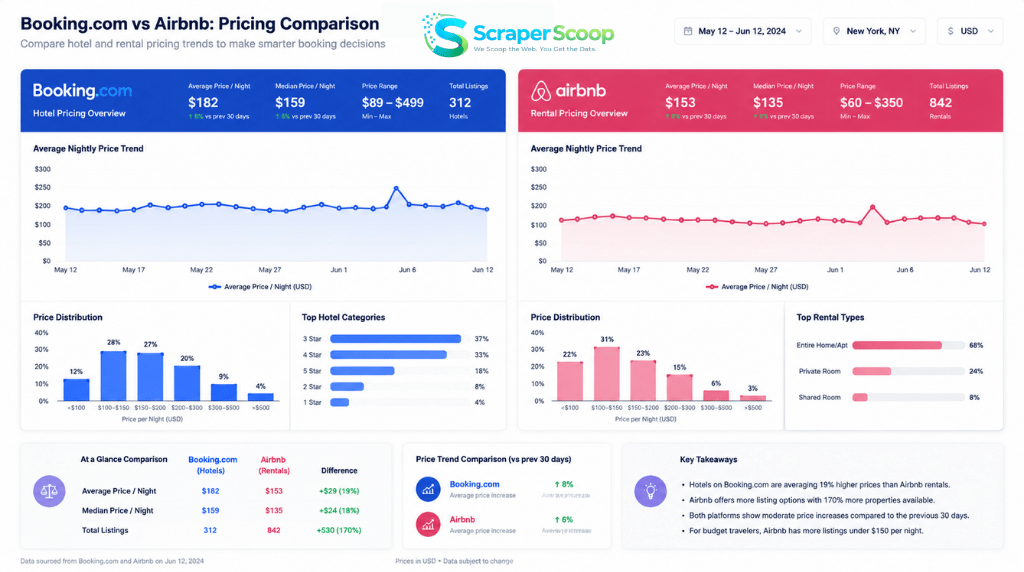
The travel and hospitality industry increasingly relies on predictive pricing models to optimize revenue, forecast demand, and monitor market trends.
Platforms like Booking.com and Airbnb generate enormous volumes of accommodation pricing data every day.
For:
- Revenue managers
- Travel startups
- Hospitality analysts
- Investment firms
- OTAs (Online Travel Agencies)
the ability to extract, clean, and forecast pricing data accurately has become a major competitive advantage.
But one critical question remains:
Which platform delivers cleaner data for price forecasting?
The answer depends on:
- Data structure
- Standardization
- Listing consistency
- Pricing transparency
- Market coverage
- Frequency of pricing changes
This article explores the strengths and weaknesses of both platforms from a data engineering and forecasting perspective.
Understanding Price Forecasting in Travel Analytics
What is Price Forecasting?
Price forecasting uses:
- Historical pricing data
- Occupancy trends
- Demand fluctuations
- Seasonal patterns
- Market events
to predict future accommodation prices.
Forecasting systems help businesses:
- Optimize pricing strategies
- Improve occupancy rates
- Predict demand spikes
- Enhance profitability
Modern forecasting models rely heavily on:
- Machine learning
- Time-series analysis
- Real-time scraping infrastructure
Why Data Quality Matters More Than Volume
Large datasets alone are not enough.
Forecasting systems require:
- Consistent formatting
- Reliable timestamps
- Stable identifiers
- Structured pricing components
- Minimal missing values
Poor-quality data introduces:
- Forecasting bias
- Inaccurate trends
- Noise in ML models
- Revenue prediction errors
This is where the differences between Booking.com and Airbnb become significant.
Booking.com Data Structure Overview
Why Booking.com Data is Often Easier to Forecast
Booking.com primarily focuses on:
- Hotels
- Resorts
- Apartments
- Traditional accommodations
The platform’s structure is relatively standardized.
Typical scraped fields include:
- Hotel name
- Star rating
- Review score
- Room type
- Nightly price
- Taxes and fees
- Availability
- Amenities
- Location coordinates
Academic research comparing Airbnb and Booking.com datasets noted that Booking.com listings tend to contain more structured hospitality-oriented attributes suitable for comparative analysis.
Advantages of Booking.com Data
1. Standardized Property Types
Hotels generally follow predictable structures:
- Single room
- Double room
- Deluxe suite
- Standardized amenities
This consistency improves:
- Feature engineering
- Data normalization
- Model training accuracy
2. More Stable Pricing Logic
Booking.com pricing is heavily driven by:
- Occupancy
- Seasonal demand
- Hotel revenue management systems
Compared to Airbnb, pricing behavior tends to be:
- More systematic
- Less emotionally influenced
- Easier to model statistically
3. Better Metadata Consistency
Booking.com typically includes:
- Star ratings
- Review counts
- Property classifications
- Geographic data
This structured metadata improves:
- Regression modeling
- Feature importance analysis
- Geographic forecasting
Airbnb Data Structure Overview
Why Airbnb Data is More Complex
Airbnb operates differently from traditional OTAs.
Listings vary dramatically across:
- Property types
- Hosts
- Pricing strategies
- Availability rules
- Cleaning fees
- Service fees
This flexibility creates both opportunities and challenges.
Advantages of Airbnb Data
1. Rich Behavioral Signals
Airbnb data often includes:
- Host status
- Superhost indicators
- Review sentiment
- Cancellation policies
- Occupancy constraints
- Unique amenities
Research datasets show Airbnb contains extensive behavioral and host-related variables valuable for advanced analytics.
2. Stronger Hyperlocal Trends
Airbnb pricing reacts rapidly to:
- Local events
- Neighborhood demand
- Tourism surges
- Short-term supply changes
This makes Airbnb highly valuable for:
- Urban demand forecasting
- Event-driven analytics
- Short-term rental intelligence
3. Better Alternative Accommodation Coverage
Airbnb dominates:
- Vacation rentals
- Unique stays
- Shared spaces
- Long-term short rentals
This creates richer datasets for:
- Non-hotel accommodation forecasting
- Investor intelligence
- Vacation rental analysis
The Biggest Data Quality Challenges
Booking.com Challenges
Despite cleaner structure, Booking.com still has challenges.
Dynamic Availability
Prices change based on:
- User location
- Session history
- Device type
- Booking urgency
Room-Level Complexity
One hotel may have:
- Multiple room categories
- Multiple refund policies
- Multiple meal plans
This complicates normalization.
Airbnb Challenges
Airbnb data quality issues are more significant.
Highly Variable Listing Structures
Hosts create listings manually, leading to:
- Inconsistent descriptions
- Different pricing logic
- Missing fields
- Varying amenity naming conventions
Fee Fragmentation
Airbnb pricing often separates:
- Nightly rate
- Cleaning fee
- Service fee
- Occupancy fees
Forecasting systems must reconstruct total costs accurately.
Availability Gaps
Many Airbnb listings:
- Have irregular calendars
- Temporarily pause bookings
- Change minimum stay rules frequently
This creates sparse forecasting datasets.
Which Platform Delivers Cleaner Data?
Booking.com Wins for Structured Forecasting
If the goal is:
- Hotel price prediction
- Revenue management
- Traditional hospitality analytics
then Booking.com generally provides cleaner datasets.
Why?
Because it offers:
- More standardized inventory
- Stable room classifications
- Consistent pricing patterns
- Structured metadata
This reduces preprocessing complexity significantly.
Where Airbnb Outperforms Booking.com
Airbnb becomes more valuable when forecasting:
- Neighborhood-level demand
- Vacation rental pricing
- Alternative accommodation trends
- Event-driven occupancy surges
Its datasets contain richer behavioral context but require more cleaning.
Data Fields Comparison
| Data Attribute | Booking.com | Airbnb |
|---|---|---|
| Price consistency | High | Medium |
| Metadata standardization | High | Medium |
| Fee transparency | Medium | Low |
| Behavioral signals | Medium | High |
| Property consistency | High | Low |
| Forecasting readiness | High | Medium |
| Hyperlocal trend sensitivity | Medium | High |
| Long-term rental insights | Medium | High |
Real-World Forecasting Example
Booking.com Forecasting Pipeline
Typical workflow:
- Scrape hotel pricing daily
- Normalize room categories
- Remove duplicate listings
- Build time-series datasets
- Train forecasting models
Example schema:
{
  "hotel_name": "City Grand Hotel",
  "city": "Bangkok",
  "room_type": "Deluxe King",
  "price": 145,
  "currency": "USD",
  "review_score": 8.7,
  "availability": true,
  "date": "2026-05-01"
}
This type of structured schema is highly forecasting-friendly.
Airbnb Forecasting Pipeline
Airbnb forecasting pipelines are more complex.
Typical preprocessing includes:
- Fee aggregation
- Amenity normalization
- Calendar reconstruction
- Host reliability scoring
Example schema:
{
  "listing_id": 872341,
  "city": "Barcelona",
  "property_type": "Entire Apartment",
  "nightly_price": 120,
  "cleaning_fee": 35,
  "service_fee": 18,
  "minimum_nights": 3,
  "superhost": true
}
Notice how pricing is fragmented across multiple fields.
The Role of Web Scraping in Price Forecasting
Modern forecasting systems depend heavily on:
- Continuous scraping
- Real-time updates
- Historical storage
- Structured pipelines
Businesses scrape:
- Prices
- Availability
- Reviews
- Occupancy signals
- Discounts
- Competitor listings
Travel intelligence providers increasingly position real-time scraping as essential for pricing analytics and hospitality intelligence.
Why Historical Data Matters
Forecasting models require:
- Seasonal trends
- Longitudinal price changes
- Occupancy cycles
Without historical snapshots:
- Forecast accuracy drops
- Event patterns disappear
- Market anomalies become harder to identify
Machine Learning Implications
Booking.com Works Better for Traditional ML Models
Because Booking.com datasets are cleaner, they integrate well with:
- ARIMA models
- Prophet forecasting
- XGBoost
- Random Forest regression
Feature engineering becomes simpler.
Airbnb Requires More Advanced Feature Engineering
Airbnb forecasting benefits from:
- NLP review analysis
- Host reliability scoring
- Neighborhood embeddings
- Dynamic fee reconstruction
This increases complexity but can improve predictive depth.
Scalability Considerations
Booking.com Scalability
Booking.com offers:
- Massive hotel inventory
- Global coverage
- Standardized room structures
The platform reportedly supports millions of properties worldwide.
This scale makes it highly suitable for:
- Enterprise forecasting
- OTA benchmarking
- Revenue intelligence systems
Airbnb Scalability
Airbnb excels in:
- Alternative accommodations
- Urban rental analytics
- Short-term stay intelligence
However, variability increases computational overhead.
Data Cleaning Best Practices
Essential Normalization Steps
For Booking.com
- Standardize room types
- Normalize taxes and fees
- Deduplicate hotels
For Airbnb
- Aggregate all pricing components
- Normalize amenities
- Standardize property categories
- Reconstruct occupancy calendars
Combining Both Platforms for Better Forecasting
The strongest forecasting systems increasingly combine:
- Booking.com hotel data
- Airbnb rental intelligence
This hybrid approach provides:
- Broader market coverage
- Better demand signals
- More accurate urban forecasting
For example:
- Booking.com captures hotel market stability
- Airbnb captures neighborhood-level volatility
Together, they create stronger predictive models.
Why Businesses Need Real-Time Travel Intelligence
Modern hospitality businesses require:
- Real-time pricing updates
- Competitor intelligence
- Demand forecasting
- Dynamic pricing automation
Static datasets are no longer sufficient.
Businesses increasingly rely on:
- Automated scraping systems
- Real-time APIs
- Historical warehousing
- AI-driven forecasting pipelines
Why Choose Us
We specialize in:
- Travel data scraping
- Hotel pricing intelligence
- Airbnb dataset extraction
- OTA monitoring systems
- Real-time forecasting pipelines
Our Capabilities Include:
- Booking.com scraping infrastructure
- Airbnb listing intelligence
- Historical price tracking
- Competitor benchmarking
- Dynamic pricing analytics
- API-ready structured datasets
We build scalable systems designed for:
- Revenue management teams
- OTAs
- Hospitality startups
- Market intelligence firms
Explore more:
Final Verdict
If your goal is:
- Cleaner structured datasets
- Easier preprocessing
- Traditional hotel forecasting
then Booking.com generally delivers cleaner data for price forecasting.
However, if you want:
- Hyperlocal demand intelligence
- Alternative accommodation insights
- Rich behavioral signals
then Airbnb provides valuable complementary data.
The Best Strategy?
Most advanced forecasting systems combine both.
Because in modern travel analytics:
- Booking.com provides structure
- Airbnb provides behavioral depth
Together, they create more accurate and resilient forecasting models.
Call to Action
Ready to build smarter travel pricing models with high-quality accommodation data?
Visit
ScraperScoop Contact Page
to discuss custom scraping solutions for Booking.com, Airbnb, and travel intelligence datasets.
You can also explore:


