

Introduction: The Food Delivery Industry Has a Data Problem — And Data Is the Solution
Here’s a scenario that plays out every single day in the food delivery industry: a restaurant owner spends hours crafting the perfect menu, carefully pricing each dish to balance customer appeal with healthy margins. Then a competing restaurant on the same Uber Eats neighborhood page drops their burger combo by $2.50, adds a “Free Delivery” promo, and captures the next 200 lunchtime orders. The first restaurant doesn’t find out until the weekly summary report — days later, hundreds of orders too late.
Sound familiar? For anyone operating in the food delivery ecosystem — whether you’re an independent restaurant, a ghost kitchen operator, a food tech startup, or a national QSR chain — the margin between winning and losing on delivery platforms is razor-thin, and it’s decided by data speed.
The global food delivery market tells the story. The global online food delivery market is valued at approximately USD 285 billion in 2026, projected to reach USD 500+ billion by 2030. In the United States alone, online food delivery revenue is expected to reach USD 388.4 billion by 2026. There are now over 2.5 billion food delivery app users worldwide, with mobile ordering dominating platform traffic across every major market.
In a market this large, this competitive, and this fast-moving, the businesses that win are not always the ones with the best food. They’re the ones with the best data. And food delivery data scraping is the engine that powers that data advantage.
In this guide, we’ll walk you through everything you need to know about food delivery data scraping in 2026 — what data you can extract, why it matters across every type of food delivery business, the powerful use cases that are driving real revenue results right now, and exactly how ScraperScoop can power your complete food delivery intelligence strategy.
What Is Food Delivery Data Scraping and Why Does It Matter in 2026?
Food delivery data scraping is the automated process of extracting publicly available data from food delivery platforms, restaurant websites, and review aggregators. This includes menu items and pricing, delivery fees, promotional offers, restaurant ratings, customer reviews, operational details like delivery times and coverage areas, and platform-specific performance signals like search rankings and featured placement status.
In practical terms: instead of manually browsing Uber Eats, DoorDash, Zomato, Grubhub, and Deliveroo page by page — copying menu prices, noting promotions, and manually comparing restaurant ratings — automated scraping solutions do all of that continuously, at scale, across every competitor that matters to your business, and deliver the results in a clean, structured, analysis-ready format.
Why the Food Delivery Market Is Uniquely Data-Intensive
No other food service environment combines the pricing volatility, operational complexity, and consumer comparison behavior of food delivery platforms. Here’s what makes food delivery data so uniquely valuable — and uniquely challenging:
- Platform concentration is extreme. In the United States, DoorDash holds approximately 67% of the food delivery market share as of 2025-2026, with Uber Eats at around 23%. In other markets, players like Zomato, Swiggy, Deliveroo, and Grab dominate with similarly commanding positions. Understanding how these dominant platforms price, rank, and promote restaurants is not optional for anyone competing in this space — it’s survival intelligence.
- The commission structure creates constant pricing pressure. Food delivery platforms typically charge restaurants commission rates ranging from 15% to 30% of each order value. This dramatically compresses already-thin restaurant margins and makes menu pricing an extremely high-stakes decision — one where real-time competitive intelligence is not just useful, it’s commercially essential.
- Consumer behavior has shifted permanently. The COVID-19 pandemic fundamentally accelerated food delivery adoption, and those behaviors have proven sticky. Mobile food ordering is now the default for millions of consumers, and platforms like DoorDash, Uber Eats, and Instacart have reported sustained strong growth well into 2026.
- Ghost kitchens have transformed competitive dynamics. The ghost kitchen market is projected to reach USD 112 billion globally by 2027. These delivery-only operations — with lower overhead and maximum flexibility for brand and menu experimentation — have flooded delivery platforms with new competitors, intensifying the need for continuous market monitoring across both traditional and virtual restaurant competition.
- Consumer loyalty is extremely fragile. When a consumer opens DoorDash or Uber Eats and sees your competitor’s burger for $2 less with free delivery, switching costs are essentially zero. Pricing is one of the most powerful levers for capturing and retaining customers on delivery platforms — and managing it effectively requires knowing what competitors are charging in real time.
This is the environment in which food delivery data scraping has gone from being a technical curiosity to being core business infrastructure for every serious player in the space — from independent restaurant groups to national QSR chains to food tech platforms building the next generation of delivery intelligence.
What Food Delivery Data Can You Actually Scrape? A Complete Breakdown
Food delivery platforms are extraordinarily rich data environments. The breadth of intelligence available through automated extraction covers virtually every commercial decision a food delivery business makes. Here’s the full landscape of what’s available — and why each data type drives real business value.
1. Menu Data & Item Pricing
The most directly actionable category of food delivery data. Web scraping tools can systematically extract complete menu data from food delivery platforms, including item names, descriptions, prices, categories, modifications, and availability status. This creates a comprehensive, continuously updated map of competitor menu pricing — item by item, category by category — that informs every menu pricing and positioning decision you make. Understanding not just what competitors charge, but how they structure their menus, name their items, and organize their categories, provides competitive intelligence that goes far beyond simple price comparison.
2. Delivery Fees and Minimum Order Data
Delivery fees and minimum order thresholds are among the most psychologically powerful drivers of platform choice for consumers. Tracking competitor delivery fee structures — including platform-subsidized free delivery offers, subscription-based free delivery programs, distance-based fee tiers, and minimum order thresholds — provides critical intelligence for structuring your own delivery economics to remain competitive without sacrificing margin.
3. Restaurant Ratings & Review Data
Platform ratings are among the most influential factors in consumer restaurant selection on delivery apps. Systematically scraping and tracking rating distributions, review volumes, and sentiment patterns across competitors reveals quality and service perception trends that directly inform your own operational improvements and marketing positioning. Over time, tracking how competitor ratings evolve in response to specific changes — menu updates, new promotions, packaging changes — provides a rich database of market feedback that would be impossible to replicate through manual monitoring.
4. Promotional Offers & Deal Data
Food delivery platforms are heavily promotional environments. Buy-one-get-one deals, percentage discounts, free delivery thresholds, bundle offers, loyalty rewards, and platform-sponsored promotions all shift consumer demand significantly. Tracking what promotions competitors are running — and how those promotions change across different times of day, days of the week, and seasonal periods — provides the intelligence needed to time your own promotional investments for maximum competitive impact.
5. Delivery Coverage Area & Zone Data
Understanding competitor delivery coverage areas and zone boundaries reveals market gaps and expansion opportunities that aren’t visible from menu data alone. If a major competitor doesn’t deliver to a specific neighborhood, that’s a direct opportunity for your business to capture that demand without facing their competitive pressure. Mapping delivery coverage across your market helps identify both white-space opportunities and the zones where competitive pressure is most intense.
6. Estimated Delivery Times
Delivery time estimates are a critical consumer-facing metric that directly affects platform ranking and conversion. Tracking competitor delivery time estimates — by restaurant, by zone, by time of day — reveals operational benchmarks that your own delivery operations need to meet or beat. In markets where consumers are increasingly impatient, speed is becoming as important as price in driving platform choice, making delivery time intelligence strategically valuable.
7. Platform Search Rankings & Visibility Data
How prominently a restaurant appears in platform search results — by cuisine type, neighborhood, meal occasion, or price range — directly determines traffic and order volume. Scraping platform search rankings reveals which restaurants are winning visibility in your market segments, how ranking positions shift over time, and the competitive landscape for featured and sponsored placement — intelligence that informs your own platform SEO and advertising investment strategies.
8. Ghost Kitchen & Virtual Brand Intelligence
The explosion of ghost kitchens and virtual restaurant brands on delivery platforms has created a new layer of competitive complexity. Tracking new virtual brand launches in your market, monitoring how ghost kitchen operators evolve their concepts in response to demand signals, and identifying the most successful virtual brand categories in your area provides early intelligence on competitive threats that traditional restaurant monitoring would miss entirely.
9. Customer Sentiment & Review Text Data
Beyond numerical ratings, scraping the text content of customer reviews across competitors reveals the specific experiences, dishes, service attributes, and delivery quality dimensions that customers care about most. NLP analysis of review text surfaces patterns — recurring complaints, frequently praised items, service dimension sentiment — that turn qualitative feedback into structured competitive intelligence informing everything from menu development to packaging decisions.
Key Food Delivery Platforms You Should Be Monitoring Right Now
The food delivery platform landscape varies significantly by geography, but understanding the dominant players in your specific market — and having continuous intelligence on how they operate — is foundational to any food delivery data strategy.
DoorDash
The undisputed U.S. market leader. DoorDash holds approximately 67% of the U.S. food delivery market share as of 2025-2026, covering more than 94% of the U.S. population. For any restaurant or food business operating in the United States, DoorDash is the non-negotiable baseline for competitive monitoring. With over 37 million monthly active users in the U.S. and a DashPass subscription program that has fundamentally shifted consumer delivery economics, understanding DoorDash’s ranking algorithms, promotional structures, and pricing dynamics is essential.
Uber Eats
The second largest U.S. player with approximately 23% market share and a powerful global footprint in over 45 countries. Uber Eats’ integration with the broader Uber transportation ecosystem and its strong international presence — particularly in Europe, Latin America, and Asia Pacific — make it a critical monitoring target for both domestic and internationally-minded food businesses. The platform’s commission structure, promotional mechanics, and restaurant ranking factors provide vital competitive intelligence for any food delivery operation.
Grubhub
While Grubhub’s U.S. market share has declined from its once-dominant position, it retains meaningful presence in key urban markets — particularly Chicago, New York, and Philadelphia — where it maintains strong consumer loyalty. For restaurants in these markets, Grubhub remains a strategically important platform to monitor for pricing, promotional activity, and consumer sentiment data.
Zomato & Swiggy
India is one of the world’s fastest-growing food delivery markets, and Zomato and Swiggy together dominate it with an extraordinary competitive duopoly. The Indian food delivery market is experiencing explosive growth, driven by rapid smartphone *****, expanding middle-class consumer spending, and aggressive platform investment in Tier 2 and Tier 3 city expansion. For food businesses and investors with India exposure, scraping Zomato and Swiggy provides essential market intelligence across menu pricing, promotional strategies, and restaurant performance metrics.
Deliveroo
The dominant food delivery platform across much of Europe and the Middle East — with particularly strong positions in the UK, France, Italy, and the UAE. Deliveroo’s premium restaurant positioning and strong brand-name restaurant partnerships make it an important monitoring target for upmarket restaurant groups and food tech companies operating in European markets.
Grab & Regional Asian Platforms
Southeast Asia’s super-app ecosystem — led by Grab — combines food delivery with ride-hailing, payments, and other services in ways that create unique competitive dynamics. Food delivery data from Grab, GoFood (GoTo/Gojek), and regional specialists across Singapore, Indonesia, Thailand, Malaysia, and Vietnam provides intelligence that’s essential for any food business with Southeast Asian market ambitions.
Direct Restaurant Websites & Apps
Increasingly, major restaurant chains and groups are driving customers toward direct ordering channels to avoid platform commission costs. Monitoring competitor direct ordering websites and apps provides pricing and promotional intelligence that supplements platform data — and reveals when competitors are running direct-channel exclusive offers that your delivery platform monitoring wouldn’t capture.
9 Powerful Use Cases: How Food Delivery Businesses Use Data Scraping to Win
1. Menu Pricing Optimization
This is the most immediately impactful application of food delivery data scraping for restaurant operators. By systematically monitoring competitor menu prices across platforms in real time, restaurants can position each item on their menu with precision — not too high to deter price-sensitive customers, not so low as to unnecessarily sacrifice margin. Restaurants that align menu pricing with market benchmarks derived from scraped competitor data consistently outperform those relying on periodic manual price checks or intuition-based pricing decisions.
Scraped competitor menu data reveals not just price points but structural patterns: which categories competitors price at a premium, where they use loss-leader pricing to drive platform traffic, and how they bundle items into combo deals to increase average order value. This structural intelligence is as valuable as the raw price data itself.
2. Competitive Promotional Intelligence
Food delivery platforms are promotional battlegrounds. Scraping competitor promotional activity — launch offers, weekly deals, free delivery thresholds, loyalty program structures, and platform-sponsored promotions — gives your marketing team the context it needs to time campaigns effectively, structure compelling counter-promotions, and protect market share during aggressive competitor discount periods.
Tracking promotional calendars over time reveals patterns: when do competitors run their deepest discounts? Do they front-load promotions on Mondays to build weekly order habits? Do they increase promotional intensity on weekends to capture peak demand periods? These patterns become predictable once you have enough scraped historical data — allowing you to pre-position your own promotions for maximum competitive impact.
3. Ghost Kitchen Brand Intelligence
For ghost kitchen operators, data scraping provides an essential competitive early warning system. Tracking new virtual brand launches in your market, monitoring how existing ghost kitchen operators evolve their concepts, and identifying the cuisine categories and price points generating the most review volume and rating success tells you where demand is concentrating — before you commit kitchen capacity to a new concept.
Ghost kitchen success depends heavily on platform visibility and menu-market fit. Scraped platform data reveals which virtual brands are gaining traction, which are stalling, and the specific menu characteristics — price architecture, item count, cuisine specificity — that correlate with strong platform performance. This intelligence is the closest thing ghost kitchen operators have to market research without spending months on primary data collection.
4. Platform Search Ranking Analysis
On food delivery platforms, your search ranking position determines how many potential customers even see your restaurant. Understanding how search rankings are distributed across your competitive set — by cuisine type, neighborhood, meal occasion, and time of day — reveals the competitive landscape for platform visibility and informs your own listing optimization, photography investment, and sponsored placement decisions.
Tracking how competitor rankings shift over time also surfaces patterns: which restaurants are gaining visibility from platform promotions, which are being algorithmically rewarded for high rating scores, and which are being penalized for slow delivery times or high cancellation rates. This intelligence is gold for any restaurant serious about improving its platform performance.
5. Delivery Coverage Gap Analysis
By mapping competitor delivery coverage areas across your market using scraped zone data, you can identify the delivery zones with strong consumer demand but limited restaurant coverage. These coverage gaps represent direct expansion opportunities — opening a new location, launching a ghost kitchen brand, or adjusting delivery radius to capture underserved demand without facing the full weight of established competitor presence.
For food aggregators and delivery tech companies, delivery coverage data also informs restaurant recruitment strategies — identifying the cuisine categories and geographic areas where their platform supply is weakest relative to consumer demand signals.
6. Customer Review & Sentiment Monitoring
Your competitors’ customer reviews are a continuous, unfiltered stream of market intelligence that most food businesses barely tap into. Systematically scraping and analyzing the text content of competitor reviews reveals the dishes customers rave about, the service dimensions that generate complaints, the packaging quality that drives repeat orders, and the delivery experience factors that lead to negative ratings.
This analysis also reveals your own opportunities: if a category of competitor consistently receives complaints about slow delivery or cold food, that’s a positioning angle your own marketing and operations can directly exploit. And if competitor reviews consistently praise a specific dish type you don’t offer, that’s a menu development signal backed by real consumer demand data.
7. New Market Entry & Location Intelligence
Before committing to opening a new restaurant location, expanding a ghost kitchen operation, or launching in a new city market, scraped food delivery data provides the competitive landscape intelligence that informs the decision. Restaurant density by cuisine category, average price points by neighborhood, rating distributions across platforms, and promotional intensity by market area — all derived from structured scraped data — give operators a data-backed view of opportunity before capital is deployed.
Analyzing this intelligence helps identify the neighborhoods and market segments where demand is high but supply is weak — the ideal conditions for a new entrant to capture meaningful market share quickly without facing entrenched competition from day one.
8. Food Tech Platform Development
For food tech startups and companies building delivery management software, restaurant analytics platforms, or food industry intelligence tools, comprehensive scraped food delivery data provides the foundation for product features that would otherwise require years of proprietary data collection. Menu database tools, competitive pricing benchmarks, restaurant discovery engines, and delivery performance dashboards all depend on structured, continuously updated food delivery data — the kind that managed scraping services deliver reliably without requiring internal engineering investment in complex data pipelines.
9. Investor & Market Research Intelligence
Investment analysts, venture capital firms evaluating food delivery investments, and market research firms producing food industry reports all use scraped food delivery data as a leading indicator of market dynamics. Restaurant launch rates, pricing inflation trends, promotional intensity levels, rating distribution shifts, and ghost kitchen brand proliferation rates — all derived from systematically scraped platform data — provide alternative data signals that inform investment decisions with a depth and currency that quarterly industry reports simply cannot match.
Menu Price Monitoring: The Core Competitive Intelligence Tool for Food Delivery in 2026
Among all food delivery data scraping applications, menu price monitoring delivers the most immediate, measurable, bottom-line impact — and it’s the capability that every serious food delivery business, at every scale, needs to have in place.
Why Menu Pricing on Delivery Platforms Is a High-Stakes Game
The economics of food delivery make pricing decisions extraordinarily consequential. With platform commission rates ranging from 15% to 30% of each order, restaurants are already working with compressed margins before a single delivery is made. Pricing a burger $1.50 too high loses orders to competitors. Pricing it $1.50 too low — across hundreds of orders per week — costs real money in margin that compounds over time.
And unlike a physical restaurant where ambiance, service, and experience differentiate the offering, delivery platform customers are making decisions based on a thumbnail image, a star rating, and a price — often within a few seconds of opening an app. In that environment, competitive pricing isn’t just one factor among many. It’s one of two or three factors that determine whether a customer taps on your restaurant or the one below you in the feed.
The Market Intelligence That Menu Scraping Unlocks
Web scrapers can systematically extract complete menu data from food delivery platforms, including item names, descriptions, prices, categories, modifications, and availability status. When this data is collected continuously and analyzed over time, it reveals intelligence that transforms menu strategy from guesswork to evidence-based decision-making:
- Price benchmarking by category: Where do your prices sit relative to the market median for each dish category? Are you premium-positioned or value-positioned, and does that align with your brand strategy?
- Price change patterns: When and how do competitors change prices? Do they adjust seasonally? During specific events? In response to cost inflation? Understanding these patterns helps you anticipate market movements rather than just react to them.
- Bundle and combo pricing structure: How do competitors construct combo deals to increase average order value? What are the most common price points for meal combinations in your category, and how do they compare to your own bundling strategy?
- Promotion-adjusted effective pricing: A $15 dish with a 20% promo active is effectively a $12 dish. Tracking the effective promotional price — not just the listed menu price — gives you the real competitive pricing picture that casual observation misses.
From Reactive to Proactive Menu Management
The restaurant operators winning on food delivery platforms in 2026 are not the ones who check competitor prices once a month and adjust accordingly. They’re the ones whose menu pricing decisions are informed by continuous data flows that surface competitive pricing shifts as they happen — enabling proactive adjustments that keep their positioning optimal without sacrificing the margin discipline that makes the delivery channel commercially viable.
This is not just an advantage for large chains. Ghost kitchen operators, independent restaurant groups, and even single-location restaurants that implement systematic menu price monitoring report meaningful improvements in both order volume and delivery channel margin — because better pricing decisions, informed by real competitor data, consistently outperform gut-instinct pricing.
Ghost Kitchen Intelligence: How Data Scraping Powers the Virtual Restaurant Revolution
The ghost kitchen revolution is reshaping the food delivery competitive landscape — and it’s creating data intelligence opportunities that didn’t exist just a few years ago.
The Ghost Kitchen Market in 2026
The ghost kitchen market represents one of the most significant structural shifts in the food industry. The ghost kitchen market is projected to reach USD 112 billion globally by 2027. In the United States, the ghost kitchen market is expected to surpass USD 1.05 billion by 2026. These delivery-only operations — running from shared commercial kitchen facilities without front-of-house overhead — have fundamentally lowered the capital and operational barriers to launching new food concepts, flooding delivery platforms with an unprecedented volume and variety of virtual restaurant brands.
Why Ghost Kitchen Operators Need Data More Than Anyone
A traditional restaurant can differentiate through location, ambiance, and service experience. A ghost kitchen competes exclusively on its delivery platform presence — menu design, pricing, photography, ratings, and platform ranking position. There is no other lever. In that environment, data intelligence isn’t a nice-to-have competitive tool — it’s the only tool available.
Data-driven virtual brands use scraped market intelligence to make every consequential decision: which cuisine categories are underserved in a specific geographic market, what price architecture maximizes order frequency without deterring first-time trials, which operational patterns (delivery time, order accuracy, packaging quality) generate the review sentiment that improves platform ratings, and when to launch or discontinue a virtual brand concept based on demand signal trends.
Concept Validation Through Market Data
Before investing in kitchen equipment, supplier relationships, and brand development for a new virtual concept, ghost kitchen operators can use scraped food delivery platform data to validate demand. How many restaurants in the target area are already serving this cuisine category? What ratings are the most successful ones achieving? What price points are generating the highest review volume? What menu structures — item count, category organization, combo pricing — correlate with strong platform performance in comparable markets?
This kind of pre-launch data validation compresses the concept testing cycle dramatically — turning what was previously a months-long trial-and-error process into a data-backed hypothesis that can be tested with much higher confidence from day one.
Why Food Delivery Data Scraping Is Complex — And How Professional Services Solve It
Food delivery platforms have evolved into some of the most technically sophisticated and actively defended data environments on the internet. Here’s what makes scraping them genuinely challenging — and how professional data services address each obstacle effectively.
Challenge 1: Dynamic JavaScript Rendering
Modern food delivery platforms — particularly Uber Eats, DoorDash, and Deliveroo — are built as sophisticated single-page applications that load menu content, pricing, and restaurant details dynamically through JavaScript after the initial page load. Traditional HTTP-based scraping tools only access the raw HTML shell, completely missing the most valuable data. Professional scraping solutions use headless browser automation that renders JavaScript exactly as a real user’s browser would — accessing the full, dynamically-loaded content that contains the intelligence you actually need.
Challenge 2: Location-Based Menu and Pricing Variations
Food delivery platforms display different menus, prices, and restaurant availability depending on the delivery address or location being searched. A restaurant’s menu on Uber Eats may show completely different prices depending on the geographic zone being served — a pricing strategy used to account for varying delivery costs, local market conditions, and competitive pressure by neighborhood. Collecting comprehensive, geographically accurate menu data requires simulating searches from multiple location points and normalizing the results across geographic zones — a capability that requires sophisticated infrastructure and domain expertise to execute reliably.
Challenge 3: App-First Platform Architecture
Several major food delivery platforms — particularly in Asian markets — are primarily accessed through mobile applications rather than web browsers. This creates a technical barrier for web-based scraping approaches and requires mobile app data extraction capabilities that go beyond standard web scraping tooling. Accessing data that exists only within native mobile app environments requires specialized technical approaches including API monitoring and mobile browser emulation.
Challenge 4: Advanced Anti-Bot Systems
Major food delivery platforms invest heavily in bot detection and automated access prevention systems. These include CAPTCHA challenges, IP-based rate limiting, behavioral fingerprinting, and session invalidation that are specifically designed to block automated data collection at scale. Overcoming these systems reliably requires sophisticated proxy rotation infrastructure, realistic user behavior simulation, intelligent request pacing, and continuous adaptation as platforms update their defensive measures — a maintenance overhead that is prohibitive for most in-house engineering teams to sustain.
Challenge 5: Menu Data Normalization Complexity
Even once the raw data is successfully extracted, normalizing it into a structured, comparable format across multiple platforms presents significant challenges. Menu item names vary across platforms. Price formats differ. Promotional pricing structures are expressed differently by different platforms. Category taxonomy is inconsistent. Ingredient and allergen information appears with different levels of completeness. Professional data services implement systematic normalization pipelines that handle all of this complexity automatically — delivering clean, cross-platform-comparable datasets rather than raw data dumps that require extensive post-processing before they’re analysis-ready.
Challenge 6: Real-Time Freshness Requirements
Food delivery promotions can launch and expire within hours. Menu prices can change multiple times in a single day. Platform search rankings shift continuously in response to order volumes, ratings, and advertising spend. Maintaining the data freshness required for truly actionable competitive intelligence demands a high-cadence, always-on scraping infrastructure that keeps costs under control through intelligent scheduling — running high-frequency monitoring on the most volatile data types and lower-frequency collection on slower-changing intelligence dimensions.
These challenges are precisely why the most successful food delivery businesses — from national QSR chains to fast-growing ghost kitchen operators to food tech startups — work with specialist managed data providers rather than attempting to build and maintain complex scraping infrastructure in-house. Talk to ScraperScoop’s team today — we’ve built the complete infrastructure, solved all the hard technical problems, and deliver ready-to-use food delivery datasets so your team can focus entirely on menu strategy, market expansion, and revenue growth.
The Proven ROI of Food Delivery Data Scraping: Where the Revenue Gets Created
Let’s talk commercial reality. In a market where platform commissions already compress restaurant margins, the ROI of investing in competitive data intelligence needs to be clear and measurable. Here’s how food delivery data scraping creates value across different business models:
For Restaurants & QSR Chains
- Menu pricing precision: Continuous competitive price monitoring enables menu pricing decisions that consistently optimize the balance between order volume and per-order margin — avoiding both over-pricing that loses orders and under-pricing that sacrifices margin across thousands of weekly orders.
- Promotional ROI improvement: Understanding competitor promotional calendars and structures allows restaurants to invest promotional spend at moments of maximum competitive advantage — rather than running undifferentiated discounts that simply reduce margin without meaningfully improving competitive position.
- Platform ranking optimization: Using scraped ranking intelligence to understand the signals that drive platform search visibility enables targeted listing optimizations — better photography, more competitive pricing, improved delivery time performance — that drive organic traffic improvements without continuous paid placement investment.
For Ghost Kitchen Operators
- Concept validation: Pre-launch market validation through scraped demand and competition data dramatically improves the success rate of new virtual brand launches — reducing the rate of failed concept investments that represent significant sunk costs in kitchen setup, supplier development, and brand creation.
- Menu-market fit optimization: Continuously monitoring which items and price points are generating the strongest rating and review volume signals across comparable competitor concepts enables ongoing menu optimization backed by real market evidence rather than internal assumptions.
- Expansion decision quality: Data-backed identification of underserved cuisine categories and geographic zones with demand-supply imbalances enables expansion decisions that consistently outperform gut-instinct market entry choices.
For Food Delivery Aggregators & Tech Platforms
- Restaurant recruitment intelligence: Identifying cuisine categories and geographic areas where platform supply is weakest relative to consumer demand signals enables more targeted and effective restaurant recruitment efforts.
- Product development acceleration: Using managed food delivery data APIs to power core platform features eliminates months of scraper development overhead — letting engineering teams focus on product differentiation and user experience rather than data infrastructure.
- Market intelligence quality: Comprehensive, continuously updated food delivery datasets provide the foundation for investor reports, market analysis publications, and strategic advisory services that command premium pricing from clients who need authoritative market intelligence.
For Investors & Market Research Firms
- Alternative data advantage: Scraped food delivery market data — restaurant launch rates, pricing inflation trends, promotional intensity patterns, ghost kitchen proliferation rates — provides leading indicators that traditional quarterly industry reports can’t match for timeliness or granularity.
- Portfolio monitoring: For investors with food delivery platform or restaurant chain portfolio exposure, continuous monitoring of scraped market data provides early signals of competitive dynamics that may not appear in financial statements for weeks or months.
How AI Is Transforming Food Delivery Data Scraping in 2026
The integration of artificial intelligence into food delivery data collection and analysis is accelerating rapidly — and the capabilities emerging in 2026 are delivering competitive intelligence that previous generations of scraping tools simply couldn’t approach.
Natural Language Processing for Review Intelligence
The application of NLP to scraped review data is transforming what food delivery businesses can learn from customer feedback. Rather than reading through thousands of competitor reviews manually — an impossible task at any meaningful scale — NLP models automatically extract structured insights: the most frequently mentioned dishes (positive and negative), the dominant service quality themes, the delivery experience dimensions that most strongly correlate with rating outcomes, and the emerging complaint patterns that signal quality deterioration before it significantly impacts overall ratings.
For restaurant operators, these NLP-derived insights from competitor reviews are a uniquely valuable intelligence source — effectively giving you access to your competitors’ internal customer feedback signals without any of the customer relationship investment that normally generates that data.
Demand Prediction Through Pattern Recognition
Machine learning models trained on scraped food delivery data can identify demand patterns that aren’t visible to human analysts reviewing the same data manually. Correlations between local events and cuisine category demand spikes, neighborhood-level delivery frequency trends that predict market growth trajectories, and promotional response elasticity patterns that reveal optimal discount depth for different menu categories — all of this emerges from ML analysis of continuously scraped food delivery platform data.
Self-Healing Data Pipelines
Food delivery platforms update their interfaces frequently — new features launch, menu page layouts change, and promotional display formats evolve. Traditional scraping pipelines break when these changes occur, requiring manual engineering intervention to restore data collection. AI-powered scraping infrastructure detects layout changes automatically and adjusts parsing logic without human intervention — eliminating the maintenance overhead that makes in-house scraping operationally expensive and unreliable.
Automated Menu Optimization Recommendations
The next generation of food delivery intelligence platforms goes beyond delivering raw competitor data to generating automated recommendations for menu pricing adjustments, promotional structures, and platform listing optimizations — driven by AI analysis of scraped competitive data combined with your own performance metrics. This moves food delivery intelligence from a reporting function to a genuinely prescriptive tool that tells operators not just what the market looks like, but what specific actions will most improve their competitive position.
Food Delivery Data Scraping Best Practices: Building Intelligence That Drives Results
1. Define Specific Commercial Questions Before Designing Your Data Strategy
The most effective food delivery data operations are built around specific, high-stakes commercial decisions — not around collecting everything that’s technically available. Before designing your scraping strategy, ask: Which competitor pricing moves are currently costing us orders? Which promotional structures are our competitors using that we haven’t tested? Which market areas represent the strongest expansion opportunities based on supply-demand dynamics? Each of these questions translates directly into a specific data collection requirement. This precision ensures every scraping investment traces to a business outcome.
2. Prioritize Multi-Platform Coverage from Day One
Your competitive intelligence is only as good as your platform coverage. Monitoring a single platform gives you a critically incomplete picture — a competitor might be running aggressive promotions on DoorDash while maintaining higher prices on Uber Eats, or vice versa. Build your monitoring architecture to cover all platforms that are commercially relevant to your business from the beginning, even if collection frequency differs by platform importance.
3. Match Collection Frequency to Data Volatility
Not all food delivery data changes at the same rate. Flash promotions may expire within hours and need near-real-time monitoring. Menu base prices might only change weekly. Restaurant ratings update with each new review. Platform search ranking positions shift throughout the day. Match your scraping cadence to the volatility of each data type to get maximum intelligence value from your data collection infrastructure without paying for unnecessary collection frequency.
4. Invest Seriously in Location-Based Data Accuracy
Because food delivery platforms display location-specific menus and prices, your competitive intelligence is only accurate to the degree that it reflects the specific geographic zones you actually compete in. Design your data collection to capture pricing and availability as seen from the delivery zones that matter most to your business — not a single city-level view that may mask significant neighborhood-level price and coverage variations.
5. Connect Data Intelligence to Operational Workflows
Competitive intelligence that lives in a database no one regularly consults drives very little commercial action. Integrate scraped food delivery data directly into the decision workflows where it’s most useful — pricing review meetings, menu development processes, promotional planning calendars, and platform optimization reviews. The businesses that extract the most value from food delivery data scraping are the ones that have made competitive intelligence a regular, structured input to their operational decision-making, not an occasional reference.
6. Maintain Full Ethical and Legal Compliance
Food delivery data scraping should always be conducted on publicly available data, in compliance with platform terms of service, at request rates that don’t burden platform infrastructure, and without collecting personally identifiable information about consumers. Operating within these boundaries is not just ethically sound — it’s the foundation of a sustainable, long-term data intelligence operation. Partnering with a compliance-first managed data provider like ScraperScoop ensures your intelligence operations are built on solid legal and ethical foundations that protect your business over the long term.
The Future of Food Delivery Data Scraping: Trends That Will Define the Industry
Predictive Demand Intelligence
The next frontier for food delivery data intelligence is shifting from descriptive — what are competitors doing right now — to genuinely predictive: what will consumers demand in the coming days and weeks, and how should we position menus and promotions to capture that demand optimally? Machine learning models trained on scraped historical food delivery data, combined with external signals like weather patterns, local event calendars, and economic indicators, will increasingly deliver forward-looking demand intelligence that enables proactive rather than purely reactive commercial decision-making.
Hyper-Local Market Intelligence
The future of food delivery competitive intelligence is hyper-local. As delivery platforms increasingly segment their markets at the neighborhood or even block level — with different restaurant recommendations, pricing, and promotions shown to users based on their precise delivery address — the intelligence value of granular geographic data collection will grow significantly. Businesses that can monitor competitive dynamics at the street-level resolution, rather than city-level averages, will have a substantial advantage in identifying micro-market opportunities and threats before they’re visible to less data-sophisticated competitors.
Social Commerce and Short-Video Food Intelligence
The explosive growth of TikTok food content, Instagram restaurant marketing, and YouTube food review culture is creating a new layer of demand signals that increasingly predict food delivery performance outcomes. Viral food trends that originate on social media consistently drive delivery platform search spikes within 24-48 hours. Integrating social media trend monitoring with food delivery platform data creates a predictive intelligence stack that positions businesses to capture viral demand before competitors recognize the opportunity.
Sustainability & Dietary Preference Tracking
Consumer preferences are shifting rapidly toward plant-based options, sustainable packaging, allergen transparency, and nutritional clarity — and these preferences are increasingly visible and trackable in food delivery platform data through menu labeling, review sentiment, and search behavior. Tracking how competitors are responding to these preferences through menu evolution and marketing positioning will become a standard dimension of food delivery competitive intelligence as dietary preference demographics continue to shift.
Cross-Platform Delivery Ecosystem Intelligence
The food delivery ecosystem is expanding beyond traditional restaurant meals — grocery delivery, convenience store delivery, alcohol delivery, and meal kit delivery are all converging onto the same consumer devices and increasingly the same platforms. As Uber Eats, DoorDash, and Grab expand their delivery category coverage, comprehensive platform intelligence will need to encompass this full ecosystem — tracking how cross-category competition from grocery and convenience delivery affects restaurant order frequency and consumer delivery spending patterns.
How ScraperScoop Delivers Food Delivery Intelligence for Every Type of Food Business
At ScraperScoop, we’ve built our food delivery data capabilities around one core conviction: every food delivery business — from an independent restaurant to a global food tech platform — deserves access to the same quality of competitive intelligence that was previously available only to the largest enterprises.
Here is exactly what ScraperScoop delivers for food delivery industry clients:
- ✅ Custom Menu Scraping Solutions: Purpose-built menu data extractors for your specific target platforms, geographic markets, competitor set, and data requirements — capturing item names, prices, categories, modifications, availability status, and promotional pricing on the refresh cadence your business needs.
- ✅ Competitive Pricing Intelligence Feeds: Continuously updated competitor menu pricing datasets that power your pricing strategy decisions — delivered in real time or on scheduled refreshes matched to your market’s competitive velocity.
- ✅ Promotional & Deal Monitoring: Real-time tracking of competitor promotional campaigns across major delivery platforms — flash deals, discount structures, bundle offers, free delivery thresholds — so your marketing team always knows what they’re competing against.
- ✅ Restaurant Rating & Review Data: Structured review and rating data scraped from all major food delivery platforms and review aggregators — with sentiment analysis that surfaces actionable competitive insights rather than raw comment volumes.
- ✅ Delivery Coverage Zone Intelligence: Geographic delivery coverage area data that maps competitor delivery zones, identifies supply-demand gaps, and surfaces expansion opportunities in your target markets.
- ✅ Platform Ranking & Visibility Data: Search ranking and featured placement intelligence that reveals the competitive landscape for platform visibility in your cuisine category and geographic market.
- ✅ Ready-Made Food Delivery Datasets: Need market data fast? Our pre-built food delivery datasets across major platforms give you immediate access to structured, validated competitive intelligence without development lead time.
- ✅ Food Delivery Data APIs: Integrate our continuously updated food delivery intelligence feeds directly into your restaurant management system, menu pricing tool, ghost kitchen dashboard, or food tech platform — with clean, normalized data in your required format.
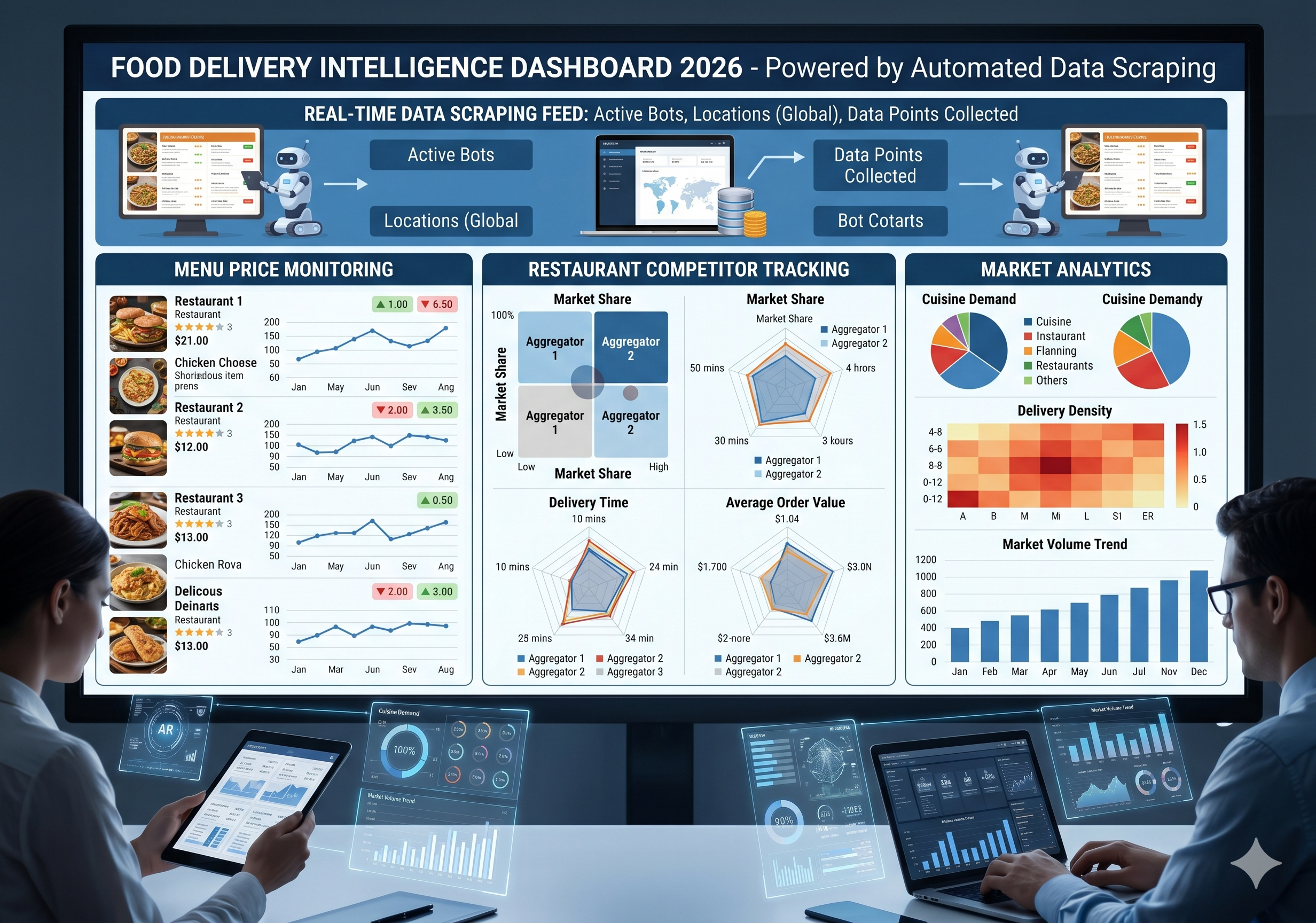
- ✅ Analytics Dashboards: Visual competitive intelligence dashboards that transform raw scraped food delivery data into clear, actionable insights — pricing position charts, promotional calendars, rating trend analysis, and coverage gap maps your entire team can act on.
- ✅ Multi-Platform & Multi-Market Coverage: Whether you need data from U.S. platforms, European markets, Asia Pacific, or multiple geographies simultaneously — our infrastructure scales seamlessly with your market coverage requirements.
- ✅ Compliance-First Operations: Every ScraperScoop food delivery data collection operation is built on ethical and legally sound foundations — respecting platform policies, data privacy regulations, and sustainable access patterns.
Ready to Build Your Food Delivery Data Advantage? Let’s Talk
The global food delivery market is growing toward USD 500+ billion by 2030. Platform competition is intensifying. Ghost kitchens are multiplying. Commission rates are compressing margins. And consumer switching costs between platforms and restaurants are essentially zero.
In that environment, the restaurants, ghost kitchen operators, food aggregators, and food tech companies that win are the ones who understand their market more deeply, respond to competitive moves faster, and make smarter pricing and operational decisions backed by real, continuously updated competitive data.
That data advantage starts with ScraperScoop.
At ScraperScoop, we deliver:
- ✅ Custom Menu Price Scrapers built for your exact platforms and competitor set
- ✅ Real-Time Competitor Menu Monitoring across all major food delivery platforms
- ✅ Promotional Intelligence Feeds that keep your marketing team ahead of competitor campaigns
- ✅ Restaurant Review & Sentiment Data from all major platforms
- ✅ Delivery Coverage & Zone Intelligence for market gap analysis and expansion planning
- ✅ Ready-Made Food Delivery Datasets for instant competitive intelligence deployment
- ✅ Food Delivery Data APIs for seamless integration with your existing tech stack
- ✅ Analytics Dashboards that transform raw data into clear commercial insights
- ✅ Compliance-First, Ethical Operations for sustainable, long-term data intelligence
🍔 Let’s Build Your Food Delivery Intelligence Operation — Starting Today
Your competitors are already watching your menu. It’s time to watch theirs — and go much, much further.
Contact ScraperScoop today for your free consultation → Tell us which platforms you need to monitor, which markets you operate in, and what commercial decisions you need better data to support — and we’ll design the perfect food delivery intelligence solution for your business.
Conclusion: In 2026, Your Menu Is Your Brand — And Data Keeps It Competitive
The food delivery industry in 2026 is one of the most competitive, most fast-moving, and most data-intensive commercial environments in the world. Prices change daily. Promotions launch and expire within hours. Ghost kitchen brands flood platforms with new competition. And consumers make switching decisions in seconds based on price, rating, and delivery time.
The businesses winning in this environment — the restaurants consistently capturing strong order volumes, the ghost kitchen operators launching successful virtual brands, the food tech platforms driving strong user engagement and conversion — all share one critical operational capability: they see the market more clearly than their competitors, and they act on that intelligence faster.
Food delivery data scraping is the infrastructure that makes all of it possible. From menu pricing intelligence that enables evidence-based pricing decisions, to promotional monitoring that keeps marketing teams ahead of competitor campaigns, to ghost kitchen concept validation that improves launch success rates, to platform ranking intelligence that drives listing optimization — the applications are broad, the ROI is proven, and the competitive disadvantage of operating without this intelligence grows larger every month.
ScraperScoop is the partner that makes it happen. Accurate, structured, continuously updated food delivery data — tailored to your business, delivered at the speed the market demands.
👉 Get in touch with ScraperScoop now — and let’s turn food delivery web data into your most powerful competitive weapon.
Frequently Asked Questions About Food Delivery Data Scraping
What is food delivery data scraping?
Food delivery data scraping is the automated extraction of publicly available data from food delivery platforms like Uber Eats, DoorDash, Zomato, and Deliveroo. This includes menu prices, delivery fees, restaurant ratings, promotional offers, delivery coverage zones, and customer review data. Restaurants, ghost kitchen operators, food tech companies, and market researchers use this intelligence to optimize pricing, track competitors, and make smarter market decisions.
Is scraping food delivery platforms like Uber Eats and DoorDash legal?
Scraping publicly available data from food delivery platforms is generally legal when conducted responsibly — respecting platform terms of service, operating at sustainable request rates, collecting only publicly visible data, and complying with data privacy regulations like GDPR and CCPA. ScraperScoop operates with a compliance-first approach to ensure all food delivery data collection is ethical and legally sound. Always consult legal counsel for specific commercial use cases.
How can menu price monitoring help my restaurant compete better on delivery platforms?
Menu price monitoring provides continuous, item-level visibility into what competitors are charging across every food delivery platform in your market. This intelligence enables pricing decisions that consistently optimize the balance between order volume and per-order margin — avoiding over-pricing that loses orders and under-pricing that unnecessarily sacrifices margin. Over time, it also reveals competitor pricing patterns, promotional structures, and bundle strategies that inform your own menu optimization and promotional planning.
How can ghost kitchen operators use food delivery data scraping?
Ghost kitchen operators use scraped food delivery data for concept validation before launch — identifying underserved cuisine categories, optimal price architectures, and menu structures correlated with strong platform performance in target markets. Ongoing scraping provides continuous intelligence on competitor virtual brands, platform ranking dynamics, and demand signal trends that inform menu evolution, promotional strategy, and expansion decisions.
Which food delivery platforms can ScraperScoop collect data from?
ScraperScoop can collect data from all major food delivery platforms including DoorDash, Uber Eats, Grubhub, Zomato, Swiggy, Deliveroo, Grab, GoFood, and regional platforms across North America, Europe, Asia Pacific, and other markets. We handle the full technical complexity of each platform’s unique architecture — JavaScript rendering, location-based pricing, anti-bot measures, and data normalization — delivering clean, structured, analysis-ready datasets.
How often should food delivery competitor data be scraped?
Ideal scraping frequency depends on data type and business need. Promotional offers may need near-real-time monitoring as they can change within hours. Menu base prices typically need daily monitoring. Platform search rankings may need multiple checks per day in competitive markets. Restaurant rating updates can be monitored weekly. ScraperScoop helps design the right refresh cadence for each data type to maximize intelligence value while controlling infrastructure costs.
Why should I choose ScraperScoop for food delivery data scraping?
ScraperScoop provides custom food delivery scraping solutions, ready-made restaurant datasets, food delivery APIs, and analytics dashboards specifically designed for food industry businesses. We handle all technical complexity — dynamic JavaScript rendering, location-based pricing variation, anti-bot navigation, and data normalization — so your team focuses on competitive strategy and revenue growth rather than data infrastructure. Contact us for a free consultation.
Can food delivery data scraping help with new market expansion decisions?
Absolutely. Scraped food delivery data provides the competitive landscape intelligence that informs expansion decisions — restaurant density by cuisine category, average price points by neighborhood, rating distributions, promotional intensity patterns, and delivery coverage gaps that represent untapped demand opportunities. This data-backed market analysis dramatically improves the quality of expansion decisions compared to gut-instinct or anecdotal market evaluation.


