

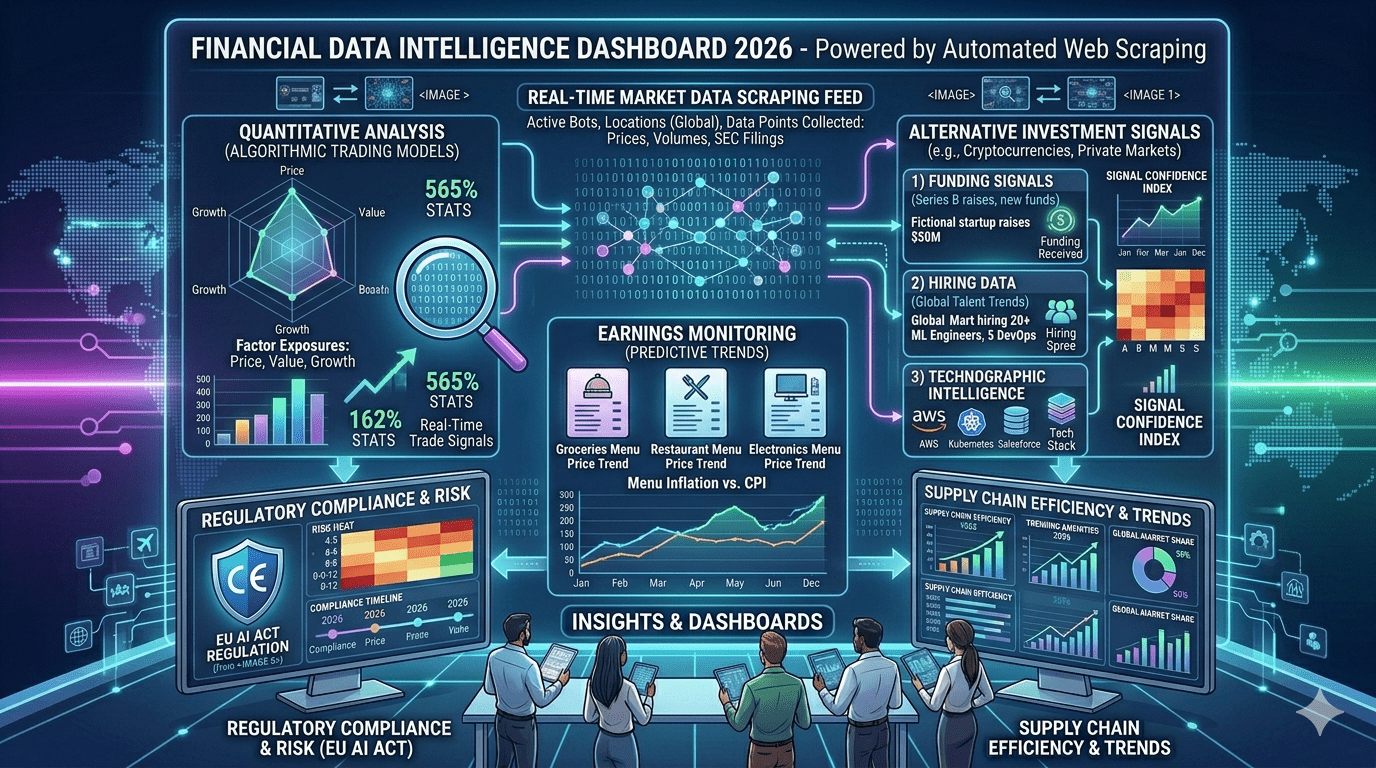
Introduction: The Investors Who Win in 2026 Don’t Just Have Capital — They Have Better Data
There’s a story that almost every serious investor has either lived or heard about: two funds analyzing the same stock, both with access to the same quarterly earnings reports, the same analyst research, the same Bloomberg terminal data. One of them holds through the earnings print, watches the stock drop 18%, and scrambles to understand what they missed. The other had already reduced their position two weeks earlier — because their alternative data operation had flagged a slowdown in app download metrics, a sharp drop in web traffic from the company’s key demographic, and a pattern of senior executive stock sales that together painted a picture that standard financial reports hadn’t yet revealed.
This is not a hypothetical scenario. It happens every earnings season, across thousands of stocks, in every asset class. And the consistent differentiator between the investors who see it coming and those who don’t is not analytical genius — it’s data quality. Specifically, it’s access to alternative data — the non-traditional, web-sourced intelligence signals that reveal what’s happening inside companies, industries, and markets before it ever appears in a financial statement.
The alternative data market reflects just how mainstream this competitive edge has become. The global alternative data market was valued at USD 7.87 billion in 2024 and is projected to reach USD 271.40 billion by 2033 — a staggering CAGR of 50.7% that reflects the explosive institutional appetite for non-traditional data signals. More than 75% of investment firms now use some form of alternative data in their investment process, up from less than 20% just a decade ago. Over 50% of hedge funds actively use alternative data sourced through web scraping as part of their investment decision-making process.
The financial data scraping revolution is not coming. It’s already here — and the competitive divide between firms using it and those that aren’t is widening every quarter.
Whether you’re a hedge fund analyst building quantitative models from non-traditional data signals, an independent investor looking for an information edge on specific sectors, a FinTech startup building the next generation of financial intelligence tools, or a corporate finance team monitoring competitive market dynamics — this guide covers everything you need to know. We’ll break down what financial data scraping is, what data is available, how the best-performing investors and financial firms are using it, the technical realities of doing it right, and exactly how ScraperScoop can power your financial intelligence operation from day one.
What Is Financial Data Scraping and What Makes It Different From Traditional Financial Data?
Financial data scraping is the automated extraction of financially-relevant information from publicly available web sources — company websites, financial news platforms, regulatory filing databases, social media platforms, job boards, review sites, pricing pages, satellite imagery analysis platforms, and any other web-accessible source that contains signals relevant to financial analysis and investment decision-making.
The critical distinction from traditional financial data is in the source and timing. Traditional financial data — earnings reports, balance sheets, analyst ratings, official economic statistics — is structured, standardized, and available to every market participant simultaneously. By the time it’s published, it’s already been anticipated, analyzed, and priced in by thousands of market participants. It tells you what already happened. It rarely tells you what’s happening right now or what’s about to happen.
The Alternative Data Advantage: Forward-Looking Intelligence
Alternative data derived through web scraping captures signals that lead financial reporting by days, weeks, or even months. Consider the intelligence hierarchy:
- An earnings report tells you what revenue was last quarter. Web traffic data scraped from digital analytics signals tells you what consumer engagement with the company’s digital properties looks like right now — weeks before the quarter closes.
- An annual report describes a company’s competitive position in broad terms. Systematic scraping of competitor pricing pages, job postings, product launches, and customer review patterns tells you how that competitive position is evolving in real time.
- An analyst’s price target reflects consensus opinion based on the same information everyone has. Scraped social sentiment, app store rating trends, and consumer review patterns often surface the early signals of sentiment shifts before they manifest in consensus estimates.
- A company’s investor relations presentation tells its best story. Scraped employee review data from platforms like Glassdoor tells you how employees experience the company from the inside — often reflecting operational realities that management presentations don’t capture.
This information asymmetry — accessing signals that reflect current and forward-looking business conditions before they appear in standardized financial reporting — is the fundamental value proposition of financial data scraping. In markets where milliseconds of information advantage translate to real alpha, having a structured alternative data operation is no longer a differentiator for elite quant funds. It’s increasingly a baseline requirement for any serious investment operation.
The Scale of Adoption Tells the Story
The market data confirms how rapidly financial data scraping has moved from niche to mainstream. More than 75% of investment firms now use some form of alternative data. Over 50% of hedge funds actively use alternative data sourced through web scraping. The largest hedge funds now employ entire teams of data scientists, engineers, and alternative data specialists dedicated to acquiring, processing, and extracting alpha signals from web-sourced data. And the market is expanding rapidly — the global alternative data market growing at over 50% CAGR reflects genuine, sustained institutional demand for the competitive intelligence that web scraping uniquely provides.
What Financial Data Can You Scrape? The Complete Alternative Data Intelligence Taxonomy
The universe of web-accessible financial intelligence is vastly larger than most market participants appreciate. Here’s a comprehensive breakdown of the data categories available through automated financial web scraping — and the specific investment intelligence each delivers.
1. Pricing & Product Intelligence
Scraping competitor pricing pages, product catalogs, and promotional structures across retail, SaaS, and service businesses provides real-time visibility into pricing strategy changes — often the first observable signal of competitive pressure, margin expansion, or volume-versus-price trade-off decisions that will show up in earnings weeks or months later. For retail sector investors, systematic eCommerce pricing data provides advance signals of promotional intensity and margin dynamics that are invisible in quarterly reports until after the fact.
2. Job Posting & Hiring Intelligence
Corporate hiring patterns are among the most reliable leading indicators of business momentum and investment direction available through public sources. A company aggressively adding sales headcount is signaling revenue growth confidence. A company making deep cuts across engineering while increasing finance and legal headcount is signaling operational restructuring. Systematic scraping of job board data and company career pages across coverage universes transforms public hiring activity into a continuous leading indicator of business trajectory that leads financial reporting by two to four quarters.
Job postings reveal not just hiring volume but strategic direction — the specific skills, technologies, and functions a company is investing in tell an analytical story about where management is placing its bets. For sector analysts covering technology companies, the technology stack mentioned in engineering job postings can reveal platform migration, product development direction, and competitive positioning changes months before any public announcement.
3. Web Traffic & Digital Engagement Signals
For businesses with significant digital operations — eCommerce companies, SaaS platforms, media properties, marketplace businesses — web traffic trends extracted from publicly accessible digital analytics signals provide near-real-time revenue proxy data. Month-over-month changes in website visits, app engagement metrics, and digital consumer interaction patterns often correlate strongly with revenue trends that won’t be reported for weeks. Alternative data providers increasingly deliver this web traffic intelligence as a core component of their financial data offerings.
4. Social Media Sentiment & Consumer Intelligence
Social media platforms collectively generate billions of pieces of consumer-facing content every day — product mentions, brand sentiment expressions, customer service interactions, viral complaints, and advocacy signals that collectively reflect the real-time state of consumer relationships with brands and products. Systematically scraping and applying NLP sentiment analysis to this data creates forward-looking consumer sentiment indicators that lead consumer discretionary revenue performance by observable periods. Social sentiment signals are now a standard component of the alternative data stack for consumer sector investment research.
5. App Store Ratings & Mobile Engagement Data
For companies whose business models are anchored in mobile applications — fintech platforms, ride-sharing services, food delivery businesses, gaming companies, social media platforms — app store rating trends, review volume patterns, and update cadence signals provide continuous performance intelligence. A systematic decline in app store ratings at a consumer fintech company is an early warning signal of product quality or service issues that will eventually manifest in user churn and revenue impact. This data is publicly available and continuously updated — making it an accessible, timely intelligence source for mobile-first company analysis.
6. News & Media Monitoring
Systematic scraping of financial news platforms, business media, industry publications, regulatory announcement feeds, and global news sources creates a comprehensive, continuously updated news monitoring capability that surfaces material developments across entire coverage universes in real time. Beyond simple news aggregation, NLP analysis of scraped news content can measure news sentiment, track narrative shifts around specific companies or sectors, detect emerging regulatory themes, and identify the early signals of reputational developments that will influence valuation multiples before analyst consensus adjusts.
7. SEC & Regulatory Filing Data
The SEC’s EDGAR database and equivalent regulatory filing systems globally contain enormous volumes of structured and unstructured financial intelligence — 10-K annual reports, 10-Q quarterly reports, 8-K material event disclosures, proxy statements, insider ownership forms, and institutional holdings filings. Automated scraping and analysis of these regulatory documents at scale enables quantitative analysis across entire market universes — tracking insider buying and selling patterns, detecting language changes in risk factor disclosures, monitoring institutional ownership shifts, and analyzing management commentary patterns that provide signals about fundamental business trajectory.
8. Employee Review & Corporate Culture Intelligence
Platforms like Glassdoor, Blind, and Indeed aggregate employee reviews that provide an insider perspective on corporate culture, management effectiveness, operational challenges, and organizational morale that financial statements don’t capture. Research has demonstrated statistically significant correlations between employee sentiment trends and subsequent stock price performance — particularly in knowledge-economy businesses where human capital quality directly determines business outcomes. Systematic scraping and analysis of employee review data provides a unique window into corporate culture dynamics that institutional investors increasingly recognize as a material factor in business performance assessment.
9. Real Estate & Geospatial Intelligence
Commercial real estate data — lease signings, property expansions, store openings and closings, distribution center activity — provides leading indicator intelligence about corporate capital allocation decisions and growth trajectory. Scraping commercial real estate listing platforms, permit filing databases, and property news sources reveals expansion or contraction signals that lead formal announcements by months. For retail sector analysts and commercial real estate investors, this data provides a fundamentally different perspective on portfolio composition changes and capital commitment shifts.
10. Supply Chain & Shipping Intelligence
Global shipping data, port activity records, freight rate indices, and logistics platform data collectively reflect the real-time state of global supply chains with significant implications for manufacturers, retailers, commodities traders, and logistics sector investors. Scraping shipping news, port authority publications, freight exchange platforms, and logistics industry sources provides supply chain intelligence that leads inventory and revenue impacts by observable periods — enabling more accurate forecasting of supply-constrained earnings outcomes.
11. ESG & Sustainability Intelligence
Environmental, Social, and Governance factors have moved from niche consideration to mainstream investment framework, with institutional capital flows increasingly influenced by ESG ratings and sustainability performance. Scraping corporate sustainability reports, environmental regulatory filings, labor practice data, governance structure disclosures, and ESG news coverage provides the raw material for independent ESG assessment that supplements — and often challenges — third-party ESG ratings that investors are increasingly scrutinizing for methodology and bias.
12. Cryptocurrency & Digital Asset Intelligence
For investors and traders with digital asset exposure, on-chain data, exchange listing and delisting announcements, protocol development activity on public repositories, developer community sentiment, and regulatory development monitoring all represent intelligence streams that drive digital asset price movements. Web scraping of crypto news platforms, community forums, exchange announcement pages, and developer activity repositories provides a comprehensive alternative data capability specifically designed for digital asset intelligence.
10 High-Impact Financial Data Scraping Use Cases Driving Investment Alpha in 2026
Understanding what data is available is the first step. Understanding how the best-performing investors, analysts, and financial platforms are actually using it to generate measurable alpha and competitive advantage is where the practical intelligence lives.
1. Earnings Preview Intelligence
The highest-stakes application of alternative data in equity investing is earnings preview — using web-scraped signals to build a more accurate picture of a company’s likely earnings outcome before the official report. This involves synthesizing multiple data streams simultaneously: web traffic trends as a digital revenue proxy, hiring and layoff data as an operational momentum indicator, social sentiment as a consumer engagement leading indicator, app store metrics for mobile-first businesses, and pricing data for margin-sensitive retail and consumer businesses.
Investors with strong alternative data capabilities consistently build earnings models that more accurately predict revenue and margin outcomes than consensus estimates — allowing them to position ahead of earnings surprises rather than reacting after the fact. This is not about illegal insider information. It is about synthesizing publicly available signals with greater sophistication and analytical rigor than competitors working from traditional financial data alone.
2. Hiring Trend Analysis for Growth Signal Detection
Job posting data is one of the most widely used and most proven alternative data signals in institutional investment. Changes in hiring volume, functional mix shifts, and technology stack requirements in job postings all provide forward-looking intelligence about business trajectory that leads earnings reporting by multiple quarters. A SaaS company accelerating its enterprise sales hiring while maintaining engineering headcount is signaling commercial confidence. A retail company simultaneously cutting store associate roles while expanding fulfillment and logistics headcount is signaling an omnichannel pivot — each a fundamentally different investment narrative than the prior-quarter numbers alone would tell.
3. Consumer Sentiment Analysis for Retail & Consumer Discretionary
For analysts and portfolio managers covering retail, consumer brands, media, and consumer technology sectors, systematic social media sentiment analysis provides a near-real-time consumer health indicator. Tracking sentiment trend lines across months reveals whether a brand is building or eroding consumer affinity in ways that lead same-store sales performance by observable periods. NLP models trained on sector-specific consumer vocabulary can detect sentiment shifts with significantly more precision than simple keyword counting — providing actionable intelligence ahead of the revenue impacts that will eventually manifest in quarterly reports.
4. Competitive Pricing Intelligence for Margin Analysis
For analysts covering retail, technology, and services sectors, systematic competitor pricing data provides direct visibility into pricing power dynamics and margin trajectory signals. A company consistently able to maintain prices while competitors discount is demonstrating strong competitive positioning. A company whose pricing is tracking downward across categories despite management commentary suggesting pricing strength is providing an early warning that the official narrative may not survive the next earnings print. Scraped competitor pricing data is the objective evidence that either validates or challenges management’s pricing power claims.
5. SEC Filing & Regulatory Document Analysis at Scale
Manual analysis of SEC filings for even a modest coverage universe is time-prohibitive at the document volume and frequency these databases generate. Automated scraping and NLP analysis of SEC filings across entire market sectors enables quantitative detection of material language changes in risk factor disclosures, tracking of insider ownership pattern shifts, monitoring of institutional holding changes across 13-F filings, and analysis of management commentary sentiment evolution over time — all across hundreds or thousands of companies simultaneously rather than the handful a human analyst team can manually cover.
6. Quantitative Model Signal Generation
For quantitative investment strategies, web-scraped alternative data provides a continuous stream of non-traditional factor inputs that can be combined with traditional financial factors in multi-factor alpha models. Factors derived from hiring data, social sentiment, web traffic, pricing dynamics, and review sentiment have demonstrated statistically significant predictive power for forward stock returns when properly constructed and combined — expanding the signal universe available to quant strategies beyond the traditional factors that have become increasingly crowded as more participants exploit the same data sources.
7. Private Company & Pre-IPO Intelligence
Traditional financial data is overwhelmingly public company focused — but the most significant investment opportunities increasingly emerge from private companies approaching IPO, SPAC transactions, or later-stage private funding rounds. For private equity firms, venture capital investors, and growth equity funds, web scraping provides the external intelligence signals — web traffic trends, hiring velocity, social engagement growth, app store performance, press coverage volume — that serve as public-market-proxy performance indicators for businesses where traditional financial reporting is either limited or non-public.
8. Industry & Sector Trend Monitoring
Continuous scraping of industry news sources, trade publications, regulatory announcement feeds, and technology development databases keeps sector analysts current across rapidly evolving industries without the impossibly high manual monitoring burden that comprehensive coverage would otherwise require. Automated industry intelligence monitoring ensures that material developments — technology disruptions, regulatory changes, competitive dynamics shifts, supply chain developments — are surfaced immediately as they emerge rather than discovered retrospectively in weekly industry summaries.
9. ESG Data Collection & Independent Scoring
The credibility of third-party ESG ratings has faced increasing institutional scrutiny — with numerous studies demonstrating significant methodology differences and rating disagreements across major ESG data providers for the same companies. Sophisticated institutional investors are increasingly supplementing third-party ESG ratings with independent ESG intelligence derived from web scraping — collecting environmental regulatory filing data, labor practice reporting, governance structure disclosures, sustainability report content, and ESG news coverage directly and building proprietary ESG assessments that better reflect their specific sustainability frameworks and materiality judgments.
10. FinTech Platform & Financial Intelligence Product Development
For FinTech companies, financial data platforms, and investment intelligence product builders, comprehensive web-scraped financial data provides the foundation for products and features that create durable competitive advantages. From earnings intelligence tools and alternative data feeds to market monitoring dashboards and quantitative factor databases — every one of these products depends on systematic, continuously-updated, high-quality web-sourced financial data. Managed financial data scraping services provide the data infrastructure that powers these products without requiring FinTech companies to build and maintain complex proprietary scraping operations in parallel with their core product development.
How Hedge Funds & Institutional Investors Use Financial Data Scraping to Generate Alpha
The most sophisticated practitioners of financial data scraping are institutional investors — hedge funds, quantitative asset managers, and alternative investment firms — who have built entire data science and alternative data teams around extracting and operationalizing web-sourced intelligence signals. Understanding how they approach it reveals both the ceiling of what’s possible and the practical framework that any investment operation can adapt for their own scale.
The Alternative Data Investment Process
The institutional approach to alternative data typically follows a structured process: data acquisition (through scraping, data vendor partnerships, or proprietary collection), signal extraction (identifying the specific metrics within the data that have predictive value for asset returns), alpha validation (backtesting signal predictive power against historical return data), and operational integration (embedding validated signals into live investment models and portfolio construction processes).
The firms generating the most consistent alpha from alternative data are those who have built proprietary data collection capabilities — custom scraping operations targeting specific data sources that their competition isn’t yet systematically accessing. As widely-used data sources become commoditized through broad adoption, the alpha advantage migrates to those who are first to identify and exploit new signals from underutilized web sources.
Job Posting Data: The Alternative Data Signal With the Most Documented Alpha
Of all alternative data signal categories, hiring data derived from web scraping has the most extensively documented relationship with forward equity returns. Research published across multiple academic studies has demonstrated statistically significant predictive power for forward stock returns from job posting volume changes, role mix shifts, and technology requirement changes in corporate hiring activity. Investment firms acting on hiring trend signals consistently show significant positive performance versus benchmarks in the periods following signal generation — a documented alpha source that has survived extensive institutional adoption without full commoditization, likely because interpreting hiring signals with analytical precision requires domain-specific expertise that generic data processing cannot replicate.
Social Sentiment as a Consumer Signal
The relationship between social media sentiment trends and subsequent financial performance has been the subject of extensive academic and practitioner research. The weight of evidence suggests that social media sentiment contains forward-looking information about stock returns — particularly for consumer-facing businesses where social engagement directly reflects the health of brand-consumer relationships. The challenge is in extracting high-quality, high-specificity sentiment signals from the noise of social media data — a challenge that requires sophisticated NLP models, noise filtering, and sector-specific semantic frameworks that generic sentiment tools struggle to provide.
The Democratization of Alternative Data
The alternative data advantage was historically confined to the largest hedge funds with the most sophisticated data science infrastructure. That barrier is rapidly eroding. Managed financial data scraping services — like those offered by ScraperScoop — are making the same quality of web-sourced financial intelligence available to independent investors, boutique hedge funds, family offices, and FinTech companies that previously only large institutional operators could access. The quality of your data is increasingly a strategic choice rather than a function of institutional scale.
FinTech & Financial Platform Applications: Building Data Moats with Web Scraping
Beyond investment applications, financial data scraping is the foundational technology powering some of the most innovative and fastest-growing FinTech companies in the market. Here’s how financial technology companies are using web scraping to build data moats and competitive advantages that are extraordinarily difficult for competitors to replicate.
Alternative Credit Underwriting
Traditional credit underwriting relies on backward-looking financial data — credit scores, income history, payment records. FinTech lenders are increasingly supplementing these with web-scraped alternative signals: business website traffic trends, social media presence quality, review sentiment and volume, hiring activity, and digital footprint characteristics that collectively build a richer, more forward-looking picture of creditworthiness. This alternative data-enhanced underwriting approach enables FinTech lenders to serve creditworthy borrowers that traditional models systematically underserve — opening new market segments while maintaining risk-adjusted return discipline.
Personal Finance & Price Comparison Platforms
Price comparison platforms across banking products, insurance, mortgages, credit cards, and investment products are entirely dependent on continuous, accurate, multi-source web scraping of competitor pricing, terms, and features. The core product value of a price comparison platform — showing users the best available option across all providers — requires comprehensive, continuously-updated competitive pricing data that only systematic scraping can deliver reliably at scale. Every rate change, every new product launch, and every promotional offer across every competitor needs to be detected and incorporated into the comparison database in near real time.
Robo-Advisors & Automated Investment Platforms
Next-generation robo-advisors are incorporating scraped alternative data signals — sector trend monitoring, ESG intelligence, economic indicator tracking, and market sentiment data — into their portfolio construction and rebalancing algorithms. This moves automated investment from purely backward-looking factor-based allocation to a more dynamic, market-aware approach that can incorporate the forward-looking signals that traditionally required active human portfolio management. Scraped financial data is the raw material that gives robo-advisory algorithms the market intelligence context to make more sophisticated allocation decisions.
Neobank Competitive Intelligence
For neobanks and digital financial services companies operating in intensely competitive markets, continuous competitive monitoring — tracking competitor interest rates, fee changes, product launches, promotional campaigns, and customer review sentiment — is essential for maintaining competitive positioning across product categories. A neobank that learns about a major competitor’s rate increase through manual weekly checks has already lost the response window. One with automated competitive data monitoring can respond within hours of the change becoming publicly visible.
Insurance Technology Applications
InsurTech companies use financial data scraping for competitive premium monitoring, claims frequency signal detection through news and social media monitoring, catastrophic event intelligence for actuarial model updates, and regulatory filing analysis across state insurance departments. The combination of competitive pricing intelligence and risk signal monitoring through web scraping is creating genuinely new capabilities for dynamic pricing and risk assessment that traditional insurance carriers are struggling to match with legacy data infrastructure.
Wealth Management Intelligence Platforms
Wealth management firms and independent financial advisors are increasingly using web-scraped financial intelligence platforms to support more sophisticated client conversations — tracking portfolio company news, monitoring sector developments, and delivering alternative data-enriched research that differentiates their advisory value from purely execution-focused competitors. For wealth management clients whose primary frustration is advisors who don’t know more than they do, alternative data-powered intelligence tools create a genuine and visible service quality differentiation.
Whether you’re building a FinTech platform or enhancing an existing financial service, reach out to ScraperScoop’s data experts today to discuss how custom financial data scraping solutions can power your platform’s core intelligence capabilities.
Key Financial Data Sources for Web Scraping: Where the Intelligence Lives
Understanding which web sources carry the most financially relevant intelligence for your specific investment or business application is the foundation of an effective financial data scraping strategy. Here’s the landscape of high-value sources and what makes each one uniquely valuable.
SEC EDGAR & Global Regulatory Filing Databases
The SEC’s EDGAR system is one of the most underexploited data sources in financial analysis — containing decades of structured and unstructured filing data across every public company in the U.S. market. Automated scraping enables quantitative analysis at a scale that makes EDGAR a genuinely powerful alternative data source rather than simply a compliance document archive. Global equivalents — Companies House in the UK, SEDAR in Canada, and regulatory filing systems across Europe and Asia — provide similarly rich intelligence for international investment coverage.
Financial News & Media Platforms
Bloomberg, Reuters, The Wall Street Journal, Financial Times, CNBC, and hundreds of industry-specific financial publications collectively generate an enormous volume of financially-relevant content that, when systematically scraped and NLP-analyzed, provides real-time news sentiment intelligence, early detection of developing narratives around specific companies or sectors, and comprehensive monitoring of material events across entire investment coverage universes. The speed advantage of automated news monitoring versus manual reading is measured in hours to days — a significant edge in news-driven market environments.
Job Board Platforms
Indeed, Glassdoor, LinkedIn Jobs, and specialized industry job boards are among the most consistently valuable alternative data sources for corporate intelligence. The combination of hiring volume, role type distribution, technology requirements, and geographic expansion patterns in job postings creates a multi-dimensional corporate intelligence signal that leads financial reporting by multiple quarters. For systematic coverage of large investment universes, automated job board scraping is the only practical approach to continuous hiring trend monitoring.
Social Media & Community Platforms
Twitter/X financial discourse, Reddit investment communities, StockTwits, LinkedIn professional commentary, and specialized industry forums collectively represent a real-time market sentiment signal that has demonstrated predictive relevance for both individual stock performance and broader market sentiment. The analytical challenge — extracting high-quality signal from the considerable noise in social media financial content — requires sophisticated NLP models with financial domain specialization, but the signal quality for consumer-facing companies and sentiment-sensitive asset classes is demonstrably valuable.
App Store Platforms
The Apple App Store and Google Play Store collectively contain rating, review, and engagement data for every significant mobile application — providing a continuous performance intelligence stream for mobile-first businesses that is publicly accessible, continuously updated, and highly correlated with business fundamentals. For consumer technology analysts, app store intelligence is increasingly a standard component of company monitoring rather than a niche supplemental signal.
Review Platforms
Glassdoor employee reviews, G2 software reviews, Trustpilot customer reviews, and sector-specific review platforms each provide unique intelligence windows. Glassdoor surfaces internal operational intelligence. G2 reveals enterprise technology competitive dynamics. Trustpilot reflects consumer financial services brand health. Each platform, when systematically scraped and analyzed over time, provides insight that financial statements simply don’t contain.
Commercial Real Estate Platforms
CoStar, LoopNet, and commercial real estate news publications track lease activity, property sales, development pipeline, and occupancy trends across commercial real estate asset classes. For REIT analysts, commercial real estate investors, and consumer discretionary analysts tracking physical retail footprints, systematic scraping of commercial real estate platforms provides intelligence on corporate capital allocation and physical expansion/contraction activity that leads formal earnings disclosures.
Cryptocurrency & DeFi Platforms
CoinMarketCap, CoinGecko, DeFi protocol documentation pages, exchange announcement feeds, and crypto community forums all contain actionable intelligence for digital asset investors. Exchange listing announcements, protocol upgrade notifications, developer activity metrics, and community sentiment shifts — all available through systematic web monitoring — drive significant price movements in digital asset markets, often before broader market awareness.
From Raw Data to Investment Alpha: How to Build Financial Intelligence Signals from Scraped Data
Collecting financial web data is the foundational step. Transforming that raw data into investment-grade intelligence signals is where the analytical work happens — and where the real alpha gets generated. Here’s how sophisticated practitioners approach the signal construction process.
Step 1: Data Cleaning and Normalization
Raw scraped financial data requires systematic cleaning before it’s analytically useful. This includes removing duplicates and irrelevant records, standardizing entity names and tickers across data sources, normalizing time series to consistent frequencies, handling missing data points appropriately, and resolving cross-source inconsistencies. The quality of the signal extracted in subsequent steps is directly constrained by the quality of the cleaning and normalization applied in this step — garbage in, garbage out applies with particular force to alternative data signal construction.
Step 2: Signal Definition and Metric Construction
For each data source, define the specific quantitative metrics that capture the commercially relevant signal. For job posting data, this might be net hiring momentum (postings added minus postings removed), functional mix ratios (sales headcount as a percentage of total postings), or technology appearance rates (specific skills mentioned as a percentage of engineering postings). For social sentiment data, this might be rolling 30-day sentiment trend, sentiment velocity (rate of change), or brand sentiment relative to sector average. The precision of metric construction determines how cleanly the underlying signal is captured.
Step 3: Universe Coverage and Entity Matching
For signals intended for systematic investment factor construction, ensuring consistent coverage across your entire investment universe is critical. Inconsistent coverage — where some companies in your universe have rich data histories and others have sparse or absent data — introduces significant biases in signal performance analysis that can generate spuriously positive backtest results. Entity matching — correctly linking scraped company data to financial identifiers like tickers, ISIN numbers, or CIK codes — is a technically demanding data engineering challenge that requires robust entity resolution capabilities.
Step 4: Alpha Backtesting and Signal Validation
Before incorporating any alternative data signal into a live investment process, rigorous backtesting against historical return data is essential. Backtesting methodology matters enormously — survivorship bias, look-ahead bias, transaction cost assumptions, and cross-signal correlation all affect the validity of performance claims from alternative data signals. Signals that generate strong in-sample performance but fail out-of-sample validation should be discarded — they’re capturing historical noise rather than persistent economic signal.
Step 5: Signal Integration and Portfolio Construction
Validated alternative data signals are typically integrated into investment models as factor inputs alongside traditional financial factors — combining alternative data-derived momentum, quality, and sentiment signals with valuation, profitability, and balance sheet factors in multi-factor models that capture complementary dimensions of expected return. The combination of alternative and traditional factors typically outperforms either source alone — because they capture genuinely different information about expected business performance, and their low correlation reduces factor-level noise in the combined model.
Financial Data Scraping Technical Challenges — Why Professional Services Matter
Financial data scraping presents a distinctive combination of technical and compliance challenges that makes it one of the most demanding domains in web data collection. Here’s what makes it genuinely difficult — and how professional data services navigate each challenge effectively.
Challenge 1: Real-Time Data Requirements
Financial markets move at speeds that make data freshness requirements far more demanding than most other scraping domains. For some applications — news sentiment monitoring, earnings event intelligence, regulatory announcement detection — data needs to be extracted and delivered within minutes of becoming publicly available. Building and maintaining the infrastructure required for near-real-time financial data collection at meaningful scale requires dedicated engineering resources and operational expertise that is expensive to develop and maintain in-house.
Challenge 2: High-Quality Anti-Bot Defenses on Financial Platforms
Major financial news platforms, regulatory databases, and market data providers deploy sophisticated bot detection systems that make automated data collection technically challenging. Financial data sources are particularly vigilant about automated access because of the commercial sensitivity of the data they contain. Professional infrastructure — sophisticated proxy rotation, JavaScript rendering, realistic behavioral simulation, and continuous adaptation to evolving defensive measures — is required for reliable, consistent access to these sources at the frequency financial analysis demands.
Challenge 3: Investment-Grade Data Quality Standards
The quality standards for financial data are significantly higher than for most other scraping applications — because errors in financial data translate directly into flawed investment decisions with real capital consequences. Missing records, misattributed data points, incorrect entity mapping, and stale data can all generate false signals that lead to poor investment outcomes. Financial data scraping operations require multi-layer validation pipelines, cross-source verification, anomaly detection, and systematic quality monitoring that goes well beyond what basic scraping implementations provide.
Challenge 4: Entity Resolution and Ticker Mapping
Mapping scraped company data from web sources to financial entity identifiers — tickers, ISIN numbers, CIK codes, LEIs — requires sophisticated entity resolution capabilities that handle name variations, subsidiary relationships, holding company structures, and historical name changes. A scraping operation that produces a jobs posting dataset without reliable, consistent ticker attribution across all records cannot support systematic quantitative analysis across investment universes — limiting the usability of the data to manual, company-specific research applications.
Challenge 5: Regulatory and Legal Compliance
Financial data collection operates at the intersection of multiple regulatory frameworks with significant compliance implications. Terms of service compliance at the platform level, data privacy regulations (GDPR, CCPA) where personal data is incidentally collected, securities law considerations around the use of material non-public information versus public web data, and financial data redistribution licensing obligations all require careful legal navigation. Professional data providers have compliance frameworks and legal counsel expertise that addresses these requirements systematically — protecting clients from regulatory exposure that naively-built scraping operations might generate.
Challenge 6: Historical Data Depth and Continuity
Building statistically meaningful backtests of alternative data signals requires historical data going back multiple years — often 5-10 years or more for robust signal validation. Building historical data depth retroactively is technically complex and often impossible for sources that don’t maintain easily accessible historical archives. Professional financial data providers who have been continuously collecting and archiving specific data sources for years have historical data assets that newly-built scraping operations simply cannot replicate — creating a genuine and durable data moat for established providers.
The convergence of these challenges across real-time requirements, quality standards, entity resolution complexity, and regulatory navigation explains why the fastest-growing users of financial alternative data are working with specialist managed data providers rather than attempting to build comprehensive in-house financial scraping infrastructure. Talk to ScraperScoop’s financial data specialists today — we’ve built the infrastructure, solved the technical challenges, and deliver investment-grade financial web data that your team can immediately incorporate into research and model workflows.
Legal, Ethical & Regulatory Considerations for Financial Data Scraping
The legal and ethical framework surrounding financial data scraping is more complex than in most other scraping domains — because the stakes of getting it wrong are significantly higher. Here’s what every financial data user needs to understand about the compliance landscape.
The Public Information Boundary
The fundamental legal principle governing financial data scraping is the public/non-public information distinction. Web scraping collects data that is publicly available — accessible to any internet user without authentication, payment, or special relationship. This publicly available data occupies categorically different legal territory from material non-public information (MNPI), which is subject to securities law restrictions around insider trading. Sophisticated investment managers using alternative data maintain legal counsel review of every new data source before deployment — confirming that the data is genuinely public, not derived from a relationship of trust or confidence, and appropriately differentiated from the MNPI concerns of securities regulation.
Securities Law Considerations
The SEC has provided guidance on the use of alternative data in investment management — acknowledging that the use of publicly available web data in investment analysis is legitimate, while emphasizing that data collection practices should not involve accessing non-public information, circumventing technical access controls, or violating terms of service in ways that create material legal exposure. Investment firms using alternative data at scale typically engage securities law counsel to review their data acquisition practices and maintain documentation of the public availability of each data source used in investment processes.
Terms of Service Compliance
The terms of service of financial data platforms, news services, and regulatory databases vary significantly in how they address automated access. While the legal enforceability of ToS restrictions on automated access has been the subject of significant legal controversy, professional financial data providers operate within the spirit of these terms — using reasonable request rates that don’t burden source systems, avoiding circumvention of technical access controls, and structuring data collection to minimize the commercial impact on source platforms. This approach is both ethically sound and practically important for maintaining the long-term sustainability of data access.
GDPR and Data Privacy in Financial Research
Financial data scraping that incidentally collects personal information — such as individual employee names in job postings, personal social media commentary in sentiment datasets, or individual review author information — triggers GDPR obligations for EU-market data processing. Financial firms using alternative data have a responsibility to implement data minimization practices, anonymize personal data where it’s not analytically necessary to maintain personally identifiable form, and apply appropriate data retention and deletion standards consistent with GDPR requirements.
Data Redistribution and Licensing
Commercial redistribution of scraped financial data — selling derived datasets or incorporating scraped data into commercially distributed financial products — raises additional licensing and intellectual property considerations that require legal review. The distinction between using scraped data internally for investment analysis versus commercially redistributing derivative products built on that data involves different legal frameworks that professional financial data providers navigate with established licensing structures and legal frameworks.
At ScraperScoop, compliance is embedded in every aspect of our financial data collection operations. We collect exclusively publicly available information, operate within sustainable access parameters, implement appropriate data minimization practices, and support clients in understanding and maintaining their own compliance obligations with respect to alternative data usage.
How AI Is Transforming Financial Data Scraping and Alternative Data Analysis in 2026
The integration of artificial intelligence into financial data scraping and alternative data analysis is occurring faster in the investment and FinTech sector than in almost any other domain — driven by the capital intensity of the industry and the direct, measurable link between data quality, analytical sophistication, and investment returns. Here’s how AI is reshaping what’s possible.
Large Language Models for Financial Document Analysis
The application of Large Language Models (LLMs) to scraped financial documents — earnings call transcripts, SEC filings, analyst reports, news articles — is enabling a qualitative-to-quantitative transformation in financial text analysis. LLMs can summarize complex financial documents, extract specific data points from unstructured text, detect language changes across time-series document collections, assess management tone and confidence signals, and flag material disclosure changes — all at the scale of entire market coverage universes simultaneously. Tasks that previously required hours of skilled analyst reading are now executed in seconds by LLM pipelines, producing structured, comparable outputs across thousands of companies.
Advanced NLP for Sentiment Signal Extraction
Financial domain-specific NLP models trained on large corpora of financial text — news articles, research reports, social media financial content, earnings communications — extract sentiment signals with significantly greater precision than generic NLP models. These specialized models understand the financial context of language: “better than expected” is positive regardless of whether the absolute number is positive or negative; “challenging environment” in a CFO’s commentary signals downside risk regardless of the numerically positive tone score a generic model might assign. Domain-specific financial NLP is increasingly table stakes for competitive alternative data applications in investment research.
Machine Learning for Predictive Signal Construction
Machine learning models trained on historical relationships between alternative data signals and subsequent stock returns identify non-linear signal combinations and interaction effects that linear factor models miss. This enables more sophisticated factor construction from the same underlying alternative data — extracting additional predictive power from data sources that simpler analytical approaches have partially exploited. The competition between quantitative investment firms in alternative data is increasingly a machine learning competition — who can build the most sophisticated predictive models from overlapping data inputs.
Autonomous Data Pipeline Management
AI-powered self-healing data pipelines automatically detect and resolve scraping failures, adapt to website structure changes, and maintain data quality standards without continuous manual engineering intervention. For financial data operations where data gaps translate directly to signal gaps in live investment processes, the reliability of continuously-operating, self-healing data pipelines has moved from a technical advantage to an operational necessity. The maintenance overhead of financial data pipelines without AI-assisted automation is prohibitive at any meaningful scale.
Predictive Market Intelligence
The emerging frontier is AI systems that don’t just process scraped financial data but synthesize signals across multiple alternative data sources to generate forward-looking market predictions — identifying the combinations of hiring trends, sentiment shifts, pricing movements, and news signals that historically precede specific financial outcomes for specific company types. This multi-signal synthesis capability represents the highest expression of alternative data intelligence — moving from individual signals to holistic business trajectory prediction that can systematically outperform consensus estimates across entire coverage universes.
Financial Data Scraping Best Practices: Building an Investment-Grade Alternative Data Operation
1. Define Investment Hypothesis Before Designing Data Collection
The most common waste in alternative data programs is collecting data speculatively — scraping everything that seems vaguely relevant and hoping signal emerges from the noise. Start with a clear investment hypothesis: what specific business phenomenon are you trying to measure, how does it relate to a financial outcome you care about, and what web-accessible signal most directly captures that phenomenon? Hypothesis-first data collection produces tighter, more purposeful datasets that are far more likely to yield genuine investment signal than fishing expeditions.
2. Prioritize Data Quality Above Data Volume
In financial data, a smaller dataset that is complete, consistent, accurately entity-matched, and thoroughly validated is worth dramatically more than a massive dataset riddled with errors, gaps, and entity mismatches. Investment-grade alternative data quality requires multi-layer validation, cross-source verification, anomaly detection, and continuous quality monitoring — standards that in-house scraping operations frequently sacrifice in the interest of speed or cost. Never compromise data quality for scale. The investment consequences of false signals from poor-quality data are severe.
3. Build Historical Depth Before Going Live
Validate every alternative data signal against historical return data through rigorous backtesting before incorporating it into live investment processes. Ensure your backtesting methodology is free of look-ahead bias, survivorship bias, and data snooping bias that can generate illusory in-sample performance. A signal that looks alpha-generating in a biased backtest can be genuinely harmful in live trading. Historical depth — ideally 5+ years covering at least one full market cycle — is the minimum standard for robust signal validation in systematic investment strategies.
4. Maintain Legal Review and Compliance Documentation
For every data source used in a financial alternative data program, maintain documentation of: the public availability of the data, the specific collection methodology, the legal review confirming appropriate use in the investment context, and the data retention and deletion policies applied. This compliance documentation is both a risk management practice and an increasingly important institutional requirement — as regulators continue to develop their framework for alternative data use in investment management, organizations with clean compliance documentation are significantly better positioned than those without it.
5. Implement Continuous Signal Monitoring
Alternative data signals degrade over time as more participants discover and exploit the same sources. Implement ongoing monitoring of signal performance in live investment processes — tracking information coefficient, hit rate, and return contribution across rolling periods to detect signal decay as it occurs rather than after the damage has been done. When signal performance deteriorates, investigate whether it reflects data quality degradation, market structure changes, or competitive exploitation of a previously proprietary signal — each requiring a different response.
6. Diversify Across Multiple Signal Sources
Single-source alternative data dependence creates concentration risk — if that source degrades, changes access policies, or becomes competitively exploited, your entire alternative data advantage disappears simultaneously. Build diversified alternative data signal portfolios across multiple source types — combining hiring data, sentiment signals, pricing intelligence, and document analysis — that provide complementary, lowly-correlated insights. Signal diversification in alternative data is as important as portfolio diversification in asset allocation.
7. Partner with Specialists for Infrastructure and Compliance
Building and maintaining investment-grade financial data scraping infrastructure in-house is a significant ongoing investment that competes with core investment or product development priorities for scarce engineering and data science resources. For most investment firms and FinTech companies, partnering with a specialist managed financial data provider — one who has already solved the infrastructure, quality, entity resolution, and compliance challenges — delivers better data at lower total cost than in-house development, faster time to investment process integration, and ongoing maintenance without internal overhead.
How ScraperScoop Powers Financial Intelligence for Investors, Analysts & FinTech Companies
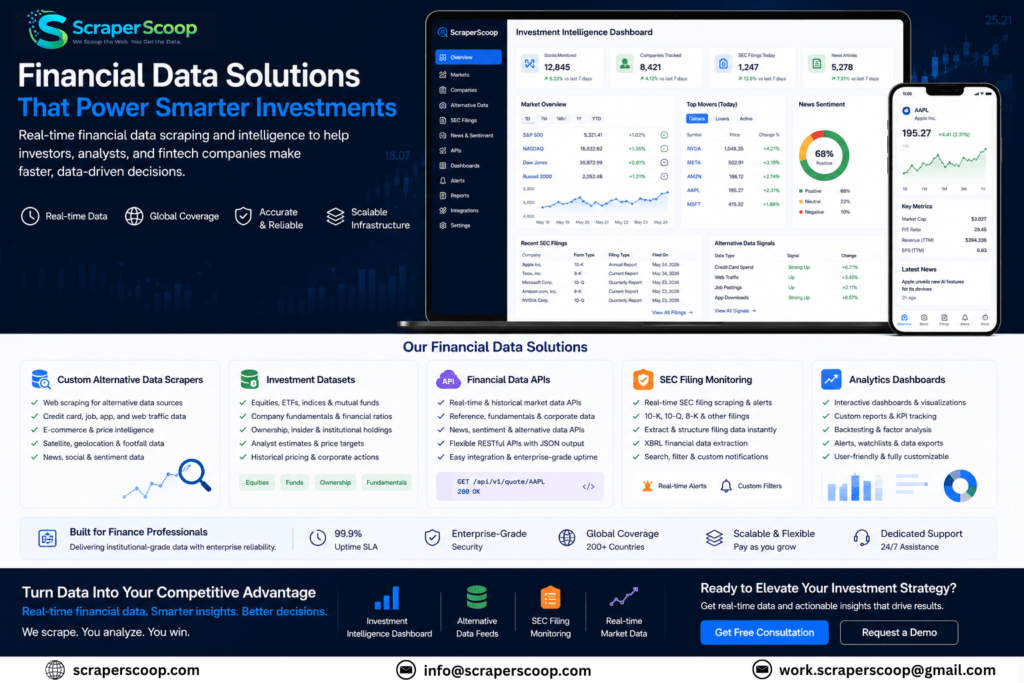
At ScraperScoop, we understand that financial data users have uniquely demanding requirements — for data quality, timeliness, entity resolution, compliance documentation, and analytical precision that go well beyond general-purpose scraping standards. Every financial data solution we build is engineered to investment-grade quality standards.
Here is precisely what ScraperScoop delivers for financial industry clients:
- ✅ Custom Alternative Data Scrapers: Purpose-built financial data extractors targeting your specific sources, coverage universes, and signal construction requirements — delivering structured, entity-mapped, ticker-attributed datasets that slot directly into your analytical workflows.
- ✅ Job Posting & Hiring Intelligence: Continuous corporate hiring activity monitoring across your investment universe — with volume metrics, functional mix ratios, technology appearance rates, and geographic expansion signals — all consistently entity-mapped to financial identifiers.
- ✅ Financial News Monitoring: Real-time scraping and delivery of financial news, earnings announcements, regulatory filings, and material event disclosures across your coverage universe — structured for NLP sentiment analysis and event-driven signal construction.
- ✅ SEC & Regulatory Filing Intelligence: Automated extraction and structured delivery of 10-K, 10-Q, 8-K, proxy, and insider ownership filings — enabling quantitative analysis of disclosure content, language changes, and filing pattern anomalies across entire market sectors.
- ✅ Social Sentiment Data: Structured social media sentiment datasets across equity-relevant platforms — cleaned, normalized, and entity-mapped for systematic sentiment factor construction and consumer intelligence analysis.
- ✅ Competitive Pricing & Product Intelligence: Real-time competitor pricing and product data for companies in your coverage universe — providing direct forward-looking intelligence on pricing power, margin dynamics, and competitive positioning that leads earnings disclosures.
- ✅ Employee Review & Culture Intelligence: Structured Glassdoor and employee review sentiment datasets for your coverage universe — enabling the corporate culture factor analysis that correlates with forward employee retention, productivity, and business performance outcomes.
- ✅ App Store Performance Data: Mobile application rating trends, review volume patterns, and update frequency data for mobile-first businesses — providing near-real-time product performance intelligence for consumer technology and digital services analysis.
- ✅ Ready-Made Financial Datasets: Need alternative data fast? Our pre-built financial datasets across major alternative data categories give you immediate access to validated, structured investment intelligence without development lead time.
- ✅ Financial Data APIs: Integrate our alternative data feeds directly into your quantitative models, portfolio management systems, research platforms, or FinTech applications — with investment-grade data delivered in the format and frequency your workflow requires.
- ✅ Analytics Dashboards: Visual intelligence dashboards that surface the most investment-relevant patterns from scraped alternative data — hiring trend maps, sentiment trend lines, pricing dynamic charts, and news volume heatmaps your investment team can act on.
- ✅ Compliance-First Documentation: Full data provenance documentation, collection methodology records, and public availability confirmation for every data source — supporting the compliance documentation requirements of institutional alternative data programs.
Ready to Build Your Financial Data Intelligence Advantage? Let’s Talk
The global alternative data market is growing at over 50% CAGR toward USD 271 billion by 2033. More than 75% of investment firms already use alternative data. The competitive divide between firms with systematic alternative data operations and those without is growing wider every quarter — in returns, in risk management, in research quality, and in client value delivered.
In financial markets, information advantages compound. The firms building the most comprehensive, highest-quality alternative data operations today are establishing advantages that will be increasingly difficult for competitors to close over time — because historical data depth, signal validation history, and refined analytical frameworks cannot be built overnight.
The best time to build your alternative data advantage was two years ago. The second best time is right now.
At ScraperScoop, we deliver:
- ✅ Custom Alternative Data Scrapers built to investment-grade quality standards
- ✅ Job Posting & Hiring Intelligence for corporate momentum signal construction
- ✅ Financial News Monitoring with real-time coverage across your investment universe
- ✅ SEC Filing Intelligence for quantitative regulatory document analysis
- ✅ Social Sentiment Data for consumer intelligence and brand health monitoring
- ✅ Competitive Pricing Intelligence for margin and pricing power analysis
- ✅ Ready-Made Financial Datasets for immediate deployment
- ✅ Financial Data APIs for seamless model and platform integration
- ✅ Analytics Dashboards for investment team intelligence visualization
- ✅ Compliance Documentation supporting institutional alternative data governance
📈 Let’s Build Your Financial Data Intelligence Operation — Starting Today
Your competitors are not waiting for better data to arrive. They’re building it right now.
Contact ScraperScoop today for your free consultation → Tell us about your investment strategy, your coverage universe, the signal categories you’re most interested in exploring, and your data integration requirements — and we’ll design a custom financial alternative data solution built precisely for your analytical needs.
Conclusion: In 2026, Alpha Lives in the Data You Have That Nobody Else Does
The greatest insight in quantitative finance is also its greatest irony: the moment a signal becomes widely known, its alpha decays. The investors generating the most consistent outperformance are not using better models on the same data — they’re using better data that their competitors haven’t yet systematically accessed.
Financial data scraping is how that information advantage gets built and sustained. From hiring signals that reveal business momentum quarters before it appears in earnings, to pricing intelligence that provides advance warning of margin dynamics, to social sentiment that captures consumer relationship health in real time — web-scraped alternative data gives investment professionals and FinTech companies a fundamentally richer, more forward-looking picture of the businesses they analyze than standard financial reporting can ever provide.
The technology is mature. The ROI is extensively documented. The institutional adoption is mainstream and accelerating. The competitive cost of operating without a systematic alternative data capability grows with every passing quarter. And the right partner — one who has solved the infrastructure, quality, entity resolution, and compliance challenges — makes building this capability faster, more cost-effective, and more reliable than any in-house development approach.
ScraperScoop is that partner. Investment-grade financial alternative data — custom-built for your strategy, delivered at the quality and timeliness financial analysis demands.
👉 Get in touch with ScraperScoop now — and let’s turn financial web data into your most powerful and sustainable market intelligence advantage.
Frequently Asked Questions About Financial Data Scraping
What is financial data scraping?
Financial data scraping is the automated extraction of financially-relevant information from publicly available web sources — including financial news platforms, regulatory filing databases, job boards, social media, company websites, review platforms, and pricing pages. The resulting alternative data provides forward-looking investment intelligence signals that supplement traditional financial reporting and help investors, analysts, and FinTech companies gain informational advantages in their markets.
Is financial data scraping legal for investment purposes?
Using publicly available web data for investment analysis is generally legal and is widely practiced by institutional investors. The SEC has acknowledged the legitimacy of alternative data use while emphasizing that collection should not involve accessing material non-public information, circumventing technical access controls, or violating platform terms of service in material ways. Investment firms using alternative data typically maintain legal counsel review of each data source and document their compliance framework. ScraperScoop operates with a compliance-first approach to all financial data collection.
What is alternative data and how is it different from traditional financial data?
Alternative data refers to non-traditional data sources — web traffic signals, job posting patterns, social sentiment, pricing intelligence, app store ratings, employee reviews — that provide investment intelligence beyond what appears in standardized financial reporting. Unlike traditional financial data (earnings reports, balance sheets, analyst ratings), which is backward-looking, widely available, and already priced in by the time it’s published, alternative data captures current and forward-looking signals that give investors information advantages before they’re reflected in consensus estimates or market prices.
What are the most valuable alternative data signals for equity investors?
The most widely used and academically documented alternative data signals for equity investment include job posting volume and mix changes (leading business momentum indicator), social media sentiment trends (consumer engagement and brand health signal), web traffic patterns (digital revenue proxy for digital-first businesses), app store rating trends (mobile platform health signal), employee review sentiment (corporate culture and operational quality indicator), pricing data (competitive dynamics and margin trajectory signal), and SEC filing language analysis (management tone and disclosure change detection). The highest-value signals are those that are consistently predictive, available ahead of consensus knowledge, and accessible before competitive exploitation commoditizes the alpha.
How can FinTech companies use financial data scraping?
FinTech companies use financial data scraping across a wide range of applications: price comparison platforms scraping competitor rates and product features, neobanks monitoring competitive product pricing, alternative lenders enriching underwriting models with business intelligence signals, robo-advisors incorporating market intelligence into allocation algorithms, InsurTech companies monitoring competitive pricing and risk signals, and wealth management platforms building differentiated research intelligence tools. ScraperScoop provides custom financial data scraping solutions and ready-made datasets for all of these FinTech applications.
How does job posting data scraping help investment analysis?
Job posting data provides forward-looking intelligence about corporate business momentum, investment priorities, and strategic direction that leads financial reporting by multiple quarters. Increasing hiring velocity signals management confidence in revenue growth. Functional mix shifts reveal strategic pivots before formal announcements. Technology stack requirements in engineering postings indicate platform investments and competitive positioning changes. Research has documented statistically significant predictive power for forward stock returns from job posting signals — making hiring intelligence one of the most well-validated alternative data categories available.
Why should I choose ScraperScoop for financial data scraping?
ScraperScoop provides custom financial alternative data scrapers, ready-made investment intelligence datasets, financial data APIs, and analytics dashboards built to investment-grade quality standards. We handle all the technical complexity — real-time data requirements, anti-bot navigation, entity resolution, data quality validation, and compliance documentation — delivering structured, ticker-attributed, analytically-ready financial alternative data that integrates directly into your investment or FinTech workflows. Contact us for a free consultation about your specific financial data needs.
What is the ROI of alternative data for investment firms?
The ROI of alternative data in investment management is documented across multiple dimensions: improved earnings prediction accuracy that enables better pre-earnings positioning, alpha generation from systematic factor signals derived from job posting and sentiment data, risk management improvements from early detection of negative business trajectory signals, and research efficiency gains from automated coverage of large investment universes. The explosive growth of the alternative data market — from USD 7.87 billion in 2024 toward USD 271 billion by 2033 — reflects genuine, sustained institutional validation of the investment ROI of high-quality alternative data programs.


