

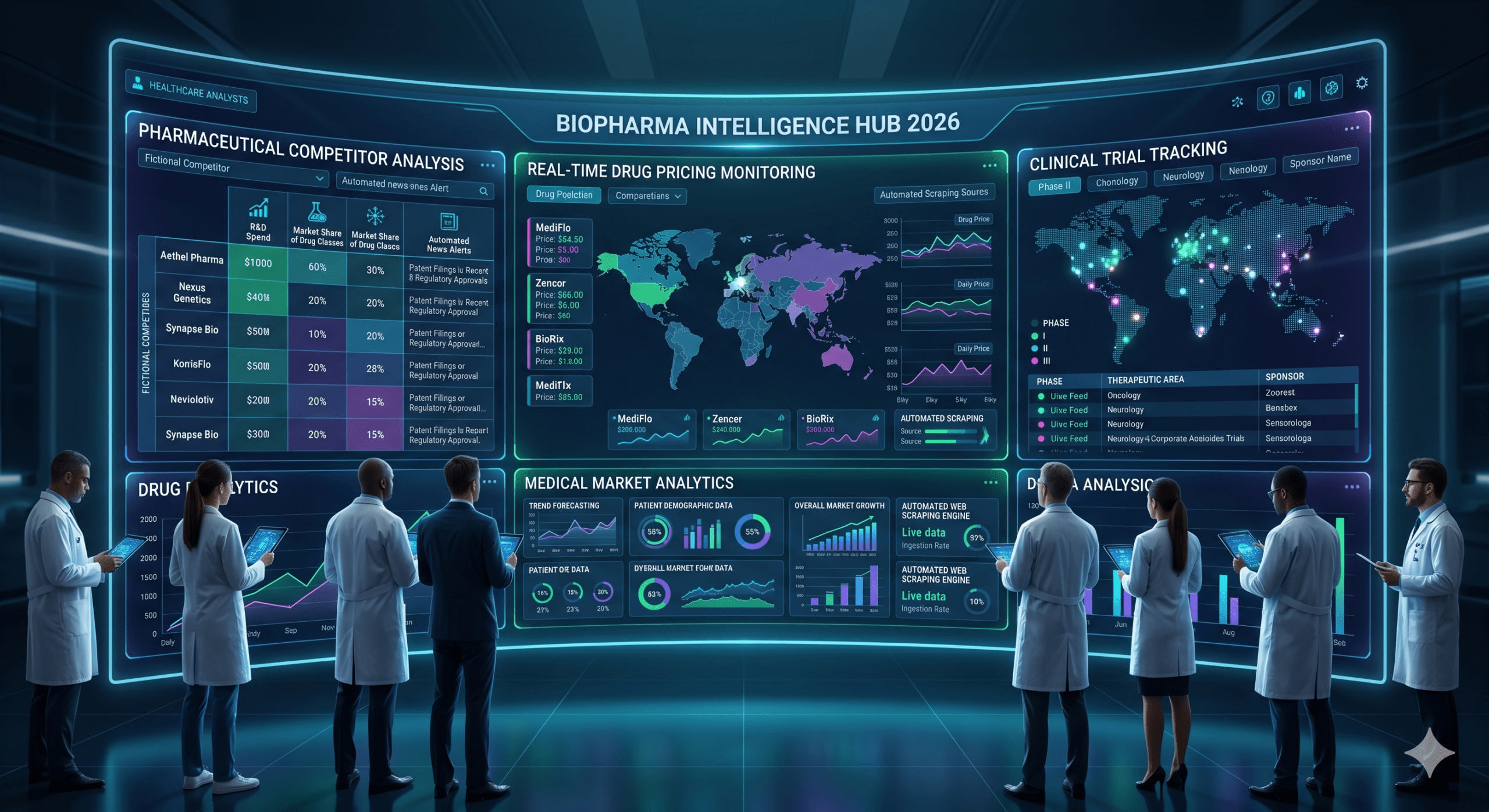
Introduction: Healthcare’s Data Revolution Is Happening Right Now — Are You Part of It?
Consider this: a mid-size pharmaceutical company’s pricing team spends three weeks manually compiling competitive drug pricing data across hospital formularies, pharmacy benefit manager (PBM) networks, and international reference pricing databases. By the time the report is complete, two competitors have quietly adjusted their net pricing strategies, a new biosimilar entry has shifted the market dynamics in one of their key therapeutic categories, and a critical formulary decision was made by a major PBM based on pricing intelligence the company didn’t have in time to respond.
This scenario doesn’t reflect a failure of talent or effort. It reflects a failure of data infrastructure. And it plays out — in different forms — across hospitals, health systems, health insurance companies, medical device manufacturers, digital health startups, and healthcare investors every single day.
The global healthcare industry is simultaneously one of the largest, most complex, and most data-intensive commercial environments on earth — and one of the most systematically underserved by modern data intelligence capabilities. The numbers establish the scale: the global healthcare market is projected to reach USD 665.37 billion in 2026, growing toward USD 992.73 billion by 2031 at a CAGR of 8.3%. The global pharmaceutical market alone is expected to reach USD 1.47 trillion by 2026. And the healthcare data market — the infrastructure supporting intelligence across this massive industry — is growing at over 15% annually, driven by relentless demand for better, faster, more actionable market intelligence.
In this environment, healthcare and pharmaceutical data scraping has emerged as a genuinely transformational capability — giving pharma companies the drug pricing intelligence they need to optimize commercial strategy, health tech startups the market data they need to build better products, hospital systems the competitive intelligence they need to negotiate more effectively, and healthcare investors the alternative data signals they need to make smarter capital allocation decisions.
This guide covers everything you need to know about healthcare data scraping in 2026 — what data is available, who is using it, how the most sophisticated players across the healthcare ecosystem are leveraging it for competitive advantage, and exactly how ScraperScoop can build the custom healthcare data intelligence operation your business needs to compete and win.
What Is Healthcare Data Scraping and Why Does It Matter in 2026?
Healthcare data scraping is the automated extraction of publicly available health, medical, and pharmaceutical information from websites, regulatory databases, clinical registries, medical literature platforms, hospital directories, pharmacy pricing networks, health insurance portals, and medical review platforms. This web-sourced intelligence enables healthcare organizations, pharmaceutical companies, health tech startups, and medical investors to collect, structure, and analyze market data that would be impossible to gather manually at meaningful scale or speed.
In simple terms: instead of having analysts manually visiting hundreds of drug pricing portals, FDA approval databases, clinical trial registries, hospital quality reporting sites, and competitor product pages — a process measured in weeks for any meaningful scope of coverage — automated healthcare scraping solutions do all of that continuously, at scale, and deliver the results in clean, structured, analysis-ready formats that support real-time commercial and clinical decision-making.
Why Healthcare Is a Uniquely Data-Intensive and Data-Underserved Industry
Healthcare combines enormous commercial scale, extreme information asymmetry, high-stakes decisions, and extraordinarily fragmented data ecosystems in ways that make it simultaneously the most data-hungry and most data-challenged major industry sector. Here’s what makes healthcare data intelligence so uniquely valuable — and so difficult to capture without automation:
- Data fragmentation is extreme. Drug pricing data is distributed across hundreds of pharmacy networks, hospital formularies, PBM contracts, government programs, and international reference pricing systems. Clinical trial data spans thousands of institution-specific registries, academic publications, and regulatory filing databases. Hospital quality data is scattered across dozens of state and federal reporting systems. No single source provides comprehensive coverage — and manually aggregating across sources is prohibitively time-consuming without automation.
- Decision stakes are extraordinarily high. A pharmaceutical company’s drug pricing decision directly impacts revenue across thousands of accounts. A hospital’s formulary decision affects patient care quality and institutional economics simultaneously. A health tech startup’s market entry decision determines whether the company gains traction or burns through capital on the wrong opportunity. In healthcare, the value of timely, accurate intelligence is magnified by the magnitude of the decisions it informs.
- Regulatory complexity creates intelligence demand. FDA approvals, CMS coverage decisions, state-level insurance regulations, international drug approval pathways, and clinical guideline updates all create continuous streams of regulatory intelligence that directly affect commercial strategy across pharma, medical devices, health insurance, and hospital systems. Monitoring this regulatory landscape comprehensively requires automated intelligence capabilities that manual monitoring simply cannot provide.
- The digital health ecosystem is expanding rapidly. The global digital health market is projected to reach USD 768.7 billion by 2032, growing at a CAGR of 18.6%. This explosion of digital health platforms, telemedicine services, health apps, wearable devices, and healthcare SaaS applications creates an entirely new competitive intelligence landscape — one that requires continuous web monitoring to track effectively.
- Patient and provider voice is increasingly accessible. Patient reviews, physician forum discussions, clinical experience reports, and healthcare provider ratings are now extensively published across digital platforms — creating a rich stream of real-world evidence about treatment effectiveness, drug tolerability, and care quality that supplements clinical trial data with the messy complexity of actual patient experience.
These factors converge to make healthcare data scraping not a luxury but a necessity for any healthcare organization serious about operating with the intelligence quality that the complexity and stakes of their market decisions demand.
What Healthcare & Pharma Data Can You Actually Scrape? The Complete Intelligence Taxonomy
The scope of healthcare intelligence available through automated web scraping is far broader than most healthcare professionals and organizations appreciate. Here’s the complete taxonomy of what’s accessible — and the specific business value each data type delivers.
1. Drug Pricing & Formulary Data
Pharmaceutical pricing data is among the most strategically valuable — and most difficult to manually aggregate — intelligence categories in the healthcare industry. Through automated scraping, organizations can extract list prices and average wholesale prices from pharmaceutical data portals, retail pharmacy pricing across major chains and independent pharmacies, formulary placement and tier status across major PBM formularies and hospital formularies, Medicare Part D pricing and coverage data across plan types, international reference pricing from national health authority databases across key markets, and biosimilar and generic competitive pricing as new entrants launch. This comprehensive pricing intelligence landscape is the foundation for pharmaceutical pricing strategy, contracting decisions, formulary negotiation preparation, and competitive positioning analysis.
2. Clinical Trial Data & Research Intelligence
ClinicalTrials.gov and equivalent international clinical trial registries contain extraordinarily rich intelligence about the global drug development landscape — every registered clinical trial, its indication, phase, enrollment status, primary endpoints, sponsoring organization, principal investigator, geographic coverage, and estimated completion timeline. Systematic scraping of these registries across therapeutic areas reveals competitor pipeline status in real time, identifies which indications are attracting the most clinical investment, surfaces combination therapy development trends, and provides early warning of competitive threats emerging from clinical stage assets that won’t reach commercial markets for years but need to be incorporated into long-range strategic planning today.
3. FDA Approvals & Regulatory Intelligence
The FDA’s public databases — covering drug approvals, biologics license applications, medical device clearances and approvals, clinical hold notices, complete response letters, and post-market safety communications — represent a comprehensive regulatory intelligence database that automated scraping makes accessible at scale. Monitoring FDA approval announcements in real time across therapeutic areas, tracking the regulatory status of competitor pipeline products, detecting safety-related label changes and post-market requirements, and identifying accelerated approval pathway trends all provide intelligence that directly informs commercial planning, regulatory strategy, and competitive assessment.
4. Medical Literature & Publication Data
PubMed, ClinicalKey, NEJM, The Lancet, and thousands of specialized medical journals collectively publish an enormous volume of clinically and commercially relevant research every day. Automated scraping of medical literature databases enables comprehensive publication monitoring across research areas, author network mapping that identifies the key opinion leaders in specific therapeutic areas, early detection of efficacy or safety data that will influence prescribing patterns, systematic literature reviews that support evidence-based market access applications, and clinical evidence tracking for competitor products that may affect comparative effectiveness positioning.
5. Hospital & Health System Quality Data
The Centers for Medicare & Medicaid Services (CMS) publishes extensive quality performance data for hospitals, skilled nursing facilities, home health agencies, and dialysis centers — including quality scores, readmission rates, patient satisfaction metrics, complication rates, and performance on specific quality measures. Systematically scraping and analyzing this public quality data enables hospital systems to benchmark their performance against peers, pharmaceutical companies to understand the care quality context of their target hospital accounts, healthcare investors to assess the operational quality of hospital system investments, and health policy researchers to analyze care quality patterns across geographies and provider types.
6. Pharmaceutical Company Financial & Pipeline Data
Annual reports, investor presentations, earnings call transcripts, pipeline update slides, and corporate press releases from public pharmaceutical companies collectively provide a rich stream of commercial and clinical intelligence — revenue data by therapeutic area and product, pipeline prioritization signals, partnership and licensing activity, geographic expansion plans, manufacturing capacity investments, and strategic repositioning announcements. Systematic scraping and monitoring of these corporate communications provides continuous competitive intelligence for business development teams, market access strategists, and pharmaceutical investors.
7. Patient Reviews & Real-World Experience Data
Platforms like Drugs.com, WebMD, Healthgrades, RxList, and patient community forums collect patient-reported experiences with medications, treatments, and healthcare providers at enormous scale — creating a rich source of real-world evidence about treatment effectiveness, side effect profiles, adherence challenges, and patient quality-of-life impacts that clinical trial data doesn’t capture. Systematic scraping and NLP analysis of patient review data provides pharmaceutical companies with insights into real-world drug performance that supplement controlled trial data, helps healthcare providers understand the patient experience of specific treatments, and gives health tech companies the patient perspective data needed to design better digital health solutions.
8. Healthcare Provider & Physician Data
Physician directory platforms, hospital medical staff listings, specialty society membership databases, and healthcare provider certification records collectively contain structured intelligence about healthcare provider networks — physician specialties, practice affiliations, geographic locations, prescribing area specializations, academic affiliations, and clinical research involvement. This provider intelligence is foundational for pharmaceutical sales force deployment optimization, medical science liaison targeting, clinical trial site identification, and healthcare market access strategy.
9. Medical Device & Technology Data
The FDA’s 510(k) clearance database, PMA approval records, medical device recall notices, and adverse event reporting systems (MAUDE database) collectively create a comprehensive medical device regulatory intelligence landscape. Paired with commercial medical device pricing data from procurement platforms, GPO contract pricing, and manufacturer websites, this data provides medical device companies, hospital value analysis committees, and healthcare investors with the intelligence needed for competitive positioning, procurement optimization, and investment analysis.
10. Health Insurance & Coverage Data
Insurance plan formulary databases, prior authorization requirement lists, coverage policy documents, and premium pricing data from health insurance marketplaces provide structured intelligence about the coverage landscape that directly influences pharmaceutical access, hospital choice, and patient care pathway decisions. For pharmaceutical manufacturers working through market access challenges, systematic monitoring of payer coverage decisions across major plans provides the early warning of coverage restrictions — and the data needed to develop evidence-based responses — that manual monitoring cannot provide at the speed commercial situations demand.
11. Digital Health App & Platform Data
App store ratings and reviews for health apps, telemedicine platform performance data, wearable device software update histories, and digital therapeutics clinical evidence databases all provide intelligence about the rapidly evolving digital health ecosystem. For health tech companies, this competitive landscape intelligence is essential for product positioning and feature development. For pharmaceutical companies evaluating digital companion therapy partnerships, app quality and engagement data informs partnership selection and due diligence.
12. Healthcare Job Postings & Workforce Intelligence
Healthcare industry job posting data provides forward-looking intelligence about organizational priorities, capability building, and strategic direction across pharmaceutical companies, health systems, insurance companies, and health tech platforms. A pharmaceutical company aggressively hiring health economics and outcomes research professionals is signaling intensified market access investment. A health system expanding its digital transformation hiring is signaling technology investment priorities. These hiring signal patterns provide competitive intelligence that leads formal announcements by multiple quarters — mirroring the alternative data applications that have proven so valuable in financial investment contexts.
10 High-Impact Healthcare Data Scraping Use Cases Driving Competitive Advantage in 2026
Understanding the data universe is the foundation. Understanding how the most sophisticated healthcare organizations are actually deploying this intelligence to drive measurable competitive advantage is where the practical value lives.
1. Pharmaceutical Pricing Strategy & Competitive Intelligence
For pharmaceutical commercial teams, real-time visibility into competitor pricing across channels — retail pharmacies, hospital formularies, PBM contracts, and government programs — is the intelligence foundation of defensible pricing strategy. Rather than periodic manual price surveys that are outdated before the analysis is complete, automated drug pricing scraping provides a continuously updated competitive pricing map that enables pharmaceutical pricing teams to monitor competitor net price movements, detect formulary positioning shifts before they impact market share, identify geographic pricing variations that create arbitrage risks, and benchmark their own pricing position against the full competitive landscape across every commercial channel simultaneously.
This intelligence is not just commercially valuable — it’s becoming a regulatory necessity as governments globally implement drug pricing transparency requirements and reference pricing policies that make comprehensive competitive pricing visibility essential for compliant pricing strategy. Organizations that have built automated drug pricing intelligence capabilities are navigating this regulatory complexity far more effectively than those relying on manual survey-based approaches.
2. Clinical Trial Landscape Monitoring & Pipeline Intelligence
Pharmaceutical business development teams, competitive intelligence analysts, and clinical development strategists use systematically scraped clinical trial registry data to build comprehensive pictures of the competitive development landscape across their therapeutic areas of focus. This intelligence reveals which competitors are advancing what programs through which clinical stages, identifies the indication white spaces where clinical investment is underrepresented relative to patient need, surfaces trial design innovations that may establish new efficacy or safety benchmarks, and provides early warning of competitive threats emerging from clinical stage assets years before they reach commercial markets.
For smaller biotech companies evaluating indication prioritization decisions, scraped clinical trial data provides the comprehensive competitive landscape assessment that would otherwise require months of manual research from multiple data sources — delivering the strategic clarity needed for resource allocation decisions with significantly compressed research cycles.
3. FDA & Regulatory Approval Tracking
Pharmaceutical commercial teams cannot afford to miss competitive approval events — a competitor’s FDA approval can instantly reshape a market, trigger formulary review processes, and initiate payer contract renegotiations that create narrow windows for strategic response. Automated FDA database monitoring across relevant therapeutic areas and application types provides real-time approval alerts that initiate pre-planned competitive response protocols the moment a material regulatory event occurs — rather than days or weeks later when market dynamics have already shifted.
Beyond approvals, monitoring FDA complete response letters, clinical holds, and post-market safety communications for competitor products provides ongoing intelligence about competitive pipeline setbacks and safety profile developments that may affect comparative positioning and physician prescribing patterns. This regulatory intelligence monitoring is most valuable when it’s comprehensive, automated, and continuous — capabilities that only systematic web scraping can deliver.
4. Medical Literature & Key Opinion Leader Monitoring
Pharmaceutical medical affairs teams use systematic publication monitoring to track the evolving evidence base across their therapeutic areas — detecting new data publications that may affect clinical guidelines, identifying shifts in key opinion leader publication focus that signal changing research priorities, monitoring comparative effectiveness research that may influence prescriber behavior, and tracking the publication of competitor-sponsored trial results that require scientific communication responses.
Publication author network analysis derived from scraped medical literature data helps medical affairs teams identify the most influential researchers in specific clinical areas — enabling more targeted KOL engagement programs that focus resources on the scientific voices most capable of shaping clinical practice in key therapeutic areas.
5. Hospital Quality Benchmarking & Competitive Positioning
Hospital systems use systematically scraped CMS quality data and publicly reported performance metrics to benchmark their performance across clinical quality, patient experience, operational efficiency, and safety dimensions against peer institutions. This competitive benchmarking serves multiple purposes: identifying specific quality dimensions where performance gaps create strategic vulnerabilities, supporting board and executive reporting on competitive position, informing value-based care program design priorities, and providing the objective performance data needed to build compelling cases for physician recruitment, patient engagement, and payer contracting discussions.
For healthcare consulting firms and hospital management companies, comprehensive competitive quality benchmarking across large hospital universes — enabled by automated CMS data scraping — provides the analytical foundation for engagement strategies and operational improvement prioritization that manual data collection could never support at comparable scope or speed.
6. Patient Sentiment & Real-World Evidence Analysis
Pharmaceutical companies, health technology companies, and healthcare providers increasingly recognize that patient-reported experience data from review platforms, patient community forums, and social health networks contains real-world evidence signals that controlled clinical trials systematically miss. Systematically scraping and NLP-analyzing patient reviews of medications reveals real-world side effect profiles that extend beyond trial populations, treatment adherence challenges that predict real-world effectiveness below clinical trial benchmarks, patient quality-of-life impacts that translate directly into health economics modeling inputs, and comparative treatment experience patterns that influence physician prescribing in ways that clinical data alone doesn’t capture.
For market access teams preparing health technology assessments and payer submissions, patient experience data derived from systematic review analysis provides the patient perspective evidence that payers and HTA bodies increasingly require as part of comprehensive value demonstration — and that traditional clinical development programs rarely collect systematically enough to support compelling market access arguments.
7. Pharmaceutical Sales Force & Market Access Optimization
Pharmaceutical commercial operations teams use scraped healthcare provider data — physician specialties, practice affiliations, geographic distributions, academic connections, and clinical research involvement — to optimize sales force territory design, targeting prioritization, and medical science liaison deployment. Rather than relying on expensive proprietary provider databases that may be months out of date, web scraping of physician directory platforms, hospital medical staff listings, and specialty society databases provides continuously updated provider intelligence that keeps targeting strategies current with the rapid changes in physician practice patterns and institutional affiliations that characterize modern healthcare delivery systems.
8. Digital Health Competitive Intelligence
The digital health market’s explosive growth has created an intensely competitive landscape where new entrants emerge constantly and established players evolve their offerings rapidly. Health tech companies use web scraping to monitor competitor app store ratings and review sentiment, track feature releases and product update announcements, analyze competitor pricing and subscription model structures, detect partnership announcements and integration launches, and monitor clinical evidence generation activities that establish competitive differentiation in evidence-sensitive market segments.
For health tech investors evaluating portfolio companies and investment opportunities, scraped digital health competitive intelligence provides the market landscape assessment needed for investment thesis validation — replacing expensive primary research with continuously updated, structured competitive data that reflects the actual state of the market in real time.
9. Healthcare Insurance & Market Access Intelligence
Pharmaceutical market access teams responsible for formulary placement and payer contracting negotiations use systematically scraped payer coverage intelligence to track formulary status changes across major commercial plans, monitor prior authorization requirement changes that affect patient access, detect coverage policy updates that signal shifts in payer value assessment criteria, and benchmark competitor formulary positioning across the payer landscape to identify market access gaps and opportunities.
This payer intelligence monitoring is most valuable when it’s comprehensive — covering the full range of commercial, Medicare Advantage, and Medicaid managed care payers that collectively define the market access landscape — and continuous, detecting coverage changes in time to respond strategically rather than after the market access impact has already been felt in prescription volume declines.
10. Healthcare Investment & M&A Intelligence
Healthcare private equity firms, venture capital investors, and strategic acquirers use web-scraped healthcare data across multiple dimensions to support investment diligence and portfolio monitoring. Clinical trial pipeline data reveals the development stage and regulatory risk profile of drug assets under consideration. Hospital quality data provides operational performance benchmarks for health system investments. Digital health app performance data informs health tech investment and acquisition assessments. Pharmaceutical pricing and market share data supports commercial model validation for product-based investments. Systematically integrating these scraped intelligence streams dramatically improves the quality and efficiency of healthcare investment diligence processes.
Drug Pricing Intelligence: The Pharmaceutical Industry’s Most Critical Data Intelligence Challenge
Among all healthcare data scraping applications, drug pricing intelligence represents the highest-stakes, most commercially consequential — and historically most difficult to execute systematically — data collection challenge in the pharmaceutical industry. Let’s examine why it matters so deeply and how automated scraping is transforming what’s possible.
The Drug Pricing Complexity Problem
Drug pricing in the United States — and globally — is among the most complex pricing environments in any industry. A single pharmaceutical product may have dozens of effective prices simultaneously: a published list price (WAC), a Medicare average sales price (ASP), a 340B ceiling price for eligible covered entities, a VA federal supply schedule price, prices under dozens of commercial PBM formulary contracts at different rebate levels, a state Medicaid rebate-adjusted price, and prices in international markets subject to reference pricing regulations. None of these prices are directly observable from a single source — and the strategic implications of each vary significantly across commercial situations.
Competitor visibility into this multi-dimensional pricing landscape has historically been fragmentary — assembled from partial data sources, industry surveys, and anecdotal intelligence with significant time lags and coverage gaps. Automated scraping of publicly accessible pricing data sources — pharmacy pricing APIs, formulary databases, government pricing portals, and international reference pricing systems — transforms this fragmented picture into a comprehensive, continuously updated competitive pricing intelligence capability that was simply not achievable through manual methods.
Biosimilar & Generic Entry Intelligence
For innovator pharmaceutical companies approaching biosimilar or generic competition, and for biosimilar/generic companies preparing market entry strategies, real-time competitor pricing intelligence is particularly high-stakes. Biosimilar market entry events create rapid, complex pricing dynamics — innovator price adjustments, formulary exclusion strategies, and contract restructuring — that unfold over compressed timeframes and require continuous intelligence monitoring rather than periodic surveys. Automated drug pricing scraping enables both innovator and biosimilar companies to monitor the full competitive pricing landscape with the currency and comprehensiveness that these high-velocity market situations demand.
International Reference Pricing Compliance
More than 20 countries use international reference pricing (IRP) systems that link domestic drug prices to the prices set in other reference countries — creating an interconnected global pricing web where a pricing decision in one market triggers automatic price adjustments in others through IRP mechanisms. Pharmaceutical companies managing global launch sequencing and pricing must monitor reference prices across this interconnected system continuously — a monitoring requirement that automated international pricing database scraping is uniquely capable of fulfilling at the comprehensiveness and frequency that sound IRP management demands.
Clinical Trial Intelligence: Mapping the Global Drug Development Landscape in Real Time
For pharmaceutical and biotech companies, understanding the clinical development landscape across their therapeutic areas of focus is not a periodic research exercise — it’s a continuous strategic intelligence requirement. Clinical trial data scraping transforms what was historically a manual, resource-intensive competitive intelligence function into a systematic, continuously updated pipeline intelligence capability.
What ClinicalTrials.gov and Global Registries Reveal
The U.S. National Library of Medicine’s ClinicalTrials.gov database contains registration data for over 450,000 studies across more than 220 countries — representing the most comprehensive public database of clinical research activity available anywhere. International equivalents — the EU Clinical Trials Register, ISRCTN Registry, WHO International Clinical Trials Registry Platform, and national registries across China, Japan, and Australia — collectively expand coverage of the global development landscape beyond what ClinicalTrials.gov alone captures.
Systematic scraping and monitoring of these registries across specific therapeutic areas reveals the full scope of competitive clinical activity — not just the high-profile Phase III programs that generate press releases, but the entire development pipeline including early-stage proof-of-concept studies, investigator-initiated research that signals academic interest in specific mechanisms, novel endpoint development trials that may establish new regulatory precedents, and combination therapy programs that suggest emerging treatment paradigm shifts.
Pipeline Intelligence for Business Development
Pharmaceutical business development teams use systematically scraped clinical trial data to identify licensing and acquisition targets — programs that match specific capability or portfolio criteria, that are approaching value inflection points where deal pricing is most favorable, or that represent therapeutic area adjacencies that align with strategic portfolio objectives. The comprehensiveness of automated clinical registry monitoring dramatically expands the deal opportunity identification surface compared to manual pipeline tracking focused only on publicly announced programs and formal out-licensing presentations.
Competitive Trial Design Benchmarking
Beyond pipeline status monitoring, scraped clinical trial data enables systematic comparison of trial design parameters — endpoint selection, patient population definitions, comparator arms, trial duration, sample sizes, and geographic enrollment strategies — across competitive development programs. This benchmarking intelligence informs clinical development team decisions about their own trial design choices, helping to anticipate the regulatory and clinical efficacy bar that competitor trials are establishing and ensuring that their own programs are designed to demonstrate comparative effectiveness against the relevant competitive context.
Digital Health & Health Tech: How Startups & Platforms Use Data Scraping to Win
The digital health sector’s explosive growth has created an intensely competitive landscape where data intelligence is a survival requirement, not a luxury. For health tech startups and established digital health platforms alike, automated web scraping provides the continuous competitive market intelligence that supports product differentiation, fundraising narratives, partnership strategies, and go-to-market positioning.
App Store Intelligence for Health Tech
For digital health companies whose products live in the Apple App Store and Google Play Store, continuous monitoring of competitor app ratings, review volume trends, feature mentions in reviews, and rating distribution shifts provides a near-real-time competitive intelligence stream that informs product roadmap priorities, user experience improvement focus areas, and marketing messaging development. A systematic decline in a competitor’s app ratings is a product vulnerability signal that creates a window for differentiated positioning. A surge in competitor positive reviews around a specific feature signals a user value dimension worth evaluating for your own roadmap.
Telemedicine & Virtual Care Platform Monitoring
The telemedicine market has grown explosively and remains highly competitive, with new platforms entering regularly and established players continuously expanding service lines, geographic coverage, and specialty depth. Scraping telemedicine platform websites, service coverage pages, pricing structures, and provider network sizes provides competitive intelligence that informs platform expansion decisions, specialty service development priorities, and pricing model optimization — all against the background of a competitive landscape that evolves too rapidly for manual periodic monitoring to track effectively.
Healthcare SaaS Competitive Intelligence
For healthcare software companies — electronic health record platforms, revenue cycle management solutions, clinical decision support tools, and population health management systems — systematically scraping competitor product pages, feature release announcements, customer case studies, and pricing pages provides the competitive intelligence needed to maintain differentiated positioning in markets where feature parity erodes quickly and pricing transparency is increasing. Understanding exactly how competitors are positioning, what clinical outcomes they’re claiming, and how they’re structuring commercial terms is essential intelligence for any healthcare software commercial team.
Health Tech Investment Due Diligence
Healthcare investors evaluating digital health investments use web scraping to rapidly build competitive landscape assessments that support investment thesis validation. Scraping app store performance data, provider network size indicators, clinical evidence publication status, regulatory clearance histories, and customer review sentiment across the competitive set of a target investment provides a structured competitive intelligence picture in days rather than the weeks of primary research that comprehensive manual assessment would require. This intelligence acceleration significantly improves investment diligence quality without proportionally extending the diligence timeline.
Whether you’re a digital health startup building your competitive positioning or an established health tech platform monitoring a rapidly evolving competitive landscape, talk to ScraperScoop’s healthcare data specialists about how we can build a custom health tech intelligence operation tailored precisely to your competitive monitoring needs.
Key Healthcare Data Sources for Web Scraping: Where the Intelligence Lives
Building an effective healthcare data scraping strategy requires understanding which specific sources carry the most actionable intelligence for your particular business application. Here’s the landscape of primary healthcare data sources and what each delivers.
FDA Public Databases
The FDA maintains multiple publicly accessible databases that are essential for pharmaceutical and medical device competitive intelligence: Drugs@FDA for approved drug applications and labeling history, the 510(k) and PMA databases for medical device clearances and approvals, MAUDE (Manufacturer and User Facility Device Experience) for medical device adverse events, the Drug Shortage Database for supply intelligence, the Orange Book for patent and exclusivity information critical to generic entry timing, and the Purple Book for biological product reference and biosimilar approval status. Systematic monitoring of these FDA databases provides a comprehensive regulatory intelligence capability that is foundational for pharmaceutical and medical device competitive strategy.
ClinicalTrials.gov & International Clinical Registries
With over 450,000 registered studies globally and continuous updates as new trials register and existing trial statuses evolve, ClinicalTrials.gov is the most comprehensive public source of clinical development pipeline intelligence available. International equivalents — the EU Clinical Trials Register (EUCTR), WHO ICTRP, Australian New Zealand Clinical Trials Registry, and national registries across major pharmaceutical markets — extend coverage to clinical programs that may not be registered in the U.S. system, providing a truly global development landscape picture that U.S.-only registry monitoring misses.
CMS Quality Reporting Databases
The Centers for Medicare & Medicaid Services publishes quality performance data for more than 5,000 hospitals, 15,000 nursing homes, and thousands of home health agencies, dialysis facilities, and other care settings through its Care Compare platform and linked quality reporting databases. This comprehensive quality data — covering clinical outcomes, patient experience, process compliance, and efficiency measures — provides the benchmarking foundation for hospital competitive intelligence, healthcare investment diligence, and healthcare policy analysis at a scope and granularity that no private data source approaches.
PubMed & Medical Literature Databases
The National Library of Medicine’s PubMed database indexes over 35 million biomedical citations and abstracts from thousands of journals globally — providing the most comprehensive single-source access to published medical and pharmaceutical research available. Systematic scraping of PubMed across therapeutic area-specific search parameters enables continuous publication monitoring, author network analysis, citation pattern tracking, and clinical evidence landscape assessment that manual literature review cannot approach at comparable scope or speed.
Patient Review Platforms
Drugs.com, WebMD’s patient reviews, Healthgrades, RxList, Everyday Health, and disease-specific patient community platforms collectively aggregate millions of patient-reported medication and treatment experiences — creating the largest real-world patient experience database available through public sources. The depth of structured sentiment, side effect reporting, and comparative treatment experience contained in these review databases represents a real-world evidence resource that pharmaceutical companies, health tech companies, and health policy researchers are increasingly recognizing as an essential complement to clinical trial data.
Hospital & Provider Directory Platforms
Healthgrades, U.S. News Health, Vitals, WebMD’s physician finder, specialty society member directories, and state medical board licensing databases collectively contain structured intelligence about healthcare provider networks — specialties, practice affiliations, quality scores, patient reviews, education, and clinical research involvement. This provider intelligence is foundational for pharmaceutical sales force targeting optimization, medical affairs KOL identification, and healthcare network analysis.
Pharmacy & Drug Pricing Platforms
GoodRx, RxSaver, NeedyMeds, and pharmaceutical manufacturer patient assistance program pages collectively provide retail-facing drug pricing intelligence across thousands of medications at pharmacy-specific, ZIP code-level resolution. Combined with Medicare Part D plan formulary data, hospital pharmacy formulary databases, and international drug price comparison platforms, these sources enable comprehensive cross-channel drug pricing intelligence monitoring that traditional manual price surveys cannot match for coverage, frequency, or geographic granularity.
International Health Authority Databases
The European Medicines Agency (EMA), Health Canada, TGA (Australia), PMDA (Japan), NMPA (China), and health technology assessment bodies like NICE (UK), G-BA (Germany), and HAS (France) all publish drug approval decisions, reimbursement assessments, and clinical evidence evaluations that provide essential intelligence for pharmaceutical international market access strategy. Systematic monitoring of these international regulatory databases provides the comparative effectiveness evidence context and reference pricing intelligence that global pharmaceutical commercial teams need to develop sound market-by-market launch and pricing strategies.
Why Healthcare Data Scraping Is Technically Complex — And How Professional Services Solve It
Healthcare and pharmaceutical data scraping presents distinctive technical, operational, and compliance challenges that make it one of the most demanding web scraping domains. Here’s what makes it genuinely complex — and how professional data services navigate each challenge effectively.
Challenge 1: Regulatory Database Complexity and Access Patterns
FDA databases, ClinicalTrials.gov, and CMS quality reporting systems are large, complex, and frequently updated databases with access patterns specifically designed for human browsing rather than automated bulk collection. The volume and structure of these databases — with thousands of interconnected records, complex search interfaces, and hierarchical data relationships — require sophisticated scraping architectures that understand domain-specific data structures and navigate database-specific access patterns without triggering rate limits or access restrictions that protect these public resources from abusive automated access.
Challenge 2: HIPAA and Patient Privacy Considerations
Healthcare data scraping must be designed from the outset to avoid collecting Protected Health Information (PHI) — the individually identifiable health information that is strictly regulated under HIPAA. While public-facing healthcare websites and review platforms contain legitimately scrapable information, the boundary between publicly shared patient information and PHI requires careful technical and legal navigation. Professional healthcare data scraping services implement privacy-by-design technical architectures that systematically exclude PHI from collection scope — protecting clients from inadvertent HIPAA exposure that naively-built scraping operations may create.
Challenge 3: Medical and Scientific Data Normalization
Healthcare data from multiple sources uses highly technical, domain-specific terminology, abbreviations, coding systems, and classification frameworks — ICD-10 diagnosis codes, NDC drug codes, NPI provider identifiers, SNOMED clinical terminology, MeSH medical subject headings — that require healthcare domain expertise to normalize correctly across sources. A generic data normalization pipeline that lacks healthcare ontology knowledge will systematically miscategorize and misattribute healthcare data — producing datasets that appear complete but contain systematic errors that undermine the quality of any downstream analysis.
Challenge 4: Dynamic and Session-Dependent Content
Many healthcare portals — particularly insurance formulary databases, hospital quality dashboards, and provider directories — display content dynamically based on search parameters, location inputs, and session state rather than through static, URL-addressable page structures. Accessing comprehensive data from these sources requires headless browser automation capable of simulating the full search and navigation interactions of human users — including multi-step form completions, geographic location inputs, and session-persistent search state management — rather than simple HTTP request-based scraping.
Challenge 5: Medical Literature Volume and Structure
PubMed alone indexes millions of citations with complex metadata structures — MeSH terms, publication types, author affiliations, funding sources, article types, and citation networks — that require both technical sophistication in data collection and healthcare domain expertise in data interpretation. Building a medical literature monitoring capability that systematically tracks publication patterns across specific therapeutic areas, identifies key opinion leader authorship networks, and detects emerging evidence themes requires a combination of technical scraping capability and healthcare domain-specific analytical frameworks that generic data services rarely provide.
Challenge 6: International Healthcare Data Complexity
For pharmaceutical companies monitoring drug pricing and regulatory status across global markets, the complexity multiplies — different regulatory systems, different data formats, different languages, different database architectures, and different legal frameworks for data access across dozens of national health authority systems. Building and maintaining multi-market international healthcare intelligence requires deep technical and domain expertise across healthcare regulatory systems globally — a capability set that only specialist providers with dedicated international healthcare data infrastructure can deliver reliably.
These challenges explain why the most sophisticated pharmaceutical companies, hospital systems, health tech companies, and healthcare investors are increasingly working with specialist managed data providers rather than attempting to build complex healthcare scraping infrastructure in-house. Get in touch with ScraperScoop’s healthcare data specialists today — we’ve built the healthcare domain expertise, technical infrastructure, and compliance frameworks needed to deliver investment-grade healthcare intelligence that your team can immediately incorporate into commercial and clinical decision workflows.
Legal, Ethical & Compliance Considerations for Healthcare Data Scraping
Healthcare data scraping operates in one of the most complex regulatory compliance environments of any industry — combining general web scraping legal considerations with healthcare-specific regulatory frameworks that have significant implications for data collection design and operational practice.
The Public vs. Protected Data Distinction in Healthcare
The most fundamental compliance principle for healthcare data scraping is the clear distinction between publicly available health information — FDA drug approval records, clinical trial registry data, hospital quality performance scores, publicly listed physician directories, published medical literature — and Protected Health Information (PHI) under HIPAA, which is individually identifiable health information that is strictly regulated and must never be collected through automated scraping.
The vast majority of commercially valuable healthcare intelligence for pharmaceutical, health tech, hospital, and investment applications falls firmly on the public information side of this boundary — regulatory filings, clinical trial data, quality metrics, published research, and market pricing data that health authorities and research institutions deliberately make publicly available. Healthcare data scraping programs designed around these public sources operate in legitimate, legally sound territory that is entirely distinct from PHI-regulated data collection.
HIPAA Compliance in Healthcare Data Collection
HIPAA applies to covered entities — healthcare providers, health plans, and healthcare clearinghouses — and their business associates when handling PHI. Web scraping operations focused on publicly available healthcare market intelligence data are generally not collecting PHI and therefore do not implicate HIPAA’s core regulatory requirements. However, healthcare organizations that are themselves covered entities need to ensure that any internal use of scraped data does not create pathways that inadvertently combine scraped public data with PHI in ways that create compliance exposure. A compliance-first healthcare data scraping design addresses these risks proactively.
GDPR and Healthcare Data in European Markets
GDPR treats health data as a “special category” of personal data requiring heightened protection — with significant implications for any data collection that might include individually identifiable health information about EU residents. Healthcare data scraping targeting European markets must be specifically designed to ensure that collected data does not include health-related personal information about identifiable individuals, with technical safeguards implemented at the collection level rather than relying on post-collection filtering as a compliance mechanism.
Terms of Service Compliance for Healthcare Platforms
Medical literature databases, healthcare professional networks, patient review platforms, and specialty clinical databases often have terms of service that address automated access with varying degrees of specificity and restriction. Responsible healthcare data scraping respects the spirit of these terms — operating at request rates that don’t burden platform infrastructure, avoiding circumvention of technical access controls, and structuring collection to minimize commercial impact on source platforms. This approach is both ethically sound and practically important for maintaining sustainable, long-term access to critical healthcare data sources.
Ethical Considerations in Patient Data Collection
Patient review data — while publicly posted on accessible platforms — involves the personal health experiences of individuals who shared that information in specific platform contexts. Ethical healthcare data scraping treats this data with appropriate sensitivity: using it for aggregate, anonymized analysis rather than individual-level tracking, implementing re-identification risk assessment before any patient experience dataset is used in analytical applications, and applying the spirit of research ethics principles — beneficence, non-maleficence, and respect for persons — that govern clinical research to the use of real-world patient experience data in commercial contexts.
At ScraperScoop, compliance is built into the design of every healthcare data collection solution we deliver. We collect exclusively publicly available health and pharmaceutical intelligence, implement privacy-by-design technical architectures that systematically exclude PHI from collection scope, operate within sustainable access parameters for all healthcare data sources, and support clients in understanding their own compliance obligations with respect to the healthcare data they use.
How AI Is Transforming Healthcare Data Scraping and Medical Intelligence in 2026
The convergence of AI and healthcare data scraping is creating capabilities that were simply impossible just a few years ago — and the pace of capability development in this domain is accelerating rapidly. Here’s how artificial intelligence is reshaping what healthcare data intelligence can deliver.
Large Language Models for Medical Document Analysis
The application of LLMs to scraped medical and pharmaceutical documents — clinical trial protocols, FDA approval packages, earnings call transcripts discussing pipeline assets, medical literature abstracts, and health technology assessment submissions — is enabling unprecedented analytical scale in healthcare intelligence. LLMs can extract structured clinical data points from unstructured trial protocols, detect language changes in regulatory submissions that signal strategic repositioning, summarize complex clinical evidence landscapes across therapeutic areas, and identify inconsistencies between management pipeline communications and regulatory filing status that may signal development setbacks before formal announcements.
Medical NLP for Patient Sentiment Analysis
Healthcare domain-specific NLP models trained on medical and patient language understand the clinical context of patient experience reports in ways that generic sentiment tools fundamentally cannot. A patient describing “manageable side effects” versus “intolerable side effects” that nevertheless leads to treatment continuation conveys fundamentally different real-world adherence implications — distinctions that clinical domain NLP models detect but generic sentiment analysis misses entirely. Medical NLP applied to scraped patient review data produces significantly more accurate and clinically meaningful sentiment signals than general-purpose NLP tools applied to the same data.
Predictive Clinical Development Intelligence
Machine learning models trained on historical clinical trial data — trial design parameters, enrollment patterns, endpoint choices, sponsor characteristics, and regulatory outcomes — are developing predictive capabilities for clinical development outcomes that support more accurate pipeline risk assessment and investment prioritization. Applied to continuously scraped clinical trial registry data, these predictive models help pharmaceutical business development teams and healthcare investors assess the probability of clinical success for assets under evaluation — supplementing traditional clinical expert judgment with data-driven probability estimates.
Automated Regulatory Signal Detection
AI-powered monitoring systems applied to continuously scraped FDA database updates, international regulatory announcements, and clinical guideline publications can automatically classify regulatory events by commercial significance, trigger pre-defined response protocols based on event type and therapeutic area, and prioritize alert delivery based on the strategic importance of each development to the organization’s portfolio. This intelligent regulatory monitoring transforms what was previously a labor-intensive manual scanning process into an automated, always-on intelligence operation that never misses a material regulatory development.
Self-Healing Healthcare Data Pipelines
Healthcare regulatory database interfaces, hospital quality reporting portals, and clinical registry platforms update their structures periodically — changing field names, adding new data elements, modifying search interfaces, and restructuring navigation flows that break traditional scraping pipelines. AI-powered self-healing pipelines detect these structural changes automatically and adapt parsing logic without manual engineering intervention — maintaining the data continuity that healthcare intelligence applications depend on without the pipeline maintenance overhead that traditional scraping approaches require.
The Proven ROI of Healthcare Data Scraping: Where the Value Gets Created
For Pharmaceutical Companies
- Pricing strategy optimization: Comprehensive, real-time competitive pricing intelligence enables pharmaceutical pricing decisions that are consistently better calibrated to actual market conditions — reducing the risk of both over-pricing that drives formulary exclusion and under-pricing that unnecessarily sacrifices margin across large commercial account portfolios.
- Market access efficiency: Automated payer coverage monitoring eliminates the information lag between coverage policy changes and organizational response — enabling market access teams to detect and respond to formulary restriction decisions in time to deploy managed care resources effectively rather than after prescription volume impacts have already occurred.
- Competitive intelligence efficiency: Automating the continuous competitive monitoring that previously required large competitive intelligence analyst teams allows pharmaceutical companies to maintain comprehensive competitive visibility at a fraction of the labor cost — redirecting analyst talent toward higher-value interpretation and strategic recommendation work rather than raw data collection.
- Business development pipeline quality: Comprehensive clinical trial data monitoring dramatically improves the deal opportunity identification surface for business development teams — surfacing relevant licensing and acquisition candidates systematically rather than depending on the incomplete visibility provided by conference attendance and formal out-licensing presentations.
For Hospital Systems & Health Networks
- Competitive quality benchmarking: Continuous monitoring of public CMS quality data across relevant peer institutions enables hospital leadership to maintain real-time visibility into their competitive quality position — supporting the evidence-based quality improvement prioritization that drives sustainable performance gains.
- Pharmaceutical procurement intelligence: Comprehensive drug pricing intelligence across commercial channels enables hospital pharmacy teams to identify procurement optimization opportunities — capturing cost savings on formulary decisions that directly impact institutional pharmacy economics at meaningful scale.
For Health Tech Companies & Digital Health Startups
- Product differentiation intelligence: Continuous competitor app performance and feature monitoring enables product teams to make roadmap decisions informed by real competitive market signals rather than periodic manual assessments — maintaining competitive differentiation in markets where feature parity erodes rapidly.
- Investment narrative quality: Comprehensive, data-backed competitive landscape intelligence dramatically improves the quality and credibility of investor presentations and due diligence responses — replacing anecdotal competitive assessments with structured, continuously updated market intelligence that sophisticated healthcare investors find significantly more compelling.
For Healthcare Investors
- Diligence efficiency: Automated healthcare data collection compresses investment diligence timelines significantly — delivering competitive landscape assessments, quality benchmarks, and pipeline intelligence in days rather than weeks, enabling faster and more informed investment decision cycles.
- Portfolio monitoring quality: Continuous automated monitoring of competitive dynamics, regulatory developments, and market performance signals across portfolio companies provides investment professionals with the early warning intelligence needed to respond proactively to value-affecting developments before they materialize in financial metrics.
Healthcare Data Scraping Best Practices: Building an Intelligence Operation That Delivers Results
1. Start with Specific Commercial or Clinical Intelligence Objectives
The most effective healthcare data scraping operations are built backward from specific, high-value intelligence requirements — not forward from available data. Before designing any collection strategy, define precisely: what commercial decision needs better data? What competitive intelligence gap creates the most strategic vulnerability? What regulatory monitoring failure has cost the most in terms of market opportunity or response efficiency? The specificity of your intelligence objectives directly determines the relevance and commercial value of your data collection architecture.
2. Design for PHI Avoidance from Day One
Healthcare data scraping operations must implement PHI avoidance at the technical architecture level — not as a post-collection filtering step. Design collection systems to target specific data fields that are structurally incapable of containing PHI, implement automated PHI detection as a collection-stage filter for any sources where PHI might be incidentally present, and build data retention policies that apply appropriate healthcare data governance standards to all collected datasets regardless of PHI classification.
3. Prioritize Healthcare Domain Expertise in Data Normalization
Generic data normalization pipelines fail systematically with healthcare and pharmaceutical data because they lack the domain-specific knowledge required to correctly interpret medical terminology, drug coding systems, clinical classification frameworks, and healthcare organizational hierarchies. Invest in healthcare domain expertise at the data normalization layer — whether through subject matter expert involvement in pipeline design, healthcare ontology integration in mapping logic, or partnership with specialist data providers who have built this expertise into their core technical infrastructure.
4. Build Multi-Source Coverage for Comprehensive Market Views
No single healthcare data source provides complete market coverage for any significant analytical application. Drug pricing intelligence requires integration across retail pharmacy, hospital formulary, government program, and international reference pricing sources simultaneously. Clinical trial intelligence requires monitoring across multiple international registries, not just ClinicalTrials.gov. Hospital quality intelligence requires combining CMS data with private accreditation and specialty quality reporting sources. Build multi-source architectures from the beginning — accepting the normalization complexity this requires in exchange for the analytical completeness it delivers.
5. Maintain Legal Review and Compliance Documentation
For healthcare data scraping operations — particularly those involving patient-facing platforms, international health authority databases, or clinical data sources — maintain comprehensive documentation of data source public availability, collection methodology, PHI avoidance measures, and legal review conclusions. Healthcare regulatory environments are evolving rapidly, and compliance documentation that is current and thorough positions organizations to demonstrate responsible data use when regulatory inquiries arise — an increasingly important risk management capability as health data governance oversight increases globally.
6. Integrate Intelligence Directly into Decision Workflows
Healthcare intelligence that lives in isolated databases or periodic report files rarely drives timely commercial or clinical action. Integrate scraped healthcare data directly into the decision workflows where it’s most valuable — pharmaceutical pricing review cycles, market access team monitoring dashboards, clinical development competitive reviews, hospital quality improvement planning processes, and healthcare investment portfolio monitoring systems. The operational value of healthcare data intelligence is fully realized only when it’s embedded in the decision processes it’s designed to inform.
7. Partner with Healthcare-Specialized Data Providers
Healthcare data scraping requires a unique combination of technical infrastructure, healthcare domain expertise, regulatory compliance knowledge, and medical data normalization capabilities that generic scraping service providers rarely possess in meaningful depth. Partnering with data specialists who have built specifically for healthcare applications — with healthcare ontology integration, PHI avoidance by design, FDA and CMS database expertise, and clinical data normalization capabilities built into their core infrastructure — consistently delivers better data quality, faster implementation, and lower compliance risk than generic scraping approaches adapted to healthcare use cases.
The Future of Healthcare Data Scraping: Trends Shaping Intelligence in 2026 and Beyond
Real-World Evidence Automation
Regulatory agencies globally — including the FDA and EMA — are expanding their use of real-world evidence (RWE) in drug approval and label expansion decisions. The demand for high-quality, systematically collected real-world patient experience data is accelerating correspondingly. Web-scraped patient review data, systematically collected and appropriately analyzed, represents one of the most accessible and richest sources of real-world evidence available for pharmaceutical market access and regulatory applications — and the analytical frameworks for transforming this data into regulatory-grade evidence are maturing rapidly.
Global Health Crisis Monitoring
The COVID-19 pandemic demonstrated the value of real-time, globally comprehensive public health monitoring for both public health response and commercial pharmaceutical decision-making. Web scraping of global health surveillance systems, WHO announcement feeds, national health authority communications, and epidemiological reporting databases provides the early warning intelligence capability for emerging infectious disease threats, outbreak geographic spread patterns, and public health policy responses that pharmaceutical companies, health systems, and investors increasingly recognize as essential operational intelligence in a world where pandemic risk is a permanent feature of the business environment.
Precision Medicine Data Infrastructure
The precision medicine revolution — with its emphasis on biomarker-driven patient selection, companion diagnostic co-development, and molecularly targeted therapy development — is creating demand for new categories of web-scraped intelligence: biomarker prevalence data across patient populations, companion diagnostic approval and availability intelligence, genetic testing adoption patterns by geography and clinical specialty, and evidence-based treatment guideline updates reflecting molecular subtype distinctions. Healthcare data scraping architectures are evolving to capture these precision medicine intelligence dimensions as they become commercially material across oncology, rare disease, and other therapeutically advanced areas.
Integrated Digital-Physical Health Intelligence
As the boundary between digital health tools and traditional healthcare delivery continues to blur — with wearables, remote monitoring devices, digital therapeutics, and AI-assisted diagnostics becoming standard components of care delivery — the intelligence landscape for health market monitoring is expanding to encompass the full digital-physical care ecosystem. Healthcare data scraping will increasingly integrate across digital health app performance signals, wearable device software update intelligence, telehealth platform capacity and coverage data, and remote monitoring adoption patterns — providing a comprehensive view of healthcare delivery evolution that purely clinical or purely digital intelligence perspectives miss.
AI-Generated Clinical Evidence Monitoring
As AI companies increasingly claim clinical evidence for their diagnostic, predictive, and therapeutic algorithms — and regulatory bodies develop frameworks for evaluating AI-based medical devices and software — monitoring the clinical evidence landscape for AI health applications is becoming a new category of competitive intelligence for health technology companies and pharmaceutical companies developing AI-enhanced products. Automated scraping and analysis of AI clinical evidence publications, FDA software as a medical device (SaMD) submissions, and health technology assessment reviews of AI health applications will emerge as a distinct and high-value healthcare intelligence capability.
How ScraperScoop Powers Healthcare Intelligence for Pharma, Health Tech & Medical Organizations
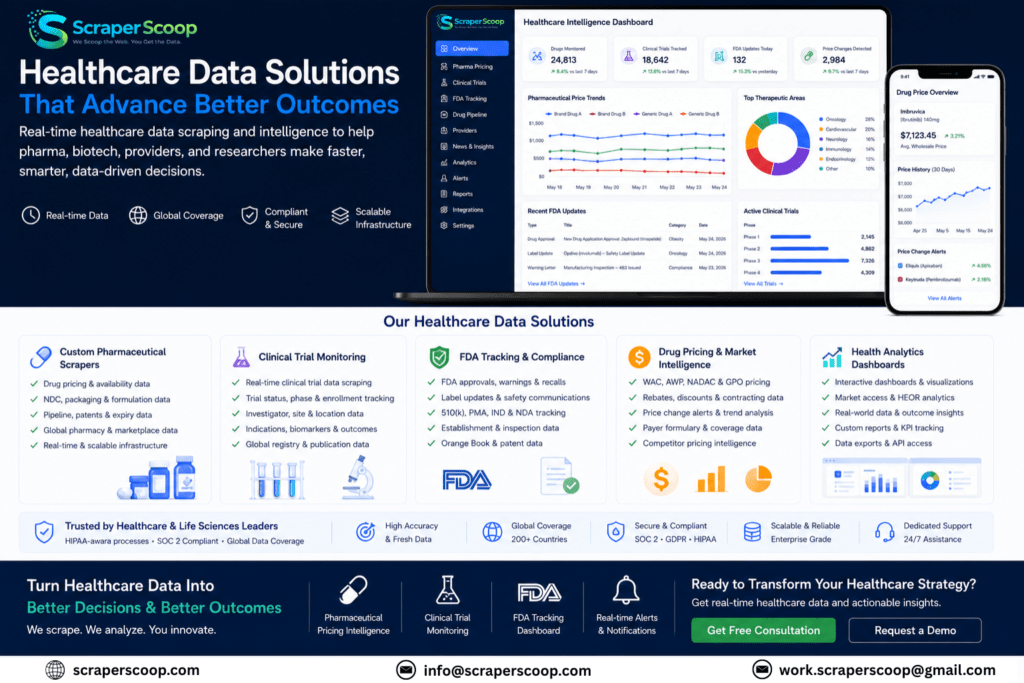
At ScraperScoop, we approach healthcare data scraping with the domain expertise, technical infrastructure, and compliance rigor that the healthcare industry’s unique intelligence requirements demand. We don’t adapt generic scraping solutions to healthcare use cases — we build healthcare-specific intelligence capabilities from the ground up.
Here is precisely what ScraperScoop delivers for healthcare industry clients:
- ✅ Drug Pricing Intelligence Solutions: Comprehensive competitive drug pricing monitoring across retail pharmacies, hospital formularies, PBM networks, government programs, and international reference pricing systems — delivering continuously updated pricing landscape intelligence that powers pharmaceutical commercial strategy, contracting preparation, and biosimilar/generic response planning.
- ✅ Clinical Trial Pipeline Monitoring: Systematic scraping and structured delivery of clinical trial registry data across ClinicalTrials.gov and international registries — with therapeutic area-specific filtering, competitor pipeline tracking, trial status change alerting, and trial design benchmarking capabilities that keep pharmaceutical competitive intelligence teams current with the full global development landscape.
- ✅ FDA & Regulatory Database Monitoring: Real-time monitoring of FDA drug and device approval databases, complete response letter announcements, safety communications, and label change notifications — with therapeutic area-specific alerting that ensures your commercial and regulatory teams never miss a material regulatory development in your competitive space.
- ✅ Medical Literature Intelligence: Automated PubMed and medical journal monitoring across defined therapeutic areas — tracking new publications, key opinion leader authorship patterns, citation network development, and emerging clinical evidence themes that inform medical affairs and competitive positioning strategy.
- ✅ Patient Review & Sentiment Data: Structured patient experience data scraped from major patient review platforms and health community sites — with medical domain NLP sentiment analysis that delivers real-world evidence insights about drug performance, treatment adherence, and patient quality-of-life impacts beyond what clinical trials capture.
- ✅ Hospital Quality Benchmarking Data: Systematically scraped and normalized CMS quality performance data across hospital, nursing facility, and home health care settings — enabling competitive quality benchmarking, operational performance assessment, and healthcare investment diligence at the scope and speed that manual data collection cannot approach.
- ✅ Digital Health Competitive Intelligence: App store performance monitoring, health tech competitor feature tracking, telemedicine platform analysis, and healthcare SaaS competitive landscape surveillance — keeping digital health companies and health tech investors current with the market’s rapid competitive evolution.
- ✅ Healthcare Provider Intelligence: Structured healthcare provider data from physician directories, hospital medical staff listings, specialty society databases, and clinical research investigator profiles — enabling pharmaceutical sales force targeting optimization, medical affairs KOL identification, and clinical trial site selection.
- ✅ Ready-Made Healthcare Datasets: Need healthcare market data immediately? Our pre-built pharmaceutical, clinical, and health market datasets give you instant access to validated, structured healthcare intelligence without development lead time.
- ✅ Healthcare Data APIs: Integrate our continuously updated healthcare intelligence feeds directly into your commercial operations systems, market access platforms, competitive intelligence dashboards, or health tech applications — with structured data delivered in the formats your workflow requires.
- ✅ Analytics Dashboards: Visual healthcare intelligence dashboards that surface the most commercially and clinically relevant patterns from scraped data — drug pricing position maps, clinical trial pipeline visualizations, FDA approval alert feeds, patient sentiment trend lines, and hospital quality benchmark charts your teams can act on immediately.
- ✅ PHI-Free, Compliance-First Operations: All ScraperScoop healthcare data collection is architected to exclude PHI systematically, operates within sustainable and respectful access parameters for all healthcare data sources, and includes full data provenance documentation supporting your organization’s healthcare data governance requirements.
Ready to Build Your Healthcare Data Intelligence Advantage? Let’s Talk
The global healthcare market is approaching USD 1 trillion by 2031. Drug pricing complexity is intensifying. Clinical development competition is accelerating. Digital health competition is multiplying. Regulatory monitoring requirements are expanding globally. And the decisions healthcare organizations make — about pricing, pipeline priorities, market access strategy, and competitive positioning — have never carried higher stakes.
In this environment, the pharmaceutical companies, health systems, health tech companies, and healthcare investors who operate with the most comprehensive, most current, and most precisely structured intelligence consistently make better decisions, respond faster to competitive developments, and capture market opportunities that competitors operating with inferior intelligence miss entirely.
ScraperScoop is the healthcare data intelligence partner that makes that advantage real and sustainable.
At ScraperScoop, we deliver:
- ✅ Drug Pricing Intelligence across retail, hospital, PBM, government, and international markets
- ✅ Clinical Trial Pipeline Monitoring across global registries and therapeutic areas
- ✅ FDA & Regulatory Database Tracking with real-time alerting
- ✅ Medical Literature Intelligence for KOL and evidence landscape monitoring
- ✅ Patient Review & Sentiment Data with medical domain NLP analysis
- ✅ Hospital Quality Benchmarking from CMS and public reporting systems
- ✅ Digital Health Competitive Intelligence for health tech companies and investors
- ✅ Ready-Made Healthcare Datasets for immediate deployment
- ✅ Healthcare Data APIs for seamless platform integration
- ✅ Analytics Dashboards with actionable health market visualizations
- ✅ PHI-Free, Compliance-First Operations with full data governance documentation
🏥 Let’s Build Your Healthcare Intelligence Operation — Starting Today
In healthcare, the cost of intelligence gaps is not just competitive — it’s clinical, commercial, and consequential in ways no other industry quite matches.
Contact ScraperScoop today for your free consultation → Tell us about your therapeutic areas, your competitive intelligence priorities, your market access challenges, and your data integration requirements — and we’ll design a custom healthcare data scraping solution built precisely for the intelligence outcomes your organization needs.
Conclusion: In 2026, Healthcare Intelligence Is a Clinical and Commercial Imperative
The healthcare industry in 2026 is operating at an intersection of unprecedented complexity — drug pricing under regulatory scrutiny, clinical development competition intensifying across every therapeutic area, digital health disrupting traditional care delivery models, and payer value assessment frameworks demanding ever more comprehensive evidence. The organizations navigating this complexity most successfully share one capability: they have better, faster, more comprehensive intelligence than their competitors — and they act on it systematically.
Healthcare and pharmaceutical data scraping is the infrastructure that makes that intelligence advantage real. From drug pricing monitoring that enables defensible commercial strategy, to clinical trial intelligence that powers business development and pipeline prioritization, to patient sentiment analysis that provides real-world evidence beyond controlled trial populations — the applications are strategically vital, the ROI is measurable, and the competitive disadvantage of operating without systematic healthcare intelligence capabilities grows with every passing quarter.
The technology is mature. The data sources are rich and continuously expanding. The domain expertise required to build and operate investment-grade healthcare intelligence systems is available through specialist partners. And the right partner — one who combines technical scraping infrastructure with healthcare domain knowledge and compliance-first operational standards — makes building this capability far faster and more reliable than any in-house development approach.
ScraperScoop is that partner. Accurate, structured, continuously updated healthcare and pharmaceutical data intelligence — built to the quality standards that healthcare decisions demand.
👉 Get in touch with ScraperScoop now — and let’s turn healthcare web data into your most powerful and sustainable competitive intelligence advantage.
Frequently Asked Questions About Healthcare & Pharma Data Scraping
What is healthcare data scraping?
Healthcare data scraping is the automated extraction of publicly available health, medical, and pharmaceutical information from websites, regulatory databases, clinical trial registries, medical literature platforms, hospital quality reporting systems, pharmacy pricing portals, and patient review platforms. This intelligence enables pharmaceutical companies, health systems, health tech companies, and healthcare investors to collect and analyze market data that would be impossible to gather manually at meaningful scale or speed.
Is healthcare data scraping legal and HIPAA compliant?
Healthcare data scraping of publicly available information — FDA approval databases, clinical trial registries, hospital quality scores, published medical literature, and public drug pricing data — is generally legal and does not implicate HIPAA when designed to exclude Protected Health Information (PHI). ScraperScoop implements PHI-avoidance at the technical architecture level for all healthcare data collection, ensuring collections target only publicly available health and pharmaceutical intelligence. Always consult legal counsel for your specific data use case and jurisdictional requirements.
How can pharmaceutical companies use drug pricing data scraping?
Pharmaceutical companies use automated drug pricing scraping to monitor competitor pricing across retail pharmacies, hospital formularies, PBM networks, government programs, and international reference pricing markets — building a comprehensive, continuously updated competitive pricing map that informs pricing strategy, formulary contracting preparation, biosimilar/generic entry response planning, and international launch sequencing decisions. This intelligence is foundational for defensible commercial pricing strategy in an environment of increasing pricing scrutiny and competition.
What can be learned from scraping ClinicalTrials.gov for pharmaceutical intelligence?
Systematic scraping of ClinicalTrials.gov and international clinical registries reveals competitor pipeline status across clinical stages, indication white spaces with underrepresented development investment, emerging combination therapy trends, trial design benchmarks being established by competitive programs, and early warning of competitive threats from clinical assets years before commercial launch. This intelligence supports business development targeting, pipeline prioritization, clinical strategy development, and long-range competitive planning for pharmaceutical and biotech companies.
How do health tech startups use competitive data scraping?
Health tech startups use web scraping to continuously monitor competitor app store ratings and review sentiment, track feature release announcements, analyze competitor pricing and subscription structures, detect partnership and integration launches, monitor clinical evidence generation activities, and benchmark their market positioning against the full competitive landscape. This intelligence supports product roadmap decisions, investor narrative development, partnership strategy, and go-to-market positioning in the rapidly evolving digital health market.
Can patient review data be scraped for pharmaceutical research?
Yes — patient reviews publicly posted on platforms like Drugs.com, WebMD, and Healthgrades can be systematically scraped and analyzed to extract real-world evidence about medication effectiveness, side effect profiles, treatment adherence patterns, and patient quality-of-life impacts that clinical trials don’t capture at equivalent scale. This patient experience intelligence supplements clinical trial data for pharmaceutical market access applications, drug development decision-making, and medical affairs strategy — with appropriate ethical standards applied to ensure responsible use of patient-shared health information.
What healthcare data sources can ScraperScoop collect from?
ScraperScoop collects from a comprehensive range of publicly available healthcare data sources including FDA drug and device databases, ClinicalTrials.gov and international clinical registries, CMS hospital and provider quality reporting systems, PubMed and medical literature databases, patient review platforms, pharmacy pricing portals, international health authority databases, hospital and physician directories, health insurance formulary systems, and digital health app stores. We handle the full technical complexity of each source’s unique architecture and deliver clean, structured, healthcare-domain-normalized datasets.
Why choose ScraperScoop for healthcare data scraping over general-purpose scraping services?
Healthcare data scraping requires specialized capabilities that general-purpose scraping services rarely provide: healthcare ontology knowledge for accurate medical data normalization, PHI avoidance architecture designed for HIPAA compliance, expertise in FDA and CMS database structures, medical NLP for patient sentiment analysis, and understanding of pharmaceutical industry intelligence requirements. ScraperScoop combines technical scraping infrastructure with healthcare domain expertise and compliance-first operational standards — delivering healthcare intelligence quality that generic scraping adaptations consistently fail to match. Contact us for a free consultation.


