

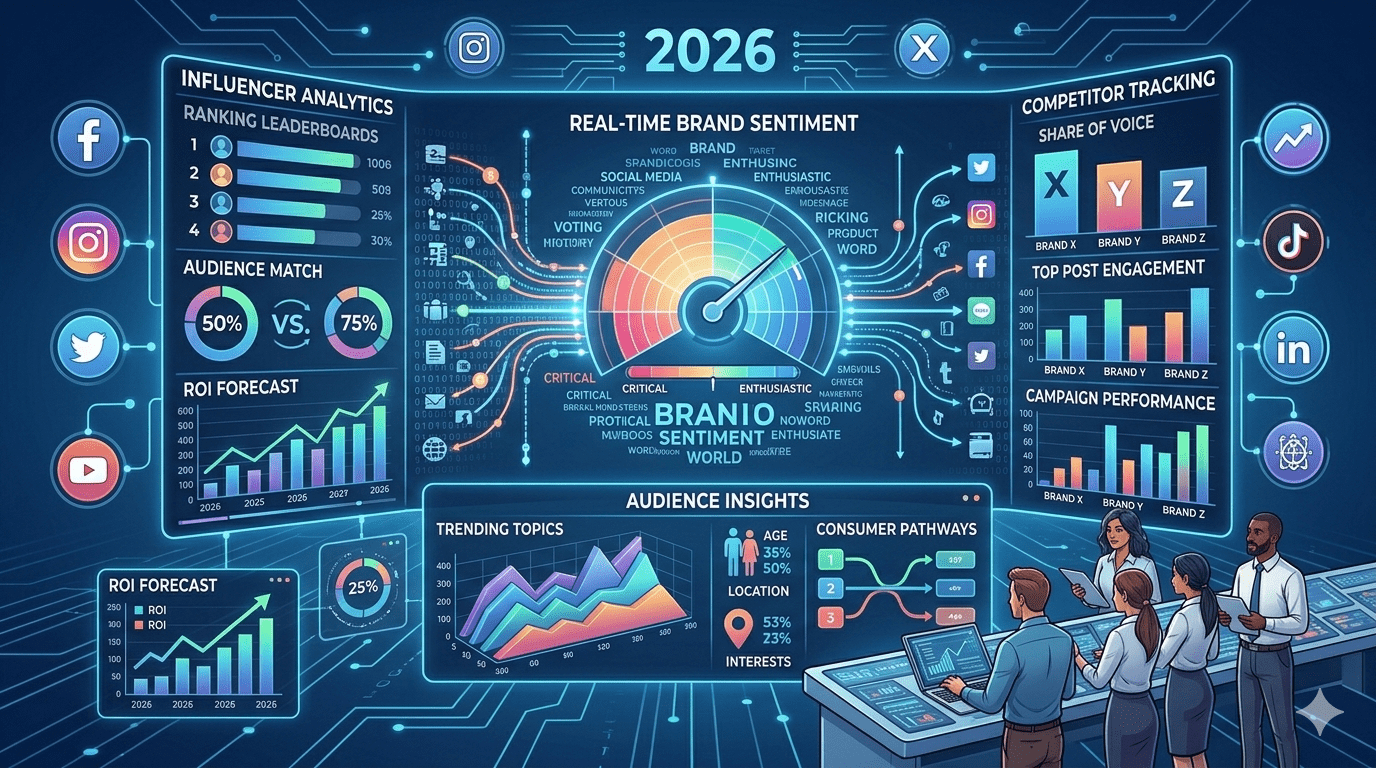
Introduction: Your Brand Lives on Social Media — But Are You Actually Listening?
Here’s a scenario that plays out every single week in marketing teams around the world: a brand launches a new product campaign with significant budget behind it — paid media, influencer partnerships, content creation, the works. Two weeks after launch, engagement metrics look decent on the surface. But buried in thousands of social media posts, comments, and community discussions, a specific product complaint is quietly gaining traction. A micro-influencer with 80,000 highly-engaged followers posts a critical review. Their audience amplifies it. Within 48 hours, the complaint is a trending conversation across three platforms.
The brand’s marketing team finds out on day four — from a junior analyst who happened to notice it while manually scrolling through mentions. By then, the negative narrative has already shaped how tens of thousands of potential customers perceive the product.
This is not a rare story. It happens to brands of every size, in every category, every single week. And the consistent differentiator between the brands that catch these moments in time to respond — or better yet, anticipate them before they escalate — and those that don’t is not team size or marketing budget. It is social media data intelligence.
The scale of the social media landscape in 2026 makes this intelligence challenge simultaneously more important and more impossible to address manually. There are now 5.42 billion social media users globally in 2026 — representing 66.2% of the world’s total population. These users collectively generate an incomprehensible volume of brand-relevant content every single day: product reviews, competitor comparisons, influencer recommendations, trend-driven purchase discussions, service complaints, brand advocacy posts, and viral content that can reshape brand perceptions overnight.
The brands, agencies, and growth companies winning in this environment are not the ones with the largest social media teams manually scrolling through feeds. They’re the ones who have built automated social media data scraping operations that continuously collect, structure, and analyze the social signals that matter most — and deliver actionable intelligence at the speed social media actually moves.
This guide covers everything you need to know about social media data scraping in 2026 — what data is available, who is using it, how the most sophisticated marketing organizations are deploying it to drive competitive advantage, and exactly how ScraperScoop can build the custom social media intelligence operation your brand or agency needs to dominate your market.
What Is Social Media Data Scraping and Why Does It Matter in 2026?
Social media data scraping is the automated process of extracting publicly available content, engagement metrics, profile data, trending topics, hashtag performance data, influencer information, and audience behavior signals from social media platforms and adjacent digital content ecosystems — including Instagram, TikTok, Twitter/X, YouTube, Facebook, LinkedIn, Pinterest, Reddit, and platform-specific community spaces.
In practical terms: rather than having a marketing analyst manually scrolling through social platforms and recording observations about competitor activity, influencer performance, or brand mention sentiment — a process that is both impossibly slow and deeply susceptible to human selection bias — automated social media scraping solutions collect all of that data continuously, at scale, across every platform that matters to your brand, and deliver it in structured, analysis-ready formats that support real-time decision-making.
Why Social Media Intelligence Has Become Non-Negotiable for Brands in 2026
The social media landscape in 2026 is not the same channel it was five years ago. It has evolved into the primary arena where brand perceptions are formed, purchase decisions are influenced, competitive battles are won and lost, and cultural trends emerge before they reach any other medium. Consider the dimensions of this transformation:
- Social commerce is mainstream and massive. Global social commerce sales are projected to reach USD 1.69 trillion in 2026 — a market that barely existed a decade ago and is now larger than many entire national retail sectors. TikTok Shop alone is expected to generate USD 23.41 billion in U.S. sales in 2026, a 48% year-over-year increase. For any brand selling consumer products, social platforms are no longer just marketing channels — they are direct revenue channels where data intelligence drives commercial performance.
- Influencer marketing has become a mainstream media channel. The influencer marketing industry is valued at USD 24 billion in 2024 and continues growing at double-digit rates. More than 89% of marketers who use influencer marketing plan to increase or maintain their investment. In this environment, making influencer partnership decisions without systematic performance data is an extraordinarily expensive way to learn.
- Brand sentiment shifts happen at social media speed. Viral moments — positive and negative — can reshape brand perceptions across millions of potential customers within hours. Brands without real-time social monitoring capabilities are effectively flying blind through a landscape where reputational turbulence is the norm rather than the exception.
- Competitor social strategy intelligence is increasingly valuable. The brands winning market share on social platforms are not necessarily the ones with the biggest budgets — they’re the ones who understand exactly what content formats, posting patterns, engagement strategies, and platform-specific approaches are generating results for competitors — and adapt those learnings faster than anyone else.
- Platform API restrictions have made scraping essential. Major social platforms have progressively restricted third-party API access over the past several years — reducing the data available through official channels and making web scraping the primary reliable method for obtaining comprehensive social intelligence at meaningful scale. For brands and agencies that depend on social data, professional scraping solutions have moved from an alternative to API access to the primary data collection approach.
These factors collectively explain why social media data scraping has moved from being an advanced capability used by the most data-sophisticated marketers to a baseline operational requirement for any brand or agency serious about competing effectively in the social-first marketing environment of 2026.
What Social Media Data Can You Actually Scrape? The Complete Intelligence Taxonomy
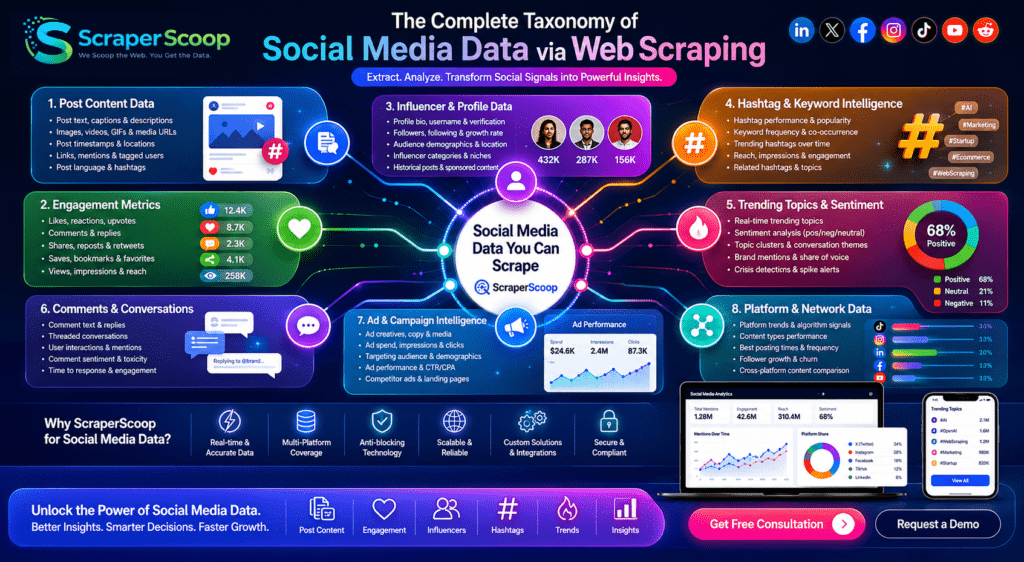
Social media platforms collectively generate an extraordinary breadth of publicly available data — far beyond the simple metrics that most marketing dashboards surface. Here’s the complete taxonomy of social intelligence accessible through automated scraping, and the specific business value each data type delivers.
1. Brand Mentions & Sentiment Data
Every time your brand name, product, or associated keywords appear in a public social media post, comment, review, or discussion, that mention is a brand intelligence data point. Systematic scraping of brand mentions across platforms — capturing the post content, author profile, engagement received, sentiment context, and conversational thread — creates a continuous, comprehensive stream of brand health intelligence that manual monitoring cannot approximate. When analyzed with NLP sentiment models, this data reveals brand sentiment trends over time, identifies specific topics or products generating positive or negative sentiment spikes, and surfaces emerging narrative patterns before they crystallize into mainstream perception.
2. Competitor Content & Strategy Data
Publicly visible competitor social media activity — post content, publishing frequency, format mix (image, video, carousel, Stories, Reels), engagement performance, hashtag strategy, caption style, call-to-action patterns, and audience response — provides a continuous intelligence stream about what social content strategies are generating results in your competitive space. Systematic scraping and analysis of competitor social content over time reveals which content themes drive the highest engagement, how competitors are adapting their strategy in response to platform algorithm changes, and what content innovations are creating competitive differentiation in the social feed.
3. Influencer Profile & Performance Data
Influencer intelligence data includes follower counts and growth trajectories, average engagement rates by content type, audience demographic signals, content niche and topic focus areas, brand partnership history, posting frequency patterns, comment quality and authenticity signals, and cross-platform presence. Systematic scraping of influencer profiles across platforms enables brands and agencies to identify genuinely high-performing creators in specific niches — moving beyond vanity metrics like raw follower counts to the engagement quality and audience relevance signals that actually predict partnership ROI.
4. Hashtag & Trending Topic Intelligence
Hashtag performance data — usage volume, growth trajectory, associated content quality, engagement rates for content using specific hashtags, and geographic distribution of usage — provides both content strategy intelligence and early trend detection capability. Monitoring trending hashtags and emerging topic clusters across platforms reveals consumer interest signals that are developing in real time — before they’re covered by mainstream media, before competitors have capitalized on them, and before the trend peaks into oversaturation. This early trend detection is increasingly one of the most commercially valuable applications of social media data scraping.
5. Post Engagement & Viral Content Signals
Like counts, comment volumes, share and repost rates, save rates, view counts for video content, and click-through rates on linked content collectively create engagement signal profiles that reveal what content is genuinely resonating with specific audiences. Systematic analysis of engagement patterns across large content datasets — both your own and competitors’ — builds empirical content performance models that replace intuition-based content strategy with evidence-based decisions about format, topic, timing, and creative approach.
6. Audience Demographic & Interest Data
Publicly available signals from social profiles — locations mentioned, interests expressed through followed accounts and engaged content, professional affiliations listed, demographic signals from profile information — collectively provide audience intelligence that supplements first-party data with a richer, more current picture of who your actual and potential customers are on social platforms. For brands entering new markets, launching products to new customer segments, or evaluating partnership opportunities, this audience intelligence is foundational for strategy development.
7. Social Commerce & Product Review Data
TikTok Shop product listings and reviews, Instagram Shopping tags and product page engagement, Pinterest product pins and purchase intent signals, and social commerce platform marketplace data collectively provide structured intelligence about social commerce performance — product ratings, review volumes, pricing on social channels, and the specific content formats that drive social commerce conversions. For brands selling through social commerce channels, this data provides the continuous competitive intelligence needed to optimize product listings, pricing, and content strategy for maximum social commerce performance.
8. Community Forum & Niche Platform Intelligence
Reddit communities, Quora discussions, Discord servers, Telegram groups, and specialized online forums collectively contain enormously rich consumer intelligence — in-depth product discussions, category education conversations, purchase decision reasoning, competitive comparisons, and genuine consumer concerns expressed in the absence of brand presence that shapes authentic community opinion. This long-form community discourse data provides a different quality of consumer intelligence than platform content — deeper, more considered, and often more revealing of genuine purchase drivers and category dynamics than the shorter-form content that dominates mainstream social platforms.
9. LinkedIn Professional & B2B Intelligence
For B2B brands and professional services companies, LinkedIn provides a uniquely valuable social intelligence layer: company page follower counts and growth, post engagement by content type and topic, employee advocacy patterns, job posting activity that signals organizational priorities, executive thought leadership content performance, and industry group discussion themes. Systematic LinkedIn intelligence scraping enables B2B marketers to understand how competitive brands are positioning through professional content, which thought leadership topics are generating the most professional community engagement, and where gaps exist in the current competitive content landscape that represent differentiation opportunities.
10. YouTube & Video Content Performance Data
YouTube video titles, descriptions, view counts, like ratios, comment sentiment, subscriber growth patterns, channel content strategy evolution, and video publishing frequency collectively provide intelligence about video content performance in specific categories. For brands investing in video content strategy, systematic analysis of what’s working on YouTube — and specifically on TikTok and Instagram Reels for shorter-form video — provides the empirical foundation for content investment decisions that maximize organic reach and audience engagement.
11. Social Listening Signals & Consumer Voice Data
Beyond brand-specific mentions, broader category conversations — discussions about product categories, consumer pain points, purchase consideration factors, and brand-independent topic communities — provide market research intelligence that rivals primary survey research in depth while far surpassing it in scale and authenticity. Consumers discussing their genuine experiences, frustrations, aspirations, and comparisons in organic social contexts reveal the real motivations and decision factors that curated research methodologies often fail to capture.
Key Social Media Platforms for Data Scraping: Where the Intelligence Lives in 2026
Understanding which platforms carry the most strategic intelligence value for your specific brand, category, and audience is foundational to building an effective social media data scraping strategy. Here’s the intelligence landscape across the major social platforms in 2026.
TikTok
TikTok has cemented its position as the defining platform of cultural trend creation in 2026. TikTok has approximately 1.69 billion monthly active users globally and is driving more product discovery conversations among Gen Z and Millennial consumers than any other platform. TikTok Shop’s explosive commercial growth makes it simultaneously a content intelligence platform and a direct commerce channel. For brands in consumer goods, fashion, beauty, food and beverage, and entertainment categories — and increasingly for B2C businesses of every type — TikTok content and trending topic intelligence is essential for staying ahead of viral moments that can drive thousands of purchase decisions within hours of emergence.
Instagram remains the dominant platform for visual brand building, influencer marketing, and aspirational consumer engagement across lifestyle, fashion, beauty, travel, food, and fitness categories. Instagram has over 2 billion monthly active users with particularly high purchase intent engagement in the 18-34 demographic. Instagram Reels continue to be the highest-organic-reach content format on the platform, while Instagram Shopping and product tag commerce features have created a significant social commerce layer. Influencer profile data, brand content performance analysis, and competitor strategy monitoring on Instagram provide intelligence that directly affects both organic social strategy and paid media efficiency.
Twitter/X
Twitter/X remains the most important platform for real-time brand conversation monitoring, crisis detection, and news-driven sentiment analysis. Despite evolving ownership and platform changes, it retains its primacy as the space where breaking brand news, customer service escalations, and public opinion formation happen fastest. For brand reputation monitoring, competitive announcement detection, and trending topic intelligence in categories with vocal online communities — technology, financial services, media, sports, and politics particularly — Twitter/X monitoring remains a non-negotiable component of comprehensive social intelligence.
YouTube
YouTube’s combination of search-driven discovery, long-form content engagement, and massive global reach — over 2.5 billion logged-in monthly users — makes it uniquely valuable for both brand sentiment intelligence and competitive content strategy analysis. YouTube comment sections provide particularly rich qualitative consumer intelligence — in-depth, considered consumer perspectives on products, brands, and categories expressed in response to video content. For categories where comparison content, tutorial videos, and product review channels drive significant purchase decisions — consumer electronics, automotive, software, home improvement — YouTube intelligence monitoring is strategically essential.
For B2B brands, professional services firms, SaaS companies, and any organization whose target audience is professionally active online, LinkedIn is the primary social intelligence platform. LinkedIn has over 1 billion members globally with particularly high engagement in technology, financial services, consulting, healthcare, and professional development categories. Company page analytics, executive thought leadership performance, job posting intelligence, and industry group discussion monitoring collectively provide B2B competitive intelligence that no other platform approaches in professional context and seniority signal quality.
Reddit’s community-based structure — with thousands of highly active subreddits covering virtually every product category, consumer interest, and professional domain — makes it one of the richest sources of authentic, unfiltered consumer intelligence available through social scraping. Reddit discussions are longer, more considered, and more honest than most social platform content — because community members are largely anonymous, genuinely helpful in spirit, and motivated by community contribution rather than personal brand building. For category insight research, purchase decision intelligence, and competitive product comparison analysis, Reddit community data is extraordinarily valuable.
Pinterest’s visual discovery and inspiration model makes it a uniquely powerful intelligence source for categories where aesthetic aspiration drives purchase intent — home decor, fashion, wedding planning, food and cooking, travel, and DIY. Pinterest has over 500 million monthly active users who are disproportionately in active purchase consideration mindsets. Trending pin data, board organization patterns, and product discovery behavior on Pinterest reveal emerging aesthetic trends and purchase intention signals weeks or months before they manifest in mainstream retail.
Despite shifting demographics, Facebook remains the world’s largest social network by monthly active users — over 3 billion monthly active users globally — with particularly strong engagement in the 35+ demographic and in international markets outside North America and Western Europe. Facebook Groups provide rich community discussion intelligence across consumer interest categories, while Facebook Marketplace data provides local consumer pricing and demand signals. For brands serving broader demographic profiles or strong international markets, Facebook intelligence monitoring remains strategically valuable.
10 High-Impact Social Media Data Scraping Use Cases Driving Marketing Performance in 2026
Understanding what data is available across platforms is the foundation. Understanding how the most sophisticated brands, agencies, and growth companies are actually deploying social intelligence to drive measurable marketing performance is where the practical value lives.
1. Real-Time Brand Sentiment Monitoring & Reputation Management
Brand sentiment monitoring is the most foundational social media intelligence application — and the one with the highest downside risk if it’s absent. Systematic scraping of brand mentions across all relevant platforms provides a continuous, comprehensive view of how consumers are discussing, evaluating, and experiencing your brand in real time. When analyzed with NLP sentiment models, this data reveals not just overall sentiment direction but the specific topics, products, and experiences generating sentiment movements — enabling PR and marketing teams to respond to emerging issues at social media speed rather than days after the fact.
The crisis prevention value alone justifies the investment. Brands that detect negative sentiment spikes within hours of emergence — rather than days later when media coverage has already amplified the issue — consistently manage reputational challenges at lower cost, with faster resolution, and with less lasting brand equity damage than those operating without real-time social monitoring capabilities.
2. Influencer Discovery & Performance Intelligence
The influencer marketing industry’s growth to USD 24 billion globally is creating an enormous intelligence challenge: with millions of creators across platforms, identifying the specific individuals whose audience genuinely aligns with your brand and whose engagement quality predicts partnership ROI requires systematic data analysis at a scale that manual influencer scouting cannot approach. Social media scraping enables brands and agencies to build comprehensive influencer databases — filtered by niche, audience size tier, engagement rate quality, content authenticity signals, audience demographic alignment, brand safety indicators, and historical partnership performance — that replace gut-instinct influencer selection with data-driven partnership decisions.
The ROI difference between data-driven and intuition-based influencer selection is documented and significant. Brands using systematic influencer performance data consistently report better campaign performance, lower cost per engagement, and higher conversion rates from influencer-driven traffic than those relying on follower count and aesthetic fit as primary selection criteria.
3. Competitor Social Strategy Intelligence
Understanding exactly what your competitors are doing on social media — what content they’re publishing, which formats are generating their best engagement, how their audience is responding, when they’re posting, and how their social strategy is evolving over time — provides actionable intelligence for positioning your own social strategy for competitive differentiation. Systematic competitor content scraping across platforms builds a continuously updated competitive social intelligence picture that reveals gaps in competitor content coverage, format opportunities your competitors haven’t exploited, audience engagement themes that are resonating in your category, and platform-specific strategic shifts that signal where your competition is investing.
4. Viral Trend Detection & Content Opportunity Intelligence
The brands consistently winning on social platforms in 2026 are not the ones with the biggest production budgets — they’re the ones who spot emerging trends earliest and publish relevant content while the trend is still building rather than after it peaks. Systematic monitoring of trending hashtags, viral content patterns, emerging audio trends on TikTok and Reels, and early-signal content clusters across platforms creates a continuous trend detection capability that gives content teams a critical timing advantage. Scraping trending topic data at scale enables algorithmic detection of emerging trends across thousands of content signals simultaneously — surfacing opportunities that manual social browsing would miss entirely in the noise.
5. Social Commerce Performance & Product Intelligence
For brands selling through TikTok Shop, Instagram Shopping, Pinterest Shopping, and other social commerce channels, continuous scraping of social commerce platform data — product ratings, review volumes, pricing by competitor, content formats driving the highest purchase conversions, and creator-product combination performance — provides the intelligence needed to optimize every dimension of social commerce strategy. Understanding which products are winning on social commerce channels, which content styles drive conversions most effectively, and how competitor pricing on social channels compares to your own is commercially essential in a market where social commerce is growing at over 30% annually.
6. Audience Research & Consumer Insight Mining
Social media platforms contain an enormous volume of authentic, unfiltered consumer intelligence — product category discussions, brand comparisons, purchase decision reasoning, and consumer experience sharing that primary research methodologies can rarely replicate at equivalent authenticity. Systematic scraping of category-relevant social conversations, Reddit community discussions, and product review content enables brands to conduct always-on consumer insight research that supplements traditional market research with real-time, naturally-occurring consumer intelligence. The questions your target customers are asking, the comparisons they’re making, the frustrations they’re expressing — all of this is visible in social data for brands willing to collect and analyze it systematically.
7. Social Media Campaign Performance Benchmarking
How does your brand’s content performance on Instagram compare to category benchmarks? What engagement rate is genuinely competitive for your brand’s follower tier on TikTok? What’s the typical video view rate for brand content in your category on YouTube? Without systematic competitive content performance data, answering these questions requires expensive primary research or uncomfortable reliance on platform-provided benchmarks that don’t reflect your specific competitive context. Scraping competitor content performance data across platforms builds category-specific benchmarks that give marketing teams genuine performance context for evaluating their own results.
8. Creator Economy & Emerging Talent Intelligence
The creator economy is evolving rapidly — new platform features, content format innovations, and audience behavior shifts continuously create new categories of influential creators whose audiences haven’t yet been saturated by brand partnerships. Systematically monitoring creator growth trajectories, engagement quality trends, and content niche emergence across platforms enables brands and talent agencies to identify high-potential creators before their partnership costs reflect their audience value — creating early-mover partnership advantages that dramatically improve influencer marketing ROI compared to competing for partnerships with already-expensive, already-saturated creators.
9. Cross-Platform Brand Health Dashboard Intelligence
Brand health — the comprehensive picture of how your brand is perceived, discussed, and experienced across the full social media ecosystem — cannot be accurately assessed from any single platform’s data alone. Different audiences, different content behaviors, and different community cultures across platforms collectively create a multi-dimensional brand health picture that only cross-platform data aggregation reveals. Systematic scraping across all relevant platforms and aggregating intelligence into unified brand health dashboards provides the complete, continuously updated brand perception view that single-platform monitoring systematically misses.
10. Market Research & Consumer Trends Intelligence
Beyond brand-specific applications, social media data scraping enables genuinely powerful category-level market research — tracking how consumer conversations about product categories, lifestyle topics, and purchase decisions are evolving over time. Longitudinal social data analysis reveals category growth and decline trajectories, shifting consumer value priorities, emerging demographic interest patterns, and geographic market development signals that traditional market research captures too slowly and too expensively to support agile strategic decision-making. For product development teams, marketing strategists, and business development professionals, this social market intelligence represents one of the most current, most accessible, and most authentic sources of consumer insight available.
Influencer Analytics: How Data Scraping Transforms Influencer Marketing from Guesswork to Science
In a market where influencer marketing spend globally exceeds USD 24 billion and brands are allocating larger shares of their marketing investment to creator partnerships every year, making influencer decisions without systematic performance data is no longer commercially acceptable. Here’s how systematic social media scraping transforms influencer marketing from creative intuition to data-driven science.
Beyond Follower Count: What Actually Predicts Influencer ROI
The influencer marketing industry spent years learning the hard way that follower count is a weak predictor of partnership ROI. Fake followers, engagement pods, inflated vanity metrics, and audience demographic misalignment have cost brands billions in ineffective influencer spend. The metrics that actually predict influencer partnership performance — systematically collected through social media scraping — are far more nuanced:
- True engagement rate: The ratio of genuine interactions (likes, comments, saves, shares) to reach — not to follower count, which can be inflated. A micro-influencer with 50,000 followers and a 6% engagement rate consistently outperforms a macro-influencer with 1 million followers and a 0.8% engagement rate for most campaign objectives.
- Comment quality signals: The proportion of substantive comments versus single-emoji or generic comments is a powerful authenticity indicator. Genuine community engagement looks fundamentally different in comment sections from engagement pod activity — and NLP analysis of scraped comment data can detect this distinction systematically across thousands of profiles.
- Audience demographic alignment: Public-facing profile data, geographic indicators in post content and comments, and age/interest signals from follower engagement patterns collectively provide proxy audience demographic intelligence that predicts how well a creator’s audience matches your target customer profile.
- Content consistency and brand safety: Historical content analysis across a creator’s full posting history reveals the consistency of their niche focus, the presence of content that may create brand safety risks, and the stability of their engagement performance over time — all essential inputs for partnership risk assessment.
- Partnership history performance: Past sponsored content performance — the engagement generated by previous branded posts compared to organic content performance — is the single most reliable predictor of future partnership performance, and it’s visible through systematic scraping of historically labeled sponsored posts.
Micro and Nano Influencer Intelligence
The influencer marketing landscape has shifted significantly toward micro-influencers (10K-100K followers) and nano-influencers (1K-10K followers), who consistently deliver higher engagement rates, more authentic audience relationships, and more cost-effective partnership economics than macro and celebrity tier creators. Systematically identifying high-quality micro and nano creators across specific niches — using scraped engagement quality metrics and audience alignment signals rather than follower count proxies — enables brands to build scaled influencer programs that reach highly targeted audiences with genuine influence at a fraction of the cost of fewer, larger partnerships.
Campaign Performance Measurement Intelligence
For ongoing influencer programs, scraping campaign post performance data — reach, engagement, sentiment in comments, hashtag adoption by audience, and cross-platform amplification — provides continuous campaign performance intelligence that enables in-flight optimization rather than post-campaign-only evaluation. Brands that can detect underperforming partnerships early and reallocate budget to better-performing creators consistently improve overall program efficiency compared to those measuring performance only after campaign completion.
Brand Sentiment Monitoring: The Social Intelligence Capability Every Brand Needs Right Now
If there is one social media intelligence capability that delivers the most immediate, most universal value across every category of brand and business — it is automated brand sentiment monitoring. Here’s why it matters so fundamentally and how systematic social scraping makes it possible at the scale and speed that social media demands.
The Speed Problem That Manual Monitoring Cannot Solve
Social media operates at a speed that fundamentally outpaces any manual monitoring approach. A brand mention cascade can begin on a single platform post and amplify across multiple platforms within hours — and the window for effective early response closes rapidly as the narrative builds momentum. Manual monitoring approaches — even with large, dedicated social media teams — cannot achieve the coverage, speed, or consistency of automated sentiment monitoring at the scale that modern social media brand exposure demands.
Automated social scraping solves this problem by operating continuously across all platforms simultaneously — detecting sentiment shifts in near real time, alerting brand teams to developing issues within minutes of their emergence, and providing the contextual intelligence — which posts, which creator, which specific topic — that enables rapid, targeted response rather than broad reactive communications that often amplify rather than resolve issues.
NLP-Powered Sentiment Intelligence
Not all brand mentions are equal in commercial significance. A high-volume of neutral mentions may be less strategically significant than a smaller volume of deeply negative mentions from high-influence accounts. An emerging pattern of specific product complaints in a small number of posts may be more operationally urgent than a broad positive sentiment spike from a viral moment. NLP analysis of scraped mention data enables automatic classification of mentions by sentiment intensity, commercial significance, topic category, and urgency level — ensuring that brand teams are alerted to the issues that matter most rather than drowning in raw mention volumes that obscure the signal in noise.
Competitive Sentiment Benchmarking
Brand sentiment only means something in competitive context. A net positive sentiment score of 72% might look strong in isolation — but if every competitor in your category is running at 85%+, it signals a brand health gap that is actively costing you customers and market share. Systematic competitor sentiment monitoring — collecting and analyzing brand mentions for your entire competitive set alongside your own brand — builds the comparative brand health intelligence that gives your sentiment scores meaningful strategic context.
Social Commerce Intelligence: The Data Edge in a USD 1.69 Trillion Market
Social commerce is not a future trend — it’s a present commercial reality of extraordinary scale. Global social commerce sales are projected to reach USD 1.69 trillion in 2026, with the United States, China, and Southeast Asia driving the majority of growth. For brands selling direct-to-consumer through social commerce channels, data intelligence is the difference between capturing this massive market opportunity and watching competitors take it.
TikTok Shop Intelligence
TikTok Shop’s explosive growth — USD 23.41 billion in projected U.S. sales in 2026, making it larger than Target’s eCommerce operation — has created an entirely new competitive intelligence landscape that most brands are still figuring out how to monitor effectively. Key intelligence dimensions for TikTok Shop include: competitor product listing performance (rating volumes, review sentiment, pricing positioning), creator-product affiliate performance by product category and creator tier, trending product discovery content characteristics that correlate with viral sales events, and pricing dynamics on the platform that may differ significantly from the same brand’s other eCommerce channels.
Brands that are systematically monitoring TikTok Shop competitive intelligence are identifying the product categories, price points, content formats, and creator partnership profiles that drive commercial success on the platform weeks ahead of those relying on organic platform discovery for competitive awareness.
Product Review & Rating Intelligence on Social Commerce
Social commerce platforms combine content discovery with purchase and review in tightly integrated loops — where product reviews directly influence the organic discovery algorithm that determines which products get shown to potential buyers. Monitoring competitor product rating trends, review volume velocities, and sentiment patterns on social commerce platforms provides early warning of competitive product quality issues and identifies the specific product features and attributes that social commerce buyers value most — intelligence that directly informs product development, marketing messaging, and listing optimization decisions.
Live Commerce & Real-Time Sales Event Intelligence
Live shopping events — where creators and brands sell products in real-time livestream broadcasts — have become a significant commerce channel in Asia and are growing rapidly in Western markets. Monitoring competitor live commerce activity, creator-brand partnership announcements, and live event performance signals provides intelligence about how competitors are approaching this channel — and creates opportunity to identify successful formats, creator profiles, and product presentations that can be adapted for your own live commerce strategy.
Social Media Data Scraping Technical Challenges — Why Professional Services Deliver Superior Results
Social media platforms present some of the most technically challenging web scraping environments that exist — combining sophisticated bot detection, constantly evolving platform architectures, API restriction policies, and real-time data freshness requirements in ways that make reliable, large-scale social data collection genuinely difficult. Here’s what makes it hard — and how professional solutions address each challenge.
Challenge 1: Sophisticated Anti-Bot Systems
Major social media platforms deploy some of the most advanced bot detection and automated access prevention systems available — including behavioral fingerprinting, device and browser environment validation, interaction pattern analysis, and machine learning-powered anomaly detection specifically designed to identify non-human browsing patterns. These systems have evolved significantly as platforms have recognized and responded to automated data collection at scale. Professional scraping infrastructure addresses these challenges through browser environment simulation, realistic behavioral patterns, intelligent request pacing, and continuous adaptation to evolving platform defenses — capabilities that DIY scraping approaches rarely maintain reliably over time.
Challenge 2: Platform API Restrictions and Rate Limiting
Social media platforms have progressively restricted API access over the past several years — reducing data availability, increasing API costs, and imposing strict rate limits that prevent comprehensive data collection through official channels. Meta has significantly restricted its Graph API data access. Twitter/X has implemented paid API tiers that make comprehensive data collection expensive for many use cases. This API restriction trend has made web scraping the primary reliable approach for comprehensive social data collection — but it also means that maintaining reliable scraping access requires ongoing technical adaptation as platforms evolve their access control architectures.
Challenge 3: Dynamic JavaScript and Single-Page App Architecture
Modern social media platforms are built as sophisticated single-page applications that load content dynamically through JavaScript, implement infinite scroll interfaces, lazy-load images and engagement metrics, and manage complex session states that traditional HTTP-based scraping cannot navigate. Accessing comprehensive social data requires headless browser automation that renders the full application environment — including infinite scroll content loading, dynamic engagement metric updates, and session-authenticated content visibility — exactly as a real user’s browser does.
Challenge 4: Login-Required Content and Authentication Walls
An increasing proportion of social media content is only visible to logged-in users — limiting what can be accessed through anonymous scraping and requiring sophisticated session management to access the full range of publicly relevant social data. Navigating authentication requirements at scale, maintaining session validity across large-volume collection operations, and managing the account risk associated with automated authenticated access requires specialized infrastructure that most in-house teams cannot sustainably maintain.
Challenge 5: Real-Time Data Freshness Requirements
Many social media intelligence applications — brand crisis monitoring, trending topic detection, viral content tracking, live commerce monitoring — require data that is fresh within minutes, not hours. Building the real-time data collection and delivery infrastructure needed for genuinely timely social intelligence requires dedicated engineering investment and operational infrastructure that is expensive to build and maintain for organizations whose core business is not data infrastructure.
Challenge 6: Data Volume, Processing, and Storage at Scale
Social media generates data at a volume that rapidly overwhelms basic data infrastructure. A comprehensive brand monitoring operation covering major platforms for a single brand in an active category might generate hundreds of thousands of data points per day — all of which require collection, storage, normalization, NLP processing, and delivery to intelligence dashboards in time to be actionable. The data engineering complexity of social intelligence at meaningful scale is significant — and is a primary reason why specialist managed social data services consistently outperform in-house approaches for organizations without dedicated data engineering teams.
These technical realities explain why the most sophisticated brands, agencies, and growth companies are working with specialist managed social data providers rather than attempting to build and maintain complex social scraping infrastructure in-house. Talk to ScraperScoop’s social intelligence specialists today — we’ve built the infrastructure, solved the technical challenges, and deliver comprehensive social data that your marketing team can immediately act on.
Legal, Ethical & Platform Policy Considerations for Social Media Data Scraping
Social media data scraping operates in a complex legal and policy landscape that requires careful navigation. Here’s what brands, agencies, and data users need to understand about the compliance environment.
Public Content and the Right to Scrape
The fundamental legal principle underlying social media data scraping is that publicly visible content — posts, profiles, engagement metrics, and hashtag data that any unregistered visitor can see without authentication — occupies categorically different legal territory from private user data. The landmark hiQ v. LinkedIn court case established important precedent that web scraping of publicly available data is generally protected under U.S. law — a principle that has shaped the legal framework within which professional social data collection operates.
However, the legal landscape continues evolving, and the specifics of what constitutes public content versus protected personal data vary by jurisdiction and platform, making compliance-first design and ongoing legal monitoring essential for any professional social media data operation.
GDPR and Personal Data in Social Scraping
GDPR treats personal information — including social media profile data that can identify specific individuals — as protected personal data requiring legal basis for collection and processing. Social media scraping operations targeting European users must implement data minimization practices, collect only what is necessary for the specific analytical purpose, and apply appropriate pseudonymization or anonymization to individual-level data before use in analytics applications. Aggregate analysis of social trends, sentiment patterns, and content performance — rather than individual-level tracking — generally represents the appropriate privacy-protective approach for social intelligence applications.
Platform Terms of Service Navigation
Major social platforms explicitly address automated data collection in their terms of service with varying degrees of restriction. Responsible social data scraping operates within the spirit of these terms — collecting publicly visible data at sustainable request rates, not circumventing technical access controls, not collecting data that platforms have restricted through authentication walls, and not using collected data for purposes that violate the reasonable expectations of the platform community. This responsible approach is both ethically sound and practically important — maintaining sustainable, long-term access to social intelligence sources without creating the platform relationship risks that aggressive, terms-violating approaches generate.
Ethical Use of Social Data
Social media users share content with varying expectations about how their posts will be used beyond their immediate audience. Ethical social data collection respects these reasonable expectations by using scraped data for aggregate intelligence purposes rather than individual surveillance, implementing re-identification risk assessment before using social profile data in commercial applications, not collecting content from accounts that have set private visibility settings, and applying responsible data retention standards that don’t maintain individual-level social activity records beyond what’s necessary for legitimate analytical purposes.
At ScraperScoop, compliance is embedded in every aspect of our social media data collection operations. We collect exclusively publicly visible social content, implement privacy-protective data handling practices, operate within sustainable platform access parameters, and support clients in understanding their own compliance obligations for social data use.
How AI Is Transforming Social Media Data Scraping and Brand Intelligence in 2026
The convergence of AI with social media data collection and analysis is delivering capabilities that are fundamentally changing what brands can know about their social media environment — and how quickly they can act on that knowledge. Here’s how artificial intelligence is reshaping social media intelligence in 2026.
Advanced NLP for Nuanced Sentiment Analysis
Consumer language on social media is complex — full of sarcasm, slang, cultural references, irony, and context-dependent meaning that generic sentiment models systematically misclassify. Modern social media NLP models trained on massive consumer language datasets detect these nuances with significantly greater accuracy — understanding that “I can’t even” can be either very positive or very negative depending on context, that “interesting” in a review is often negative, and that emerging slang terms carry sentiment loading that outdated lexicons miss entirely. This linguistic sophistication directly improves the quality of brand sentiment signals extracted from scraped social data.
Computer Vision for Visual Content Intelligence
A significant and growing proportion of brand-relevant social media content is purely visual — images and videos that contain brand logos, products, colors, and visual identity elements without any text mention of the brand name. Traditional text-scraping approaches miss this visual brand exposure entirely. Computer vision AI applied to scraped image and video content automatically detects brand logos, product appearances, and visual identity elements in social media posts — creating a comprehensive brand exposure tracking capability that captures the full extent of social brand visibility beyond text mentions.
Predictive Trend Detection
Machine learning models trained on historical viral content patterns can identify the early structural signals of content that is likely to go viral — the combination of topic novelty, creator characteristics, content format elements, and timing factors that have historically preceded viral amplification events. Applied to continuously scraped social data, these predictive models give brands and content teams advance notice of emerging trends before they peak — creating the timing advantage that separates brands that lead trends from those that follow them belatedly into oversaturation.
Automated Influencer Authenticity Scoring
AI models that analyze follower growth patterns, engagement rate consistency, comment quality distributions, follower-to-following ratios, and posting pattern characteristics can automatically score influencer account authenticity at scale — identifying fake follower inflation, engagement pod activity, and other forms of metric manipulation that brand safety and partnership ROI require detecting before investment decisions are made. This automated authenticity scoring enables brands and agencies to screen thousands of potential influencer partners systematically without requiring manual investigation of each account.
Real-Time Crisis Detection and Automated Alerting
AI-powered anomaly detection applied to scraped brand sentiment data automatically identifies statistically significant negative sentiment spikes — distinguishing routine mention volume fluctuations from genuine developing crises that require immediate response — and triggers automated alerting protocols that reach the right stakeholders within minutes of detection. This automated crisis detection replaces the manual monitoring dependency that created dangerous response lag times in social media crisis situations, providing brands with the earliest possible warning of developing reputation threats.
Generative AI for Content Strategy Optimization
Combining scraped competitor content performance data and audience engagement patterns with generative AI enables automated content strategy recommendations — identifying the content topics, formats, and creative approaches most likely to outperform for specific brand audiences based on empirical evidence from the competitive content landscape. This moves content strategy from creative intuition to data-informed creative decisions that consistently outperform intuition-only approaches across key performance metrics.
The Proven ROI of Social Media Data Scraping: Where the Value Gets Created
Influencer Marketing Efficiency
Brands using data-driven influencer selection consistently report significant improvements in campaign performance metrics compared to intuition-based approaches. When influencer partnerships are selected based on genuine engagement quality, audience demographic alignment, and historical sponsored content performance — all derived from systematic social data scraping — cost per engagement, cost per acquisition from influencer-driven traffic, and overall influencer program ROI all improve substantially. In a market where influencer marketing represents a significant and growing budget allocation for most consumer brands, these efficiency improvements represent direct, measurable revenue impact.
Brand Crisis Prevention and Early Response Value
The financial value of brand crisis prevention is notoriously difficult to quantify precisely — but the cost of brand crises that are detected late is extensively documented across case studies spanning every consumer category. Brands that detect developing negative sentiment in time to respond before media amplification consistently manage reputational issues at dramatically lower cost, with faster resolution, and with less lasting brand equity damage than those without real-time monitoring capabilities. For most established consumer brands, the brand equity protection value of systematic social sentiment monitoring represents one of the highest ROI investments in their entire marketing technology stack.
Content Strategy Performance Optimization
Brands that use systematic competitor content performance data to inform their own content strategy decisions consistently outperform those relying on intuition and internal performance data alone — because competitive benchmarking surfaces the full range of content approaches generating results in their category, not just those they’ve already tried themselves. Higher organic reach rates, improved engagement metrics, and better conversion rates from social content — all derived from evidence-based content strategy decisions informed by scraped competitive performance data — translate directly to reduced paid media dependency and improved overall social marketing efficiency.
Social Commerce Revenue Optimization
For brands competing in social commerce channels, systematic competitive intelligence about product pricing, listing optimization, creator partnership performance, and content-to-conversion patterns provides the continuous optimization intelligence that drives measurable revenue improvements. Brands with systematic TikTok Shop and Instagram Shopping competitive intelligence consistently identify pricing and content opportunities that competitors without this intelligence miss — translating data advantage into direct social commerce revenue superiority.
Market Research Cost Reduction
Social media data scraping provides continuous, always-on market research intelligence at a cost that traditional primary research cannot approach — replacing expensive, time-consuming surveys and focus groups for many market research applications with richer, more current, more authentic social data that updates continuously rather than at survey cadence. Organizations that integrate social intelligence into their market research frameworks consistently reduce primary research costs while improving the currency and authenticity of the consumer insights that inform strategic and product decisions.
Social Media Data Scraping Best Practices: Building an Intelligence Operation That Delivers
1. Define Specific Intelligence Objectives Before Designing Collection
The most effective social media intelligence operations are built around specific, high-value decisions they’re designed to inform — not around collecting everything that’s technically available. Before designing your collection strategy, define precisely: what brand decisions need better social data? Which competitor social strategies most need monitoring? Which influencer evaluation processes most need data improvement? Which market research questions most need social intelligence answers? This objective clarity ensures every collection investment traces directly to marketing and business decisions that genuinely benefit from better social data.
2. Build Cross-Platform Coverage from Day One
Social media brand presence and conversation is multi-platform — and the platforms where different audience segments discuss your brand, your competitors, and your category vary significantly by demographic, content type, and community culture. Single-platform monitoring provides a dangerously incomplete picture. Build your social intelligence architecture to cover all platforms relevant to your brand’s audience distribution and competitive landscape from the beginning — accepting the complexity this requires in exchange for the analytical completeness it delivers.
3. Prioritize Data Quality and NLP Model Accuracy
Social intelligence is only as valuable as the accuracy of its underlying sentiment and content analysis. Invest in NLP model quality — using domain-specific models trained on consumer language in your specific category rather than generic sentiment tools that systematically misclassify the nuanced language patterns of social media communication. The quality of insights derived from social data is directly constrained by the analytical quality applied to it — garbage NLP produces garbage brand insights regardless of how comprehensive the underlying data collection is.
4. Match Data Freshness to Use Case Requirements
Different social intelligence applications have fundamentally different freshness requirements. Brand crisis monitoring requires near-real-time data collection and alerting. Influencer performance analysis may only require weekly data refreshes. Competitive content strategy analysis might be meaningful on a monthly cadence. Audience trend research can be conducted at quarterly intervals. Match your collection frequency to the actual decision speed of each intelligence use case — controlling infrastructure costs by collecting high-frequency data only where timely intelligence genuinely changes decisions.
5. Integrate Intelligence Directly into Marketing Workflows
Social intelligence that lives in isolated data files or periodic reports rarely drives consistent marketing action. Integrate scraped social data directly into the decision workflows where it’s most valuable — content planning calendars, influencer partnership evaluation processes, brand health review meetings, competitive strategy planning cycles, and real-time monitoring dashboards that surface actionable alerts to the right team members at the moment they can act on them. The operational value of social intelligence is fully realized only when it’s embedded in the marketing processes it’s designed to improve.
6. Implement Responsible Data Governance Standards
Social media data governance — covering collection scope limitations, individual data minimization practices, GDPR compliance for European audience data, retention period standards, and third-party data sharing policies — is increasingly a formal operational requirement for marketing organizations, not an optional best practice. Implement data governance standards from the beginning of your social intelligence operation rather than retrofitting them after collection is underway — the compliance infrastructure is significantly easier to build into initial design than to impose on existing operations.
7. Partner with Specialists for Scale, Speed, and Compliance
Building and maintaining social media scraping infrastructure capable of delivering comprehensive, real-time brand intelligence across multiple platforms requires continuous engineering investment that competes with core marketing and product priorities for scarce organizational resources. For most brands and agencies, partnering with a specialist managed social data provider — one who has already built and optimized the technical infrastructure, NLP analytical pipelines, and compliance frameworks — delivers better intelligence at lower total cost than in-house development. Partnering with ScraperScoop gives your team access to professional-grade social data infrastructure without the engineering overhead of building it yourself.
The Future of Social Media Data Scraping: Trends Shaping Intelligence in 2026 and Beyond
Multimodal AI for Comprehensive Content Understanding
The next generation of social media intelligence goes beyond text NLP to genuinely multimodal content understanding — analyzing the combined signals of text, image, video, audio, and context simultaneously to extract intelligence that any single modality analysis misses. For brands, multimodal AI applied to scraped social content provides a richer, more accurate picture of how their brand, products, and competitors are being represented and discussed — capturing the full complexity of social media communication rather than the text-only fragment that previous generation tools analyzed.
Augmented Reality & Spatial Social Signals
As augmented reality features become increasingly mainstream across social platforms — AR try-on for fashion and beauty, spatial social experiences on mixed-reality devices, location-anchored AR social content — new categories of social intelligence signals are emerging. AR product try-on engagement rates, spatial social content brand integration patterns, and location-anchored social content brand association data will become increasingly valuable intelligence dimensions for brands investing in immersive social experiences.
Predictive Social Commerce Intelligence
Machine learning models trained on historical social commerce performance data — the combination of content signals, creator characteristics, product attributes, and timing factors that have preceded viral social commerce sales events — are developing predictive capabilities that give brands advance notice of social commerce opportunities before they fully materialize. This shifts social commerce strategy from reactive trend-chasing to proactive opportunity positioning — a fundamental competitive advantage in a market where first-mover timing consistently captures the majority of viral commerce value.
Creator Economy Forecasting
As the creator economy matures and institutional investment in creator partnerships increases, predictive intelligence about creator trajectory — which emerging creators are most likely to achieve significant audience growth, which niches are approaching saturation, and which platform format innovations will create new creator category opportunities — becomes increasingly commercially valuable. Social data scraping combined with ML growth prediction models provides early-signal creator trajectory intelligence that transforms talent identification from art to science.
Real-Time Social Intelligence Streaming
The evolution of social intelligence is from periodic reports to continuous streaming intelligence — where scraped social data is processed, analyzed, and delivered to marketing decision-makers in near real-time rather than through scheduled report delivery. This streaming intelligence model enables the kind of always-on brand monitoring, real-time content opportunity detection, and instantaneous crisis response that social media’s pace genuinely demands — and represents the direction of travel for the most sophisticated social intelligence operations as data engineering costs continue to decline.
How ScraperScoop Powers Social Media Intelligence for Brands, Agencies & Growth Companies
At ScraperScoop, we believe that every brand — from ambitious startup to established enterprise — deserves access to the social intelligence that was previously available only to the most data-sophisticated marketing organizations.
Here is precisely what ScraperScoop delivers for social media intelligence clients:
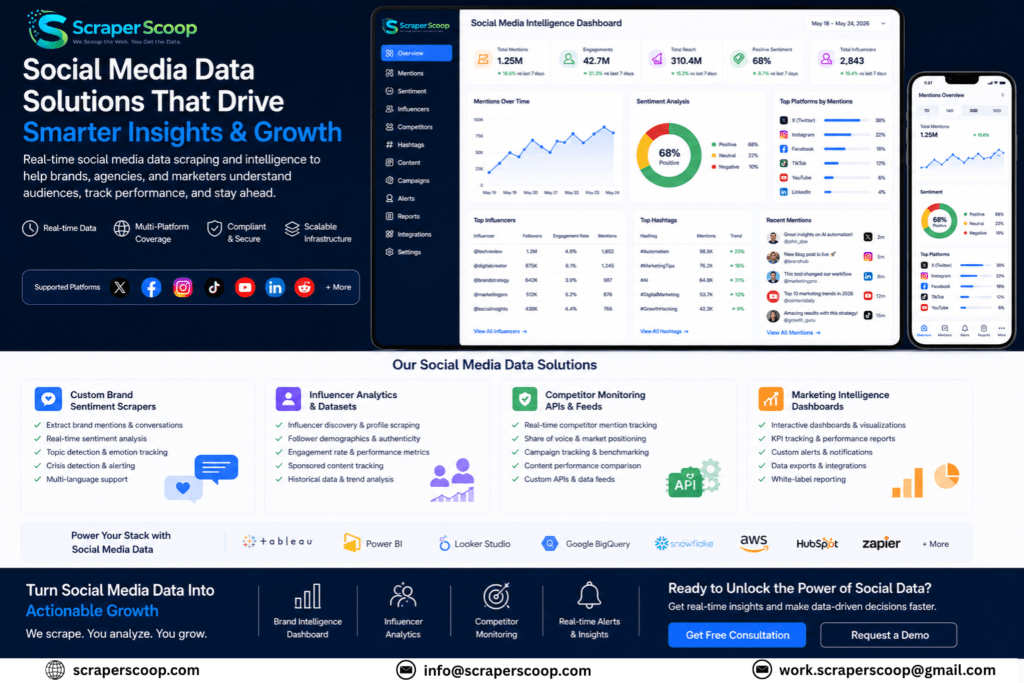
- ✅ Custom Brand Sentiment Monitoring Solutions: Purpose-built brand mention scrapers targeting your specific brand terms, product names, competitor keywords, and category hashtags across all relevant platforms — with NLP sentiment analysis delivering structured brand health intelligence in real time or on scheduled refreshes matched to your monitoring requirements.
- ✅ Influencer Discovery & Analytics Datasets: Comprehensive influencer profile data across platforms — including engagement rate calculations, audience demographic signals, content authenticity scoring, niche classification, brand safety assessment, and historical partnership performance indicators — enabling data-driven influencer selection across every tier from nano to celebrity.
- ✅ Competitor Social Strategy Intelligence: Systematic scraping of competitor content performance data, posting patterns, hashtag strategies, engagement benchmarks, and platform strategy evolution — delivering the competitive social intelligence that informs content strategy, platform investment decisions, and brand differentiation positioning.
- ✅ Trending Topic & Hashtag Intelligence: Real-time and scheduled monitoring of trending hashtag performance, emerging topic clusters, and viral content pattern signals across target platforms — providing the early trend detection capability that enables content teams to move first on emerging opportunities.
- ✅ Social Commerce Data Intelligence: Comprehensive TikTok Shop, Instagram Shopping, and social commerce platform data — including competitor product listings, pricing, review volumes, creator-product partnership performance, and content-to-conversion pattern analysis — for brands competing in social commerce channels.
- ✅ Audience Insight & Consumer Research Data: Structured consumer conversation data from social platforms and community forums — cleaned, categorized, and NLP-analyzed for brand, category, and consumer insight research applications that supplement traditional market research with always-on social intelligence.
- ✅ Ready-Made Social Media Datasets: Need social intelligence immediately? Our pre-built social media datasets across brand monitoring, influencer analytics, and competitive intelligence categories give you instant access to structured social data without development lead time.
- ✅ Social Data APIs: Integrate our continuously updated social intelligence feeds directly into your marketing technology stack — CRM systems, marketing automation platforms, content management tools, or custom analytics environments — with structured data in your required format.
- ✅ Analytics Dashboards: Visual social intelligence dashboards that surface the most marketing-relevant patterns from scraped social data — brand sentiment trend lines, influencer performance comparisons, competitor content benchmarks, trending topic heatmaps, and social commerce performance charts your entire marketing team can act on.
- ✅ Multi-Platform & Multi-Market Coverage: Whether you need monitoring across global platforms in multiple languages or hyper-focused intelligence on specific platform-audience combinations in specific geographies — our infrastructure scales seamlessly with your coverage requirements.
- ✅ Compliance-First, Privacy-Protective Operations: All ScraperScoop social media data collection targets publicly visible content, implements data minimization practices, operates within platform access parameters, and supports your organization’s GDPR and data governance compliance requirements.
Ready to Build Your Social Media Intelligence Advantage? Let’s Talk
There are 5.42 billion social media users globally in 2026, generating brand-relevant content at a scale that manual monitoring cannot touch. Social commerce is approaching USD 1.69 trillion. Influencer marketing is a USD 24 billion industry where data-driven decisions consistently outperform intuition-based approaches. And the brands building systematic, automated social intelligence operations today are establishing competitive advantages that will compound with every passing quarter as the social landscape becomes more competitive and more consequential for commercial outcomes.
The brands, agencies, and growth companies winning on social media in 2026 are not the ones with the biggest creative teams or the highest production budgets. They are the ones who understand their social landscape more deeply, respond to signals faster, and make smarter decisions backed by real, continuously updated social intelligence.
That intelligence advantage starts with ScraperScoop.
At ScraperScoop, we deliver:
- ✅ Custom Brand Sentiment Monitors built for your specific brand, competitors, and categories
- ✅ Influencer Analytics & Discovery Datasets across all major creator platforms
- ✅ Competitor Social Strategy Intelligence for content and platform positioning decisions
- ✅ Trending Topic & Hashtag Monitoring for early trend detection and content opportunity
- ✅ Social Commerce Intelligence for TikTok Shop, Instagram Shopping & beyond
- ✅ Audience Insight & Consumer Research Data from social platforms and community forums
- ✅ Ready-Made Social Media Datasets for immediate intelligence deployment
- ✅ Social Data APIs for seamless martech stack integration
- ✅ Analytics Dashboards with actionable social intelligence visualization
- ✅ Compliance-First, Privacy-Protective Operations for sustainable long-term social intelligence
📱 Let’s Build Your Social Media Intelligence Operation — Starting Today
Your competitors are watching your social media strategy. Your audience is telling you exactly what they want. The question is whether you’re collecting the intelligence to act on both.
Contact ScraperScoop today for your free consultation → Tell us about the platforms you need to monitor, the brands and influencers most relevant to your competitive space, and the marketing decisions you need better social intelligence to support — and we’ll design a custom social media data solution built precisely for your intelligence needs.
Conclusion: In 2026, Social Media Intelligence Is the Heartbeat of Competitive Marketing
Social media in 2026 is not a marketing channel. It is the primary arena where brand perceptions form, purchase decisions get made, competitive battles are won and lost, and cultural trends emerge before reaching any other medium. With 5.42 billion users, USD 1.69 trillion in commerce flowing through social platforms, and an influencer economy worth USD 24 billion — the commercial stakes of social media performance have never been higher.
The brands winning consistently in this environment share one operational capability: they see the social landscape more clearly, respond to signals faster, and make smarter decisions informed by systematic, automated social intelligence that their competitors operating on manual monitoring simply cannot match.
Social media data scraping is the infrastructure that makes this intelligence advantage real and sustainable. From brand sentiment monitoring that detects crises before they escalate, to influencer analytics that transforms partnership selection from creative intuition to data science, to competitor content intelligence that keeps your social strategy consistently ahead of the curve — the applications are broad, the ROI is proven, and the competitive disadvantage of operating without systematic social intelligence grows with every passing quarter.
The technology is mature. The data is rich and continuously expanding. And the right partner — one who combines world-class technical social data collection infrastructure with NLP analytical sophistication, compliance-first operations, and marketing domain expertise — makes building this capability faster, more reliable, and more cost-effective than any in-house development approach.
ScraperScoop is that partner. Accurate, comprehensive, continuously updated social media intelligence — tailored to your brand, your competitive landscape, and your marketing objectives.
👉 Get in touch with ScraperScoop now — and let’s turn social media data into your most powerful and sustainable competitive intelligence advantage.
Frequently Asked Questions About Social Media Data Scraping
What is social media data scraping?
Social media data scraping is the automated extraction of publicly available content, engagement metrics, profile data, trending topics, hashtag performance, influencer information, and audience behavior signals from social media platforms including Instagram, TikTok, Twitter/X, YouTube, Facebook, LinkedIn, Pinterest, and Reddit. Brands, marketing agencies, and growth companies use this intelligence for brand sentiment monitoring, influencer analytics, competitor strategy tracking, social commerce intelligence, and audience insight research.
Is social media data scraping legal?
Scraping publicly visible social media content — posts, profiles, engagement metrics, and public hashtag data accessible without authentication — is generally legal in many jurisdictions. The landmark hiQ v. LinkedIn case established important U.S. legal precedent supporting the legality of public web scraping. It is important to operate within platform terms of service, comply with GDPR for European user data, implement data minimization practices, and avoid collecting private or authentication-protected content. ScraperScoop operates with a compliance-first approach to all social media data collection.
How can social media scraping improve influencer marketing ROI?
Social media scraping enables data-driven influencer selection based on genuine engagement rate quality, audience demographic alignment, content authenticity signals, brand safety assessment, and historical sponsored content performance — moving beyond vanity metrics like follower count. Brands using systematic influencer performance data consistently report better campaign performance, lower cost per engagement, higher conversion rates from influencer-driven traffic, and improved overall influencer marketing ROI compared to intuition-based selection approaches.
Which social media platforms can ScraperScoop collect data from?
ScraperScoop collects publicly available data from all major social media platforms including TikTok, Instagram, Twitter/X, YouTube, Facebook, LinkedIn, Pinterest, Reddit, and platform-specific community spaces. We handle the full technical complexity of each platform’s unique architecture — dynamic content loading, anti-bot navigation, and data normalization — delivering structured, analysis-ready social intelligence across your entire platform coverage requirement.
How does brand sentiment monitoring through social scraping work?
Brand sentiment monitoring through social scraping involves continuously extracting public mentions of your brand name, products, and associated keywords across social platforms, then applying NLP sentiment analysis to classify each mention by sentiment direction, intensity, and topic category. This delivers a continuously updated brand health intelligence stream that reveals sentiment trends over time, identifies specific topics generating sentiment spikes, and provides automated alerting for developing issues — enabling rapid response to brand reputation challenges before they escalate into crises.
How can brands use social media scraping for social commerce intelligence?
Brands use social media scraping for social commerce intelligence by monitoring competitor product listings, pricing, and review performance on TikTok Shop and Instagram Shopping, tracking creator-product combination performance data, identifying content formats that drive the highest purchase conversion rates, detecting trending product categories before they peak, and monitoring live commerce event performance across competitive brands. This intelligence enables data-driven social commerce strategy optimization in a market growing at over 30% annually toward USD 1.69 trillion in 2026.
What is the difference between social media API access and web scraping for social data?
Social media APIs provide structured, platform-authorized data access — but major platforms have progressively restricted API access, reduced data availability, and increased API costs significantly in recent years. Web scraping collects publicly visible social data directly from platform interfaces without depending on official API availability or quota limits — providing broader coverage, greater data completeness, and more reliable access for comprehensive social intelligence applications than increasingly restricted API channels. ScraperScoop uses both approaches where appropriate, optimizing for the data quality and coverage your specific intelligence requirements demand.
Why should I choose ScraperScoop for social media data scraping?
ScraperScoop provides custom social media scraping solutions, ready-made social intelligence datasets, social data APIs, and marketing analytics dashboards specifically designed for brand monitoring, influencer analytics, and competitive social intelligence applications. We handle all technical complexity — anti-bot navigation, dynamic content rendering, multi-platform coverage, NLP sentiment analysis, and compliance — delivering structured, analysis-ready social intelligence that your marketing team can immediately act on. Contact us for a free consultation about your specific social intelligence needs.


