


Introduction: The Automotive Industry’s Data Revolution Is Already Here
Here’s a scenario that plays out across car dealerships every single week: a regional dealer group spends three days manually compiling a competitive pricing report — pulling vehicle prices from competitor websites, local listings, and manufacturer portals one page at a time. By the time the spreadsheet is complete, two competitor dealers have run weekend flash sales, a major OEM has quietly adjusted its MSRP on a popular trim level, and the used vehicle market has absorbed a wave of off-lease returns that shifted residual values by 4% in one of their key segments.
The report gets presented in Monday morning’s management meeting. Decisions get made. Pricing gets adjusted. And the competitive landscape they’re responding to is already three days old.
This story isn’t unique to small dealers. It repeats itself — at different scales and with different financial consequences — across automotive manufacturers, marketplace platforms, fleet management companies, auto insurance providers, and automotive investors every single week. And the consistent driver of this problem is not effort or talent — it’s the absence of automated, real-time automotive market intelligence.
The global automotive industry is one of the world’s largest and most data-intensive commercial sectors. The global automotive market is valued at USD 2.87 trillion in 2026, growing toward USD 3.86 trillion by 2030. The global automotive eCommerce and digital marketplace segment alone is growing at a CAGR of over 20%, driven by the accelerating shift toward online vehicle research, digital retailing, and direct-to-consumer sales models. Meanwhile, the EV revolution is fundamentally restructuring competitive dynamics across every segment — with EV sales projected to reach 25.4 million units globally in 2026, representing over 28% of total new vehicle sales.
In this environment — fast-moving, structurally shifting, and commercially enormous — automotive data scraping has emerged as the foundational intelligence capability that separates market leaders from market followers. It’s the technology powering the real-time vehicle pricing intelligence that keeps dealer margins competitive, the EV market monitoring that helps manufacturers track competitive positioning in the fastest-changing segment of the industry, the inventory analytics that help marketplace platforms deliver comprehensive search experiences, and the market research intelligence that helps automotive investors make smarter capital allocation decisions.
This guide covers everything you need to know about automotive data scraping in 2026 — what data is available, who is using it, how the most sophisticated automotive businesses are deploying it for competitive advantage, and exactly how ScraperScoop can build the custom automotive data intelligence operation your business needs to compete and win.
What Is Automotive Data Scraping and Why Does It Matter in 2026?
Automotive data scraping is the automated process of extracting publicly available vehicle listings, pricing data, dealer inventory information, EV market intelligence, consumer review data, manufacturer specifications, financing terms, and automotive market trend signals from websites, automotive marketplace platforms, manufacturer portals, review sites, regulatory databases, and industry news sources — and structuring that raw web data into actionable, continuously updated automotive market intelligence.
In practical terms: rather than having pricing analysts manually visiting AutoTrader, Cars.com, CarGurus, dealer websites, and manufacturer inventory pages to compile competitive pricing reports — a process measured in days for any meaningful market coverage — automated automotive scraping solutions do all of that simultaneously, continuously, and at the full breadth of the market, delivering results in structured, analysis-ready formats that enable real-time pricing and inventory decisions.
Why the Automotive Industry Is Uniquely Data-Intensive in 2026
The automotive market in 2026 is navigating a structural transformation unlike anything it has experienced in decades — and every dimension of this transformation is creating new, urgent demand for data intelligence that traditional manual research simply cannot satisfy:
- The EV revolution is reshaping every segment simultaneously. Electric vehicles are no longer a niche category — they’re the fastest-growing, most competitive, and most data-intensive segment in the industry. EV pricing changes rapidly as battery costs evolve, government incentive programs shift, and new entrants from traditional OEMs, Chinese manufacturers, and startup brands alter the competitive landscape monthly. Tracking EV pricing, range specifications, charging infrastructure, and competitive positioning across this rapidly evolving segment requires automated intelligence capabilities that manual monitoring simply cannot deliver.
- Digital automotive retail is mainstream. More than 80% of car buyers now begin their purchase journey online, and the proportion completing significant portions of the purchase process digitally — including pricing negotiation, financing, and trade-in valuation — is growing rapidly. For dealers, marketplace platforms, and OEMs competing in this digital-first environment, real-time online pricing intelligence is as critical as showroom presentation was in the pre-digital era.
- Used vehicle markets are extraordinarily volatile. Post-pandemic supply chain disruptions created unprecedented used vehicle price appreciation, and the subsequent normalization has been uneven and geographically varied. In this environment, used car residual value intelligence — updated continuously from marketplace listing data — is foundational for dealers managing inventory risk, lenders assessing collateral values, and investors analyzing automotive sector exposures.
- Market concentration in automotive retail is intensifying. The top dealer groups continue expanding their market footprint through acquisition, and the largest marketplace platforms — CarMax, AutoNation, and digital-first operators — are competing with increasing analytical sophistication. Smaller and mid-size dealers without systematic market intelligence capabilities face growing competitive disadvantage against operations with dedicated data science teams.
- Chinese automotive manufacturers are entering global markets aggressively. BYD, SAIC, Geely, NIO, and dozens of other Chinese OEMs are expanding their global market presence — particularly in EV segments — at a pace that is reshaping competitive dynamics across European, Southeast Asian, and emerging market automotive sectors. Tracking the pricing, specifications, and market positioning of these new competitive entrants requires continuous intelligence monitoring that only automated scraping can deliver at meaningful scope.
These factors converge to make automotive data scraping not a technical curiosity but a genuine commercial necessity for any automotive business operating at meaningful scale in 2026’s market environment.
What Automotive Data Can You Actually Scrape? The Complete Intelligence Taxonomy
The scope of automotive intelligence accessible through automated web scraping covers virtually every dimension of commercial decision-making in the auto industry. Here is the complete taxonomy of what’s available — and the specific business value each data category delivers.
1. Vehicle Listing & Pricing Data
New and used vehicle listing data is the most foundational and most commercially impactful category of automotive intelligence. Through automated scraping of automotive marketplace platforms, dealer websites, and manufacturer portals, organizations can extract VIN-level listing data including make, model, year, trim level, mileage, condition, listed price, days on market, geographic location, and listing source. This listing data creates a continuously updated market pricing map that enables real-time competitive pricing analysis, price-to-market positioning assessment, and dealer pricing strategy optimization at granularity levels — individual model, trim, mileage band, and geographic market — that periodic manual surveys cannot approach.
2. Dealer Inventory Intelligence
Dealer inventory data — what vehicles specific dealers currently have in stock, at what prices, for how long — provides competitive intelligence that goes beyond pricing to reveal the inventory management strategies and market positioning approaches of competitive dealers. Tracking inventory composition, pricing relative to market, days-on-lot patterns, and inventory turn rates across competitive dealer sets reveals which dealers are managing inventory most effectively, where over-stock situations create pricing pressure opportunities, and how inventory mix is shifting in response to market demand changes. For dealer groups and automotive investors, this competitive inventory intelligence is foundational for strategic and operational decision-making.
3. Electric Vehicle Market Data
EV-specific data scraped from manufacturer websites, EV marketplace platforms, charging network operator portals, and automotive review sites includes vehicle range specifications, battery capacity, charging speed capabilities, base and configured pricing, government incentive eligibility, charging network coverage by geography, model availability and delivery windows, and software update histories. This EV intelligence is essential for both competitive positioning by OEMs and consumer decision-making platforms — as EV specifications and pricing change significantly more rapidly than traditional ICE vehicle parameters.
4. Consumer Reviews & Ownership Experience Data
Automotive review platforms — Edmunds, Consumer Reports, Car and Driver, J.D. Power, Google reviews for dealerships, and owner community forums — collectively generate an enormous volume of consumer experience intelligence about vehicles, dealers, and automotive services. Systematic scraping and NLP analysis of this review data provides manufacturers with real-world product quality intelligence beyond warranty claim data, gives dealers visibility into their own and competitor reputation trajectories, and enables marketplace platforms to build more trustworthy product recommendation engines backed by genuine owner experience data.
5. Vehicle Specifications & Feature Data
Manufacturer specification pages, automotive media databases, and regulatory certification documents contain structured vehicle specification data — powertrain options, safety ratings, technology features, dimensions, payload capacities, fuel economy ratings, and standard and optional equipment lists. Systematic scraping of specification data across competing models enables automotive product planners to benchmark their own specifications against the competitive landscape, helps marketplace platforms maintain accurate and complete vehicle specification databases, and provides automotive investors with the product attribute data needed for competitive positioning analysis.
6. Financing & Incentive Data
Manufacturer financing offers, dealer incentive programs, lease terms, APR promotions, cash back offers, and government purchase incentives for EVs and low-emission vehicles collectively define the effective transaction price environment in automotive retail — often diverging significantly from listed MSRP. Scraping OEM incentive pages, dealer special offer sections, and government incentive program databases provides the complete incentive intelligence picture that enables accurate true-cost-of-ownership analysis, more competitive dealer offers, and more accurate market price modeling than MSRP-only comparison allows.
7. Automotive Parts & Accessories Pricing
OEM parts pricing from manufacturer portals, aftermarket parts pricing from online parts retailers, accessories pricing from dealer and third-party sources, and labor rate data from service shops collectively form the parts and service market intelligence landscape. For automotive parts retailers, insurance companies estimating repair costs, and fleet operators managing maintenance budgets, systematic scraping of parts pricing data across the competitive landscape provides the market pricing intelligence needed for purchasing optimization, cost estimation accuracy, and competitive pricing strategy.
8. Auction & Wholesale Market Data
Wholesale vehicle auction platforms, dealer-to-dealer trade networks, and wholesale pricing guides collectively represent the upstream supply side of the used vehicle market — where dealer acquisition costs are set and residual values are ultimately determined. Scraping auction platform listings, wholesale price guides, and trade network data provides the supply-side intelligence that makes used vehicle acquisition strategies more accurate and used vehicle residual value models more reliable — complementing retail-side listing data with the wholesale market signals that complete the used vehicle pricing picture.
9. Automotive News & Market Trend Intelligence
Automotive trade publications, OEM press release feeds, regulatory announcement platforms, industry analysis publications, and automotive finance news sources collectively generate a continuous stream of market intelligence — production volume announcements, recall notices, regulatory compliance developments, electrification investment decisions, partnership and joint venture announcements, and supply chain disruption signals. Systematic scraping and monitoring of automotive news provides the early warning intelligence that allows automotive businesses to anticipate market structure changes rather than reacting to them after the fact.
10. EV Charging Infrastructure Data
For EV market participants — OEMs, charging network operators, fleet managers, real estate developers, and municipalities planning EV infrastructure — systematic scraping of charging station databases, network expansion announcements, charger availability and reliability data, and charging pricing across networks provides the infrastructure intelligence that informs EV market entry strategies, range anxiety risk assessment, and charging network investment decisions. As EV adoption accelerates, charging infrastructure data becomes increasingly central to automotive market intelligence — defining the geographic boundaries of practical EV usability that directly influence consumer purchase decisions.
11. Fleet & Commercial Vehicle Market Data
Commercial vehicle listings, fleet operator procurement announcements, government fleet tender data, and commercial vehicle market pricing from fleet management platforms collectively provide intelligence for the commercial vehicle segment that retail-focused automotive data sources underrepresent. For commercial vehicle manufacturers, fleet management companies, and automotive investors with commercial vehicle exposure, systematic scraping of fleet market data sources provides the specialized intelligence needed for accurate commercial segment analysis and competitive positioning.
12. Automotive Job Postings & Industry Workforce Intelligence
Hiring patterns across automotive OEMs, supplier companies, dealer groups, and automotive technology firms provide forward-looking intelligence about organizational investment priorities and strategic direction that leads formal announcements by multiple quarters. An OEM aggressively expanding its software-defined vehicle engineering team is signaling a connected car technology investment. A dealer group hiring in digital marketing and digital retailing roles is investing in the online purchase experience. A charging network operator expanding into new geographic markets through hiring signals competitive expansion before facility openings are announced. This automotive hiring intelligence provides a continuous leading indicator stream that complements product and pricing data with organizational strategy signals.
10 High-Impact Automotive Data Scraping Use Cases Driving Competitive Advantage in 2026
Understanding what automotive data is available is the foundation. Understanding how the most sophisticated players across the automotive ecosystem are actually deploying this intelligence to drive measurable competitive and commercial results is where the practical value lives.
1. Real-Time Vehicle Pricing Strategy & Competitive Intelligence
Vehicle pricing is the most immediately and universally impactful application of automotive data scraping. For dealers, competitive pricing at the individual VIN level — knowing exactly what comparable vehicles are priced at by competing dealers in the same market, with how many miles, in what condition, and for how many days — is the foundational intelligence for pricing decisions that balance turn rate targets against margin objectives. For OEMs, monitoring how their vehicles’ MSRP-to-market-transaction pricing relationship compares to competitive models provides the market signal that informs production allocation, incentive program design, and regional pricing strategy adjustments.
The competitive pricing advantage from systematic market intelligence is substantial and measurable. Dealers using real-time competitive pricing data consistently achieve better balance between inventory turn rates and gross profit per unit than those pricing from periodic market surveys — because they can identify and respond to market pricing movements within hours rather than the days or weeks that manual monitoring requires.
2. Used Vehicle Acquisition & Residual Value Intelligence
The used vehicle market is the most data-dependent segment of automotive retail — where pricing accuracy at acquisition directly determines retail profitability, and where the market price for any specific vehicle configuration can shift meaningfully within a week in response to supply and demand dynamics. Systematic scraping of used vehicle listings across marketplace platforms provides the real-time market pricing intelligence that powers acquisition decisions for dealer used vehicle buyers, residual value models for automotive finance companies, collateral valuation tools for auto insurance providers, and market value estimates for consumer-facing trade-in evaluation platforms.
The financial precision required in used vehicle valuation — where a $500 over-acquisition on a $15,000 unit directly translates to margin loss that compounds across hundreds of monthly acquisitions — makes real-time, comprehensive market pricing data from systematic scraping not a competitive enhancement but a financial necessity for any operation managing used vehicle inventory at meaningful scale.
3. EV Competitive Positioning & Market Intelligence
The EV segment’s extraordinary growth — and extraordinary competitive dynamism — creates intelligence demands that no other automotive segment matches in urgency or complexity. New EV models launch monthly. Pricing adjustments happen quarterly. Battery specifications improve continuously. Charging network coverage expands weekly. Government incentive eligibility changes with each legislative session. And Chinese EV manufacturers are entering markets at pricing levels that are fundamentally challenging the competitive economics of established OEMs.
For any OEM, EV startup, or automotive intelligence platform with EV market exposure, systematic automated monitoring across EV pricing, specifications, availability, charging infrastructure, and competitor positioning is the only approach that maintains meaningful market visibility across this rapidly evolving competitive landscape. Organizations using automated EV market intelligence consistently identify competitive pricing threats, specification benchmark shifts, and market entry events significantly faster than those relying on periodic manual research — translating data speed advantage into commercial response capability that matters enormously in a segment moving at EV speed.
4. Dealer Performance Benchmarking & Network Intelligence
For automotive OEMs managing dealer networks, and for dealer group holding companies managing multiple franchise operations, systematic data collection on dealer-level performance signals — pricing relative to market, inventory composition versus sales mix, days-to-sale patterns, customer review trajectories, and promotional activity — provides the continuous dealer network intelligence needed for performance management, network optimization, and dealer support resource allocation. Rather than depending entirely on periodic dealer reporting and regional field team observations, OEM and dealer group leadership can monitor dealer performance signals continuously through systematic market data collection and analysis.
5. Automotive Marketplace Development & Listing Optimization
Online automotive marketplace platforms — from established players like Cars.com, AutoTrader, and CarGurus to emerging digital-native operators — depend on comprehensive, accurate, continuously updated vehicle listing data to deliver the search and comparison experience that drives consumer engagement and dealer advertising value. Systematic data collection across the automotive listing landscape provides marketplace platforms with the inventory coverage intelligence needed to identify listing gaps, optimize search result quality, maintain price accuracy, and benchmark their own inventory coverage against competitive marketplace platforms. For marketplace platforms, data intelligence is literally the product — and systematic automotive data scraping is the infrastructure that powers it.
6. Consumer Sentiment & Brand Health Monitoring
Automotive consumer sentiment — expressed through reviews on Edmunds, CarGurus, Google, dealer review platforms, and automotive community forums — provides a continuous stream of product quality and customer experience intelligence that complements internal warranty and customer satisfaction survey data with the unfiltered voice of actual owners and buyers. For automotive OEMs monitoring the real-world reception of new model launches, for dealers managing their online reputation across review platforms, and for automotive investors assessing brand health as a component of franchise value analysis, systematic scraping and NLP analysis of automotive consumer reviews provides intelligence depth that internal data sources alone cannot match.
7. Automotive Finance & Insurance Market Intelligence
For automotive finance companies, banks with auto loan portfolios, and automotive insurance providers, systematic vehicle market data provides the collateral value and market risk intelligence foundational for portfolio management. Real-time used vehicle market pricing data derived from systematic scraping enables more accurate loan-to-value calculation, more timely identification of collateral value deterioration in declining segments, and more precise market risk assessment for automotive portfolio stress testing. For automotive insurance providers, current vehicle market values from comprehensive listing data improve settlement accuracy and competitive premium pricing in a market where vehicle values have been anything but stable in recent years.
8. Fleet Management & Commercial Vehicle Intelligence
Corporate fleet managers responsible for procurement, valuation, and disposal of large vehicle portfolios use systematic automotive market data to optimize acquisition timing, identify disposal windows that maximize residual value capture, benchmark total cost of ownership across competitive vehicle options, and track the fleet market pricing of specific vehicle categories over time. For fleet operators managing hundreds or thousands of vehicles simultaneously, systematic market intelligence can generate substantial savings across the vehicle lifecycle — and the data volume required for meaningful fleet market coverage makes automation essential.
9. Automotive Investment & M&A Intelligence
Private equity firms, venture capital investors evaluating automotive technology companies, and strategic acquirers evaluating dealer group and automotive marketplace acquisitions use scraped automotive market data across multiple intelligence dimensions. Market share trend data reveals competitive positioning dynamics. Dealer performance signals inform franchise value assessments. EV market evolution data supports investment thesis validation for electrification-related investments. Vehicle pricing trends provide macroeconomic context for automotive sector investment timing decisions. Systematically integrating these automotive intelligence streams dramatically improves the quality and efficiency of automotive investment diligence.
10. Automotive SEO & Digital Marketing Intelligence
For automotive dealers and marketplace platforms competing for online visibility in one of the most competitive digital marketing environments that exists, systematic monitoring of competitor SEO performance, content strategies, listing quality scores, and digital advertising activity provides the competitive intelligence needed to maintain and improve digital marketing effectiveness. Understanding which competitors are gaining organic search visibility in key vehicle category searches, what content strategies are driving their digital presence, and how their listing quality compares to yours enables targeted digital marketing improvements that deliver measurable lead generation and traffic results.
Vehicle Pricing Intelligence: The Commercial Heartbeat of Automotive Data Scraping
Among all automotive data scraping applications, real-time vehicle pricing intelligence is simultaneously the most universally needed, the most commercially impactful, and the most technically demanding to execute systematically. Let’s examine why it matters so fundamentally — and how automated scraping is transforming what’s possible across the automotive pricing landscape.
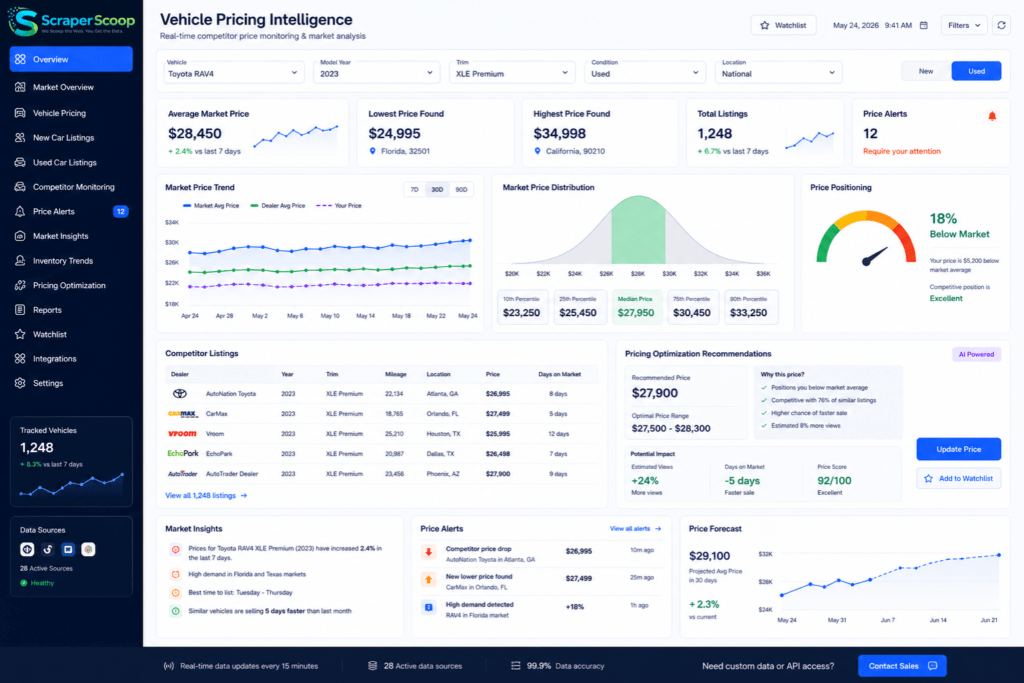
The Automotive Pricing Problem in 2026
Automotive pricing is uniquely complex because it operates simultaneously at multiple levels — MSRP set by manufacturers, sticker prices set by dealers, transaction prices negotiated with buyers, wholesale prices determined by auction and trade markets, and effective prices shaped by incentives, financing terms, and trade-in values — and because vehicle pricing is deeply geographically segmented, with competitive pricing in Denver meaningfully different from competitive pricing in Dallas for the identical vehicle configuration.
Add the velocity of market change — used vehicle prices can shift 3-5% in a single week during periods of supply volatility — and the competitive dynamics of a market where consumers routinely compare listings across multiple platforms before contacting a dealer, and the requirement for continuously updated, geographically precise, model-specific pricing intelligence becomes clear. Manual pricing analysis simply cannot maintain the currency, granularity, or geographic comprehensiveness that competitive automotive pricing requires.
How Systematic Pricing Intelligence Transforms Dealer Economics
Dealers using real-time competitive pricing data operate with a fundamentally different decision framework than those relying on periodic market guides or manual checks. Rather than pricing vehicles based on acquisition cost plus target margin — and then discovering through slow sales velocity that the market has moved below that price — data-driven dealers price every unit relative to the live market from the moment it enters inventory. This market-relative pricing approach consistently delivers better outcomes across the metrics that matter most: faster inventory turn reduces carrying cost and capital exposure, better price-to-market positioning drives higher lead conversion rates, and systematic identification of overpriced units enables proactive price adjustments before units age into deep discount territory.
OEM Pricing Strategy Intelligence
For automotive manufacturers, systematic monitoring of how their vehicles’ transaction pricing — not just MSRP — compares to competitive models in real market conditions provides intelligence that shapes production allocation, incentive program design, and regional pricing strategy. When a competitive model’s transaction prices are tracking 8% below MSRP while yours are tracking 2% below — a pattern that becomes visible through systematic market pricing data long before it appears in sales share reports — the competitive pricing pressure signal arrives early enough to inform a proactive incentive response rather than a reactive one.
Price Trend Analysis and Market Forecasting
Historical pricing data derived from systematic, continuous scraping creates the longitudinal market price record needed for trend analysis and market forecasting. Seasonal price patterns, the price impact of competitive new model launches, the residual value trajectory of specific models over their lifecycle, and the correlation between macroeconomic indicators and automotive market pricing — all of these analytical capabilities depend on comprehensive historical pricing data that only systematic, continuous scraping builds over time. Organizations that have been collecting automotive market pricing data systematically for years possess a historical data asset that dramatically improves their forecasting accuracy versus those working from periodic point-in-time surveys.
EV Market Intelligence: Navigating the Fastest-Moving Segment in Automotive History
The electric vehicle market is the most data-intensive, most rapidly evolving, and most competitively complex segment in automotive history. EV sales reaching 25.4 million units globally in 2026 represents a market that barely existed at commercial scale a decade ago — now growing at rates that require continuous, automated intelligence monitoring just to maintain basic competitive awareness.
The EV Competitive Intelligence Challenge
Competitive intelligence in the EV segment is fundamentally more demanding than in traditional ICE vehicle markets. EV pricing changes significantly more frequently — Tesla has famously adjusted pricing multiple times within single quarters, and the pressure from Chinese EV manufacturers is driving pricing responses from established OEMs at an unprecedented pace. EV specifications — range, charging speed, software features — evolve continuously through over-the-air updates, creating a moving specifications benchmark that static competitive databases cannot track. And government incentive eligibility, which dramatically affects effective consumer pricing, changes with legislative and regulatory developments that require continuous monitoring across dozens of national and regional programs simultaneously.
For any organization with EV market exposure — whether as an OEM competing for EV market share, an automotive marketplace platform maintaining accurate EV listings, an investor analyzing EV sector dynamics, or a fleet manager evaluating EV total cost of ownership — systematic automated EV market data collection is the only approach that maintains meaningful intelligence in a segment moving at this pace.
Chinese EV Competitor Intelligence
The entry of Chinese automotive manufacturers into global EV markets — with vehicles offering specifications competitive with Western OEMs at prices 20-40% below comparable models — represents one of the most significant competitive developments in the global automotive industry in decades. BYD, SAIC-MG, Geely (including Polestar and Volvo), NIO, XPeng, and dozens of smaller Chinese brands are now available or actively entering European, Southeast Asian, Australian, and Latin American markets at a pace that established OEMs are struggling to monitor comprehensively.
Systematic scraping of Chinese EV manufacturer portals, international auto show announcements, regional market entry press releases, and dealer network development news provides the competitive intelligence that helps established OEMs understand the full extent of the Chinese EV competitive threat — including the specific markets, price segments, and vehicle categories where Chinese entrants are most aggressively competing — in time to develop informed strategic responses rather than discovering the scope of competition after market share has already been lost.
EV Charging Infrastructure Intelligence
EV adoption is inextricably linked to charging infrastructure — and charging network coverage, reliability, pricing, and expansion trajectory are increasingly central to consumer EV purchase decisions and EV market forecasting accuracy. Systematic scraping of charging network databases — including PlugShare, ChargePoint, Electrify America, Tesla Supercharger network data, and regional network operator portals — provides geographic infrastructure coverage intelligence that enables more accurate range anxiety risk assessment by geography, better EV suitability analysis for fleet operators evaluating electrification, and more realistic EV market ***** forecasting that accounts for infrastructure constraints alongside vehicle pricing and specification factors.
Government Incentive Monitoring
Government purchase incentives — federal tax credits, state rebates, utility company incentives, fleet electrification grants, and commercial incentive programs — significantly affect the effective consumer price of EVs and directly influence purchase timing and model selection decisions. These incentive programs change with each legislative session, often with significant retroactive or prospective effects on consumer purchasing economics. Systematic scraping of government incentive program databases, legislative update feeds, and regulatory announcement platforms provides continuous incentive monitoring that keeps automotive retailers, fleet managers, and EV market analysts current with the full effective pricing picture across all available incentive programs.
Automotive Marketplace Intelligence: How Platforms Win the Listing and Discovery Battle
The competitive dynamics of online automotive marketplaces are among the most intense in digital commerce — where inventory comprehensiveness, listing quality, pricing accuracy, and search experience are all simultaneously battlegrounds in a market worth billions in annual dealer advertising revenue.
Inventory Coverage Intelligence
For automotive marketplace platforms, the comprehensiveness of inventory listed is a fundamental product quality dimension — because consumers searching for specific vehicle configurations will navigate to whichever platform most reliably shows them the full available market. Systematic monitoring of which dealer inventories appear across competitive marketplace platforms, and which do not appear on your own platform, identifies dealer acquisition opportunities where your competitive coverage gap is most significant. This coverage gap intelligence transforms dealer recruitment from a geographic priority exercise into a data-driven strategic priority focused on the specific inventory and geographic gaps most likely to improve consumer search completeness and platform engagement.
Pricing Accuracy and Market Price Freshness
Automotive marketplace consumers are price-sensitive and increasingly sophisticated — and the platforms that consistently show the most accurate, most current pricing establish the trust that drives repeat consumer engagement. Systematic monitoring of competitor platform pricing accuracy — how quickly competitive platforms update prices after dealer changes, the frequency of price discrepancies between platform listings and dealer website prices, and the completeness of incentive and fee disclosure in competitive listings — provides intelligence for platform product improvement that directly affects the consumer trust metrics underlying long-term platform engagement.
Consumer Search Trend Intelligence for Marketplace Product Development
Systematically scraping search trend data, popular filter combinations, and consumer vehicle preference patterns from publicly accessible automotive marketplace signals reveals the changing consumer search behaviors that should drive platform feature development priorities. When consumer search activity shifts toward specific body styles, powertrain types, or price segments — patterns detectable through systematic platform data monitoring — marketplace platforms that detect and respond to these shifts first in their UX, search algorithms, and dealer recruitment priorities consistently deliver better consumer experiences than those developing product strategy from internal data alone.
Whether you’re building an automotive marketplace or competing to maintain leadership in an established one, talk to ScraperScoop’s automotive data specialists about how we can build the comprehensive automotive intelligence infrastructure your platform needs to compete effectively.
Key Automotive Data Sources for Web Scraping: Where the Intelligence Lives in 2026
Understanding which automotive data sources carry the most intelligence value for your specific business application is foundational for building an effective automotive scraping strategy. Here’s the landscape of high-value sources across the automotive intelligence ecosystem.
Major Automotive Marketplace Platforms
AutoTrader, Cars.com, CarGurus, CarMax, Carvana, and Vroom collectively represent the largest aggregations of automotive listing data available — with millions of new and used vehicle listings updated continuously. These platforms are the primary competitive pricing reference for most automotive market participants and are essential monitoring targets for any organization requiring comprehensive vehicle price and inventory intelligence. Each platform has different inventory coverage strengths — CarGurus excels in dealer market coverage, Carvana and CarMax provide retail-priced used vehicle benchmarks, and AutoTrader provides the broadest geographic new vehicle listing coverage — making multi-platform monitoring essential for complete market intelligence.
OEM & Manufacturer Portals
Manufacturer websites contain structured vehicle specification data, MSRP pricing across all trim configurations, build-and-price tool outputs, production availability information, and incentive program details that are foundational for competitive product benchmarking and market positioning analysis. For companies monitoring the EV landscape specifically, manufacturer EV product pages — for Tesla, Rivian, Lucid, BYD, NIO, and the EV lineups of traditional OEMs — provide the specification and pricing data needed for continuous competitive benchmarking across the rapidly evolving EV competitive set.
Automotive Review & Rating Platforms
Edmunds, Kelley Blue Book (KBB), Consumer Reports, Car and Driver, Motor Trend, and J.D. Power provide professional automotive editorial and consumer review intelligence that shapes consumer purchase decisions and brand perceptions. Dealer review platforms — Google Business reviews, DealerRater, and Cars.com dealer reviews — provide dealer-level reputation intelligence. Scraping and analyzing this review ecosystem provides manufacturers with product reception intelligence, dealers with reputation monitoring, and marketplace platforms with data to enrich listing quality with editorial and consumer review context.
Wholesale & Auction Platforms
Manheim, ADESA, and dealer-to-dealer digital auction platforms represent the wholesale used vehicle market where dealer acquisition costs are set. Monitoring wholesale auction platforms provides the upstream supply-side intelligence that complements retail-side listing data — enabling more accurate total market pricing analysis and more precise used vehicle acquisition strategy based on the actual wholesale cost environment dealers are operating within.
Government & Regulatory Databases
The NHTSA (National Highway Traffic Safety Administration) recall database, fuel economy ratings from the EPA, safety rating publications from IIHS and NHTSA, and emissions certification records collectively provide regulatory intelligence that directly affects vehicle valuation, consumer purchase decisions, and manufacturer competitive positioning. For automotive investors and market analysts, systematic monitoring of recall announcements, safety rating publications, and regulatory enforcement actions provides early warning intelligence about brand equity risks that may affect competitive positioning and market share.
EV-Specific Data Sources
PlugShare, ChargePoint, Electrify America, and national charging network databases provide EV charging infrastructure intelligence. Department of Energy EV incentive databases and state-level energy authority portals provide incentive program intelligence. International EV Sales Tracker, EV Volumes, and regional EV market reporting platforms provide sales volume and market share intelligence. Together, these EV-specific sources create a comprehensive EV market intelligence picture that generic automotive data sources don’t cover adequately.
Automotive Finance & Valuation Sources
Black Book, NADA Guides, and JM&A Group market data publish vehicle valuation guides that inform dealer pricing, insurance settlement values, and loan collateral assessments. Systematic monitoring of these valuation guide updates, combined with retail listing pricing from marketplace platforms, creates the comprehensive vehicle valuation intelligence picture needed for accurate automotive finance and insurance applications.
International Automotive Sources
For automotive intelligence with international market coverage — essential for OEMs, global investors, and automotive businesses expanding internationally — monitoring platforms such as AutoScout24 (Europe), Gumtree Motoring (UK/Australia), OLX Autos (Latin America), and regional Asian automotive marketplace platforms provides the geographic market coverage needed for comprehensive global automotive intelligence beyond North American-focused sources.
Automotive Data Scraping Technical Challenges — Why Professional Services Deliver Superior Results
Automotive data scraping presents a distinctive set of technical challenges that make reliable, comprehensive, investment-grade data collection genuinely complex. Here’s what makes it hard — and how professional data services address each challenge effectively.
Challenge 1: Dynamic Listing Content and Pagination Complexity
Automotive marketplace platforms manage millions of listings with sophisticated search, filtering, and pagination systems that load content dynamically through JavaScript and respond to user interaction patterns rather than static URL structures. Accessing comprehensive listing data across all relevant makes, models, geographic markets, and condition categories requires headless browser automation capable of navigating complex search interfaces, handling infinite scroll or multi-page result sets, managing session state across extended browsing sessions, and adapting to the frequent UI changes that major platforms implement. Traditional HTTP-based scraping approaches miss the majority of listing content on modern automotive platforms.
Challenge 2: Anti-Bot Detection on High-Value Platforms
Major automotive marketplace platforms protect their listing data aggressively with sophisticated bot detection systems — including behavioral fingerprinting, IP velocity analysis, CAPTCHA deployment, and machine learning-powered anomaly detection. These defensive systems have become increasingly sophisticated as automotive data has become more commercially valuable and as platforms have recognized the scale of automated access attempts. Professional automotive data infrastructure addresses these defenses through realistic browser behavior simulation, intelligent proxy rotation, adaptive request pacing, and continuous anti-detection technology adaptation that maintains reliable access without triggering blocking events that interrupt data collection continuity.
Challenge 3: VIN-Level Data Matching and Vehicle Identity Resolution
Comparing automotive listings across multiple platforms for the same vehicle requires reliable Vehicle Identification Number (VIN) matching — a deceptively complex challenge because the same vehicle may appear on multiple platforms with slightly different listing descriptions, trimmed or modified VINs, or without VIN disclosure altogether. Building accurate cross-platform vehicle identity matching requires automotive domain expertise in VIN structure, make-model-year-trim matching algorithms, and anomaly detection for duplicate or fraudulent listings — capabilities that generic data normalization pipelines typically cannot provide without significant automotive domain customization.
Challenge 4: Geographic Pricing Variation and Market Segmentation
Automotive pricing is deeply geographically segmented — the same vehicle may be priced 10-15% differently in coastal markets versus interior markets, in high-demand urban markets versus rural markets, or across different regional competitive density environments. Collecting geographically comprehensive pricing data requires monitoring at the appropriate geographic granularity — not just national averages but market-level pricing that reflects the actual competitive environment in specific dealer trading areas. This geographic precision requirement significantly expands the data collection scope and technical complexity compared to single-market monitoring.
Challenge 5: Data Normalization Across Diverse Listing Formats
Automotive listing data from different platforms and dealers uses inconsistent field formats, description conventions, condition grading standards, pricing disclosure practices, and feature specification nomenclature. A vehicle described as “certified pre-owned” on one platform may be listed as “CPO” or “factory certified” on another. Mileage may be listed with or without commas. Price may or may not include dealer fees, documentation costs, or reconditioning. Feature options may be listed individually or as package names that vary by manufacturer. Professional automotive data normalization translates all of this variation into consistent, comparable data structures that enable meaningful cross-platform analysis — a transformation that requires both technical infrastructure and automotive domain knowledge to execute accurately.
Challenge 6: Freshness Requirements and High-Frequency Collection
Automotive market pricing moves fast enough that data age significantly affects decision quality. For used vehicle acquisition decisions, pricing data older than 24-48 hours may be materially stale in active markets. For real-time competitive pricing dashboards used in dealer daily pricing meetings, overnight data collection frequency is the minimum acceptable standard. Building the technical infrastructure for high-frequency automotive data collection across multiple marketplace platforms — with the reliability and data completeness standards that commercial decision-making requires — is a substantial ongoing engineering commitment that most automotive businesses cannot sustain as a core capability alongside their primary business operations.
These challenges collectively explain why the most sophisticated automotive businesses — from major dealer groups to OEM competitive intelligence teams to automotive marketplace platforms — work with specialist managed automotive data providers rather than attempting to build and maintain complex scraping infrastructure in-house. Get in touch with ScraperScoop’s automotive data team today — we’ve built the automotive domain expertise, technical infrastructure, and operational reliability needed to deliver continuously updated, investment-grade automotive intelligence that your team can immediately incorporate into pricing, inventory, and strategic decisions.
How AI Is Transforming Automotive Data Scraping and Market Intelligence in 2026
The convergence of artificial intelligence with automotive data collection and analysis is creating capabilities that are fundamentally changing the intelligence available to automotive market participants — and the pace at which they can act on it. Here’s how AI is reshaping automotive data intelligence in 2026.
Machine Learning Vehicle Valuation Models
Machine learning models trained on comprehensive historical and current vehicle listing data — incorporating VIN-level specifications, mileage, condition, geographic market, listing duration, and comparable sale patterns — generate vehicle valuation estimates that significantly outperform traditional book value guides in precision. These ML valuation models continuously update as market conditions change, capturing the dynamic nature of automotive pricing far more accurately than static or periodically-updated valuation guides. For automotive finance companies, insurance providers, and dealer acquisition teams, ML-powered valuation intelligence derived from systematically scraped market data delivers pricing precision that directly improves decision quality across high-volume, high-stakes applications.
Natural Language Processing for Consumer Review Intelligence
NLP models applied to scraped automotive consumer reviews extract structured intelligence from unstructured text — identifying the specific vehicle attributes receiving consistent positive or negative mention, detecting emerging quality concerns before they accumulate into significant brand reputation issues, comparing the sentiment trajectory of specific models over their lifecycle, and benchmarking consumer sentiment across competitive models in specific segments. Automotive-domain NLP models understand the specific vocabulary consumers use when describing vehicle experiences — terms like “hesitation,” “clunking,” “pulling,” and “rattling” carry precise diagnostic implications that generic sentiment analysis systematically misclassifies.
Predictive Inventory Optimization
AI models trained on historical automotive market data — including seasonal pricing patterns, local market demand signals, days-to-sale distributions by segment, and the pricing trajectories of aging inventory — enable predictive inventory optimization that tells dealers not just what vehicles are currently selling and at what prices, but what their inventory will look like in 30-60 days if current market trends continue and where pricing adjustments today would most improve their forward inventory turn performance. This predictive capability moves automotive inventory management from reactive response to proactive optimization — a significant operational efficiency improvement for dealers managing complex, capital-intensive inventory.
Automated Competitive Alert Systems
AI-powered anomaly detection applied to continuously scraped automotive market data automatically identifies statistically significant competitive pricing events — a competitor launching a deep discount program on specific models, a new competitive model entering a segment at a disruptive price point, a systematic inventory build-up in a segment that signals incoming pricing pressure — and triggers automated alerts to the relevant decision-makers before the market impact is visible in sales data. This early warning capability is particularly valuable in the EV segment, where pricing events from competitors like Tesla or aggressive Chinese entrants can reshape segment economics within days of announcement.
Computer Vision for Automotive Image Intelligence
Computer vision AI applied to vehicle listing images provides additional data intelligence beyond what structured listing fields capture — detecting vehicle condition signals visible in exterior images, identifying specification discrepancies between listed features and visual evidence, flagging potentially misrepresented vehicle conditions, and enabling visual similarity search capabilities that improve matching between consumer search preferences and available inventory. For marketplace platforms seeking to improve listing quality and consumer trust, computer vision-powered image intelligence represents a significant product differentiation opportunity built on AI analysis of scraped listing imagery.
Self-Healing Automotive Data Pipelines
Automotive marketplace platforms update their interfaces frequently — new search features, modified listing page structures, updated VIN display formats, and reorganized filter systems all create structural changes that break traditional scraping pipelines. AI-powered self-healing pipelines detect these structural changes automatically and adapt parsing logic without requiring manual engineering intervention — maintaining the data collection continuity that automotive pricing intelligence applications require without the ongoing maintenance burden that traditional scraping approaches impose. For automotive data operations monitoring dozens of marketplace platforms simultaneously, self-healing pipeline capability is an operational necessity rather than a technical enhancement.
The Proven ROI of Automotive Data Scraping: Where the Value Gets Created
For Car Dealers & Dealer Groups
- Pricing optimization revenue impact: Real-time competitive pricing data enables dealers to price every unit optimally relative to the current market — reducing both the margin sacrifice of over-discounted units and the turn rate cost of overpriced units that age into deep discount territory. Dealers consistently using market intelligence-driven pricing report measurable improvements in gross profit per unit alongside improved inventory turn rates — a combination that directly improves overall dealership financial performance.
- Acquisition cost precision: Used vehicle buyers using real-time retail market pricing to calibrate acquisition bids avoid systematic overpayment that erodes used vehicle department margins — and identify acquisition opportunities where wholesale pricing is temporarily favorable relative to strong retail demand signals in specific vehicle categories.
- Inventory aging reduction: Predictive inventory intelligence that identifies units likely to age past turn targets before traditional metrics flag them enables proactive pricing adjustments that prevent the deeply discounted wholesale disposals that represent the most expensive inventory management failures.
For Automotive OEMs & Manufacturers
- Competitive positioning intelligence: Continuous monitoring of competitor transaction pricing, specification benchmarks, and dealer inventory levels provides the market intelligence foundation for informed incentive program design, production allocation decisions, and product planning that responds to competitive realities rather than lagging internal metrics.
- EV competitive response speed: In a segment where competitive pricing events can reshape market share trajectories within weeks, OEMs with automated EV competitive monitoring consistently detect and respond to competitive pricing moves significantly faster than those depending on periodic manual competitive reviews — translating data speed into commercial response capability that matters enormously in the EV race.
- Product quality intelligence efficiency: Systematic consumer review analysis across multiple platforms delivers product quality intelligence at scale that internal customer satisfaction survey programs cannot replicate — surfacing quality concerns, competitive product perception gaps, and feature appreciation patterns that inform product development and marketing investment decisions.
For Automotive Marketplace Platforms
- Inventory coverage competitive advantage: Data-driven dealer acquisition strategies that identify specific coverage gaps improve platform inventory comprehensiveness — directly improving consumer search experience quality and the platform’s value proposition for dealer advertising investment.
- Listing quality improvements: Systematic competitive listing quality monitoring identifies specific data accuracy and completeness dimensions where your platform trails competitors — enabling targeted product improvements that improve consumer engagement metrics and dealer listing performance.
For Automotive Finance, Insurance & Investment
- Collateral valuation accuracy: Real-time market pricing data improves loan-to-value calculation accuracy for automotive finance — reducing collateral value overstatement risk in a market where vehicle values can move significantly within weeks.
- Investment diligence efficiency: Automated automotive market data collection dramatically compresses investment diligence timelines for automotive sector investments — delivering competitive landscape assessments, pricing trend analyses, and market share intelligence in days rather than weeks.
Legal & Compliance Considerations for Automotive Data Scraping
Automotive data scraping — like all web scraping activities — operates within a legal and policy framework that requires thoughtful navigation. Here’s what automotive data users need to understand about the compliance landscape.
Public Listing Data and Legal Access
Automotive vehicle listings are published publicly by dealers and marketplace platforms with the explicit intent of reaching the maximum possible consumer audience — making this data categorically public in nature. Vehicle listing data — prices, specifications, mileage, condition, dealer information, and listing details — that any consumer can access without authentication is generally accessible for systematic scraping. The legal framework supporting access to publicly available web data, including the precedent established in landmark cases addressing automated data collection from publicly accessible sources, provides a sound legal foundation for automotive listing data scraping conducted responsibly and within ethical operational parameters.
Platform Terms of Service Navigation
Major automotive marketplace platforms address automated data access in their terms of service with varying specificity. Responsible automotive data scraping respects the spirit of platform terms — operating at request rates that don’t impair platform performance, not misrepresenting automated access as human browsing in deceptive ways, and not using scraped data in ways that directly compete with the platform’s core commercial functions in bad faith. Professional automotive data providers maintain ongoing legal review of relevant platform terms and structure collection operations to minimize legal exposure while maintaining the data access required for legitimate intelligence applications.
Consumer Data Privacy Considerations
Automotive listing data that relates to specific dealers or vehicle sellers in commercial contexts is generally not personal data in the GDPR/CCPA sense — but automotive data operations should be designed to avoid collecting personally identifiable information about individual private sellers, and should implement appropriate data minimization practices for any data fields that could be used to identify specific individuals. Responsible automotive data collection focuses on vehicle and pricing market intelligence rather than individual-level consumer tracking.
Compliance-First Automotive Data Operations
At ScraperScoop, compliance is embedded in every automotive data collection solution we design. We collect exclusively publicly available automotive market data, operate within sustainable access parameters that respect platform infrastructure, implement data minimization practices appropriate to the intelligence purpose, and support clients in understanding and maintaining their own compliance obligations for automotive data use.
Automotive Data Scraping Best Practices: Building an Intelligence Operation That Delivers Results
1. Define Your Competitive Market Geography Precisely
Automotive pricing is geographic — and the competitive market for most dealers and many market intelligence applications is defined by specific geographic trading areas, not national averages. Before designing your data collection strategy, define precisely which geographic markets your intelligence needs to cover — at what granularity (zip code, metropolitan market, regional market, national) and for which makes, models, and segments. This geographic precision ensures your pricing intelligence reflects the actual competitive environment relevant to your decisions rather than national averages that may significantly misrepresent local conditions.
2. Prioritize VIN-Level Data Granularity
Aggregate market pricing data — average prices by make, model, and year — provides useful context but insufficient granularity for most automotive decision-making applications. Mileage, trim level, option package, condition, days on market, and local competitive density all significantly affect appropriate pricing for individual vehicles. Build your automotive data collection to capture VIN-level listing data where possible — enabling the granular pricing intelligence that model-year-level averages cannot provide and that is foundational for both precise competitive pricing and accurate individual vehicle valuation.
3. Build Multi-Platform Coverage for Complete Market Views
No single automotive marketplace platform captures the complete inventory of vehicles available in any market — different dealers list preferentially on different platforms, private sellers use different sources, and dealer-to-dealer wholesale activity happens through separate channels entirely. Comprehensive automotive market intelligence requires aggregating data from multiple platforms simultaneously. Build your collection architecture to cover all platforms material to your specific intelligence application from the beginning — accepting the normalization complexity that multi-source aggregation requires in exchange for the market completeness it delivers.
4. Match Data Freshness to Decision Speed
For used vehicle acquisition decisions in volatile markets, data from 48 hours ago may already be materially stale. For strategic market analysis and investment research, weekly or monthly data aggregation may be entirely sufficient. Match your automotive data refresh cadence to the actual speed at which your decisions need to be made — investing in high-frequency collection only where data currency genuinely changes decision quality, and using lower-cadence collection for intelligence applications where current accuracy is less commercially critical.
5. Implement Robust Data Quality ValidationAutomotive listing data from marketplace sources contains errors, outliers, and fraudulent listings that can significantly distort pricing analysis if not systematically identified and handled. Implement automated data quality validation that detects statistically anomalous prices, identifies duplicate listings across platforms, flags listings with internally inconsistent data fields, and quarantines suspicious listings for review before they affect pricing model outputs. The quality of decisions made from automotive pricing data is directly constrained by the quality validation applied to the underlying data — and in automotive contexts where pricing decisions have direct financial consequences, this investment in data quality is always worthwhile.
6. Integrate Intelligence Directly into Pricing and Operational Workflows
Automotive pricing intelligence that requires manual export and spreadsheet manipulation before it can be used in daily pricing decisions creates a friction that reduces usage frequency and delays response time. Build integration pathways from your automotive data intelligence to the dealership management systems, pricing tools, and analytical platforms your team actually uses daily — so that competitive pricing intelligence is available at the point of decision without additional workflow steps that reduce the practical utilization of the intelligence investment.
7. Monitor EV Market Intelligence as a Separate, Dedicated Stream
The EV market moves fast enough that it requires dedicated monitoring with higher collection frequency, broader source coverage, and EV-specific data fields that generic automotive collection architectures don’t capture adequately. Build EV market intelligence as a dedicated component of your automotive data strategy — with specific coverage of EV-focused platforms, OEM EV product pages, charging infrastructure databases, government incentive programs, and EV-specific news and announcement sources that general automotive marketplace scraping misses.
The Future of Automotive Data Scraping: Trends Shaping Intelligence in 2026 and Beyond
Connected Vehicle Data Intelligence
As connected vehicles become the norm across new vehicle segments, the data signals generated by fleet-level vehicle usage — aggregated, anonymized, and publicly reported — are becoming a new category of automotive market intelligence. Fuel consumption patterns, charging behavior data, software feature utilization rates, and vehicle health monitoring aggregate signals collectively provide intelligence about real-world vehicle performance that complements specification data and consumer review sentiment with objective usage behavior intelligence. For OEMs developing next-generation products, fleet operators managing large vehicle pools, and automotive investors assessing technology adoption trajectories, connected vehicle data intelligence represents a growing intelligence dimension to monitor.
Autonomous Vehicle Market Intelligence
The autonomous and semi-autonomous vehicle technology market — including advanced driver assistance systems (ADAS), over-the-air software update capabilities, and the competitive development programs of both traditional OEMs and technology-first AV developers — is creating entirely new automotive intelligence dimensions that will grow in commercial importance as autonomous capabilities move from premium options to mainstream features across vehicle segments. Monitoring the regulatory approval progress, safety record publications, technology deployment announcements, and pricing evolution of autonomous and semi-autonomous systems across competitors will become increasingly standard in automotive competitive intelligence operations as this segment matures.
EV Battery Intelligence and Second-Life Markets
As the first generation of high-volume EVs approaches end-of-first-life battery conditions, the EV battery secondary market — battery reconditioning, repurposing for energy storage applications, and responsible recycling — is becoming a significant automotive intelligence domain. Monitoring battery technology performance data, battery replacement cost trends, second-life battery value signals, and the competitive landscape of battery recycling and reconditioning operators provides intelligence relevant to EV residual value modeling, fleet electrification economics, and automotive investor assessment of EV manufacturers’ long-term business model sustainability.
Direct-to-Consumer OEM Retailing Intelligence
The Tesla agency model — where vehicles are sold directly by the OEM without independent franchise dealers — is influencing traditional OEM distribution strategy discussions globally. As more OEMs experiment with direct-to-consumer digital retailing channels alongside or in place of traditional dealer networks, monitoring the pricing, availability, delivery windows, and customer experience quality of OEM direct channels becomes a distinct and growing automotive intelligence requirement — both for competitive OEMs assessing distribution strategy alternatives and for automotive investors analyzing the implications of distribution model shifts for franchise dealer group valuations.
Subscription and Mobility-as-a-Service Intelligence
Vehicle subscription services, car-sharing platforms, and mobility-as-a-service providers are creating new automotive market segments that require their own intelligence monitoring approaches. Pricing, vehicle fleet composition, geographic coverage, membership economics, and consumer adoption patterns for subscription and sharing services provide intelligence relevant both to traditional automotive businesses evaluating new mobility business model opportunities and to urban planners and real estate developers assessing the impact of mobility service adoption on parking demand and transportation infrastructure requirements.
How ScraperScoop Powers Automotive Intelligence Across the Industry Ecosystem
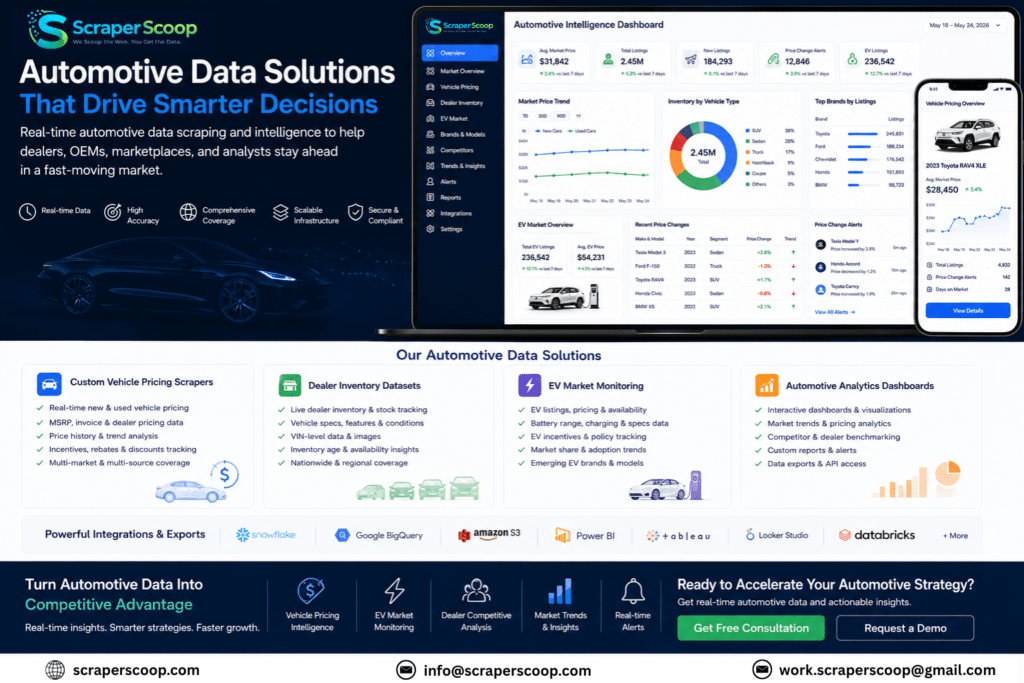
At ScraperScoop, we build automotive data intelligence solutions that meet the specific technical requirements, geographic coverage needs, and data quality standards that automotive market participants actually operate at. We understand that automotive data decisions have direct financial consequences — and we build our solutions to the accuracy, freshness, and reliability standards those consequences demand.
Here is precisely what ScraperScoop delivers for automotive industry clients:
- ✅ Vehicle Pricing Intelligence Solutions: Comprehensive competitive vehicle pricing monitoring across major marketplace platforms and dealer websites — with VIN-level granularity, geographic market segmentation, and freshness cadences matched to your decision-making requirements. Delivered as structured datasets, API feeds, or integrated analytics dashboard data.
- ✅ Dealer Inventory & Competitive Intelligence: Systematic tracking of competitor dealer inventory composition, pricing strategies, days-on-lot patterns, and market positioning — providing the competitive dealer intelligence that dealer groups and OEM field teams need for performance benchmarking and competitive response planning.
- ✅ EV Market Monitoring Solutions: Dedicated EV intelligence collection across OEM product portals, EV marketplace platforms, government incentive databases, and charging infrastructure networks — delivering the comprehensive, continuously updated EV competitive intelligence that the segment’s pace demands.
- ✅ Consumer Review & Sentiment Analytics: Structured consumer review data from Edmunds, KBB, CarGurus, Google, and automotive community platforms — with NLP sentiment analysis delivering product quality intelligence, competitive brand health benchmarking, and dealer reputation monitoring.
- ✅ Automotive Marketplace Intelligence: Competitive marketplace listing coverage analysis, pricing accuracy benchmarking, consumer search trend monitoring, and dealer network intelligence for marketplace platforms competing in the automotive digital advertising market.
- ✅ Wholesale & Residual Value Intelligence: Used vehicle market pricing data from retail and wholesale sources combined into unified residual value intelligence that supports automotive finance, insurance, and investment applications requiring accurate vehicle valuation.
- ✅ Vehicle Specification & Feature Benchmarking: Structured specification data across competing vehicle models — enabling product planning teams, marketplace platforms, and automotive analysts to maintain current, accurate, and comprehensive competitive specification databases.
- ✅ Automotive Finance & Incentive Intelligence: Continuous monitoring of OEM financing offers, dealer incentive programs, lease terms, and government purchase incentives — providing the complete effective pricing intelligence that MSRP-only analysis systematically misses.
- ✅ Ready-Made Automotive Datasets: Need automotive market data immediately? Our pre-built automotive datasets across vehicle pricing, dealer inventory, EV market, and consumer review categories give you instant access to structured, validated intelligence without development lead time.
- ✅ Automotive Data APIs: Integrate our continuously updated automotive intelligence feeds directly into your dealer management system, pricing tool, marketplace platform, or investment analytics environment — with structured data delivered in your required format and at your required frequency.
- ✅ Analytics Dashboards: Visual automotive intelligence dashboards that surface the most commercially relevant patterns from scraped data — competitive price positioning maps, inventory composition trends, EV market share trackers, consumer sentiment trend lines, and market pricing heat maps your entire team can act on.
- ✅ Compliance-First, Ethical Data Collection: All ScraperScoop automotive data collection targets publicly available market intelligence, operates within sustainable platform access parameters, and is structured to minimize legal and regulatory exposure while delivering the comprehensive coverage that automotive intelligence applications require.
Ready to Build Your Automotive Data Intelligence Advantage? Let’s Talk
The global automotive market is approaching USD 3.86 trillion by 2030. EV competition is intensifying monthly. Chinese automotive manufacturers are disrupting established competitive economics globally. Digital automotive retail is mainstream. And the decisions automotive businesses make — on pricing, inventory, EV positioning, market expansion, and competitive strategy — have never carried higher financial stakes.
The automotive businesses winning in this environment are not necessarily the largest or the best-funded. They are the ones who see the market more accurately, respond to competitive developments faster, and make pricing, inventory, and strategic decisions backed by continuously updated, geographically precise, model-level intelligence that their competitors operating without systematic data capabilities cannot match.
That data advantage starts with ScraperScoop.
At ScraperScoop, we deliver:
- ✅ Real-Time Vehicle Pricing Intelligence at VIN-level granularity across all major markets
- ✅ Dealer Inventory & Competitive Monitoring for dealer groups and OEM networks
- ✅ EV Market Intelligence across OEMs, pricing, specifications, incentives & charging infrastructure
- ✅ Consumer Review & Sentiment Analytics from all major automotive review platforms
- ✅ Automotive Marketplace Intelligence for listing coverage and competitive benchmarking
- ✅ Wholesale & Residual Value Intelligence for finance, insurance & investment applications
- ✅ Ready-Made Automotive Datasets for immediate intelligence deployment
- ✅ Automotive Data APIs for seamless DMS and platform integration
- ✅ Analytics Dashboards with actionable automotive market visualizations
- ✅ Compliance-First, Ethical Operations for sustainable long-term intelligence
🚗 Let’s Build Your Automotive Intelligence Operation — Starting Today
Your competitors are already monitoring your pricing. The market is moving faster than manual research can track. And the EV revolution is reshaping your competitive landscape every single month.
Contact ScraperScoop today for your free consultation → Tell us about your geographic markets, the vehicle segments you compete in, your pricing and inventory intelligence requirements, and your data integration needs — and we’ll design a custom automotive data intelligence solution built precisely for your competitive situation.
Conclusion: In 2026, Automotive Market Leadership Is a Data Intelligence Competition
The automotive industry in 2026 is navigating its most significant structural transformation in a century — electrification, digitalization, new competitive entrants from non-traditional markets, and the shift of consumer purchase journeys to digital channels are all simultaneously reshaping the competitive landscape. In this environment, operating with the speed, precision, and intelligence that the market demands is not achievable through manual research processes that move at human speed in a market that moves at digital speed.
Automotive data scraping is the infrastructure that makes real-time, comprehensive, geographically precise market intelligence achievable at the scale and currency that 2026’s automotive market demands. From vehicle pricing intelligence that keeps dealer margins competitive, to EV market monitoring that tracks a competitive landscape evolving by the week, to consumer review analysis that provides product quality signals ahead of formal feedback channels — the applications are commercially vital, the ROI is measurable, and the competitive disadvantage of operating without systematic automotive intelligence capabilities compounds with every passing quarter.
The technology is mature. The data sources are rich and continuously expanding. The automotive domain expertise needed to collect, normalize, and deliver investment-grade automotive intelligence is available through specialist partners. And the right partner — one who combines technical scraping infrastructure with automotive market knowledge and compliance-first operations — makes building this capability faster, more reliable, and more cost-effective than any in-house development approach.
ScraperScoop is that partner. Accurate, VIN-level, continuously updated automotive market intelligence — tailored to your market, your segments, and the commercial decisions your business needs to make better and faster.
👉 Get in touch with ScraperScoop now — and let’s turn automotive web data into your most powerful and sustainable competitive intelligence advantage.
Frequently Asked Questions About Automotive Data Scraping
What is automotive data scraping?
Automotive data scraping is the automated extraction of publicly available vehicle listings, pricing data, dealer inventory information, EV market intelligence, consumer reviews, manufacturer specifications, financing terms, and automotive market trend signals from websites, marketplace platforms, manufacturer portals, and industry sources. Car dealers, OEMs, marketplace platforms, automotive finance companies, and investors use this intelligence for vehicle pricing strategy, competitive analysis, EV market monitoring, inventory optimization, and market research.
Is automotive data scraping legal?
Scraping publicly available automotive listing data — vehicle prices, specifications, dealer inventory, and market information accessible to any consumer without authentication — is generally legal. The legal foundation for scraping publicly available web data is well-established, and automotive listing data is explicitly published for public access with consumer discovery as the explicit purpose. ScraperScoop operates with a compliance-first approach, collecting only publicly available automotive market data within responsible access parameters. Always consult legal counsel for specific commercial use cases.
How can car dealers use vehicle pricing data scraping?
Car dealers use vehicle pricing data scraping to monitor competitor pricing at VIN-level granularity across their trading market — enabling real-time competitive pricing decisions that balance turn rate targets against gross profit objectives. Systematic pricing intelligence allows dealers to identify over-priced inventory before units age into costly discount territory, optimize used vehicle acquisition bids based on current retail market conditions, and respond to competitor pricing events hours rather than days after they occur — directly improving both inventory turn performance and per-unit margin results.
What EV market data can be scraped for competitive intelligence?
EV market scraping can collect OEM vehicle specifications including range, battery capacity, and charging speed, pricing across all trim configurations and geographic markets, government incentive program eligibility data, charging infrastructure coverage from network databases, delivery window availability, software update histories, consumer review sentiment for EV models, and competitor EV launch announcements. This comprehensive EV intelligence is essential for OEMs competing in the rapidly evolving EV segment, marketplace platforms maintaining accurate EV listings, fleet managers evaluating electrification economics, and investors analyzing EV market dynamics.
Which automotive platforms can ScraperScoop collect data from?
ScraperScoop collects automotive data from all major platforms including AutoTrader, Cars.com, CarGurus, CarMax, Carvana, Edmunds, Kelley Blue Book, OEM manufacturer websites, dealer websites, Manheim and ADESA wholesale auction platforms, PlugShare and EV charging network databases, government incentive portals, automotive review sites, and international automotive marketplace platforms. We handle the full technical complexity of each platform’s unique architecture and deliver clean, VIN-level, geographically accurate automotive intelligence datasets.
How often should automotive pricing data be scraped?
Automotive data freshness requirements vary by application. Used vehicle acquisition decisions in active markets may require daily pricing data updates to reflect current market conditions. Dealer competitive pricing monitoring for daily pricing decisions typically needs overnight or same-day data refresh. Strategic market analysis and investment research may be well-served by weekly aggregation. EV market specification and pricing monitoring may need multiple updates per week given the segment’s rapid evolution. ScraperScoop helps design optimal refresh cadences for your specific applications.
How can automotive marketplace platforms use data scraping?
Automotive marketplace platforms use data scraping to monitor competitive inventory coverage and identify dealer acquisition opportunities where their listing gaps are largest, benchmark pricing accuracy and freshness against competitive platforms, track consumer search trend evolution to inform platform feature development, monitor competitor listing quality and completeness standards, and maintain comprehensive vehicle specification databases that support rich consumer search and comparison experiences. Data intelligence is foundational to the product quality and competitive differentiation of automotive marketplace platforms.
Why choose ScraperScoop for automotive data scraping?
ScraperScoop provides custom automotive scraping solutions, ready-made vehicle pricing and inventory datasets, automotive data APIs, and analytics dashboards built with automotive domain expertise and commercial-grade reliability standards. We handle all technical complexity — VIN-level data matching, geographic market segmentation, anti-bot navigation, data normalization across diverse listing formats, and compliance — delivering structured, analysis-ready automotive intelligence that your team can immediately incorporate into pricing, inventory, and strategic decisions. Contact us for a free consultation.


