

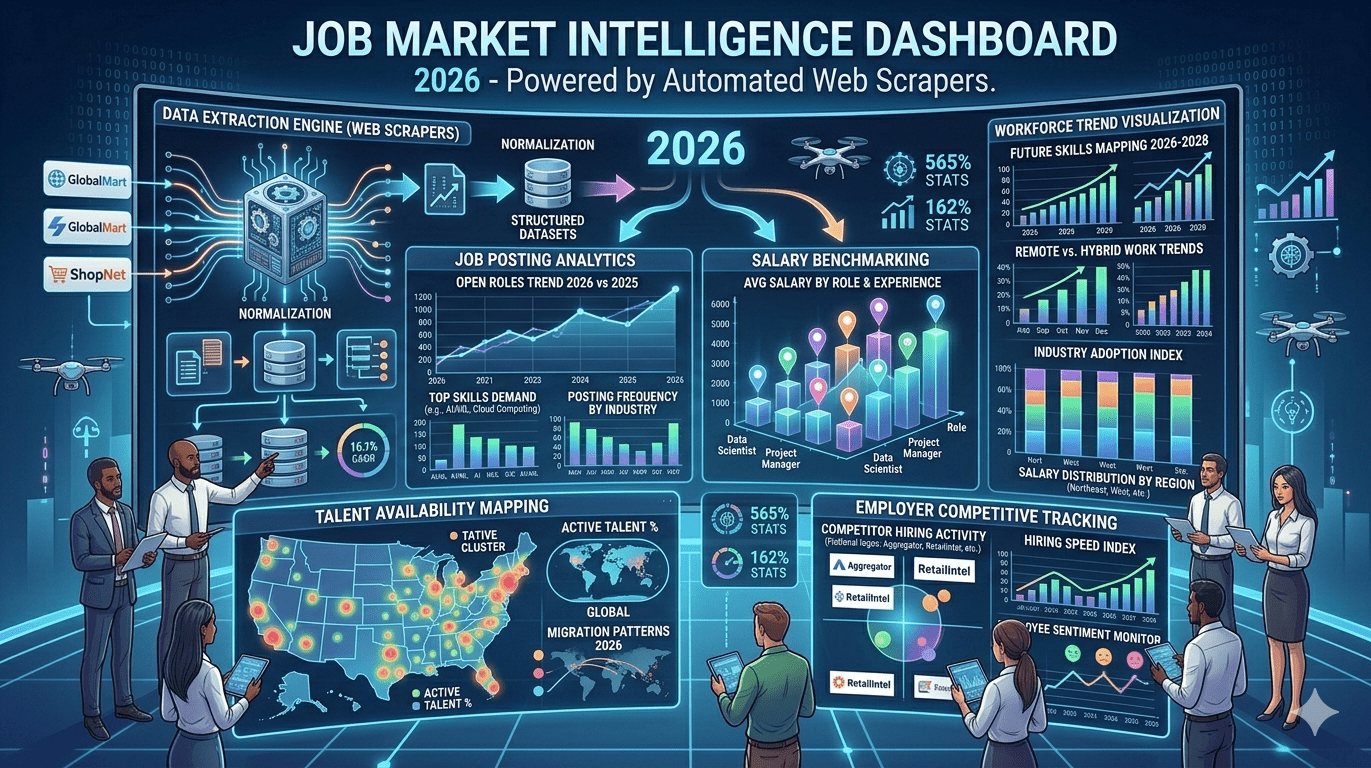
Introduction: The Labor Market Data Revolution Is Reshaping How the World Hires, Plans, and Invests
Picture this: a Chief People Officer at a fast-growing technology company is trying to understand why their engineering hiring is consistently taking 30% longer than the industry benchmark — and costing 40% more per hire than competitors of comparable size. They’ve tried salary increases. They’ve upgraded their employer branding. They’ve added recruiter headcount. Nothing moves the needle.
Then a workforce analytics consultant pulls three months of scraped job posting data from every competitor in their hiring markets. The picture becomes immediately clear: two well-funded competitors have been systematically targeting the exact same talent profiles — running always-on hiring pipelines for senior engineers in the specific technology stack this company relies on, in the exact same metropolitan markets, with total compensation packages structured 18% higher. The company hasn’t been losing the talent war through bad recruiting. They’ve been fighting with a blindfold on in a market their competitors were mapping in real time.
This scenario repeats itself across thousands of organizations every single day — in talent acquisition teams that don’t know what competitors are paying, in HR strategy functions that can’t see the supply of skills they’re trying to hire, in workforce planning functions building headcount models without current market intelligence, and in labor economists analyzing policy implications without real-time job market data. The consistent theme is the same: high-stakes workforce decisions being made with insufficient, lagging, or absent job market intelligence.
The global labor market in 2026 is simultaneously one of the most data-rich and most data-underserved environments in the entire business intelligence landscape. The global HR technology market is projected to reach USD 38.36 billion in 2026, growing toward USD 81.84 billion by 2033 at a CAGR of 11.4%. The global recruitment process outsourcing market alone is valued at USD 26.4 billion in 2026. And the demand for labor market intelligence — the structured data about who is hiring, what they’re paying, what skills are scarce, and how workforce dynamics are shifting — has never been greater or more commercially valuable.
Job market data scraping is the technology that transforms the web’s vast, publicly available labor market information — job postings, salary disclosures, employer reviews, skills data, workforce trend signals — into the structured, continuously updated intelligence that gives HR leaders, recruiters, staffing agencies, workforce tech companies, labor economists, and investors the market clarity they need to make genuinely informed decisions.
In this guide, we’ll cover everything: what job market data scraping is, what intelligence it unlocks, who is using it and how, the technical realities of building reliable workforce intelligence at scale, and exactly how ScraperScoop can build the custom job market intelligence operation your organization needs to compete and win in the talent economy of 2026.
What Is Job Market Data Scraping and Why Does It Matter Critically in 2026?
Job market data scraping is the automated process of extracting publicly available employment and workforce information from job boards, company career pages, professional networking platforms, salary aggregation sites, employer review platforms, workforce analytics publications, and labor market databases — and structuring that raw web data into actionable, continuously updated labor market intelligence.
In practical terms: rather than having HR analysts manually searching job boards, reviewing competitor career pages, compiling salary survey data, and reading employer review platforms — a process measured in weeks for any meaningful scope of market coverage — automated job market scraping solutions do all of that simultaneously, continuously, across every source that matters, delivering structured intelligence that informs talent acquisition strategy, compensation benchmarking, workforce planning, and competitive HR positioning in real time.
Why the Labor Market Is Uniquely Data-Intensive and Data-Underserved in 2026
The global labor market in 2026 is navigating a convergence of structural changes that make real-time intelligence more operationally critical than at any point in modern employment history:
- Skills volatility is accelerating dramatically. The World Economic Forum estimates that 44% of workers’ core skills will be disrupted within five years, driven primarily by AI automation, digital transformation, and the green economy transition. Organizations that cannot monitor skills demand and supply dynamics in real time are making workforce investment decisions — hiring, training, redeployment — based on skills landscapes that may be materially outdated by the time the decisions are implemented.
- Remote work has permanently globalized talent competition. The normalization of remote and hybrid work has transformed talent markets from local competitive environments to genuinely global competitions for in-demand skills. A tech company in Austin is now competing for senior engineers against employers in San Francisco, New York, London, and Toronto simultaneously — making comprehensive, cross-geography talent market intelligence essential for competitive hiring strategies that previously only needed to account for local market conditions.
- AI is creating unprecedented skills displacement and demand. Generative AI adoption is simultaneously eliminating demand for certain skill categories and creating urgent, globally scarce demand for AI-adjacent skills — prompt engineering, AI governance, ML operations, and domain-specific AI implementation expertise — at a pace that traditional labor market reporting cannot track adequately. Organizations building AI-driven competitive strategies without systematic AI skills availability intelligence are planning blind.
- Compensation inflation has created benchmarking crises. Post-pandemic compensation inflation — particularly in technology, data science, and healthcare — has made traditional annual salary surveys dangerously outdated as compensation benchmarking tools. Organizations whose compensation philosophy relies on surveys published 6-12 months ago are consistently out of market in ways that drive costly voluntary turnover among their most valuable employees.
- The talent market has become intensely competitive across every sector. Organizations competing for talent — particularly for roles requiring specialized technical, analytical, or domain expertise — are increasingly facing well-informed, data-equipped competitors whose talent acquisition operations have access to real-time market intelligence. Without equivalent intelligence capabilities, companies are systematically disadvantaged in compensation negotiation, offer timing, and talent pipeline strategy.
These factors collectively create the conditions where job market data scraping has evolved from an advanced analytical capability to a baseline operational requirement for organizations serious about competing effectively in the talent economy of 2026.
What Job Market Data Can You Actually Scrape? The Complete Intelligence Taxonomy
The breadth of labor market intelligence accessible through automated web scraping is significantly larger than most HR professionals and workforce analysts appreciate. Here is the complete taxonomy of what’s available — and the specific workforce decision value each data type delivers.
1. Job Posting Data
Job postings are the richest and most universally valuable category of labor market intelligence available through web scraping. Each posting contains a remarkable density of structured information: job title and role level, required skills and qualifications, preferred experience and education, compensation ranges where disclosed, location and remote work availability, employment type, benefits highlights, technology stack requirements for technical roles, team structure indicators, company growth stage signals, and the specific language and positioning that reveals how employers are competing for talent. Systematic scraping of job postings at scale creates a continuously updated picture of workforce demand — what roles organizations are actively trying to fill, at what seniority, with what skill requirements, in which locations, and at what compensation levels.
2. Salary & Compensation Data
Compensation intelligence scraped from job postings with disclosed salary ranges, employer-submitted salary databases, crowdsourced compensation platforms, and government wage reporting databases provides the market salary benchmarking data that HR compensation teams, recruiters, and job seekers need for informed compensation decisions. As salary transparency legislation expands — with requirements for salary range disclosure now active in New York, California, Colorado, Washington, and other jurisdictions — the volume of publicly available compensation data embedded in job postings has grown dramatically, making job board scraping increasingly valuable as a real-time compensation benchmarking source that supplements annual surveys with continuous market data.
3. Skills Demand & Competency Intelligence
Analyzing the skills requirements embedded in large volumes of job postings — which technical skills appear most frequently in specific role categories, which skill combinations command the highest salary premiums, which skills are trending upward in demand versus declining, and which newly-emerging skills are appearing at increasing frequency before mainstream awareness — creates a skills demand intelligence layer that is foundational for workforce planning, learning and development investment prioritization, and competitive talent positioning strategy. This skills intelligence is particularly valuable in technology and AI domains where skill demand evolution outpaces traditional education and certification frameworks.
4. Employer Review & Culture Intelligence
Employer review platforms — Glassdoor, Blind, Indeed Reviews, LinkedIn recommendations, and company-specific review aggregators — contain enormous volumes of employee experience intelligence that provides unique insights into competitive employer positioning. Systematic scraping and analysis of employer review data reveals the specific compensation satisfaction levels, culture dimensions, management quality perceptions, work-life balance experiences, and career development opportunities that define employer brand equity in specific talent pools — intelligence that is foundational for both competitive employer positioning strategy and talent retention risk assessment.
5. Hiring Velocity & Workforce Demand Signals
Tracking job posting volume trends over time — how many roles is a specific employer actively posting, in which functions, at which seniority levels, in which geographies — creates hiring velocity intelligence that reveals organizational investment priorities and business trajectory signals with a forward-looking quality that financial reporting data cannot match. Increasing hiring velocity in a competitor’s commercial organization is a signal of revenue growth confidence. Systematic reductions in headcount across engineering while increasing finance and legal hiring signals operational restructuring. These workforce demand signal patterns provide competitive business intelligence that extends well beyond traditional HR applications into strategic planning and investment research use cases.
6. Remote Work & Location Intelligence
The evolution of remote and hybrid work policies is one of the most consequential workforce trend dimensions in 2026 — and it’s visible through systematic job posting analysis in ways that self-reported employer surveys and policy announcements often obscure. Tracking what proportion of each employer’s active postings are fully remote, hybrid, or fully in-office — by function, seniority level, and geographic market — provides the ground-truth picture of remote work policy implementation that individual company statements often fail to accurately represent. For talent acquisition teams designing their own work location policies, this competitive remote work intelligence is increasingly important for maintaining competitive positioning in candidate-driven talent markets.
7. Time-to-Fill & Market Tightness Indicators
The duration that job postings remain active before being removed — a proxy for time-to-fill and market tightness for specific role categories — provides a market temperature indicator that reveals where talent scarcity is creating extended hiring timelines. Postings that remain active for 60-90 days in specific role categories are signaling genuine talent scarcity — locations and skill combinations where demand exceeds supply by meaningful margins. This market tightness intelligence informs both sourcing strategy (where to source from when local market supply is insufficient) and compensation strategy (where to offer premium compensation to accelerate hiring in tight markets).
8. Benefits & Perks Competitive Intelligence
The benefits, perks, and working conditions that employers explicitly highlight in job postings and employer branding content provide competitive intelligence about how organizations are differentiating their employee value propositions beyond base compensation. As compensation transparency increases and base salary differentials narrow in many talent segments, non-compensation benefits — equity programs, flexible work arrangements, parental leave policies, learning and development investment, wellness benefits, and career progression frameworks — have become increasingly important competitive differentiators. Systematic monitoring of how competitors articulate their benefits positioning in recruiting content reveals the employer branding battleground in specific talent pools.
9. Education & Credential Requirement Trends
The requirements employers set for educational credentials — degree requirements, certifications, specific institutional affiliations — and how those requirements are evolving over time provide workforce policy intelligence that matters for educational institutions, workforce development programs, policy makers, and employers designing their own talent pipeline strategies. The widely-discussed trend of “degree inflation” — employers removing formal degree requirements in favor of skills-based hiring criteria — is visible and measurable through systematic analysis of job posting requirement evolution, providing early evidence of workforce credential policy shifts before they reach mainstream business press coverage.
10. Layoff & Workforce Reduction Intelligence
Company layoff announcements, WARN Act filing data (publicly available for large U.S. workforce reductions), and the disappearance of previously active job posting categories in specific employers collectively provide talent availability signals that are highly valuable for talent acquisition teams in sectors where competitors are reducing workforce. Organizations whose competitors announce significant layoffs in functions they’re actively hiring represent extraordinary talent acquisition opportunities — but capturing that opportunity requires detecting the signal quickly and activating sourcing programs before affected talent is absorbed by other employers. Systematic monitoring of workforce reduction signals enables exactly this rapid response.
11. Freelance & Gig Economy Market Intelligence
Freelance platform posting data from Upwork, Fiverr, Toptal, and specialized professional services platforms provides visibility into the gig economy talent market — the pricing, skill availability, project types, and competitive dynamics of the contingent workforce layer that increasingly supplements full-time employment. For organizations managing blended workforces, project-based hiring requirements, or talent strategy assessments that include contingent workforce considerations, systematic gig platform intelligence provides market data that traditional job board monitoring misses entirely.
12. Executive & Leadership Hiring Intelligence
Senior leadership hiring activity — C-suite appointments, VP-level functional leadership additions, board member appointments, and senior director hires — provides strategic organizational direction signals that go well beyond functional workforce planning. A company hiring its first Chief AI Officer is signaling a strategic AI investment commitment. A competitor adding multiple revenue-focused senior leadership positions is signaling aggressive commercial growth plans. Systematic monitoring of executive hiring announcements and senior leadership career page postings creates a continuous strategic intelligence stream about organizational direction changes that leads formal strategic communication by multiple months.
Key Job Market Data Sources for Scraping: Where the Workforce Intelligence Lives in 2026
Building an effective job market intelligence strategy requires understanding which platforms and sources carry the most valuable workforce intelligence for your specific application. Here’s the landscape of primary sources and what makes each uniquely valuable.
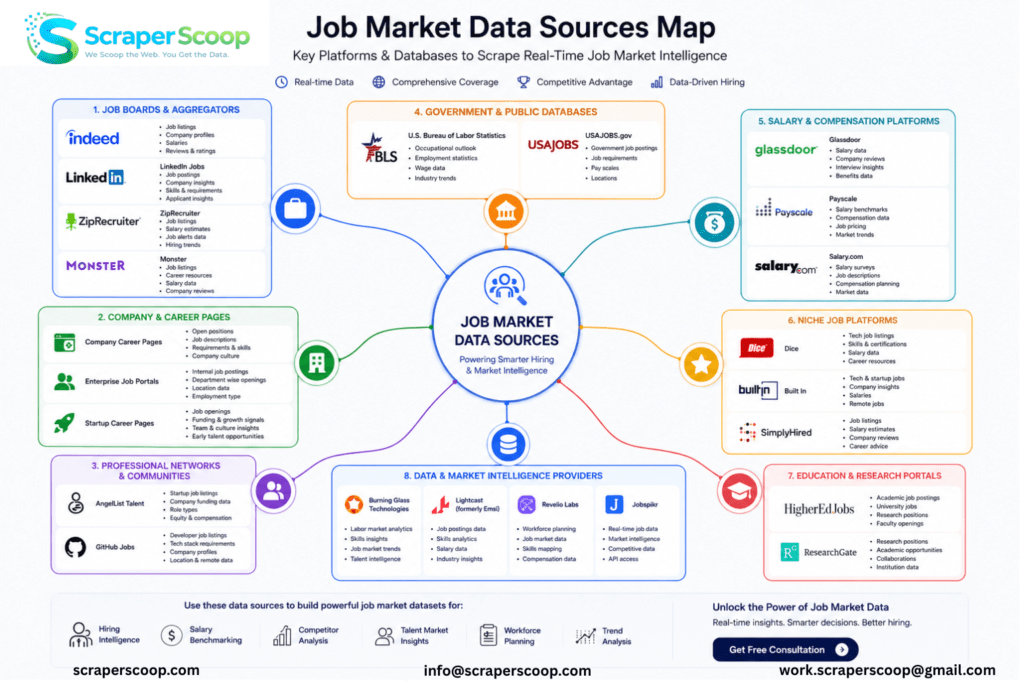
Indeed
Indeed is the world’s largest job site, aggregating postings from thousands of employer career pages, direct employer postings, and third-party job board sources — making it the most comprehensive single-source coverage of job posting activity available. With hundreds of millions of job seeker visits monthly and postings spanning virtually every industry, geography, and role type globally, Indeed is the foundational monitoring target for any comprehensive job market intelligence operation. Indeed’s salary data, collected from employer disclosures and employee self-reporting, also provides one of the largest publicly accessible compensation benchmarking datasets available through systematic collection.
LinkedIn’s job posting database provides unique intelligence value beyond raw listing volume — because LinkedIn job postings are contextually enriched with company size, industry, employee count, company growth trajectory, and poster professional network data that creates a more complete employer intelligence picture than job-only platforms. LinkedIn’s company page data — follower counts, employee count changes, and engagement with company content — provides additional workforce demand and employer brand signals that complement posting volume with organizational context. For professional and managerial role categories particularly, LinkedIn posting coverage is often more complete and more professionally relevant than other platforms.
Glassdoor
Glassdoor’s combination of employer reviews, salary reports, interview experience data, and job postings makes it uniquely valuable for multi-dimensional employer intelligence. The employee review component — covering compensation satisfaction, culture ratings, CEO approval scores, work-life balance assessments, and career development perceptions — provides the employer brand health intelligence that complements posting volume data with the qualitative workforce experience signals that determine employer attractiveness in competitive talent markets. For organizations building or monitoring employer brand strategies, Glassdoor intelligence monitoring is essential and irreplaceable.
ZipRecruiter, Monster & Niche Job Boards
Platform-specific coverage differences mean that ZipRecruiter, Monster, CareerBuilder, and hundreds of industry-specific and geographic job boards collectively contain posting activity not fully represented on broader platforms. Healthcare-specific boards, technology-specialist platforms, finance industry recruiters, and geographic-specific employment sites all provide coverage that comprehensive labor market intelligence requires. Building multi-source job market monitoring that includes niche platforms alongside major aggregators consistently delivers more complete market coverage than major-platform-only monitoring approaches.
Company Career Pages
Direct scraping of employer career pages provides the most current and complete job posting data for specific organizations — because career pages are the authoritative source from which aggregators pull, and career page postings often appear before full propagation to aggregator platforms. For competitive employer monitoring — tracking specific competitor organizations’ hiring activity — direct career page scraping provides the most timely and complete intelligence. Career pages also frequently contain richer job description content, team context information, and company culture signals than the condensed versions that appear on aggregator platforms.
Government Labor Market Databases
The Bureau of Labor Statistics (BLS) in the U.S., Eurostat in Europe, and equivalent national statistical agencies globally publish comprehensive labor market data — unemployment rates by sector and geography, wage growth by occupation category, job opening and labor turnover (JOLTS) data, and occupational employment and wage statistics. Systematic scraping and integration of government labor data with commercial job posting intelligence creates a more complete labor market picture that combines the real-time granularity of posting data with the macroeconomic context of official statistics.
Salary Transparency & Compensation Platforms
Levels.fyi (technology compensation specialization), Compensation.cafe, PayScale, Salary.com, and H-1B salary disclosure databases (publicly available through USCIS for visa applications) collectively provide compensation benchmarking data at varying levels of detail, industry specialization, and geographic granularity. As state-level salary transparency legislation expands the mandatory disclosure of salary ranges in job postings, the job posting platforms themselves are becoming increasingly rich sources of compensation intelligence — making job posting scraping and compensation benchmarking increasingly converging intelligence applications.
Professional Certification & Training Platforms
Coursera enrollment trends, LinkedIn Learning course popularity data, AWS and Google certification registration volumes, and professional association membership growth patterns collectively provide skills investment intelligence — revealing which competencies the workforce is actively acquiring in response to market demand signals. Monitoring these learning and certification platform signals alongside job posting demand data creates a supply-side workforce intelligence layer that complements demand-side posting analysis with evidence of how quickly the talent supply is adapting to changing market skill requirements.
WARN Act & Layoff Tracking Sources
State-level WARN Act filing databases (publicly available for qualifying U.S. workforce reductions of 50+ employees), Layoffs.fyi, tech industry layoff tracking platforms, and corporate restructuring press release monitoring collectively provide workforce reduction intelligence that reveals talent availability signals and competitive vulnerability patterns in real time — enabling HR teams and talent acquisition organizations to identify and mobilize recruiting resources toward available talent pools before competitors do.
10 High-Impact Job Market Data Scraping Use Cases Driving Competitive Advantage in 2026
Understanding what data is available is the foundation. Understanding how the most sophisticated HR organizations, staffing companies, workforce tech platforms, and labor market researchers are actually deploying this intelligence for measurable competitive advantage is where the practical value lives.
1. Talent Competitive Intelligence & Competitor Hiring Monitoring
Understanding what your talent market competitors are hiring — what roles, at what seniority levels, with what skill requirements, in which locations, and at what disclosed compensation levels — is the foundational intelligence for competitive talent strategy. Systematic scraping of competitor career pages and job board postings creates a continuously updated picture of competitor workforce investment priorities that reveals strategic direction signals, functional capacity building plans, and talent market demand concentrations that will affect your own hiring timelines and compensation positioning.
Organizations that monitor competitor hiring continuously — rather than periodically checking career pages when a specific concern arises — consistently identify competitive talent market threats earlier, respond to compensation benchmark shifts faster, and make talent acquisition investment decisions with better market context than those operating without systematic competitive hiring intelligence. For talent acquisition leaders managing competitive hiring in scarce skill markets, this intelligence is not a nice-to-have — it’s the difference between building talent pipelines ahead of demand and perpetually chasing a market that competitors are moving faster within.
2. Real-Time Compensation Benchmarking & Pay Equity Intelligence
Annual compensation surveys are structurally inadequate for organizations competing in talent markets that are moving on quarterly or even monthly cycles. Job posting salary data — collected continuously from the expanding universe of transparency-compliant postings, government wage databases, and crowdsourced compensation platforms — provides the real-time compensation benchmarking capability that annual surveys cannot deliver. HR compensation teams using systematic salary intelligence consistently identify and close compensation gaps faster, reduce flight risk from below-market compensation earlier, and negotiate offer acceptance rates more effectively than those relying on survey data that may be 6-18 months old in fast-moving talent segments.
Pay equity analysis — ensuring compensation equity across gender, race, and other demographic dimensions — is also increasingly supported by external market data that provides the benchmark context for internal equity assessments. Organizations whose compensation philosophy incorporates continuous market data alongside internal equity analysis consistently build more defensible, more equitable, and more competitive compensation structures than those treating pay equity and market competitiveness as separate analytical exercises.
3. Skills Gap Analysis & Workforce Planning Intelligence
Strategic workforce planning requires understanding not just how many people you need but what skills they need to have — and how available those skills are in the market. Systematic analysis of job posting skills requirements across large posting datasets reveals the specific competency combinations that are most in demand, the skills whose market supply is tightest relative to demand, the skills whose demand trajectory is rising fastest, and the geographic markets where specific skill concentrations are highest. This skills landscape intelligence transforms workforce planning from a headcount exercise into a genuine capability planning discipline — enabling organizations to identify where to build talent pipelines, where to invest in internal reskilling, and where talent scarcity requires product or process redesign to reduce the human capital bottleneck.
4. Employer Brand Health Monitoring & Competitive EVP Intelligence
Your employer brand — how current and potential employees perceive your organization as a workplace — directly affects the quantity and quality of job applications you attract, the acceptance rates of your offers, and the voluntary turnover rates in your most valuable talent segments. Systematic scraping and NLP analysis of employer reviews across Glassdoor, Indeed Reviews, LinkedIn, and Blind provides continuous employer brand health intelligence — tracking your review score trends, identifying the specific culture and compensation dimensions generating the most negative sentiment, and benchmarking your employer brand health metrics against key competitor employers in your talent markets. For HR leaders responsible for employer branding investment, this continuous monitoring intelligence is far more timely and actionable than periodic survey-based brand assessments.
5. Recruitment Agency & Staffing Company Market Intelligence
For staffing agencies, executive search firms, and recruitment process outsourcing companies, systematic job market data scraping provides the business development intelligence, placement market intelligence, and client relationship intelligence needed to compete effectively in a market where speed and market knowledge are primary competitive differentiators. Understanding which clients are actively hiring in your specialty areas before they contact recruiters — derived from continuous job posting monitoring — enables proactive business development outreach that consistently outperforms reactive proposal responses. Understanding the full supply of available candidates in specific skill categories — derived from talent supply analysis across posting and professional network data — enables more accurate and faster placement processes that build the placement performance reputation that drives referrals and repeat business.
6. HR Technology Platform Development & Data Products
For HR technology companies building talent intelligence platforms, compensation benchmarking tools, workforce analytics solutions, and recruitment technology products, comprehensive, continuously updated job market data is literally the product foundation. Every salary benchmarking feature, skills demand visualization, talent availability map, and competitive hiring intelligence module in a workforce analytics platform depends on a robust, continuously updated job market data infrastructure. Managed job market data scraping services provide the data foundation that HR tech companies need without requiring them to build and maintain complex scraping operations in parallel with their core product development — enabling faster time-to-market for data-powered HR tech features and more reliable data quality than in-house scraping approaches typically achieve.
7. Labor Market Research & Economic Policy Intelligence
Labor economists, government policy analysts, academic researchers, think tanks, and economic consulting firms use systematic job market data to analyze employment trends, evaluate policy interventions, model labor market equilibrium dynamics, and produce research publications that inform both private sector strategy and public policy decisions. Real-time job posting data provides a leading indicator of labor demand that leads official government employment statistics by weeks to months — enabling more timely analysis of economic condition changes that backward-looking official data cannot capture at equivalent speed. Organizations producing labor market research with systematic web-scraped job data consistently produce more timely, more geographically granular, and more skill-specific intelligence than those working from official statistics alone.
8. Investment Intelligence & Alternative Hiring Data
As documented in financial data contexts, hiring signal data derived from job posting scraping is one of the most extensively validated alternative data signals for forward equity returns — and this investment application extends directly into the labor market intelligence domain. Investment analysts tracking specific publicly traded companies use systematic job posting monitoring to detect business momentum signals, strategic investment direction changes, and organizational restructuring developments that lead earnings reporting by multiple quarters. For private equity firms conducting operational due diligence on portfolio companies and acquisition targets, comprehensive competitive hiring intelligence provides the workforce strategy and organizational capability assessment that financial metrics alone cannot deliver.
9. Geographic Talent Market Mapping & Location Strategy
For organizations evaluating new office location decisions, remote work hub strategies, or geographic expansion of talent acquisition into new markets, systematic job market data provides the talent supply intelligence needed to make these high-stakes capital decisions with evidence rather than intuition. How large is the available talent pool for your critical role categories in specific metropolitan markets? How competitive is the hiring environment — how many other employers are actively competing for the same talent profiles? What compensation levels are required to attract talent in each geographic market? What is the trajectory of talent supply — is the local workforce for your critical skills growing or declining? Systematic job market scraping provides rigorous answers to all of these location strategy questions.
10. Diversity, Equity & Inclusion Workforce Intelligence
DEI strategy execution requires understanding not just internal workforce composition but external talent market composition and the hiring practices of competitive employers. Systematic analysis of job posting language — including the presence of inclusive language signals, demographic barrier indicators in qualification requirements, and explicit diversity commitment statements — across competitive employers provides DEI program benchmarking intelligence. Combined with analysis of where diverse talent populations are concentrated geographically and which industries and role types are most successfully attracting underrepresented talent, this DEI workforce intelligence supports more evidence-based, more targeted, and more effective diversity hiring and retention strategies.
Real-Time Compensation Benchmarking: Why Annual Surveys Are No Longer Enough
Among all job market data scraping applications, real-time compensation benchmarking has emerged as the highest-urgency, most universally relevant intelligence capability for HR organizations in 2026 — and the one where the gap between organizations using continuous data and those relying on annual surveys is most starkly visible in talent outcomes.
The Annual Survey Problem in 2026
Traditional compensation benchmarking has relied on participation in annual industry salary surveys — organizations submit their compensation data, receive anonymized market data in return, and use that data to set pay bands and compensation philosophy decisions for the coming year. This model has three structural problems that have become increasingly costly in the post-pandemic labor market:
- Temporal lag: Annual surveys reflect compensation levels 6-18 months before the data reaches decision-makers — a period in which technology sector compensation, for example, has historically moved by double-digit percentages in both directions. Decisions made from lagging data can leave organizations systematically below market in ways they don’t discover until voluntary turnover spikes in exactly the roles where they’re most exposed.
- Sample coverage gaps: Survey participation is voluntary and self-selected — creating coverage gaps in specific industries, geographies, and emerging role categories where the organizations most likely to have novel compensation approaches are also least likely to participate in traditional survey programs.
- Granularity limitations: Annual surveys provide useful national and regional averages but often lack the role-specific, location-specific, seniority-specific granularity needed for individual compensation decisions — requiring interpolation and judgment that introduces significant error into the final compensation positioning.
How Salary Transparency Legislation Is Transforming the Data Landscape
The rapid expansion of salary transparency legislation — requiring salary range disclosure in job postings across an increasing number of U.S. states and internationally — is fundamentally transforming the compensation benchmarking data landscape. As jurisdictions requiring pay range disclosure continue expanding, the proportion of job postings containing disclosed compensation data is growing rapidly — creating an increasingly rich real-time compensation benchmarking dataset embedded directly in job posting streams.
Organizations that are systematically collecting and analyzing this disclosed compensation data from job postings — at the role, seniority, location, and industry granularity that individual compensation decisions require — are building real-time market compensation intelligence that is structurally more current, more granular, and more specific than annual survey data. This is not a replacement for traditional surveys in all contexts — but it is a critical complement that significantly improves compensation benchmarking currency and granularity for organizations willing to invest in systematic job market data collection.
The Voluntary Turnover Prevention ROI
The financial cost of voluntary turnover — particularly in high-value technical, commercial, and managerial roles — is extensively documented and consistently significant. Estimates range from 50% to 200% of annual salary when accounting for recruiting costs, productivity gaps during transition, knowledge loss, and the downstream impact on team performance and morale. Organizations that maintain continuous compensation market intelligence and proactively address below-market compensation before it drives voluntary turnover decisions consistently achieve materially lower turnover rates in their most valuable talent segments — generating compensation intelligence ROI that dwarfs the investment in the underlying data infrastructure.
Skills Intelligence: Mapping the Future Workforce with Real-Time Demand Data
Skills intelligence — understanding which competencies are in demand, which are scarce, and how demand is evolving — is increasingly recognized as the most strategically important dimension of labor market intelligence for organizations navigating the AI-driven transformation of work. Job market data scraping provides the most comprehensive, most current, and most granular skills demand intelligence available from any source.
The AI Skills Intelligence Imperative
No skills category is evolving faster or creating more strategic urgency than AI-related competencies. Demand for AI engineers, ML operations professionals, prompt engineers, AI governance specialists, and domain-specific AI implementation experts is growing at rates that traditional talent pipeline development simply cannot keep pace with — creating genuine scarcity that is limiting organizations’ ability to execute AI strategies at the speed their competitive situations demand.
Systematic analysis of AI and machine learning job posting trends reveals the specific AI competency combinations that are most in demand by role category, the compensation premiums that AI skills are commanding relative to equivalent-seniority non-AI roles, the geographic concentrations of AI talent supply, and the trajectory of AI skill demand growth across different industry sectors. Organizations with this intelligence are making better decisions about where to compete for AI talent externally, where to invest in internal AI upskilling programs, and where to use AI tool adoption to reduce dependency on scarce AI specialist talent.
Skills Decay and Future-Proofing Intelligence
The declining frequency with which specific skills appear in job postings over time — the skills decay signal — is an early warning indicator of automation risk and role obsolescence that responsible workforce planning cannot afford to ignore. Organizations that monitor skills decay patterns in their workforce-relevant job posting data can identify which current employee skill profiles are losing market demand relevance — enabling proactive reskilling investments that protect employee career trajectories and organizational capability continuity before displacement creates costly disruption.
Skills Adjacency Mapping for Internal Mobility
Analysis of the skills combinations that most frequently co-appear in job postings reveals the skills adjacency relationships that make internal mobility between roles most viable. When organizations understand which current employee skill profiles map most closely to the profiles of the roles they’re struggling to fill externally, they can build targeted internal mobility programs that reduce external hiring dependency in scarce categories while creating career development pathways that improve employee retention in their existing workforce. This internal mobility intelligence — derived from systematic comparison of internal workforce skill profiles against external job posting demand patterns — represents one of the highest-ROI applications of skills demand data available.
Staffing Agency & Recruitment Intelligence: How Data Transforms the Talent Intermediary Business
For staffing agencies, executive search firms, recruitment process outsourcing providers, and independent recruiters — the intermediaries who collectively power billions of dollars in talent placement annually — job market data scraping provides the continuous market intelligence that is increasingly the primary competitive differentiator between firms that win mandates and fill roles consistently and those that struggle with both.
Proactive Business Development Intelligence
The most valuable capability that job posting monitoring provides for staffing agencies is proactive identification of client hiring needs before clients reach out to recruiters. When a target client organization — or a prospect the agency wants to develop into a client — begins posting multiple positions in the agency’s specialty areas, that posting activity is a direct signal of active hiring demand that represents a specific, timely business development opportunity. Agencies that detect this signal within hours of posting activity beginning — through automated monitoring of target company career pages and job board listings — can initiate proactive outreach with specific, credible offers of assistance that demonstrate market knowledge and create conversation opportunities before the client has activated competing recruitment relationships.
Market Supply and Demand Clarity for Candidate Advisement
Systematic job posting data analysis gives recruitment professionals the current market supply and demand context needed to counsel candidates accurately — setting realistic timeline expectations, providing evidence-based compensation guidance, and identifying the market conditions that make specific career moves genuinely favorable versus marginally advantageous. Recruiters who can say “based on current posting volumes for your profile, you’re looking at a 3-4 week active search timeline with a market range of X-Y” — backed by current data rather than experience-based estimates — consistently build stronger candidate relationships and more efficient placement processes than those relying on intuition and historical pattern memory.
Placement Quality Improvement Through Market Intelligence
Understanding the full landscape of available opportunities for each candidate profile — not just the specific openings a recruiter happens to know about personally — enables more comprehensive placement processes that consistently improve outcomes for both candidates and client employers. Systematic monitoring of all relevant active postings for specific skill profiles gives recruiters a complete market opportunity picture that maximizes the probability of finding the optimal match rather than the first available match — improving placement quality, retention outcomes, and the long-term relationships that drive recruiter reputation and referral business.
Ready to transform your staffing agency or recruitment function with job market data intelligence? Talk to ScraperScoop’s workforce intelligence specialists today — we build custom job market data solutions specifically designed for staffing and recruitment applications.
HR Tech Platform Development: Building Workforce Intelligence Products with Scraped Job Data
The HR technology market’s explosive growth — projected from USD 38.36 billion in 2026 toward USD 81.84 billion by 2033 — is creating extraordinary opportunities for workforce tech companies whose competitive differentiation depends on the quality, breadth, and freshness of the underlying labor market data powering their products.
Salary Benchmarking Products
Compensation benchmarking tools — whether standalone products or embedded features in broader HRIS and talent management platforms — depend fundamentally on comprehensive, current salary market data to deliver the competitive positioning intelligence that their users pay for. The expanding universe of salary-transparent job postings, combined with H-1B wage disclosure data, government occupation wage statistics, and crowdsourced compensation reports, provides the raw data foundation that systematic scraping transforms into the structured, normalized, continuously updated compensation datasets that power competitive salary benchmarking features.
Skills Intelligence & Workforce Analytics Features
Skills demand visualization tools, talent availability maps, skills gap analysis engines, and workforce planning simulations all depend on large-scale, continuously refreshed job posting data as their primary input. HR tech companies that maintain proprietary, systematically scraped job market datasets — updated with sufficient frequency to reflect the actual pace of labor market change — consistently deliver more accurate, more timely, and more granular workforce intelligence features than those depending on periodic data purchases from third-party providers or attempting to build scraping infrastructure in-house alongside product development priorities.
Talent Intelligence & ATS Integration
Applicant tracking systems, talent intelligence platforms, and recruitment marketing tools that integrate real-time job market data — showing recruiters the current competitive posting landscape for roles they’re trying to fill, surfacing compensation benchmarks at the time of offer creation, and alerting teams when competitor employers begin posting in talent categories they’re actively recruiting — create demonstrably better recruiter productivity and hiring outcome metrics than those operating from static or manually updated market data. For HR tech companies competing in the talent acquisition technology market, real-time job data integration is increasingly a product differentiation requirement rather than a feature enhancement.
Job Market Data Scraping Technical Challenges — Why Professional Services Deliver Superior Results
Job market data scraping presents a distinctive set of technical challenges that make reliable, comprehensive, investment-grade data collection significantly more complex than it might appear. Here’s what makes it genuinely hard — and how professional data services address each challenge effectively.
Challenge 1: Sophisticated Anti-Bot Protection on Major Job Platforms
Major job platforms — particularly LinkedIn, Indeed, and Glassdoor — deploy advanced bot detection and automated access prevention systems that are specifically designed to prevent large-scale automated data collection. These systems include CAPTCHA challenges, behavioral fingerprinting, IP velocity analysis, session invalidation, and machine learning-powered anomaly detection that make reliable, high-volume automated collection technically demanding. Professional scraping infrastructure addresses these defenses through realistic browser behavior simulation, intelligent proxy rotation, adaptive request pacing, and continuous technical adaptation as platform defenses evolve — maintaining the reliable access that comprehensive job market monitoring requires.
Challenge 2: Job Posting Deduplication and Entity Resolution
The same job posting frequently appears across multiple platforms simultaneously — because employers post directly on job boards, through ATS integrations, and on their own career pages, and aggregators then scrape and republish these postings. Without sophisticated deduplication logic, a job market intelligence database built from multiple sources will dramatically over-count actual job demand by counting the same posting multiple times. Effective deduplication requires employer entity matching, job content similarity analysis, and temporal deduplication logic that identifies duplicate postings without removing genuinely distinct opportunities from the same employer — a technically demanding problem that requires both engineering sophistication and workforce domain expertise to solve accurately.
Challenge 3: Compensation Data Normalization
Salary information in job postings appears in radically diverse formats: hourly rates, annual salaries, daily rates for contract positions, ranges versus point estimates, plus-bonus-and-equity total compensation descriptions, and per-project fee structures for freelance postings. Normalizing all of these formats into comparable compensation metrics — enabling meaningful cross-job, cross-platform salary benchmarking — requires sophisticated parsing logic that handles edge cases, currency conversions for international data, and the contextual judgment to correctly interpret ambiguous compensation disclosures. Generic data normalization pipelines consistently fail at the compensation normalization problem in ways that produce systematically misleading salary benchmarks.
Challenge 4: Skills Extraction and Taxonomy Mapping
Extracting structured skills intelligence from job posting free text requires NLP capabilities that can identify skill mentions within variable-format job description text, resolve skill name variations (Python vs. Python programming vs. Python scripting all refer to the same skill), map specific skills to standardized taxonomy frameworks (ESCO, O*NET, or proprietary classification systems), and distinguish required skills from preferred skills from nice-to-have mentions — distinctions that significantly affect the demand signal interpretation. Building accurate skills extraction pipelines requires both NLP engineering investment and workforce domain expertise that most general-purpose text processing approaches lack.
Challenge 5: High-Volume Data Collection and Storage Infrastructure
Comprehensive job market monitoring at meaningful scale involves collecting and processing tens of millions of job postings continuously — across dozens of platforms, multiple geographies, and dozens of role categories simultaneously. The data engineering infrastructure required for this — high-throughput collection systems, distributed processing pipelines, efficient storage architectures, and real-time delivery mechanisms — represents a significant ongoing technical investment that is rarely cost-justified for organizations whose core business is using workforce intelligence rather than producing it. Partnering with specialist data providers who have already built and optimized this infrastructure dramatically reduces time-to-intelligence and total cost compared to in-house builds.
Challenge 6: Historical Data Depth for Trend Analysis
Skills demand trend analysis, compensation trajectory forecasting, and labor market cycle research all require historical data going back multiple years — and often multiple economic cycles — to produce statistically meaningful insights. Retroactively building historical job posting data depth is technically complex or impossible for sources that don’t maintain accessible archives. Professional job market data providers who have been systematically collecting and archiving specific platforms for years possess historical data assets that newly-built scraping operations cannot replicate — creating a meaningful and durable intelligence quality advantage for established providers.
These challenges collectively explain why the most sophisticated users of job market intelligence — from enterprise HR organizations to HR tech platforms to workforce research institutions — work with specialist managed data providers rather than attempting to build comprehensive job market scraping infrastructure in-house. Get in touch with ScraperScoop’s workforce intelligence team today — we’ve built the infrastructure, solved the technical challenges, and deliver clean, structured, analysis-ready job market intelligence that your team can immediately incorporate into talent acquisition, workforce planning, and strategic decision processes.
Legal, Ethical & Platform Policy Considerations for Job Market Data Scraping
Job market data scraping operates within a legal and ethical framework that requires careful navigation — particularly as major platforms have become more assertive about automated data collection policies and as data privacy regulations have implications for workforce data.
Public Job Postings and Legal Access Principles
Job postings are published publicly by employers with the explicit intent of reaching the widest possible audience of potential candidates — making job posting data categorically public information. The legal precedent supporting automated collection of publicly available web data — including the significant hiQ v. LinkedIn precedent in the U.S. context — provides a sound legal foundation for systematic collection of publicly visible job posting information. Organizations have been collecting and analyzing job posting data for labor market research, competitive intelligence, and HR strategy purposes for many years, and this activity has broad commercial and academic legitimacy.
GDPR and Workforce Data Privacy
Job postings contain employer information — company names, job titles, location details, contact information — that is generally not personal data in the GDPR sense. However, job market intelligence operations that extend to collecting individual professional profile data from platforms like LinkedIn — where individual professionals have created personal professional profiles — do involve personal data that triggers GDPR obligations for European users. Responsible job market intelligence collection designs its scope to focus on aggregate market intelligence from job posting data rather than individual-level professional tracking — minimizing personal data processing exposure while delivering the labor market intelligence that workforce applications require.
Platform Terms of Service Navigation
Major job platforms address automated data access in their terms of service with varying specificity. LinkedIn has been among the most assertive in pursuing legal action against automated data collection — though its legal positions have faced significant challenges in court. Responsible job market intelligence collection operates within the spirit of platform terms — collecting publicly available posting data at sustainable rates, not circumventing authentication systems to access private content, and not using collected data in ways that directly compete with platform commercial functions in bad faith. Professional data providers maintain ongoing legal review of platform terms and structure collection operations to minimize exposure while maintaining the comprehensive coverage that intelligence applications require.
Ethical Workforce Data Use
Workforce intelligence derived from job market data should be used for legitimate business, research, and policy purposes — not for individual employee surveillance, discriminatory hiring practice enablement, or competitive intelligence that crosses into commercial espionage. Ethical job market data use respects the intended public-facing context of job postings, implements aggregate analysis approaches that protect individual privacy, and applies workforce intelligence toward outcomes that improve organizational performance, benefit job seekers, and support labor market efficiency rather than disadvantage workers.
At ScraperScoop, compliance is foundational to every job market data solution we deliver. We collect exclusively publicly available job posting and workforce intelligence data, implement appropriate data minimization practices, operate within sustainable platform access parameters, and support clients in understanding and maintaining their own compliance obligations for workforce data use.
How AI Is Transforming Job Market Data Scraping and Workforce Intelligence in 2026
The convergence of artificial intelligence with job market data collection and analysis is creating workforce intelligence capabilities that are fundamentally more powerful than previous generation tools — and the pace of capability development in this domain is accelerating rapidly driven by the commercial urgency of talent competition.
Large Language Models for Job Description Analysis
LLMs applied to job posting text extract structured intelligence at a depth and nuance that traditional keyword-based parsing cannot approach. Rather than simply identifying skill keywords, LLM analysis understands the relationship between role descriptions and implied competency requirements — extracting the actual job scope, seniority indicators, team context, and strategic importance signals embedded in natural language descriptions. For HR tech platforms building role matching engines, workforce planning tools, and career pathing features, LLM-powered job description analysis provides the semantic understanding of role requirements that produces materially better matching and intelligence outcomes.
Machine Learning Compensation Intelligence
ML models trained on large historical and current compensation datasets — incorporating role characteristics, seniority level, geographic market, company size, industry sector, and skills premium factors — generate compensation estimates that significantly outperform simple averages in accuracy and usefulness for individual compensation decisions. These models capture the non-linear interactions between compensation factors — the way that specific skills combinations, company stage, and geographic market together determine compensation in ways that factor-by-factor average comparison misses — providing compensation intelligence that is structurally more sophisticated than the salary range lookups that traditional benchmarking tools deliver.
Predictive Talent Availability Forecasting
ML models trained on historical job posting volume patterns, skills demand cycles, graduation and certification data, and workforce demographic trends can forecast the future availability of specific talent profiles in specific markets — giving talent acquisition teams advance warning of demand-supply imbalances before they manifest in extended time-to-fill and compensation inflation. For workforce planners designing hiring programs 12-24 months ahead of need, predictive talent availability intelligence provides the planning certainty that enables proactive pipeline development rather than reactive hiring under scarcity conditions.
Automated Skills Taxonomy Management
The skills landscape evolves continuously — new technology terms emerge, existing skill names evolve, and the relationships between skills shift as the nature of work changes. AI-powered skills taxonomy management systems automatically detect emerging skill terms in job postings, classify them within existing or new taxonomy categories, and update skills relationship models — maintaining skills intelligence accuracy in a domain that changes faster than manual taxonomy maintenance can sustainably track. For HR tech companies and workforce analytics organizations whose products depend on current, accurate skills taxonomies, AI-powered taxonomy management is increasingly a core infrastructure requirement.
Employer Brand Intelligence Automation
AI sentiment analysis applied to scraped employer review data provides automated employer brand health monitoring at the scale, frequency, and analytical depth needed for effective employer brand strategy. Automated analysis of review sentiment by dimension — compensation, culture, leadership, work-life balance, career development — across thousands of reviews from multiple platforms creates a multi-dimensional employer brand health picture that manual review reading simply cannot maintain comprehensively across competitive employer sets. This automated intelligence supports the always-on employer brand monitoring that talent competitive strategy in 2026’s market demands.
The Proven ROI of Job Market Data Scraping: Where the Value Gets Created
For HR & Talent Acquisition Functions
- Voluntary turnover prevention: Organizations that use continuous compensation intelligence to proactively maintain market-competitive pay for their most valuable talent segments consistently achieve materially lower voluntary turnover rates — generating savings that typically exceed the cost of the intelligence infrastructure by multiples when calculated across the full cost of turnover in high-value roles.
- Time-to-fill reduction: Talent acquisition teams with real-time market intelligence — understanding the exact competitive posting landscape, the current candidate supply levels, and the effective compensation positioning needed to compete — build more targeted sourcing strategies that consistently reduce time-to-fill for critical roles compared to teams operating without systematic market intelligence.
- Hiring cost reduction: Better market intelligence enables more efficient hiring processes — more accurate candidate targeting, better offer calibration that reduces offer rejections, and more effective sourcing channel selection — that reduce cost-per-hire while improving hire quality through better candidate-role matching.
For Staffing Agencies & Recruitment Firms
- Proactive business development revenue: Agencies that detect client hiring signals early through job posting monitoring and initiate proactive outreach before clients activate recruitment relationships consistently win business from competitors dependent on inbound inquiries or reactive response to published job postings.
- Placement quality and speed improvements: Recruiters with comprehensive market visibility — the full landscape of opportunities and candidates in their specialty — consistently achieve better placement outcomes, higher retention rates post-placement, and stronger client and candidate referral rates than those working from incomplete market knowledge.
For HR Tech & Workforce Analytics Companies
- Product differentiation and competitive moat: HR tech companies with proprietary, comprehensive, continuously updated job market data infrastructure build product features that competitors without equivalent data foundations cannot replicate at comparable quality — creating durable competitive advantages in compensation benchmarking accuracy, skills intelligence depth, and talent availability precision.
- Customer outcome quality: HR tech products powered by better underlying job market data consistently deliver better customer outcomes — more accurate benchmarks, more reliable workforce insights, more effective talent matching — generating higher satisfaction scores, lower churn rates, and stronger word-of-mouth that reduces customer acquisition costs.
For Labor Market Researchers & Policy Analysts
- Research quality and timeliness: Systematic job market data enables labor market research that is more geographically granular, more skill-specific, and more temporally current than official statistics allow — producing research publications and policy analyses with genuine differentiation from those working from standard government data sources.
- Policy impact improvement: Workforce policy interventions informed by real-time labor market intelligence — targeting skills training programs at genuinely scarce competencies, geographic economic development at markets with emerging talent demand concentration — consistently demonstrate better employment outcomes than policies designed from lagging official statistics alone.
Job Market Data Scraping Best Practices: Building a Workforce Intelligence Operation That Delivers
1. Define Specific Workforce Intelligence Objectives Before Collection Design
The most effective job market data operations are built around specific, high-value decisions they’re designed to inform — not around collecting everything that’s technically available. Before designing your collection strategy, define precisely: what talent acquisition decisions need better market context? What compensation benchmarking gaps are creating voluntary turnover risk? What workforce planning uncertainties need skills availability intelligence? What competitive employer intelligence questions most affect your talent strategy effectiveness? This objective clarity ensures every data collection investment traces directly to HR and business decisions that genuinely benefit from better labor market intelligence.
2. Build Multi-Platform Coverage for Complete Market Intelligence
No single job platform captures the complete landscape of active hiring in any market. Different employer types, role categories, and geographic markets have different platform preferences — and comprehensive labor market intelligence requires aggregating across major platforms alongside direct company career page monitoring and niche platform coverage for industry-specific roles. Build your data collection architecture for multi-source coverage from the beginning, accepting the deduplication complexity it requires in exchange for the market completeness it delivers.
3. Invest in Deduplication Quality as a Core Data Asset
Job market intelligence built on poor deduplication systematically overstates demand by counting multi-platform postings multiple times — producing false scarcity signals and inflated demand measurements that mislead every downstream decision. Treat deduplication quality as a core data asset, not a data cleaning afterthought. Implement multi-signal deduplication logic — job content similarity, employer entity matching, temporal deduplication — and monitor deduplication accuracy continuously with quality metrics that catch systematic failures before they corrupt intelligence outputs.
4. Standardize Skills Extraction with a Domain-Quality Taxonomy
Skills intelligence is only as valuable as the consistency and accuracy of the underlying skills extraction and classification. Implement a recognized skills taxonomy framework — ESCO, O*NET, or a proprietary framework built on these standards — and apply it consistently across all collected postings. Monitor taxonomy coverage regularly to detect emerging skills terms that your taxonomy doesn’t yet capture, and implement structured processes for adding new skills to your taxonomy framework as the market evolves.
5. Match Data Freshness to HR Decision Cadence
Different job market intelligence applications have different freshness requirements. Real-time competitive hiring monitoring for active recruiter use may require daily or more frequent updates. Compensation benchmarking for annual compensation review cycles may only need monthly data refreshes. Workforce planning simulations for annual headcount planning may be well-served by quarterly aggregations. Match your collection frequency to the actual decision speed of each intelligence application — investing in high-frequency collection only where data currency genuinely changes decision quality.
6. Integrate Intelligence Directly into HR Workflows and Tools
Job market intelligence that requires separate login to isolated databases or manual download and spreadsheet analysis creates friction that reduces utilization and delays response. Integrate scraped job market data directly into the HR tools your teams use daily — ATS platforms, HRIS systems, compensation management tools, and workforce planning applications — so that competitive intelligence and market benchmarks are available at the point of decision without workflow friction that reduces the operational value of the intelligence investment.
7. Complement Scraped Data with First-Party HR Analytics
Job market data scraping provides external market intelligence that is most powerful when combined with internal HR analytics — workforce demographic data, internal skills assessments, voluntary turnover patterns, performance distribution, compensation versus market gap analysis. The organizations that extract the most value from job market intelligence integrate it with their own workforce data to build a complete picture of their talent situation that neither external market data nor internal HR data alone can provide.
The Future of Job Market Data Scraping: Trends Shaping Workforce Intelligence in 2026 and Beyond
AI Skills Displacement and Augmentation Intelligence
As generative AI and automation tools increasingly augment or displace human labor across knowledge worker roles, monitoring the specific occupational categories experiencing demand decline versus those emerging as AI-augmented hybrid roles represents a growing and critically important labor market intelligence dimension. Job market scraping at scale — analyzing which specific role titles and skill requirements are declining in posting frequency versus which AI-adjacent roles are growing — provides the most timely and granular AI displacement intelligence available from any source. Organizations and policy makers using this intelligence for reskilling investment, educational program design, and workforce transition support will consistently achieve better workforce adaptation outcomes than those working from lagging official statistics.
Global Talent Flow Intelligence
Remote work normalization is creating global talent flow patterns — the movement of knowledge workers across international markets for remote employment — that are increasingly measurable through systematic analysis of job posting geographic distribution, cross-border remote work opportunity trends, and professional network location data. Understanding where global talent pools are concentrating, which geographic markets are gaining and losing talent to remote work flows, and how compensation differentials are evolving across international markets provides workforce planning intelligence that is increasingly essential for organizations competing for talent in a genuinely globalized labor market.
Skills-Based Hiring Evolution Tracking
The accelerating shift from credential-based to skills-based hiring — eliminating degree requirements in favor of demonstrated competency criteria — is one of the most significant structural workforce trends of the decade and is directly visible in systematic analysis of job posting requirement evolution. Organizations that monitor this trend in their specific talent markets can identify the hiring requirement approaches that are proving most effective for acquiring talent in scarce categories — and adapt their own hiring criteria accordingly to access talent pools that credential-barrier approaches systematically exclude.
Workforce Wellbeing & Mental Health Intelligence
As workforce wellbeing becomes an increasingly prominent factor in both talent attraction and retention, the presence and quality of mental health benefits, wellness programs, and flexible work support in job postings and employer review sentiment is becoming a measurable competitive employer differentiation dimension. Future job market intelligence will increasingly incorporate wellbeing-focused employer comparison intelligence — tracking how organizations are competing on the wellness and work-life quality dimensions of their employee value proposition — alongside the compensation and skills dimensions that current analytics platforms prioritize.
Real-Time Labor Market Streaming
The evolution direction for job market intelligence mirrors the broader data intelligence industry trajectory — from periodic batch reporting to continuous real-time streaming intelligence. As the talent market moves faster and the competitive consequences of intelligence delays grow larger, the organizations building the most durable competitive advantages are those investing in real-time labor market data infrastructure — streaming job posting signals, instant compensation alert systems, and live competitive hiring dashboards that keep HR decision-makers current with market conditions at the speed the talent market actually moves.
How ScraperScoop Powers Job Market Intelligence for HR Teams, Staffing Agencies & Workforce Tech Companies
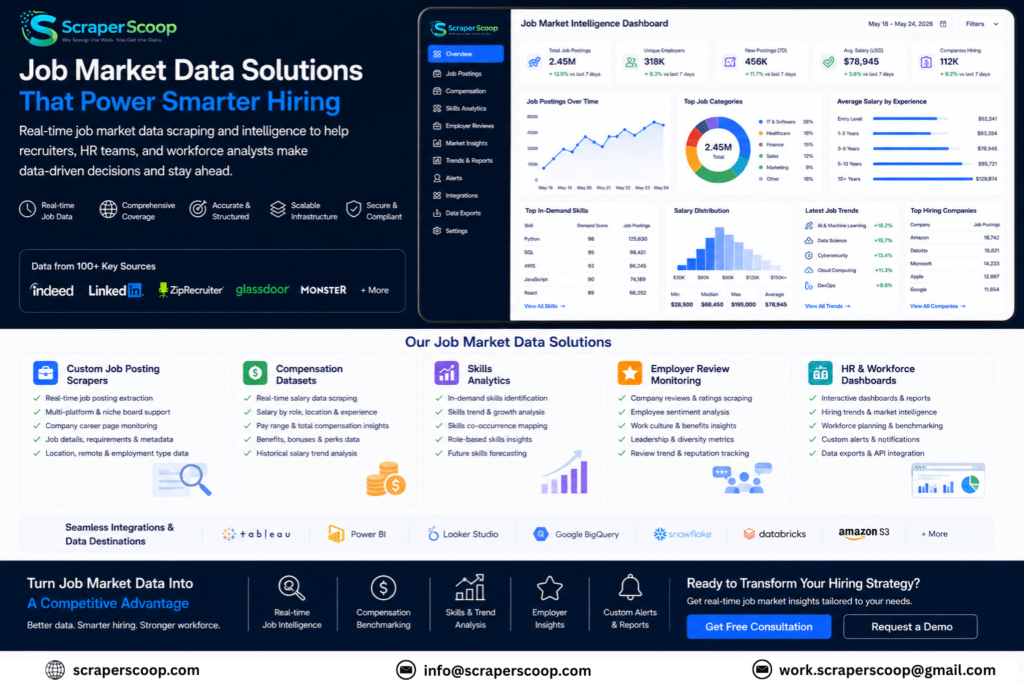
At ScraperScoop, we believe that every organization — from ambitious growth companies to established enterprises, from boutique recruitment firms to global staffing agencies, from independent HR researchers to funded workforce tech startups — deserves access to the labor market intelligence that was previously available only to the most data-sophisticated talent operations.
Here is precisely what ScraperScoop delivers for job market intelligence clients:
- ✅ Custom Job Posting Intelligence Solutions: Purpose-built job posting scrapers targeting your specific platforms, geographic markets, role categories, employer sets, and intelligence requirements — with deduplication, skills extraction, and compensation normalization pipelines that deliver structured, analysis-ready workforce intelligence rather than raw data dumps.
- ✅ Real-Time Compensation Benchmarking Data: Continuously updated salary range intelligence from transparency-compliant postings, government wage databases, and aggregated compensation sources — at the role, seniority, location, and industry granularity that individual compensation decisions actually require rather than the broad averages that annual surveys provide.
- ✅ Skills Demand Intelligence: Structured skills demand analytics from large-scale job posting analysis — trending skills identification, scarcity mapping, skills combination demand patterns, geographic availability distribution, and trajectory forecasting — supporting workforce planning, L&D investment prioritization, and competitive talent strategy.
- ✅ Employer Brand & Review Intelligence: Comprehensive employer review data from Glassdoor, Indeed, and professional platforms — with NLP sentiment analysis delivering employer brand health benchmarking, competitive EVP intelligence, and specific culture dimension monitoring across your competitive employer set.
- ✅ Competitive Hiring Intelligence: Systematic monitoring of competitor employer hiring activity — role volumes, functional mix, seniority distribution, geographic expansion, and compensation disclosure analysis — providing the continuous competitive talent strategy intelligence that proactive HR leadership requires.
- ✅ Hiring Velocity & Business Signal Intelligence: Competitor hiring volume trend analysis mapped to business function and organizational priority signals — delivering the strategic intelligence about competitor investment direction that leads financial reporting by multiple quarters.
- ✅ Talent Supply & Availability Analysis: Geographic talent supply intelligence — quantifying the available professional talent pools for specific skill profiles in target hiring markets — supporting location strategy, sourcing market prioritization, and workforce planning with current supply-side market evidence.
- ✅ Ready-Made Job Market Datasets: Need workforce intelligence immediately? Our pre-built job market datasets across role categories, geographic markets, and intelligence types give you instant access to structured, validated labor market data without development lead time.
- ✅ Workforce Data APIs: Integrate our continuously updated job market intelligence feeds directly into your ATS, HRIS, compensation management platform, workforce analytics tool, or HR tech product — with structured data delivered in the formats your systems require.
- ✅ Analytics Dashboards: Visual workforce intelligence dashboards that surface the most HR-relevant patterns from scraped job market data — competitive hiring maps, compensation trend lines, skills scarcity heat maps, employer brand comparison charts, and talent availability visualizations your HR team can act on immediately.
- ✅ Multi-Platform & Multi-Market Coverage: Whether you need monitoring across global job markets in multiple languages, focused intelligence on specific metropolitan talent markets, or comprehensive coverage of industry-specific and niche platforms — our infrastructure scales with your coverage requirements.
- ✅ Compliance-First, Privacy-Protective Operations: All ScraperScoop job market data collection targets publicly available posting and workforce intelligence data, implements appropriate personal data minimization practices, operates within sustainable platform access parameters, and supports your organization’s data governance requirements.
Ready to Build Your Job Market Intelligence Advantage? Let’s Talk
The global HR technology market is growing toward USD 81.84 billion by 2033. AI is disrupting skill demand at an unprecedented pace. Salary transparency legislation is expanding the available compensation data every quarter. And the organizations winning the talent competition in 2026 are not the ones with the biggest recruiting teams or the most generous pay packages — they are the ones who understand the talent market more precisely, respond to competitive developments faster, and make every workforce decision backed by continuously updated, geographically granular, role-specific intelligence.
The talent strategy gap between organizations with systematic job market intelligence and those relying on annual surveys and periodic manual research is widening every quarter — in voluntary turnover rates, time-to-fill performance, compensation competitiveness, and the organizational capability growth that follows consistently better hiring decisions.
That intelligence advantage starts with ScraperScoop.
At ScraperScoop, we deliver:
- ✅ Custom Job Posting Scrapers built for your specific platforms, markets, and roles
- ✅ Real-Time Compensation Benchmarking Data at role and location granularity
- ✅ Skills Demand Intelligence for workforce planning and L&D investment
- ✅ Employer Brand & Review Analytics from all major platforms
- ✅ Competitive Hiring Intelligence for talent strategy and counter-positioning
- ✅ Talent Supply & Availability Analysis by geography and skill profile
- ✅ Ready-Made Job Market Datasets for immediate intelligence deployment
- ✅ Workforce Data APIs for ATS, HRIS, and HR tech integration
- ✅ Analytics Dashboards with actionable workforce intelligence visualization
- ✅ Compliance-First, Privacy-Protective Operations for sustainable intelligence
💼 Let’s Build Your Workforce Intelligence Operation — Starting Today
Your competitors are monitoring your job postings right now. Your best employees are comparing your compensation to live market data. The question is whether you have the intelligence to stay ahead of both.
Contact ScraperScoop today for your free consultation → Tell us about your hiring markets, the role categories most critical to your business, the compensation benchmarking gaps affecting your talent strategy, and the HR decisions you need better data to support — and we’ll design the perfect job market intelligence solution for your organization.
Conclusion: In 2026, Talent Strategy Is a Data Intelligence Competition — And the Best Data Wins
The labor market in 2026 is operating at an intersection of structural transformation — AI-driven skills disruption, globalized talent competition through remote work normalization, salary transparency legislation expanding compensation visibility, and intensifying competition for specialized talent across every high-growth sector. The organizations navigating this complexity most successfully share one capability: they have better, faster, more precise intelligence about the talent market they’re competing in than their competitors — and they use it consistently to make smarter talent decisions.
Job market data scraping is the infrastructure that makes this intelligence advantage real. From real-time compensation benchmarking that prevents the below-market drift that drives costly voluntary turnover, to competitive hiring intelligence that reveals competitor talent strategy before it affects your pipeline, to skills demand analytics that inform workforce planning with current market evidence rather than lagging official statistics — the applications are strategically vital, the ROI is measurable, and the competitive disadvantage of operating without systematic job market intelligence grows with every passing quarter.
The technology is mature. The data sources are rich and expanding as salary transparency legislation creates ever more publicly available compensation data. The domain expertise required to collect, normalize, and deliver investment-grade workforce intelligence is available through specialist partners. And the right partner — one who combines technical job market scraping infrastructure with HR domain knowledge and compliance-first operational standards — makes building this capability far faster, more reliable, and more cost-effective than any in-house development approach.
ScraperScoop is that partner. Accurate, comprehensive, continuously updated job market intelligence — tailored to your talent markets, your workforce priorities, and the business decisions your HR function needs to make better and faster.
👉 Get in touch with ScraperScoop now — and let’s turn job market web data into your most powerful and sustainable talent intelligence advantage.
Frequently Asked Questions About Job Market Data Scraping
What is job market data scraping?
Job market data scraping is the automated extraction of publicly available employment and workforce information from job boards, company career pages, salary platforms, employer review sites, and labor market databases. HR teams, recruiters, staffing agencies, workforce tech companies, and labor market researchers use this intelligence for talent competitive analysis, real-time compensation benchmarking, skills gap assessment, workforce planning, employer brand monitoring, and labor market research.
Is job market data scraping legal?
Scraping publicly available job posting data — which employers publish explicitly to reach the widest possible candidate audience — is generally legal. The legal precedent supporting automated collection of publicly available web data, including the significant hiQ v. LinkedIn case, provides a sound legal foundation for systematic job posting intelligence collection. It is important to respect platform terms of service, implement appropriate data minimization for any personal data, comply with GDPR for European user data, and conduct collection within sustainable access parameters. ScraperScoop operates with a compliance-first approach to all job market data collection.
How can HR teams use job market scraping for compensation benchmarking?
HR teams use job market scraping to collect salary range data from transparency-compliant job postings, government wage databases, and compensation aggregation platforms — building real-time compensation benchmarks at role, seniority, location, and industry granularity. This enables continuous market positioning assessment that identifies below-market compensation situations before they drive voluntary turnover decisions, more accurate offer calibration that improves offer acceptance rates, and evidence-based compensation review processes that replace annual survey data with continuously updated market evidence.
What job boards and platforms can ScraperScoop collect data from?
ScraperScoop collects job market data from major platforms including Indeed, LinkedIn, Glassdoor, ZipRecruiter, Monster, CareerBuilder, company career pages, government labor databases, salary platforms like Levels.fyi and PayScale, WARN Act filing databases, and niche industry-specific job boards. We handle the full technical complexity of each platform’s architecture — anti-bot navigation, dynamic content rendering, deduplication across sources, and data normalization — delivering structured, analysis-ready workforce intelligence.
How can staffing agencies use job market data scraping?
Staffing agencies use job market scraping to proactively detect client hiring activity before formal outreach — enabling business development conversations based on observed market activity rather than waiting for inbound requests. Recruiters gain complete market opportunity visibility for candidate placement, more accurate compensation counsel for both client and candidate advisement, faster placement processes through better market context, and competitive advantage over agencies relying on incomplete manual market knowledge.
How does job posting data help with skills gap analysis and workforce planning?
Large-scale job posting analysis reveals which specific skills and competency combinations are most in demand in target hiring markets, which skills are experiencing scarcity relative to demand, how skills demand is trending over time, and where specific talent pools are geographically concentrated. This skills demand intelligence enables workforce planners to identify where to build external talent pipelines, where to invest in internal reskilling programs, and where talent scarcity requires process redesign — transforming workforce planning from headcount estimation to genuine capability strategy.
Can job market data scraping power HR tech platform features?
Absolutely. HR technology companies use scraped job market data to power salary benchmarking engines, skills demand visualization tools, talent availability maps, competitive hiring intelligence features, workforce planning simulations, and recruiter market context tools. ScraperScoop provides HR tech companies with the comprehensive, continuously updated job market data infrastructure that powers these features — enabling faster product development, better data quality, and more reliable performance than in-house scraping approaches. Contact us to discuss your specific HR tech data requirements.
Why choose ScraperScoop for job market data scraping over building in-house?
Building comprehensive job market scraping infrastructure in-house requires significant ongoing investment in anti-bot navigation, deduplication systems, skills extraction NLP, compensation normalization pipelines, multi-platform coverage maintenance, and compliance frameworks — all competing with core HR and product priorities for scarce engineering resources. ScraperScoop has already built all of this infrastructure across multiple client engagements — delivering better data quality, faster deployment, lower total cost, and ongoing maintenance without internal overhead. Contact us for a free consultation.


