

Web Scraping for Market Research: How Smart Businesses Decode Their Competition
The complete playbook for using web data extraction to understand your market, track competitors, spot emerging trends, and make decisions your competitors wish they'd made first.
📑 What You'll Learn in This Guide
- The Market Research Revolution
- What Market Research Data Can You Scrape?
- Building a Competitive Analysis Engine
- Industry-Specific Applications
- Pricing Intelligence: Your Sharpest Weapon
- Tracking Consumer Trends at Scale
- Getting Started: The Practical Roadmap
- Key Data Sources for Market Research
- Frequently Asked Questions
- Conclusion
The Market Research Revolution: Why Traditional Methods Are Dying
Let's be brutally honest about something: most traditional market research is painfully slow, absurdly expensive, and outdated the moment it's published. A typical industry report takes 3–6 months to produce, costs anywhere from $5,000 to $50,000, and by the time it reaches your desk, the market has already moved on.
Web scraping has fundamentally changed this equation. What used to require teams of analysts spending weeks on manual data collection can now be accomplished in hours — with better accuracy, broader coverage, and at a fraction of the cost.
The smartest businesses in 2026 aren't waiting for annual reports or relying on surveys with 200 respondents. They're building continuous market intelligence systems powered by web scraping services that deliver fresh competitive data on demand.
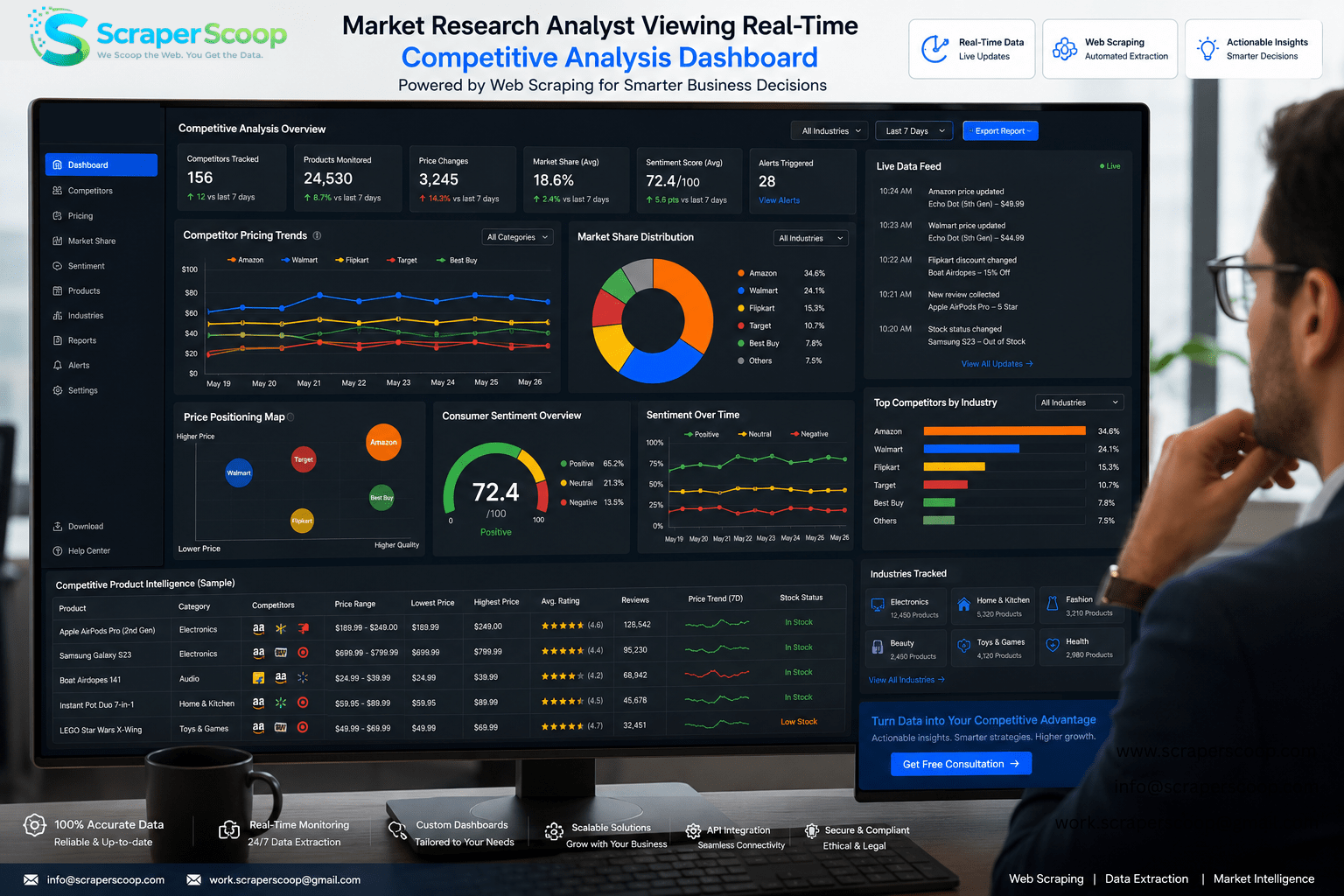
Here's the paradigm shift in numbers:
This isn't about replacing human analysis — it's about arming human analysts with vastly more data, vastly faster, so they can focus on what they do best: interpretation, strategy, and action.
What Market Research Data Can You Actually Scrape?
When people think of web scraping for market research, they often picture product prices on Amazon. That's just scratching the surface. The web is an enormous, constantly-updating repository of market intelligence — if you know where to look. Here's a comprehensive map:
| Intelligence Category | Data Sources | What You Learn |
|---|---|---|
| Product Intelligence | E-commerce platforms, brand websites, marketplaces | What competitors sell, product features, catalog strategy |
| Pricing Intelligence | Amazon, Walmart, Flipkart, D2C stores, aggregators | Competitor pricing, discount patterns, promotional calendars |
| Consumer Sentiment | Product reviews, social media, forums, Q&A platforms | What customers love/hate, unmet needs, brand perception |
| Brand & Advertising | Social platforms, ad libraries, influencer profiles | Competitor marketing strategy, messaging, partnerships |
| Talent & Hiring | Job boards like Indeed, LinkedIn, Naukri | Competitor expansion plans, tech stack, strategic priorities |
| Real Estate & Location | Property portals, mapping services, business directories | Competitor locations, expansion patterns, market coverage |
| Industry & News | News sites, press releases, regulatory filings | Market events, partnerships, funding, compliance changes |
The real power emerges when you combine multiple intelligence categories. For example, scraping a competitor's e-commerce product data alongside their job listings can reveal not just what they're selling today, but what categories they're quietly building teams to enter tomorrow.
💡 Research Insight: A 2024 McKinsey study found that companies using real-time external data in their decision-making process achieved 23% higher revenue growth than competitors relying solely on internal analytics and periodic market reports. Web scraping is the most cost-effective way to build this capability.
Building a Competitive Analysis Engine with Web Scraping
Let's get tactical. Competitive analysis through data scraping isn't a one-time project — it's an ongoing system. The businesses getting the most value treat it as a core business function, not a side project. Here's how to build yours:
Step 1: Map Your Competitive Landscape
Before you scrape anything, define your competitive universe. This isn't just your five biggest direct competitors. Think broader:
- Direct competitors — companies selling the same product/service to the same customer
- Indirect competitors — different solutions addressing the same customer need
- Emerging threats — startups or adjacent players who might enter your market
- Substitute products — entirely different categories that could replace your offering
- Aspirational benchmarks — companies in other markets doing what you want to do
Step 2: Define Your Intelligence Requirements
What decisions will this data actually drive? Be specific. Vague research goals produce vague results. Here are focused intelligence objectives we commonly see:
Step 3: Set Up Automated Data Collection
This is where custom data scraping services become essential. Manual competitive research doesn't scale — and it's impossible to maintain consistency. A well-designed scraping system collects the same data points, from the same sources, on the same schedule, without human error or fatigue.
Our scheduled data scraping services run on whatever cadence your business requires — hourly for price monitoring, daily for review tracking, weekly for catalog analysis, or monthly for broader market snapshots.
Step 4: Clean, Structure, and Analyze
Raw scraped data needs refinement before it's useful. Our data cleaning and structuring services handle normalization, deduplication, categorization, and enrichment — delivering analysis-ready datasets directly to your team.
Step 5: Deliver Insights to Decision-Makers
The final mile matters enormously. Data trapped in spreadsheets doesn't drive decisions. We offer multiple delivery pathways including API-based delivery for your BI tools, real-time data feeds for live dashboards, and downloadable datasets for ad-hoc analysis.
See our competitive analysis solutions in action
Explore Market Research & Competitive Analysis Solutions →Industry-Specific Applications: Where Web Scraping Transforms Research
Web scraping for market research isn't a one-size-fits-all proposition. The most impactful applications are highly industry-specific. Here's how different sectors are using scraped data to gain competitive advantages:
E-Commerce & Retail
Arguably the most mature use case. Retail brands and marketplace sellers use web scraping to track competitor pricing across platforms, monitor product launches, analyze promotional strategies, and benchmark their catalog coverage. Whether you're selling on Amazon, Walmart, Flipkart, or Shopify, the data is there to be captured.
Our e-commerce datasets and e-commerce scrapers are specifically built for this sector.
Quick Commerce & Food Delivery
The quick commerce space moves at lightning speed — new dark stores, shifting product assortments, aggressive pricing wars between Zepto, Blinkit, Swiggy Instamart, and others. Our quick commerce data scraping captures everything from product availability and pricing to delivery times and promotional offers.
Similarly, food delivery data scraping on platforms like Zomato and Swiggy is powering restaurant chains, cloud kitchen operators, and food industry consultants with unprecedented competitive visibility.
Explore the insights already available through our Zepto Products Intelligence Dashboard and Zomato Analytics Dashboard.
Real Estate & Property
Real estate data scraping helps investors, developers, and brokerages track property pricing trends, rental market dynamics, and competitive landscape shifts. Whether it's property listing extraction, price data extraction, rental data scraping, or commercial property intelligence — the applications are extensive.
Travel & Hospitality
Hotels, OTAs, and travel agencies rely on travel data scraping for hotel price monitoring, flight fare tracking, Airbnb competitive analysis, and OTA data extraction. The travel industry's razor-thin margins make pricing intelligence not just valuable, but essential for survival.
Social Media & Brand Intelligence
Social media data scraping is increasingly central to market research. From sentiment analysis data collection to influencer data scraping and review and rating extraction, social platforms provide a real-time pulse on consumer preferences that no survey can match.
Recruitment & Talent Intelligence
Job listings are a window into a competitor's strategy. Scraping Indeed, LinkedIn public data, and Naukri reveals what technologies competitors are adopting, which markets they're expanding into, and how aggressively they're scaling specific functions. Our recruitment data extraction services make this intelligence accessible.
Pricing Intelligence: Your Sharpest Competitive Weapon
Of all the ways web scraping fuels market research, pricing intelligence delivers the most immediate, measurable ROI. Here's why pricing data is in a class of its own:
Price is the single most influential factor in purchase decisions for the majority of consumer categories. A study by Deloitte found that 60% of consumers consider price the primary factor when choosing between otherwise similar products online. Yet most businesses have surprisingly poor visibility into competitor pricing — relying on spot-checks, anecdotal data, or outdated competitive reports.
With systematic price monitoring and competitor tracking, you can:
- See every competitor price change as it happens — not weeks or months later
- Detect pricing patterns — weekly promotions, seasonal adjustments, event-triggered discounts
- Identify pricing anomalies — unauthorized sellers undercutting MAP, predatory pricing, or grey market activity
- Model pricing scenarios — what happens to volume if you lower prices by 5%? What does the competitive response look like?
- Protect your margins — knowing the floor price in your category means you never give away more margin than necessary
📈 Case Study: A mid-sized consumer goods company used our pricing intelligence service to monitor 3,400 competing SKUs across Amazon and Walmart. They discovered that their primary competitor dropped prices by 8–12% every Wednesday evening — a pattern invisible without daily data. By adjusting their own promotional calendar to match this rhythm, they improved their weekly conversion rate by 26% and recaptured Buy Box ownership on 340 shared listings.
Tracking Consumer Trends at Scale: Beyond Surveys and Focus Groups
Traditional consumer research has a fundamental limitation: you only learn what you think to ask about. Surveys are constrained by your hypotheses. Focus groups are influenced by group dynamics. Panel data is expensive and lagging.
Web scraping flips the model. Instead of asking consumers what they think, you observe what they actually say and do — at scale, in real time, without any observer bias. Here's what that looks like in practice:
Review Mining for Unfiltered Insights
Amazon alone has billions of product reviews. Each one is a tiny piece of unfiltered consumer feedback. When you scrape and analyze thousands of reviews across a category using our review scraping service, patterns emerge that no survey would ever reveal:
- Recurring complaints that point to product design flaws your R&D team should address
- Feature requests that reveal adjacent market opportunities
- Language patterns that should inform your marketing copy and SEO strategy
- Seasonal satisfaction shifts that correlate with production or supply chain issues
Social Listening at Scale
Social media data scraping captures conversations about your brand, competitors, and category in real time. Combined with sentiment analysis, this becomes a powerful early-warning system for emerging trends, viral complaints, or shifts in brand perception that traditional monitoring tools miss.
Restaurant & Food Trend Tracking
For the food industry specifically, scraping restaurant menu data and restaurant reviews across delivery platforms reveals emerging cuisine trends, pricing shifts, and consumer preference changes faster than any industry report.
Explore ready-made datasets across industries
Browse Featured Datasets for Immediate Download →Getting Started: The Practical Roadmap for Your Organization
Whether you're a solo market researcher or a VP of Strategy at a Fortune 500 company, building a web scraping-powered research capability follows the same fundamental path. Here's your step-by-step roadmap:
- Start with One High-Impact Use Case Don't try to scrape everything at once. Pick the single research question that would create the most business value if answered with fresher, more comprehensive data. Pricing intelligence and competitor product tracking are the most common starting points.
- Choose Between Datasets and Custom Scraping For exploratory research, pre-built datasets get you started immediately. For ongoing intelligence needs, custom data scraping services deliver exactly what you need, on your schedule.
- Integrate Data Into Your Workflow The fastest path to value is integrating scraped data directly into tools your team already uses. Our API-based data delivery connects with Tableau, Power BI, Google Sheets, and virtually any analytics platform.
- Build Analysis Frameworks Raw data needs context. Establish the benchmarks, KPIs, and analytical frameworks that transform data into actionable insights. Our team can help design these during your onboarding process.
- Expand Coverage Gradually Once your first use case is delivering value, expand to adjacent intelligence needs — adding new competitors, new data sources, new markets, or new data fields to your collection.
- Automate and Systemize The end goal is an always-on competitive intelligence system that runs in the background, continuously feeding your team fresh data. Our scheduled scraping services make this a reality without requiring any ongoing effort from your side.
Key Data Sources for Market Research: Where to Scrape and Why
The web is vast, but for market research purposes, certain data sources consistently deliver the highest intelligence value. Here's where professional research teams focus their scraping efforts:
| Source Category | Specific Platforms | Primary Intelligence Value | ScraperScoop Solution |
|---|---|---|---|
| E-Commerce | Amazon, Walmart, Flipkart, eBay, Shopify stores, Meesho | Product, pricing, inventory, review data | E-commerce Scraping |
| Quick Commerce | Zepto, Blinkit, Swiggy Instamart, BigBasket | Assortment, pricing, availability, delivery | QC Scrapers |
| Food Delivery | Zomato, Swiggy, DoorDash, Uber Eats | Menu data, restaurant data, pricing, reviews | Food Delivery Scrapers |
| Travel | Booking.com, Airbnb, MakeMyTrip, Expedia | Hotel rates, flight fares, availability | Travel Scrapers |
| Real Estate | 99acres, MagicBricks, Zillow, Realtor | Property prices, rental rates, market trends | Real Estate Scrapers |
| Job Boards | Indeed, LinkedIn, Naukri, Glassdoor | Competitor hiring, tech stack, expansion | Job Scraping |
| Directories | Google Maps, Yelp, Justdial, Yellow Pages | Business listings, market coverage, reviews | Directory Scraping |
| Social Media | Instagram, Twitter/X, YouTube, Reddit | Brand mentions, sentiment, trends | Social Scraping |
For organizations that need API-level access to scraped data, our web scrapers and APIs catalog includes pre-built solutions for all major platforms. Browse by category:
Frequently Asked Questions
Q How is web scraping for market research different from using market research databases?
Traditional market research databases (like Statista, IBISWorld, or Euromonitor) provide aggregated, curated data with significant time delays — often 3–12 months old. Web scraping provides raw, granular, real-time data directly from the source. Think of databases as the newspaper and web scraping as the live news feed. Both have value, but scraping gives you speed, customization, and granularity that databases simply cannot match.
Q Is it legal to scrape competitor websites for market research?
Scraping publicly available data — information any visitor can access without logging in — is generally considered legal under established precedents like hiQ vs. LinkedIn. Professional scraping services like ScraperScoop focus exclusively on public data, respect robots.txt directives, and implement rate limiting. We never access data behind login walls or use deceptive practices. However, we always recommend consulting your legal counsel for jurisdiction-specific guidance.
Q How much does web scraping for market research cost?
Costs vary significantly based on scale, complexity, and frequency. Pre-built datasets start at accessible price points — perfect for initial exploration. Custom scraping projects for ongoing competitive intelligence typically range from a few hundred to several thousand dollars monthly, depending on the number of sources, data volume, and delivery requirements. Contact us for a personalized quote based on your specific needs.
Q How fresh is the data you deliver?
Freshness depends entirely on your requirements. We offer hourly scraping for price-sensitive applications, daily runs for standard competitive monitoring, and weekly or monthly schedules for broader market analysis. Our real-time data feeds provide near-instantaneous data for mission-critical applications.
Q Can you scrape data from any website?
We can extract publicly available data from the vast majority of websites. Some sites with exceptionally aggressive bot protection may require specialized approaches, but our engineering team has successfully built scrapers for hundreds of different platforms across every major industry. If you have specific target websites in mind, our team will confirm feasibility during your initial consultation.
Q Do I need technical skills to use your services?
Absolutely not. Our team handles everything — from scraper development and maintenance to data cleaning and delivery. You simply define what intelligence you need, and we deliver it in your preferred format (CSV, Excel, JSON, API, or database integration). Many of our market research clients are business analysts, strategists, and consultants with no coding background whatsoever.
Conclusion: The Unfair Advantage of Data-Driven Market Research
The gap between businesses that use web scraping for market research and those that don't isn't shrinking — it's accelerating. Every day without automated competitive intelligence is a day your competitors might be making better decisions with better data.
The good news? Getting started has never been easier. You don't need a data science team, a massive budget, or months of infrastructure work. With ScraperScoop, you can go from zero to actionable competitive intelligence in days — whether through our ready-made datasets, pre-built scrapers and APIs, or fully customized scraping solutions.
The businesses winning in 2026 aren't necessarily smarter. They simply have access to better data, faster. That's an advantage available to any organization willing to embrace it.
Your next step is simple: talk to our data experts, tell us what competitive intelligence would make the biggest difference for your business, and let us show you what's possible. No commitment, no pressure — just a conversation about how data can sharpen your competitive edge.


