

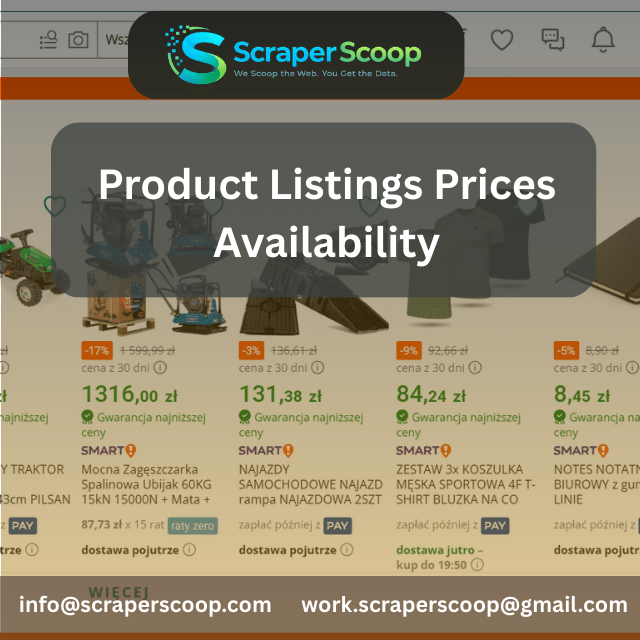
If you’ve ever tried selling products online or researching market trends in Europe, there’s a good chance you’ve come across Allegro. For those unfamiliar with it, Allegro is one of the largest eCommerce marketplaces in Central and Eastern Europe, particularly dominant in Poland. Millions of buyers and sellers use the platform daily, making it a treasure trove of valuable market data.
But here’s the challenge.
Manually browsing thousands of listings, checking prices, comparing sellers, and tracking stock availability is almost impossible. Even if you dedicate hours every day, you’d still miss a huge portion of the data.
This is where web scraping becomes incredibly powerful.
By extracting Allegro product listings, prices, and availability automatically, businesses can unlock deep insights into market trends, competitor pricing strategies, and product demand.
I still remember a conversation with a client who was expanding their electronics business into Europe. They asked a simple question:
“How do we know what price our competitors are selling at on Allegro?”
At first glance, it sounded simple. But Allegro had thousands of sellers offering the same products, with prices changing constantly.
Within a week of implementing a web scraping solution, they suddenly had access to a full dataset of:
- Seller listings
- Price variations
- Availability status
- Product rankings
That single dataset completely changed how they approached their pricing strategy.
In this guide, we’ll walk through everything you need to know about scraping Allegro product listings, prices, and availability for powerful eCommerce intelligence.
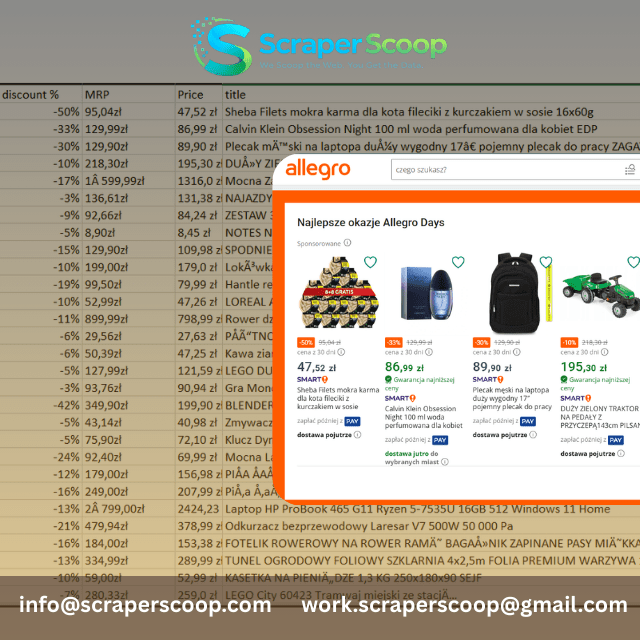
Understanding the Allegro Marketplace
Before diving into scraping techniques, it’s important to understand why Allegro is such a valuable data source.
Founded in Poland, Allegro has grown into one of the largest eCommerce ecosystems in Europe. The platform hosts:
- Millions of product listings
- Thousands of active sellers
- A wide range of categories including electronics, fashion, home goods, and automotive products
Unlike some marketplaces that primarily sell their own products, Allegro operates as a seller-driven marketplace, meaning multiple vendors can list the same item.
This leads to a highly competitive pricing environment where:
- Sellers constantly adjust prices
- Stock availability changes frequently
- Promotions appear and disappear rapidly
For businesses, this means valuable insights are hidden inside product listings.
And the only practical way to collect them at scale is through automated data extraction.
Why Businesses Scrape Allegro Product Data
Companies across industries use Allegro data to make smarter business decisions.
Let’s explore the most common reasons.
Competitive Price Monitoring
One of the most common reasons businesses scrape Allegro is price intelligence.
If you’re selling products online, your competitors might be adjusting their prices several times per day.
Without automated tracking, you’ll always be behind.
By scraping Allegro product listings, companies can monitor:
- Minimum and maximum product prices
- Seller pricing differences
- Discount patterns
- Flash promotions
For example, imagine tracking a popular gaming console listing:
| Seller | Price | Availability |
|---|---|---|
| Seller A | €399 | In Stock |
| Seller B | €415 | Limited |
| Seller C | €389 | Out of Stock |
With automated data collection, businesses can quickly identify the most competitive price point.
Product Demand Insights
Product availability tells a story.
When a product repeatedly goes out of stock, it signals high consumer demand.
Scraping Allegro availability data allows businesses to monitor:
- Stock levels across sellers
- Fast-selling products
- Seasonal demand patterns
For instance, during major sales events, certain electronics products can sell out within hours.
Tracking availability helps retailers identify high-demand products worth stocking.
Marketplace Seller Intelligence
Another powerful insight comes from analyzing seller behavior.
Scraped Allegro data can reveal:
- Top-performing sellers
- Pricing strategies
- Product catalog size
- Seller ratings and reviews
This information helps companies understand how competitors operate within the marketplace.
Catalog Expansion
Many businesses use marketplace scraping to discover new products.
For example, a retailer entering the Polish market might want to understand:
- Which products are trending
- Which categories are saturated
- Which price ranges are popular
Instead of guessing, scraped product listings provide real data from the marketplace.
What Data Can Be Extracted from Allegro Listings
Allegro product pages contain a wealth of structured data that can be extracted.
Here are the most commonly collected data points.
Product Information
- Product title
- Product ID
- Category
- Brand
- Product description
Pricing Data
- Current price
- Discounted price
- Promotional offers
- Currency
Seller Details
- Seller name
- Seller rating
- Seller location
Availability Data
- Stock availability
- Quantity available
- Delivery options
Listing Metrics
- Number of reviews
- Product rating
- Popularity indicators
Product Media
- Image URLs
- Product thumbnails
Once extracted, this data can be stored in formats such as:
- CSV
- Excel
- JSON
- APIs
- Databases
This structured dataset becomes extremely valuable for analytics.
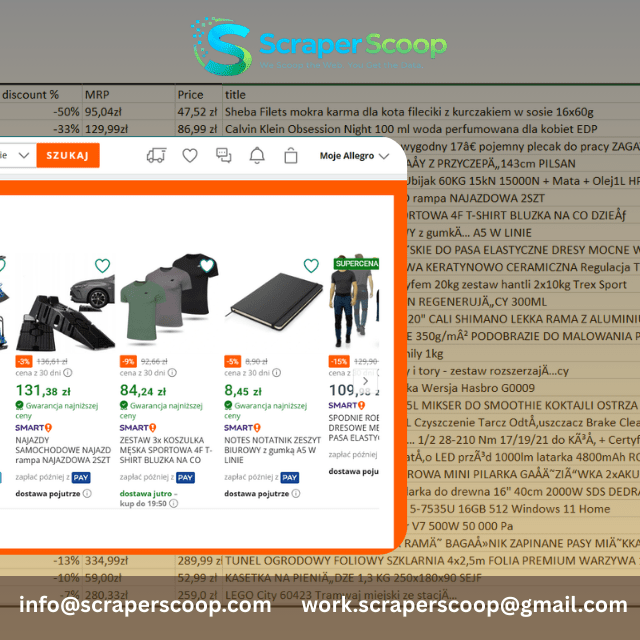
How Allegro Web Scraping Works
Let’s break down the typical scraping workflow.
Step 1: Discover Product Listings
The scraper first navigates Allegro category pages or search results.
Examples include searches like:
- smartphones
- gaming laptops
- wireless headphones
Each search results page contains dozens of product listings.
The scraper collects all listing URLs before moving to the next step.
Step 2: Extract Listing Details
From each listing page, the scraper collects key information such as:
- Product title
- Price
- Seller details
- Availability
This step typically involves parsing HTML elements or retrieving structured JSON data embedded in the page.
Step 3: Capture Seller Variations
Many products on Allegro are sold by multiple sellers simultaneously.
The scraper identifies all sellers offering the same product and extracts:
- Individual prices
- Stock availability
- Delivery details
This creates a comprehensive dataset showing market competition for a single product.
Step 4: Handle Pagination
Search results can span hundreds of pages.
Scrapers automatically navigate through pagination to collect all listings.
Without this step, only a small fraction of the marketplace would be captured.
Step 5: Store and Process the Data
After extraction, the data is stored in a database or exported to structured files.
Businesses can then integrate it into:
- Business intelligence dashboards
- Pricing tools
- Data analytics systems
Real-World Use Cases of Allegro Data Scraping
Let’s look at how companies actually use this data.
eCommerce Retailers
Retailers track Allegro data to stay competitive.
For example, an electronics seller might monitor the price of a specific smartphone model daily to ensure their listing remains attractive.
Price Comparison Websites
Price comparison platforms rely heavily on scraped marketplace data.
They use Allegro listings to build comparison tools showing users:
- Cheapest seller
- Shipping options
- Availability
Market Research Firms
Research companies analyze marketplace data to produce reports on:
- Consumer demand trends
- Pricing fluctuations
- Category growth
These insights are often sold to brands and investors.
Brand Monitoring
Manufacturers use scraped data to see how their products are being sold.
They can identify:
- Unauthorized resellers
- Price violations
- Counterfeit listings
Challenges in Scraping Allegro
Scraping large marketplaces comes with technical challenges.
Anti-Scraping Measures
Marketplaces often implement systems to detect automated scraping.
Common obstacles include:
- Rate limits
- IP blocking
- Captchas
Using rotating IPs and proper request pacing helps overcome these challenges.
Dynamic Content Loading
Modern websites load data dynamically using JavaScript.
Scrapers must handle:
- API calls
- Dynamic rendering
- Hidden JSON responses
Frequent Page Structure Changes
Marketplaces frequently update their layouts.
Scrapers must be maintained regularly to adapt to these changes.
Best Practices for Allegro Data Extraction
Based on experience, here are some practical tips.
Scrape Structured Data When Possible
Many marketplaces embed structured JSON data inside pages.
Extracting this data directly improves accuracy.
Implement Request Delays
Sending too many requests too quickly can trigger blocking.
Proper delays ensure stable scraping.
Use Rotating Proxies
Rotating IP addresses helps avoid detection.
Store Historical Data
Tracking historical data allows businesses to analyze:
- Price trends
- Seasonal demand
- Market growth patterns
Why Marketplace Data Is So Valuable
What makes marketplace data so powerful is its real-time reflection of consumer behavior.
Unlike surveys or reports, scraped data shows what is actually happening in the market:
- What people are buying
- Which products are popular
- How prices fluctuate
For businesses making strategic decisions, this type of data is invaluable.
A Quick Story From the Field
One of the most interesting Allegro projects I worked on involved tracking electronics prices.
The client assumed their pricing was competitive.
But after scraping thousands of listings, the data revealed something surprising.
Their products were consistently priced 5–8% higher than competitors.
Once they adjusted their pricing strategy using the scraped data, their sales increased within weeks.
That experience reinforced a simple truth:
Data removes guesswork.
Final Thoughts
Allegro is one of the most valuable sources of eCommerce intelligence in Europe.
By extracting product listings, prices, and availability through web scraping, businesses can unlock insights that help them:
- Monitor competitor pricing
- Discover trending products
- Track seller performance
- Analyze demand patterns
- Improve pricing strategies
In a marketplace where prices and availability change constantly, having real-time data makes all the difference.
Join the Conversation
Have you ever used marketplace data for competitor analysis or product research?
Or are you thinking about using web scraping to gain insights from Allegro?
Share your thoughts or questions in the comments — I’d love to hear how others are approaching eCommerce intelligence.
Need Help Extracting Allegro Data?
If you’re looking to scrape Allegro product listings, prices, and availability, our team can help you build a reliable and scalable data extraction solution.
Whether you need marketplace monitoring, competitor intelligence, or product trend analysis, we can design a system tailored to your needs.
Let’s turn marketplace data into actionable business insights.
Request a free consultation
Ready to unlock the power of data?


