

A few years ago, grocery shopping followed a pretty predictable pattern.
You would walk into a store, grab a cart, browse the aisles, and pick what you needed. If something was out of stock, you either substituted it or came back another day.
Fast forward to today, and grocery shopping looks completely different.
Customers might:
- Browse products on a mobile app
- Compare prices on a website
- Order groceries through a delivery platform
- Pick up items using curbside pickup
- Or still shop in-store
This blend of physical and digital experiences is what retailers call omnichannel retail.
But running an omnichannel grocery operation isn’t easy. Retailers must synchronize data across multiple systems—inventory, pricing, product listings, and promotions—all in real time.
That’s where grocery API scraping becomes incredibly valuable.
By extracting structured data from grocery platforms and APIs, retailers can gain visibility into competitor pricing, product availability, and local demand patterns. This helps them create seamless shopping experiences across both online and offline channels.
Let’s explore how grocery API scraping supports omnichannel retail strategies and why it’s becoming essential for modern grocery businesses.
What Is Omnichannel Retail in Grocery?
Omnichannel retail means providing a consistent shopping experience across multiple channels.
For grocery retailers, those channels typically include:
- Physical stores
- Mobile apps
- E-commerce websites
- Delivery platforms
- Third-party marketplaces
The key idea behind omnichannel retail is simple:
Customers should be able to interact with a brand anywhere and receive the same experience.
For example:
A customer might:
- Browse groceries on their phone
- Add items to a cart
- Check availability at a nearby store
- Choose curbside pickup
All of this should happen smoothly.
Behind the scenes, however, this requires massive amounts of real-time data.
Retailers must constantly track:
- Product availability
- Local store inventory
- Price changes
- Promotions
- Customer demand
Without reliable data, omnichannel systems break down.
What Is Grocery API Scraping?
Before we dive deeper, let’s clarify what API scraping means.
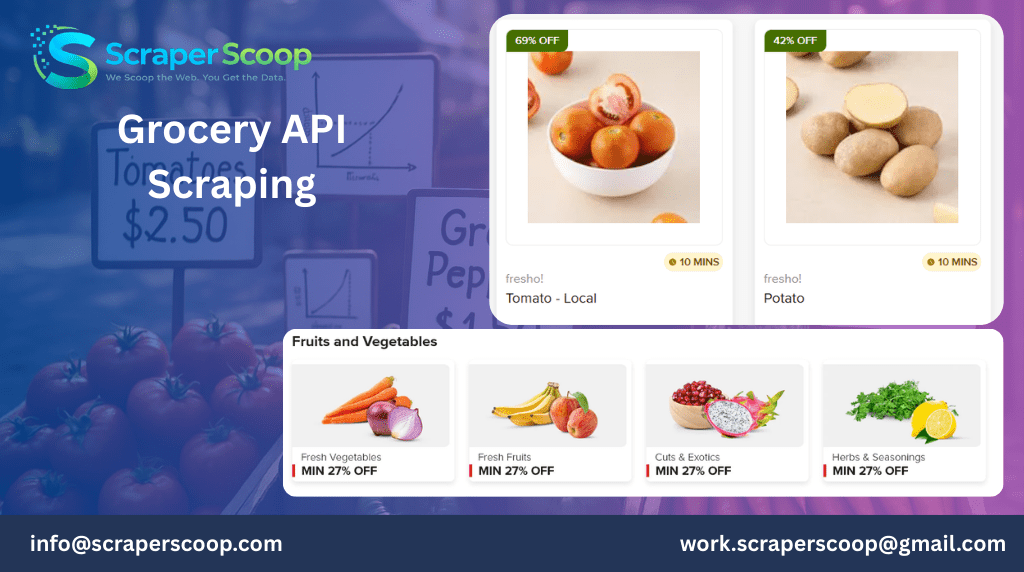
Many grocery platforms provide product data through internal APIs that power their websites and apps.
These APIs deliver structured information such as:
- Product listings
- Pricing
- Stock availability
- Store locations
- Delivery times
Instead of scraping raw HTML pages, developers can extract data directly from these API responses.
This process is commonly called API scraping or API data extraction.
Because APIs return clean, structured data, they often provide more accurate insights than traditional page scraping.
Why Grocery Data Is Critical for Omnichannel Retail
In an omnichannel environment, data must move quickly between multiple systems.
For example:
A retailer may need to synchronize data between:
- Store inventory systems
- Online marketplaces
- Mobile apps
- Delivery platforms
If one channel shows a product as available but the store is actually out of stock, the customer experience suffers.
This is why retailers increasingly rely on external market data as well.
By scraping grocery APIs across platforms, companies can see what’s happening in the broader market.
Key Ways Grocery API Scraping Supports Omnichannel Retail
Let’s look at the most important ways grocery API data strengthens omnichannel strategies.
1. Real-Time Competitive Price Monitoring
Pricing in the grocery industry changes constantly.
Competitors may run:
- Flash promotions
- Temporary discounts
- Bundle deals
- Location-based pricing
Without automated monitoring, retailers may not notice these changes quickly.
By scraping grocery APIs, businesses can track competitor prices across multiple platforms in real time.
For example, a retailer might monitor:
- Walmart grocery prices
- Instacart listings
- regional grocery chains
- online supermarkets
This allows retailers to quickly adjust their own pricing across all channels.
The result?
Consistent pricing across physical stores, websites, and apps.
2. Inventory Visibility Across Locations
Inventory management becomes much more complicated in omnichannel retail.
A product might be:
- Available in one store
- Out of stock in another
- Available for delivery but not pickup
API data helps retailers track inventory signals across locations.
For example, scraped data may reveal:
- which stores frequently run out of stock
- which products sell fastest
- which areas have high demand
Retailers can then adjust their supply chains accordingly.
This improves product availability and prevents stockouts.
3. Product Assortment Optimization
Different regions often have different grocery preferences.
A product that sells extremely well in one city might perform poorly in another.
By analyzing grocery marketplace data, retailers can identify:
- regional demand patterns
- trending products
- underperforming items
This helps them customize product assortments by location.
For example:
Urban stores may emphasize ready-to-eat meals, while suburban stores may focus on family-sized grocery packages.
This type of localized inventory strategy is a key component of omnichannel retail.
4. Promotion and Campaign Intelligence
Promotions are a huge driver of grocery sales.
Retailers run campaigns such as:
- buy-one-get-one offers
- weekly discounts
- seasonal promotions
By extracting promotional data from grocery platforms, retailers can analyze competitor marketing strategies.
This insight helps them plan better campaigns across:
- in-store promotions
- website banners
- mobile app notifications
- email campaigns
The goal is to ensure promotions feel consistent across all channels.
5. Delivery and Fulfillment Insights
Delivery has become a major component of grocery retail.
Customers now expect fast delivery options, sometimes within hours.
API data from grocery platforms often includes details such as:
- delivery time estimates
- store fulfillment locations
- service coverage areas
Retailers can analyze this data to improve their own delivery networks.
For example:
If competitors offer faster delivery in certain neighborhoods, retailers can prioritize logistics improvements in those areas.
6. Local Market Intelligence
Omnichannel retail is becoming increasingly location-specific.
Customers in different neighborhoods have different shopping habits.
By analyzing grocery data across ZIP codes or cities, retailers can uncover insights such as:
- which products trend in specific regions
- local price sensitivity
- seasonal buying patterns
This enables retailers to deliver hyperlocal experiences.
A Real Example from Grocery Data Analysis
I once worked on a grocery data project where we analyzed pricing across multiple online grocery platforms.
Initially, the retailer assumed their prices were competitive.
But after scraping marketplace data, we discovered something surprising.
Their online prices were consistently higher than competitors in certain cities, even though their in-store prices were competitive.
This mismatch confused customers.
Once they adjusted pricing across channels, their online conversion rates improved significantly.
That experience showed how important data synchronization is in omnichannel retail.
Challenges of Grocery API Scraping
While API scraping offers powerful insights, it also comes with technical challenges.
Some of the most common issues include:
Rate Limits
Many APIs restrict the number of requests that can be made.
Authentication Systems
Some platforms require session tokens or authentication headers.
Dynamic Inventory
Grocery inventory changes constantly, making data collection more complex.
Platform Updates
APIs may change frequently, requiring regular maintenance.
Building reliable data pipelines requires strong engineering practices.
The Future of Omnichannel Grocery Retail
The grocery industry is evolving rapidly.
Several trends are shaping the future of omnichannel retail:
Hyperlocal fulfillment
Retailers are building micro-fulfillment centers to speed up delivery.
AI-driven inventory management
Machine learning models predict demand and optimize stock levels.
Personalized grocery experiences
Apps increasingly recommend products based on past purchases.
Integrated online and offline shopping
Customers expect seamless transitions between physical stores and digital channels.
In this environment, data is the foundation of everything.
Retailers who leverage data effectively will have a major advantage.
Final Thoughts
Omnichannel grocery retail requires retailers to manage a complex ecosystem of stores, digital platforms, delivery networks, and customer touchpoints.
Without reliable market data, maintaining consistency across these channels becomes extremely difficult.
Grocery API scraping helps solve this problem by providing real-time insights into:
- competitor pricing
- product availability
- regional demand patterns
- promotional strategies
- delivery logistics
By leveraging these insights, retailers can create seamless shopping experiences that connect physical stores with digital platforms.
And in today’s competitive grocery landscape, that kind of data-driven strategy can make all the difference.
Join the Conversation
How do you think omnichannel retail will evolve in the grocery industry over the next few years?
Have you noticed changes in how grocery platforms manage pricing or availability across stores?
Share your thoughts in the comments—I’d love to hear your perspective.
Need Help Extracting Grocery API Data?
If you’re looking to extract grocery marketplace data or build a scalable API scraping solution, our team can help.
We specialize in collecting and analyzing data from grocery platforms to support:
- price monitoring
- product availability tracking
- competitive intelligence
- omnichannel retail analytics
Let’s transform grocery data into actionable retail insights.
Request a free consultation
Ready to unlock the power of data?


